
Dossier
Donbas 2014–2021: how many died, how many were civilians, and what the figures actually show
How many died in the Donbas before 2022? UN and OSCE data, civilians and combatants, MH17, mines and the limits of attribution.
In brief
Green
documented figure
OHCHR, the United Nations Human Rights Office, recorded at least 3,404 civilian deaths between 14 April 2014 and 31 December 2021, including the 298 people aboard flight MH17. [1]
Green
estimate with an explicit range
the overall toll of 14,200–14,400 deaths also includes approximately 4,400 members of Ukrainian forces and approximately 6,500 members of armed groups. It is not a total consisting only of civilians. [1]
False
wording incompatible with the cited document
presenting the UN estimate of 14,200–14,400 deaths as “14,000 civilians killed by Ukraine”. This assessment concerns that specific distortion of the figure, not a denial of abuses committed against civilians. [1]
Frequently asked questions
Were all 14,000 people who died civilians?
No. It is a rounded summary of a toll that includes civilians and combatants on both sides. Confusing these categories radically changes the meaning of the source.
Should the 298 MH17 deaths be added to the 3,404?
No: they are already included. Adding them again would count them twice.
Do the statistics prove that all civilians were killed by Kyiv?
No. The OHCHR total does not attribute every death to a perpetrator. Answering that question requires investigations into individual incidents, evidence and specific assessments.
Had the conflict stopped causing casualties before 2022?
No. Annual civilian deaths had fallen considerably compared with 2014–2015, but had not reached zero. Mines and explosive remnants continued to kill even when firing diminished.
Do the UN and OSCE have the same figures?
Not necessarily. Their respective publications have different periods, criteria and verification cut-off dates. They should not be added together or combined by choosing whichever annual figure is most convenient.
Does a table of deaths prove genocide?
No. A figure alone, however grave, does not establish a specific legal classification. Documented victims, attribution of conduct and the elements required by law must be distinguished.
Methodological dossier. Statistical period: 14 April 2014–31 December 2021. Judicial documents updated separately through 6 November 2026.
Before Russia’s full-scale invasion in February 2022, fighting had already been going on in the Donbas for almost eight years. People died in shelling, in minefields and in detention; others were injured or lost their homes. Acknowledging that history is necessary. It is equally necessary not to turn the victims into a figure capable of proving any argument.
The question “how many died?” actually contains other questions: over what period, civilians or combatants, deaths or also injuries, and according to what method? Knowing where someone died is not enough to establish who killed them.
1. What we are counting
This dossier takes as its statistical reference the OHCHR factsheet with data through 31 December 2021, revised on 27 January 2022. The revision date matters: verification of a death can come after the event and retrospectively change the series.[1] [2]
The source concerns conflict-related casualties in Ukraine: the reference to the Donbas identifies the conflict being analysed; it does not turn the count into a census of local residents alone.
The English word casualties is a major source of confusion. In the documents examined, it can mean people killed and injured, not just deaths. Rendering a table of 946 civilian casualties as “946 civilians killed” is therefore incorrect: in the relevant OSCE report, there were 161 deaths and 785 injuries.
“At least” and “approximately” are not decorative words either. A verified minimum does not guarantee that every case has been identified; a rounded estimate is not an individual-by-individual census. The OHCHR document distinguishes these categories and also notes that military losses include non-combat deaths while serving in the conflict zone.
Finally, the human cost goes beyond the deaths directly counted. Illness, inaccessible treatment, trauma, displacement and impoverishment cannot simply be read from the deaths column. The OSCE report, for example, excludes natural deaths at checkpoints and deaths resulting from lack of medical care from its direct casualty statistics.
2. The parties’ accounts and the civilian total
On 31 January 2022, Russian ambassador Vassily Nebenzia told the Security Council that the majority of the 14,000 dead were Donbas civilians killed by Ukrainian shelling. The statement is preserved on the Russian Mission to the UN website [7] (Official UN meeting record, p. 12 [10]; Rosemary DiCarlo’s statement on the overall death toll [11]). It is a specific claim to check: Nebenzia said “the majority”, not “all”, and his statement should not be changed to make it easier to challenge.
Ukraine, in its application to the International Court of Justice as summarised in the March 2022 order, denied committing genocide and disputed the use of that accusation to justify Russia’s action. That is Ukraine’s position in the proceedings, not an independent assessment of its conduct. The two positions must be tested against the documents, without automatically assigning them equal evidentiary weight.[8]
The OHCHR factsheet estimates 14,200–14,400 deaths overall during the period. Within that overall estimate, it places at least 3,404 civilians, approximately 4,400 members of Ukrainian forces and approximately 6,500 members of armed groups.[1]
In the OHCHR toll, civilians account for roughly a quarter, not the majority. The numerical part of Nebenzia’s statement therefore does not match that breakdown. Attributing the deaths to Ukrainian shelling additionally requires evidence that the total does not provide.
These categories rule out two opposite shortcuts. One is to describe the entire total as civilians killed by a single side. The other is to treat actual civilian victims as irrelevant because a figure has been exploited. Exposing a false use of numbers does not erase the people who died.
Nor should rounded values be added together with a claim to precision that the source does not make. The document gives a range for the total and approximations for military components. Accurate reporting retains these features.
3. When civilians died: the annual series
| Year | Civilian deaths recorded by OHCHR |
|---|---|
| 2014 | 2,084 |
| 2015 | 955 |
| 2016 | 112 |
| 2017 | 117 |
| 2018 | 58 |
| 2019 | 27 |
| 2020 | 26 |
| 2021 | 25 |
| Total | 3,404 |
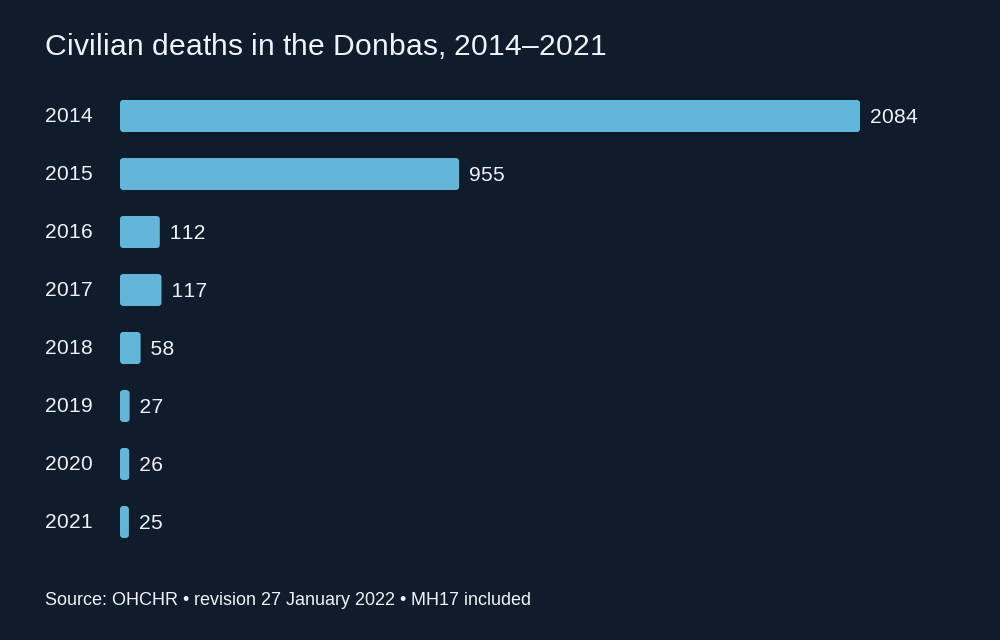
The concentration in the first two years is clear. This does not turn the later period into peace, but it makes it misleading to describe eight years as though they all had the same lethal intensity for civilians.
The series alone does not measure the intensity of every battle, the number of rounds fired or political intentions. It shows one specific dimension: civilian deaths recorded using that methodology. Reconstructing the origins of the conflict requires a separate investigation; measuring its human cost requires this distinction between periods. · Origins of the war in the Donbas
4. MH17: part of the toll, not a figure to count twice
Flight MH17 was shot down on 17 July 2014. The 298 people aboard are included in the OHCHR civilian total used here. Their inclusion explains why the count cannot automatically be turned into a toll consisting solely of local residents, still less of a particular ethnicity or language group.[1]
Responsibility for the downing requires examination of the investigations and decisions devoted to that case. The point here is narrower: recognising what the data cover and not counting the same people twice. · MH17
5. Where people died is not the same as who killed them
The OSCE analyses a different interval: 1 January 2017 to 15 September 2020. It records 946 civilians killed or injured: 657 in non-government-controlled areas, 270 in government-controlled areas and 19 in areas controlled by neither side. For deaths alone, the respective figures are 97, 55 and 9.[1] [2]
The larger number of casualties in one area is a fact to explain, not to hide. But it does not automatically identify the perpetrator of each incident. Information is needed on the trajectory of fire, weapon type, circumstances of explosions and presence of mines or unexploded ordnance.
Another percentage in circulation comes from OHCHR data on active hostilities alone in 2018–2021: 310 of the 381 civilians killed or injured in that particular category were in areas of the self-proclaimed republics. That is approximately 81.4%. It does not mean “81.4% of all civilians who died since 2014”, nor prove that one side caused precisely that share.
Changing the period, category and geographical meaning at the same time creates a new claim that the original table does not support.
6. Two incidents show how attribution is established
Donetsk, 23 August 2014
In the account published the following day, OSCE monitors describe damage in the Kalinski district and three covered bodies. Reports that another child had died on the way to hospital came from residents, rather than direct observation by the patrol. Analysis of impacts in the market suggested that the fire came from the east.
This document allows us to distinguish direct observation, testimony and technical analysis. It does not, on its own, identify a particular unit responsible. A serious reconstruction preserves these distinctions rather than placing everything under the label “established”.[3]
Mariupol, 24 January 2015
Here, the OSCE account contains different elements. The patrol observed seven dead civilians; hospitals and emergency services reported a higher initial toll that was still provisional. The initial crater analysis traced Grad and Uragan rockets to north-easterly and easterly directions, identifying areas under “DPR” control.
The origin of the fire is therefore more specifically supported by that document. Identifying who issued the orders or establishing individual responsibility remains a separate step. Not everything that is not a judgment is unproven; not everything a monitoring mission observes already amounts to a judgment.[4]
7. Mines and explosive remnants: danger that outlasts shelling
A ceasefire can reduce firing without making fields, roads or courtyards safe. Unexploded ordnance and mines continue to cause casualties, including when someone tries to pick up or dismantle an object.[1] [2]
The OSCE report covering 2017 to 15 September 2020 attributes 81 deaths to mines, explosive remnants and other explosive devices: more than the 77 recorded for shelling and small-arms fire combined. This comparison applies to that report and that period, not the entire war.
It is a concrete reason not to reduce every civilian death to “shelling by the opposing side”. It is also a reason to assess the success of a ceasefire alongside demining, risk education and access to contaminated areas.
8. Executions and abuses outside combat
Not all violence can be reconstructed through a crater. People who are detained, wounded or otherwise hors de combat can be victims of executions and ill-treatment. Statistical classification does not exhaust the obligations to protect them.[6]
After missions in eastern Ukraine in 2014, Amnesty International documented evidence of summary killings attributed to both pro-Ukrainian forces and separatists. In the Komunar/Nyzhnya Krynka area, it distinguished four apparent execution victims from five other bodies identified as separatist combatants: not the large, undifferentiated number circulated in some accounts.
The investigation was the work of a human rights organisation, not a court judgment or a comprehensive census. It nevertheless illustrates an essential principle: numerical propaganda can be challenged while accountability is sought for genuinely documented abuses. “Both sides” does not automatically mean the same scale, the same orders or equal responsibility.
9. Why an increase in 2021 can coexist with an annual decline
In September 2021, OHCHR reported an increase in casualties during February–July compared with the previous six months. The subsequent annual factsheet, however, shows that the total number of civilians killed and injured in 2021 was lower than in 2020.[1] [5]
This is not a contradiction: these are different time windows. After an especially favourable period, renewed firing can worsen a six-month comparison without exceeding the previous year’s total.
The strengthened ceasefire of 27 July 2020 helped reduce the effects of hostilities on civilians. The subsequent deterioration does not justify erasing that improvement; the improvement does not justify denying subsequent harm. Assessing a trend requires stating exactly what is being compared.
10. From genocide rhetoric to judicial proceedings
In his speech of 24 February 2022, Vladimir Putin invoked the protection of people who, he claimed, were suffering genocide at the hands of the Kyiv regime. That speech does not contain the figure “14,000”: wording absent from the text should not be attributed to it.[7] [8]
On 16 March 2022, in its order on provisional measures, the International Court of Justice stated that it did not have evidence before it substantiating Russia’s allegation of genocide on Ukrainian territory. This was a provisional-measures decision, not a final conclusion on every possible act or crime.
The decision of 2 February 2024 defined the jurisdictional scope of the proceedings. On 5 December 2025, the Court admitted Russian counterclaims without thereby finding them well founded on the merits. The order of 6 November 2026 sets further written deadlines: Ukraine’s Reply on 8 March 2027 and Russia’s Rejoinder on 8 June 2028. As of that documentary cut-off date, the proceedings remain ongoing.
The distinction matters in both directions: admissibility does not mean proof; the absence of evidence noted at a provisional stage is not a final judgment on the entire conflict. Nor can casualty statistics replace the specific elements of a legal offence. · Russia and Ukraine: the two cases
11. What remains to be established
The sources are neither infallible nor complete. The OSCE describes difficulties accessing medical data, especially in non-government-controlled areas, and restrictions on movement. OHCHR explains its corroboration work and the possibility of late revisions. A verified number can therefore change without the earlier version having been invented.[1] [2] [9]
The end date matters too. The subsequent OHCHR report closing on 31 January 2022 takes the civilian total to 3,405: it covers one more month. It should not silently replace the 3,404 in a series ending in December 2021.
Above all, work remains on individual incidents: names, places, circumstances, material evidence, chains of command and judicial decisions. Not everything can be resolved with a table; that does not mean every interpretation carries the same weight.
Conclusion
Donbas civilians are not a footnote to propaganda. They are people whose deaths must be reconstructed accurately, without erasure or rhetorical multiplication. The sources document thousands of civilian deaths before 2022, a concentration in the early years and persistent risks even after firing diminished.[1]
They do not document, through the general total alone, “14,000 civilians killed by Ukraine”. The difference is not a semantic dispute: it is the boundary between using a source and making it say something else.
Sources and method
The original sources, pages used, limitations and separate checks are listed in the documentary register. OHCHR and OSCE are different data collections, but not entirely isolated: OHCHR may also use OSCE material. Two publications that cite one another do not automatically constitute two independent confirmations of the same incident.
Original documents consulted
- Check A. Provenance and passage consulted
- OHCHR: civilian toll through 31 December 2021, revised 27 January 2022, pages 1–3.
- Check B. What it documents and its limits
- It gives the estimated overall death toll and a verified civilian minimum for the stated period. The total includes combatants and does not attribute individual deaths. MH17 is already included.
- Check A. Provenance and passage consulted
- OSCE: civilian casualties, January 2017–15 September 2020, methodology and tables, pages 7–11; causes and risks in subsequent sections. · OSCE SMM · PDF
- Check B. What it documents and its limits
- It documents 161 civilians killed and 785 injured in the reporting period. Its methodology and dates differ from OHCHR’s. Place and responsibility are separate.
- Check A. Provenance and passage consulted
- OSCE: Donetsk, report dated 24 August 2014.
- Check B. What it documents and its limits
- It distinguishes the monitors’ own observations from witness accounts. It does not identify a specific unit responsible.
- Check A. Provenance and passage consulted
- OSCE: Mariupol, 24 January 2015.
- Check B. What it documents and its limits
- It records an initial assessment of where the fire came from. It is not a judgment on individual responsibility.
- Check A. Provenance and passage consulted
- OHCHR: statement of 23 September 2021.
- Check B. What it documents and its limits
- It compares two periods in 2021. The rise noted in September is compatible with the year-on-year decline.
- Check A. Provenance and passage consulted
- Amnesty International: investigation into summary killings, 20 October 2014, with report EUR 50/042/2014, printed pages 5–13 consulted for this dossier.
- Check B. What it documents and its limits
- It documents cases and allegations of summary killings on more than one side and the limits of verification. It is not a census of all victims.
- Check A. Provenance and passage consulted
- Vassily Nebenzia: statement of 31 January 2022; Vladimir Putin: speech of 24 February 2022. Sources for their respective political assertions, not evidence that those assertions are true.
- Check B. What it documents and its limits
- It documents two Russian statements. On 31 January Nebenzia said “most”. The 24 February speech does not use the number. The statements do not verify the allegations.
- Check A. Provenance and passage consulted
- ICJ: order of 16 March 2022, paragraphs 2 and 59–60; judgment of 2 February 2024, paragraphs 140–151; order of 5 December 2025, paragraphs 53–68; order of 6 November 2026, procedural timetable. · ICJ · case 182
- Check B. What it documents and its limits
- The documents cover provisional measures, jurisdiction, admission of counterclaims and deadlines. None of the four decides the merits of the allegation.
- Check A. Provenance and passage consulted
- OHCHR: 33rd report, 28 March 2022, paragraph 31, printed page 5: update through 31 January 2022, distinct from the main series.
- Check B. What it documents and its limits
- The same OHCHR series extended to 31 January 2022 records 3,405 civilians. It is neither independent confirmation nor the December total.
- Check A. Provenance and passage consulted
- Official UN meeting record, p. 12
- Check B. What it documents and its limits
- The meeting record confirms Nebenzia’s wording about a majority. This is the same statement reproduced by the Russian mission.
- Check A. Provenance and passage consulted
- Rosemary DiCarlo’s statement on the overall death toll
- Check B. What it documents and its limits
- DiCarlo cites over 14,000 lives lost in the conflict. She does not say most were civilians or provide an independent statistical series.
- Check A. Provenance and passage consulted
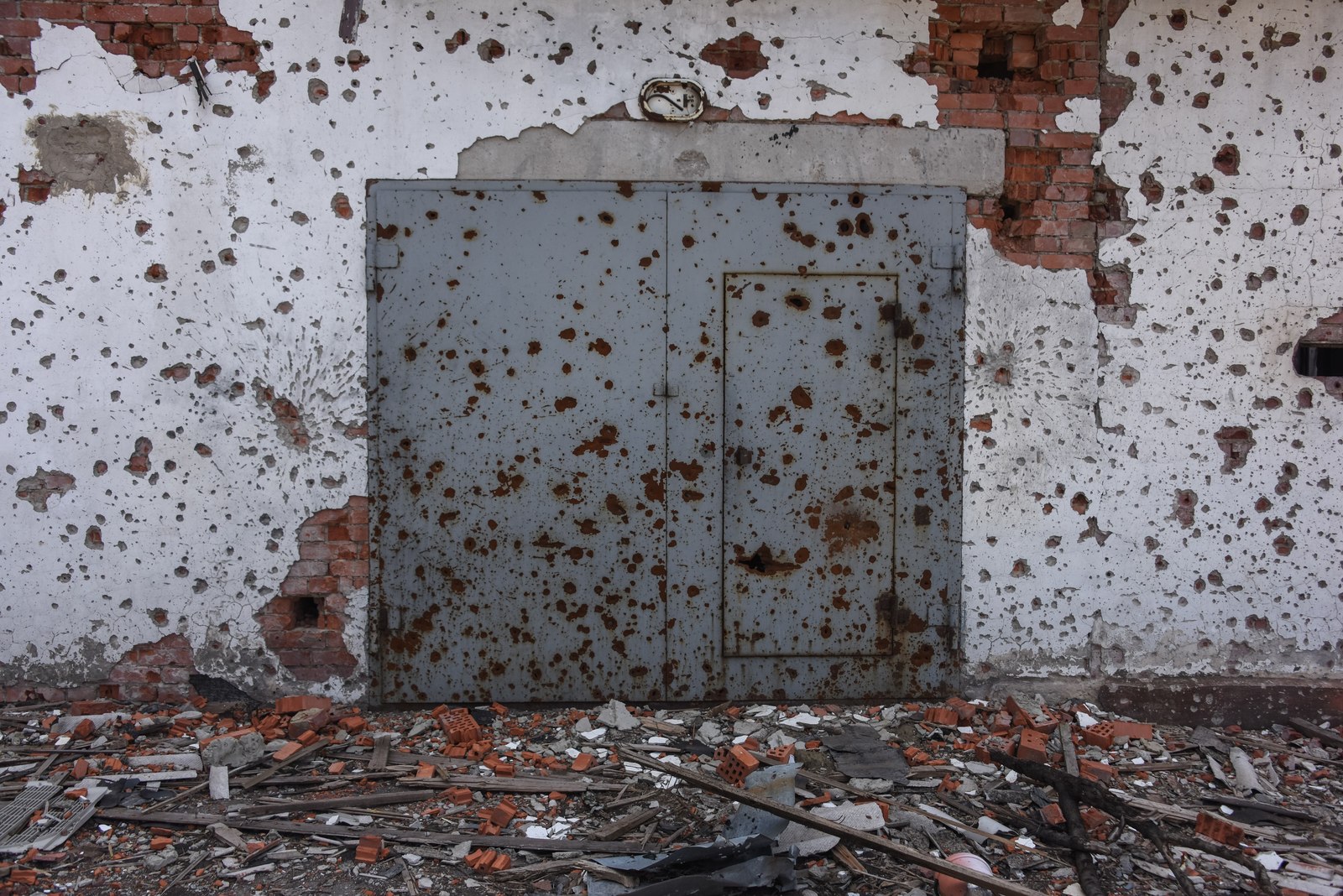
- Damage to a building near Donetsk airport, 18 May 2015. Archive photograph. · Mstyslav Chernov/UnFrame · CC BY-SA 4.0
- Check B. What it documents and its limits
- Archive photographs. They document what is in the frame and cannot identify those responsible or count casualties.
- Check A. Provenance and passage consulted
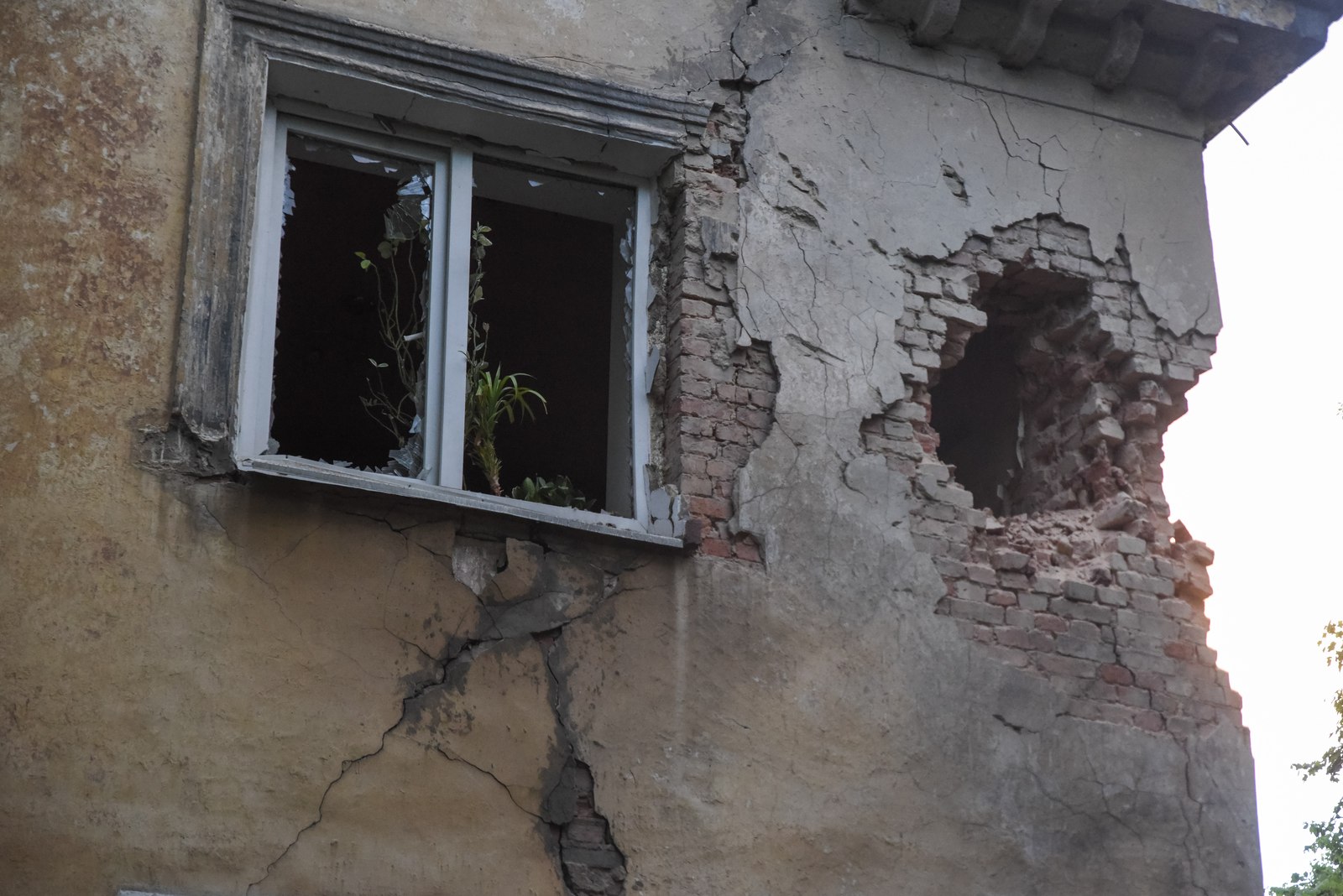
- A damaged civilian building in Donetsk, 1 June 2015. Archive photograph. · Mstyslav Chernov/UnFrame · CC BY-SA 4.0
- Check B. What it documents and its limits
- Archive photographs. They document what is in the frame and cannot identify those responsible or count casualties.
- Check A. Provenance and passage consulted
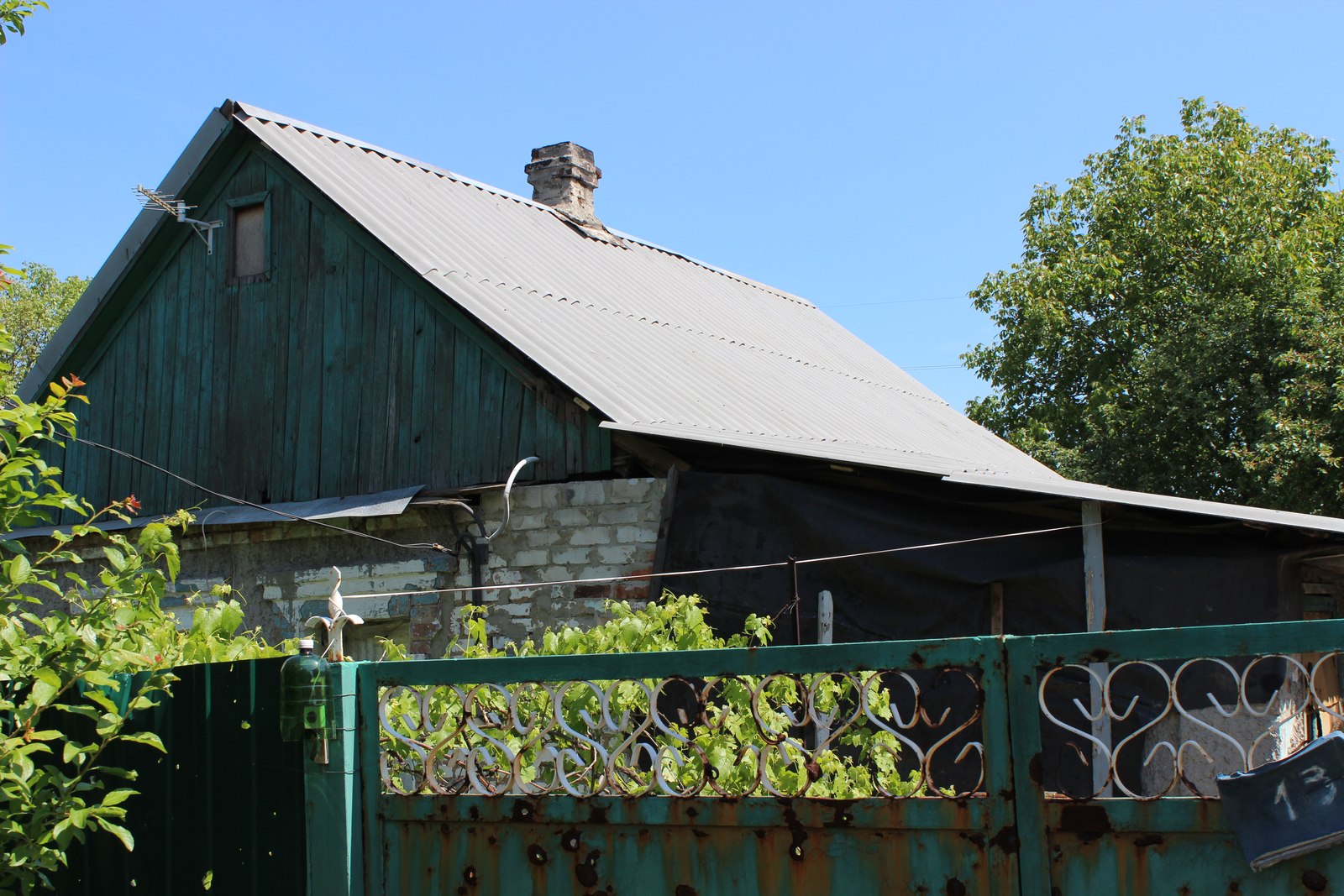
- A house in Avdiivka during restoration work following shelling, 24 May 2017. Archive photograph. · Donetsk Regional Military Civil Administration / dn.gov.ua · CC BY 4.0
- Check B. What it documents and its limits
- Archive photographs. They document what is in the frame and cannot identify those responsible or count casualties.


