
Dossier
MH17: the missile, the evidence and responsibility
What DSB, JIT and the courts established about MH17: Buk, radar, convictions, Russian responsibility, Ukrainian airspace and unanswered questions.
The full translation was reviewed. The additions on flight times, court proceedings and video links have not had a separate linguistic review.
In brief
- What struck MH17? The Dutch Safety Board, responsible for the safety investigation, concluded that a 9N314M warhead carried by a 9M38-series missile, used by the Buk system, exploded near the cockpit.
- Where was the missile launched? The criminal investigation and the Dutch court identified a field near Pervomaiskyi, in an area then controlled by pro-Russian separatists. This is not simply the broad area initially delineated by the technical investigation.
- Where did the launcher come from? The Joint Investigation Team reconstructed its arrival from Russia and its subsequent return. In 2018, it attributed the launcher to Russia's 53rd Anti-Aircraft Missile Brigade. Identifying the unit of origin does not identify every crew member.
- Who was convicted? In November 2022, the District Court of The Hague sentenced Igor Girkin, Sergei Dubinskiy and Leonid Kharchenko to life imprisonment and acquitted Oleg Pulatov. It did not find that the three convicted men had physically pressed the launch control.
- What international responsibility has been established? In 2025, the European Court of Human Rights found violations of the Convention by Russia; the ICAO Council found a breach of Article 3 bis of the Chicago Convention. The ICAO decision has been suspended since 18 September 2025 pending the outcome of Russia's appeal to the International Court of Justice.
The accounts and disputed reconstructions
The defence challenged the launch site and the significance of the technical evidence. The material assessed included reconstructions by Almaz-Antey, the Russian manufacturer of the Buk system, and the hypothesis of a launch from another area, near Zaroshchenske. The court did not dismiss these objections merely because they originated in Russia: it discussed the transparency of the calculations, their reproducibility and their comparison with other expert findings.
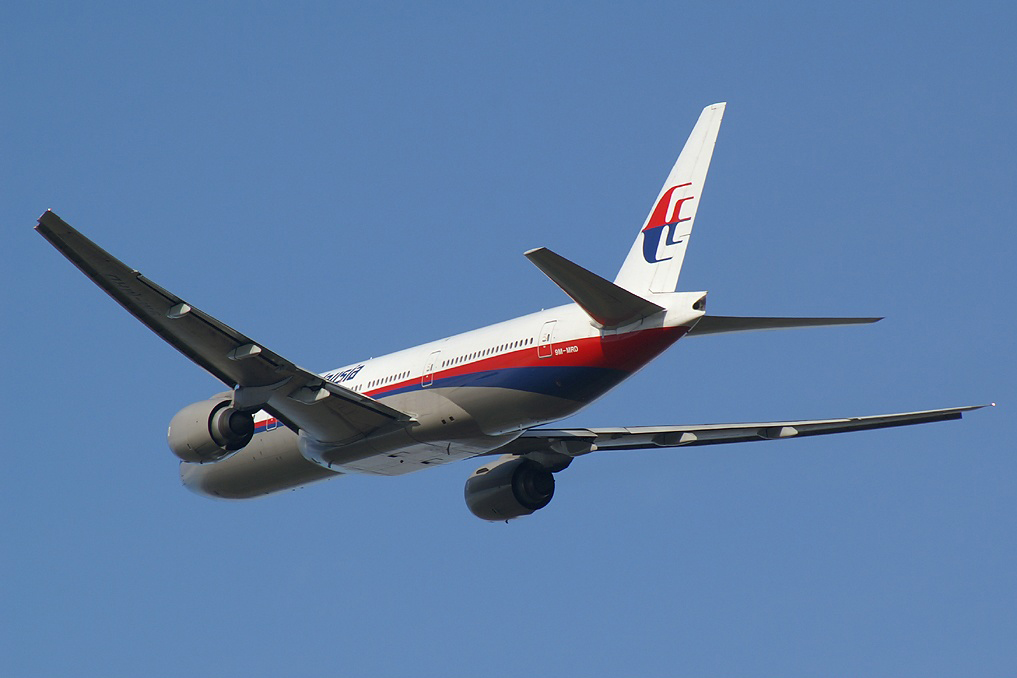
On 17 July 2014, a Malaysia Airlines Boeing flying from Amsterdam to Kuala Lumpur was shot down over eastern Ukraine. All 298 people on board were killed. Since then, MH17 has stood for a human tragedy, a technical investigation, a criminal trial and several international proceedings. These are not different names for the same exercise: each had different questions to answer.
That distinction explains how it is possible to know which weapon system destroyed the aircraft, have convictions for its use and an established finding of state responsibility, without knowing for certain the identity of every member of the crew operating it. Gaps remain and must be reported. But an unanswered question does not erase answers already supported by evidence.
This dossier follows the chain of findings: from the aircraft wreckage to the launcher's route, from the responsibilities of the four defendants to the decisions concerning Russia. It also examines the decision to leave Ukrainian airspace open. That is an uncomfortable and important question, separate from who launched the missile.
Contents
- In brief
- The accounts and disputed reconstructions
- 1. A permitted flight in increasingly dangerous airspace
- 2. How the investigation reached the Buk conclusion
- 3. The launcher's route and the field near Pervomaiskyi
- 4. The 53rd Brigade: what that establishes, and what it does not
- 5. Radar: missing data does not mean no evidence
- 6. Alternative scenarios were not all ignored
- 7. Three life sentences and an acquittal: four cases, not one undifferentiated group
- 8. If they believed the target was military, why murder?
- 9. The crew, orders and the limits of the evidence concerning Putin
- 10. The European Court: state responsibility, not a new trial of the four defendants
- 11. ICAO and Russia's appeal: a decision exists, but its status matters too
- 12. The ICJ's 2024 judgment is not the appeal against ICAO
- 13. The families and the distance between judicial findings and justice enforced
- Essential timeline
- Video and transcripts
- Frequently asked questions
- Sources
1. A permitted flight in increasingly dangerous airspace
MH17 was following a civilian route at approximately 33,000 feet, flight level FL330. Ukrainian restrictions extended to FL320. Its passage was therefore permitted. That does not demonstrate that the risk assessment was adequate.
Ukrainian military aircraft had been shot down in the preceding days. Information released by the Ukrainian authorities themselves about the incidents of 14 and 16 July indicated the possible presence of weapons capable of reaching altitudes normally used by civilian aviation. The Dutch Safety Board found sufficient grounds to close the airspace above eastern Ukraine as a precaution. It was not merely making an abstract recommendation for the future.
The report described an assessment dominated by military considerations, in which the risk to civilian flights did not receive the necessary attention. It also identified shortcomings in how airlines, other states and international organisations had recognised and managed the danger. Malaysia Airlines was not the only operator using that corridor.
Two conclusions must be kept together: leaving the airspace open attracted serious safety criticism; that does not automatically transfer responsibility for launching the missile to those managing the airspace. Preventing a mass killing and carrying it out are related questions, not interchangeable ones.
Source: Dutch Safety Board, final report, conclusions and airspace safety [1], §§10.1–10.5.
The preliminary report puts take-off from Schiphol at 10:31 UTC (12:31 local time). The crew’s last recorded radio transmission began at 13:19:56 UTC and the flight recorders stopped at 13:20:03 UTC. In the final report, 10:13 UTC is the time the aircraft left gate G3 after preparation, before take-off. Dutch Safety Board · Preliminary report · September 2014 [2] · Dutch Safety Board · Final report · 13.10.2015 [1]
Strong evidence
The DSB considered a precautionary closure of the airspace justified.
The evidence of high-altitude threats was sufficient. The safety criticism also concerns other actors and does not identify who launched the missile.
Two passages of the same report: no second independent source is claimed. [1] [1]
2. How the investigation reached the Buk conclusion
The technical reconstruction did not arise from a single photograph or a political announcement. The Dutch Safety Board examined the distribution of damage, recovered fragments, traces on the wreckage, flight recorders and the sequence of the aircraft's breakup. The front of the aircraft, near the cockpit, was the centre of the initial damage.
Taken together, the findings led to the conclusion that a 9N314M warhead had exploded, associated with a 9M38-series missile used by a Buk system. Characteristic fragments were one component of the demonstration, not an object to be considered in isolation. The investigation ruled out other causes in light of the information examined, such as an internal failure capable of explaining that damage pattern.
The DSB delineated a possible launch area of approximately 320 square kilometres. Its task was not to establish individuals' criminal responsibility or to complete the precise identification of the launch point by itself. This matters: using that initial area to suggest that all subsequent investigations remained equally uncertain confuses different stages and mandates.
The work of the Joint Investigation Team and the court added investigative material to the technical reconstruction. The result was not a new opinion about the same photograph, but a chain of evidence addressing a more specific question: which launcher, travelling along which route, and firing from which field?
In September 2014, the preliminary report recorded damage consistent with numerous high-energy objects entering from outside. Investigators had yet to recover some components for examination. The more specific identification of the weapon followed in the final report in October 2015. Dutch Safety Board · Preliminary report · September 2014 [2]
Strong evidence
The DSB identifies a 9N314M warhead and a 9M38-series missile used by the Buk system.
The technical conclusion rests on damage, fragments, recorders and other converging evidence. It does not itself identify the person who fired.
Technical investigation and judicial summary; no new independent examination of the physical evidence. [1] [3]
3. The launcher's route and the field near Pervomaiskyi
The Joint Investigation Team included investigators from several countries, including the Netherlands and Ukraine. The participation of a party involved in the conflict makes it important to ask how materials were checked. It is not a reason either to accept them automatically or to reject them all because of their origin.
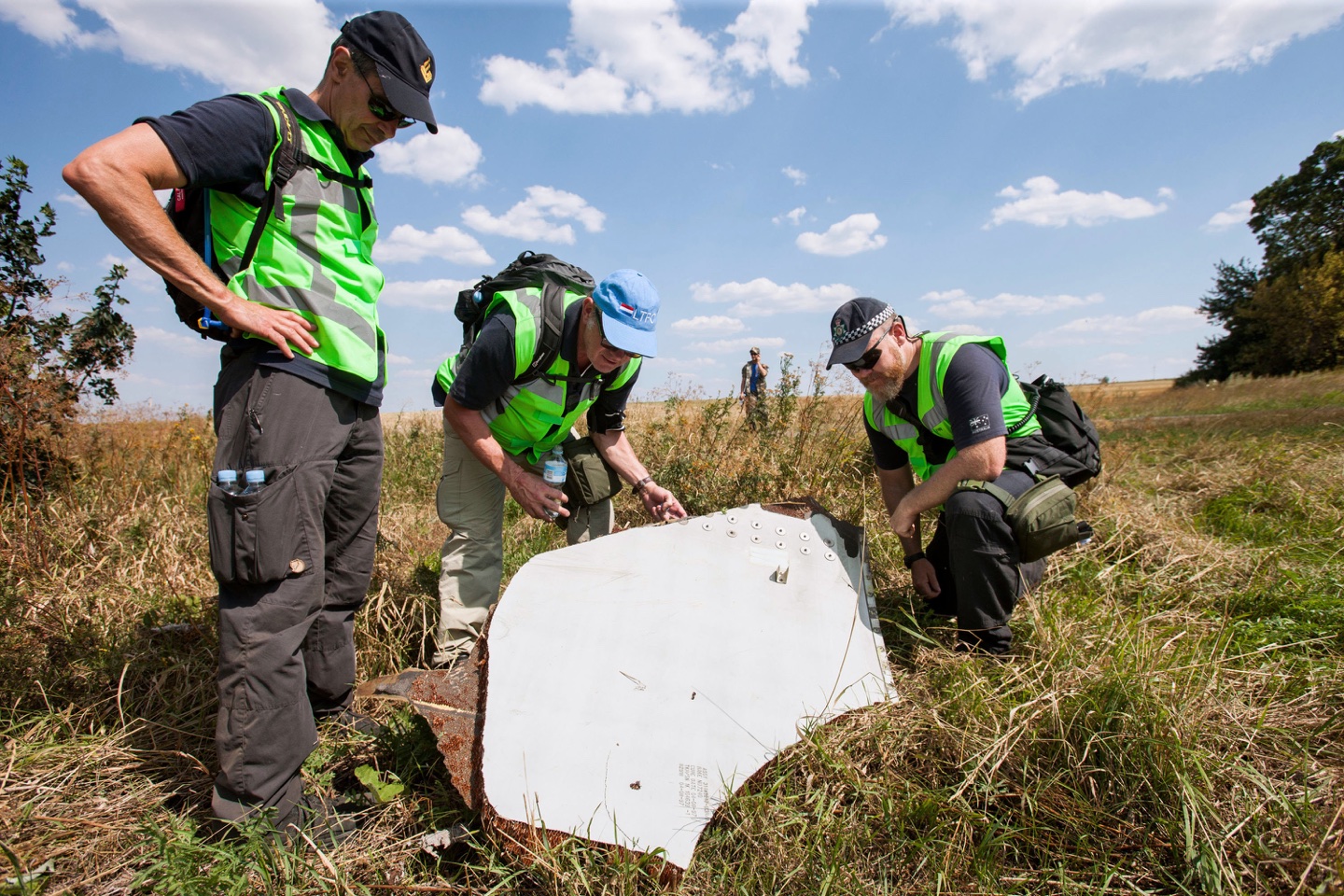
At trial, the court examined precisely such questions of reliability: photographs of the smoke trail, images of the vehicle, intercepted communications, telephone data, witness evidence and satellite imagery. The identification of the field near Pervomaiskyi emerged from the combination of those elements. A burn mark in a field does not, by itself, demonstrate which weapon was used; a photograph does not necessarily identify who operated it. The judicial reconstruction rests on converging evidence.
The court also considered a photographer's political sympathies and the passage of material through the Ukrainian security services, without treating them as an automatic bar to its use. It described checks on files and photographic equipment and assessed external corroboration. Not every photographer behind every image was identified: that limitation must also be preserved.
In September 2016, the JIT announced that the Buk had entered from Russia, reached the launch area and been returned to Russia after the downing. The court in 2022 assessed the criminal case file and found that the missile had originated from the identified field.
Sources: official account of the trial [3]; Girkin judgment, §§6.2.2–6.2.3, accessible reproduction [4].
Strong evidence
The court identifies the launch field near Pervomaiskyi.
The location follows from a combined assessment of photographs, witness evidence, intercepted communications and other corroboration, not one photograph.
Reproduction of the judgment and official summary of the same proceedings, not two independent investigations. [4] [3]
4. The 53rd Brigade: what that establishes, and what it does not
In May 2018, the JIT attributed the launcher to Russia's 53rd Anti-Aircraft Missile Brigade, based in Kursk. The comparison used recognisable vehicle features and images of its movement in Russia and Ukraine. The 2023 report describes the connection between the Russian convoy of June 2014 and the vehicle photographed in Ukraine on 17 and 18 July.
That attribution must be assigned correctly to the investigation that made it. A detail appearing at an investigative press conference cannot be attributed, without checking, to every subsequent judgment. Equally, distinguishing between documents does not cancel the established Russian origin.
A vehicle belonging to a particular unit does not itself provide a verified list of everyone on board at a particular moment. The JIT investigated names and compatible roles without establishing the entire crew's identity with certainty. That limitation concerns people and operational orders; it does not reset the reconstruction of the vehicle's route to zero.
Source: JIT report, February 2023 [5], chapters 3 and 4.
Strong evidence
The JIT attributes the launcher to Russia’s 53rd Brigade.
This is a specific JIT conclusion about the vehicle; it does not automatically establish every crew member’s identity.
The 2018 presentation and 2023 report belong to the same JIT investigation; they are not two independent verifications of the brigade’s identity. [5] [15]

5. Radar: missing data does not mean no evidence
The statement that “Ukrainian radar was not working” is too broad. The DSB distinguishes between systems and data availability. Civilian primary radar systems in the area were down for maintenance; for military systems, the Ukrainian ministry cited the absence of its own military aircraft in the sector as the reason they were not operating. Ukrainian secondary radar data were available. These are different systems and cannot be merged into a single claim of total radar blindness.
The chronology also matters for Russia. In its 2015 technical investigation, the DSB had a Russian radar replay video, but not the corresponding raw data needed to verify it in the same way. The criminal investigation subsequently received Russian primary radar data. Saying that those data were never supplied would therefore go beyond what is documented.
Civilian radar is not a device that automatically displays every airborne object. Size, speed, sensitivity and filtering affect missile detection. The DSB and the assessments presented at trial explain why the absence of a missile trace is not proof that no missile was launched. For a larger military aircraft, the technical assessment is different.
The conclusion about the weapon comes from the combination of damage, fragments and other evidence, not from an absolute reading of a single radar screen. Data gaps must be shown accurately: exaggerating or concealing them produces two equally misleading versions of the same story.
Sources: DSB report, §§2.9.5 and 3.4.2 and conclusions; official prosecution summary on radar data, 10 June 2020 [6].
Strong evidence
In 2015, Ukrainian secondary radar data were available, but the area’s primary radar data were not.
The report distinguishes systems and reasons for non-operation. Maintenance concerned civilian primary radar, not all Ukrainian radar.
The case file expanded after the technical report. No independent reconstruction of raw data is claimed. [1] [3]
6. Alternative scenarios were not all ignored
A source with an interest in the outcome warrants particular scrutiny, but its nationality is no substitute for analysis. The court found parts of Almaz-Antey's work insufficiently verifiable and preferred conclusions supported by other corroboration. It also examined the scenario that a different civilian aircraft had been targeted, explaining problems of range and system orientation. It did not establish every imaginable physical possibility: some were unnecessary to resolve the particular alternative put forward.
The scenario involving a fighter aircraft near MH17 was also examined. In its 2025 judgment, the European Court described as demonstrably false the Russian claim of 21 July 2014 that a Ukrainian Su-25 had been detected near the flight. That conclusion concerns the specific assertion and the evidence examined in the proceedings. It is important to distinguish this judicial assessment from the idea that every Russian statement about every detail is false by definition.
The methodological point is straightforward: an alternative theory must explain the evidence as a whole, not merely raise a question about one photograph. A serious rebuttal must identify the particular assertion checked, by whom, and within what limits.
Sources: Girkin judgment, §6.2.3; European Court of Human Rights, judgment of 9 July 2025 [7], §§487–500.
7. Three life sentences and an acquittal: four cases, not one undifferentiated group
On 17 November 2022, the District Court of The Hague imposed three life sentences and acquitted one defendant. Igor Girkin, Sergei Dubinskiy and Leonid Kharchenko were found responsible for offences involving the downing and the killing of those on board. Oleg Pulatov was acquitted of every variant of the charges examined. The outcome was not the automatic conviction of everyone holding a role in the separatist organisation.
Dubinskiy and Kharchenko. The court identified essential contributions to organising, directing, escorting and protecting the Buk's deployment. Their responsibility did not require them to have been seated in the launcher: participation in an offence can include those who make its commission possible through a decisive contribution.
Girkin. The court applied a form of functional perpetration under Dutch law. It assessed his authority and acceptance of activities of that kind, alongside requests for air defence and his subsequent conduct. It nevertheless preserved an important limitation: it had not been proved that he knew that particular Buk was available before the launch. Translating the conviction into “Girkin was proved to have ordered the firing at MH17” would add a fact the judgment did not reconstruct.
Pulatov. The court did not find a sufficient contribution proved, or the necessary power to change or stop the relevant operational orders. The knowledge and contacts that emerged were insufficient to bridge that gap. His acquittal was not a general declaration concerning all his activities in the Donbas, but it was complete in respect of the charges at trial.
Distinguishing these positions is a safeguard of judicial reasoning, not a technicality to erase for a sharper narrative. In December 2022, the prosecution announced that it would not appeal and stated that the outcomes were final. A final conviction and its actual enforcement nevertheless remain separate questions.
Sources: official operative provisions [8]; Girkin judgment, §§6.2.5–6.2.6; prosecution statement of 1 December 2022 [9].
Strong evidence
The trial ended with three life sentences and Pulatov’s acquittal.
Individual positions were distinguished; the court did not assign everyone the same contribution or establish that they were the launcher’s crew.
Summary and operative provisions of the same judgment. Finality refers to the subsequent prosecution statement; enforcement is not assumed. [3] [8]
8. If they believed the target was military, why murder?
The court considered it implausible that the crew had deliberately selected a civilian aircraft knowing it was civilian. It instead proceeded on the assumption that the target had been mistaken for a military aircraft. It did not establish with certainty which model the operators thought they were targeting.
A mistake about the target's nature does not make the launch unintentional. The court observed that deploying the system required preparation and a deliberate sequence of actions, with foreseeable lethal consequences for the aircraft's occupants. It therefore distinguished the intention to destroy the aircraft from exact knowledge of its civilian identity. In criminal-law terms, it also found intent to kill the occupants and premeditation proved: the mistake about the type of aircraft did not remove those elements. In the absence of combatant privilege, shooting down a military aircraft would not have been lawful for the perpetrators either.
Combatant immunity was also relevant: under certain conditions, a combatant may carry out lawful acts of war without being prosecuted for those same acts as ordinary crimes. In this case, the court did not recognise the necessary status for DPR fighters. Russian overall control, used to classify the conflict as international, did not automatically amount to the membership of the Russian armed forces required for that different legal step.
It is inaccurate to summarise the reasoning simply as immunity being denied because the aircraft was civilian. The court had already stopped at the status requirement. Nor can this be turned into a general rule that every targeting mistake in war is always identical in criminal law: the applicable law, the facts and the individual defendant's position matter.
Sources: Girkin judgment, §§4.4.3.1.4 and 6.2.5.3, text consulted [4].
Strong evidence
The court proceeded on the assumption that a civilian aircraft had been mistaken for a military aircraft.
In the judgment’s reasoning, the mistake about the aircraft’s nature did not exclude intent to kill or premeditation. The court did not establish a knowing choice of civilians.
Distinguish the judicial finding from the identity and thoughts of every operator, which have not all been reconstructed. [4] [7]
9. The crew, orders and the limits of the evidence concerning Putin
After the convictions, the JIT continued examining the possible involvement of other people. Its February 2023 report explained why it lacked the evidence needed to proceed further against specific crew members and others in the decision-making chain. Names compatible with a role are not the same as proven identification.
Information about the final order, the target-identification process and who was inside the launcher remained incomplete. The report describes indications, interlocutors and chains of command, but also highlights second-hand information and insufficient corroboration. The suspension announced in 2023 was not a declaration that nothing remained to clarify: new information could allow further investigative activity to resume.
Regarding President Vladimir Putin, the JIT reported strong indications concerning a decision to supply a Buk or a longer-range air-defence system. It did not conclude that it had proved a presidential order to shoot down MH17. The distinction between authorising a military supply and ordering that particular launch is decisive.
The report identified an evidentiary limitation and, separately, the issue of a serving head of state's personal immunity before the Dutch national courts. Those were not two ways of saying the same thing. Writing that “immunity was the only obstacle” would erase the evidentiary insufficiency described by the investigators themselves. Extending that reasoning to every international tribunal would be another improper generalisation.
Source: JIT report of February 2023, chapters 4, 5 and 7, particularly p.65.
Strong evidence
The JIT’s 2023 report does not establish the entire crew’s identity with certainty.
The available evidence did not allow proceedings against specific additional individuals. The 2023 suspension does not amount to irreversible closure.
Documentary verification of the same report; dated 2023, not real-time monitoring of the investigation. [5] [5]
Strong evidence
The JIT’s 2023 report does not prove an order from Putin to shoot down MH17.
It identifies strong indications concerning the supply of an air-defence system, but distinguishes evidentiary insufficiency and immunity. It is not a personal conviction.
Green verifies what the document concludes, not the historical absence of any involvement beyond what has been proved. [5] [5]
10. The European Court: state responsibility, not a new trial of the four defendants
On 9 July 2025, the Grand Chamber of the European Court of Human Rights delivered a much broader judgment on the conflict in Ukraine, including MH17. In this part of the case, it found violations of the right to life, investigative obligations and the right to an effective remedy, as well as inhuman treatment of victims' relatives, in breach of Article 3.
The Court held the downing attributable to Russia. It did not necessarily need to resolve the identity of the individual who fired the missile: in the judgment's reasoning, the relevant acts were attributable to the state whether committed by a member of the Russian military crew or a DPR member in the circumstances established. That is a question of state responsibility, different from the proof required to convict a particular person.
The judgment accepted the reconstruction of an intentional launch probably carried out in the belief that the target was a military aircraft. It nevertheless examined measures to distinguish civilian from military targets and the precautions taken. It concluded that the attack breached the principles of distinction and precaution. It also found that the necessary preventive measures had not been taken in relation to the risk created for civilian flights.
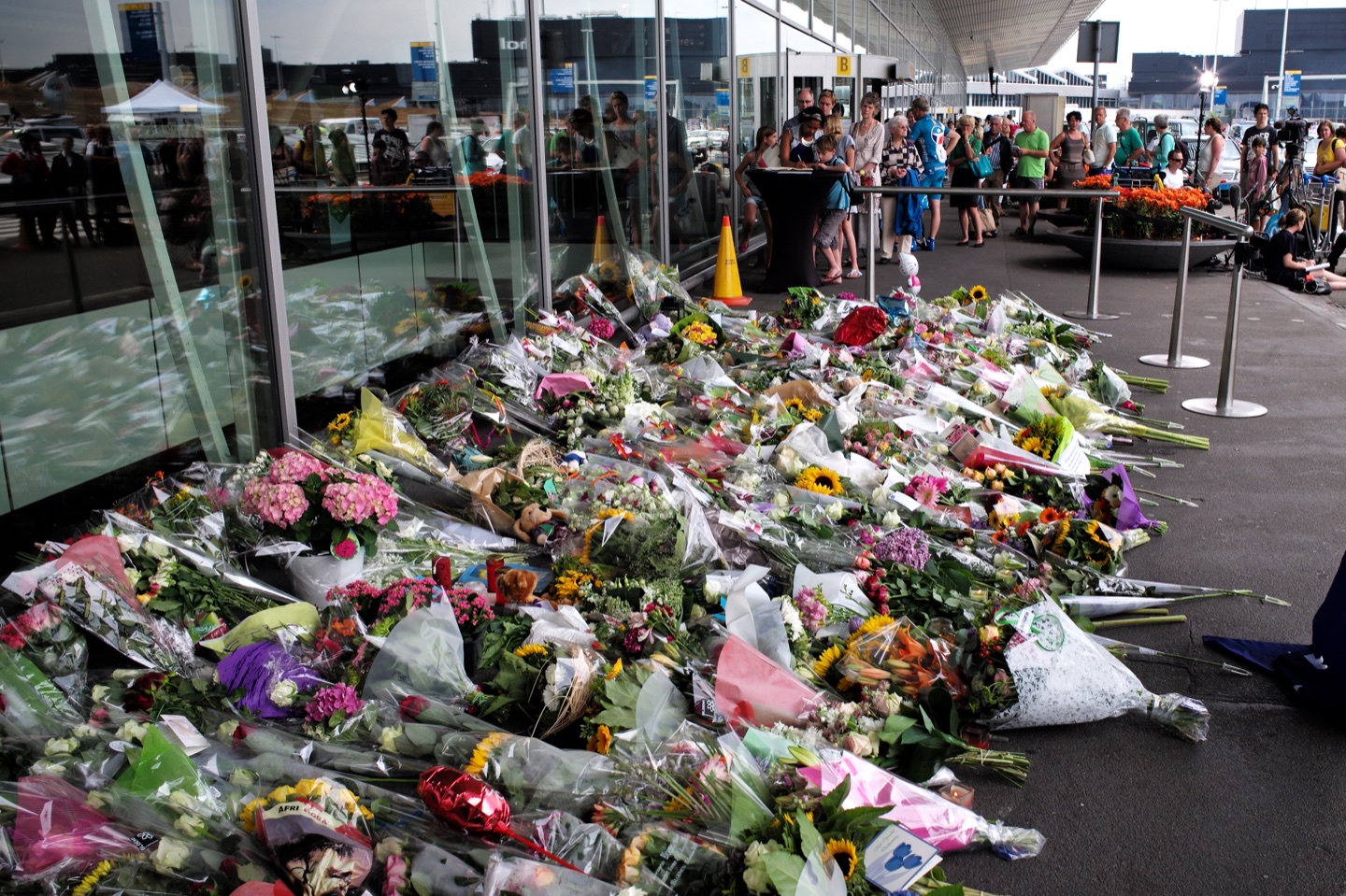
The lack of cooperation and misleading information were not merely political background. They formed part of the assessment of the investigation and the additional suffering inflicted on relatives. This was not simply the unavoidable grief of bereavement: the Court also considered the effects of the authorities' subsequent conduct.
Understanding the judgment therefore requires avoiding two opposite shortcuts. It is not a criminal judgment personally convicting Putin. But neither is it a general call for cooperation: it contains specific findings of state responsibility for the downing and what followed.
Source: ECtHR judgment [7], §§452–466,485–500,510–514,545–555 and operative provisions.
The Court reserved the question of just satisfaction under Article 41. Paragraph 1650 and operative points 28–29 defer the issue and sever Dutch application no. 28525/20 for that stage. The judgment of 9 July set no amounts. European Court of Human Rights · Judgment · 09.07.2025 · §1650, operative points 28–29 [7]
Strong evidence
The ECtHR establishes Russia’s responsibility and violations concerning MH17.
The judgment concerns the state: the right to life, investigation, effective remedies and treatment of relatives. It is not an individual criminal conviction.
Passages and operative provisions of the same original judgment; state responsibility is distinct from identifying the person who fired. [7] [7]
11. ICAO and Russia's appeal: a decision exists, but its status matters too
The Council of the International Civil Aviation Organization, ICAO, examined the case brought by Australia and the Netherlands. Following the vote announced on 12 May 2025, its reasoned decision of 30 June found Russia in breach of Article 3 bis of the Chicago Convention, concerning the use of weapons against civilian aircraft in flight.
The original text is available among the annexes filed in the subsequent proceedings before the International Court of Justice. The original reasoning therefore makes it possible to read the finding directly, beyond the statements of the governments concerned. It assesses the investigative material and addresses attribution of the conduct to Russia. The vote on the violation was 22 in favour, 3 against and 10 abstentions. The decisions on continuing good-faith negotiations over reparations had a different, unanimous outcome.
There is also an important legal distinction: the text records a lack of consensus on an additional duty of prevention derived from Article 3 bis. Not every ECtHR conclusion on positive obligations to protect life can be transferred automatically here: the instruments and the reasoning differ.
Russia appealed the decision. ICAO's 2025 annual report states that it was suspended with effect from 18 September 2025 until the International Court of Justice decides the appeal. Suspension does not mean the ICJ has already ruled for Russia on the merits; it means the ICAO decision cannot accurately be presented as fully operative while ignoring the appeal.
In the case file consulted as of 17 November 2026, ICJ proceedings no.201 do not show a final judgment on the appeal. The order of 27 November 2025 set 29 June 2026 as the deadline for Russia's memorial and 29 January 2027 for Australia's and the Netherlands' counter-memorial. A procedural deadline is not a promised date for a future judgment.
Sources: ICAO decision, annex 2, pp.A1–A7 [10]; ICAO 2025 annual report [11], settlement of differences section; ICJ case file no.201 [12].
The ICAO decision sets no amount for reparations. In paragraphs 225–230, the International Court of Justice’s report A/81/4 records that Russia filed its memorial within the time limit of 29 June 2026. The stated deadline for Australia and the Netherlands to file their counter-memorial is 29 January 2027. International Court of Justice · Report A/81/4 · §§225–230 [13]
Strong evidence
ICAO decided on a breach of Article 3 bis, but the decision is suspended.
The reasoned decision of 30 June 2025 exists. The annual report records suspension from 18 September 2025 until the outcome of the ICJ appeal.
Original decision filed among a party’s annexes; suspension confirmed by the organisation, not reversal of the merits. [10] [11]
Strong evidence
Russia’s appeal against ICAO is separate from the ICJ’s 2024 judgment.
Case 201 concerns the 2025 ICAO decision. The order of 27 November 2025 sets written-pleading deadlines; it does not decide the merits.
The index shows no final judgment at the cutoff; a memorial deadline does not establish filing or a judgment timetable. [12] [16]
12. The ICJ's 2024 judgment is not the appeal against ICAO
The International Court of Justice also appears in this story through an earlier decision, dated 31 January 2024. Those proceedings concerned the conventions on terrorism financing and racial discrimination. Confusing them with the appeal against the 2025 ICAO decision creates a logical short circuit: an answer to one legal question is used as though it settles all the others.
In the terrorism-financing branch, the Court interpreted “funds” as resources supplied for their monetary or financial value. It distinguished those funds from means used to carry out an attack, such as weapons. Supplying a weapon did not, merely as such, fall within the material scope of that particular convention.
The Court also explained that it was unnecessary to determine whether the individual incidents identified by Ukraine constituted the predicate acts covered by the convention. That is not a judgment saying MH17 was not shot down, Russia had no role, or the attack was lawful. Nor is it a negative determination that MH17 was not terrorism: that characterisation was not resolved in the way such slogans imply.
Russia was nevertheless found in breach of the duty to investigate under Article 9, concerning information received about alleged funders. Precision matters here too: an obligation to conduct a meaningful investigation can arise before an individual's criminal offence has been proved. Establishing a failure to investigate does not mean every person named in diplomatic communications has already been convicted.
The Court dismissed all the other claims based on the terrorism-financing convention. That outcome did not turn the proceedings into a general judgment on the lawfulness of the downing.
Comparing courts is useful when it clarifies their respective mandates. It becomes misleading when reduced to a scoreboard of national “victories” and “defeats”.
Source: ICJ judgment of 31 January 2024 [14], §§53,74–75,102–111 and 404(1)–(2).
Strong evidence
The ICJ in 2024 did not need to determine whether MH17 constituted a terrorist predicate act.
The Court distinguished weapons from funds, found a breach of the duty to investigate and dismissed the other claims under the terrorism-financing convention.
Two parts of the same original judgment. This is neither a general acquittal over the downing nor proof of every alleged funder’s individual guilt. [14] [14]
13. The families and the distance between judicial findings and justice enforced
The proceedings have produced reconstructions, convictions and international findings. For the families, that does not necessarily end the matter. Knowing the launcher's route does not bring someone back; a conviction does not itself ensure that the convicted person will be surrendered and serve the sentence.
The Dutch court also examined relatives' compensation claims. The ECtHR recognised that the Russian authorities' conduct had added suffering and obstructed access to answers. These aspects prevent MH17 from being told merely as an exercise in geopolitics or a comparison of judicial institutions.
Concrete questions remain: the crew's complete identity, the sequence of operational orders, the information available to those selecting the target, and the possibility of enforcing established responsibilities. These are gaps to fill, not a reason to turn every earlier finding into a matter of equally weighted opinions.
The most rigorous conclusion is neither “we know everything” nor “nothing can be known”. The evidence concerning the weapon, location and launcher's origin is much more settled than the reconstruction of every individual role. Explaining exactly where that boundary lies is the work of a dossier, not a refusal to take evidence seriously.
Essential timeline
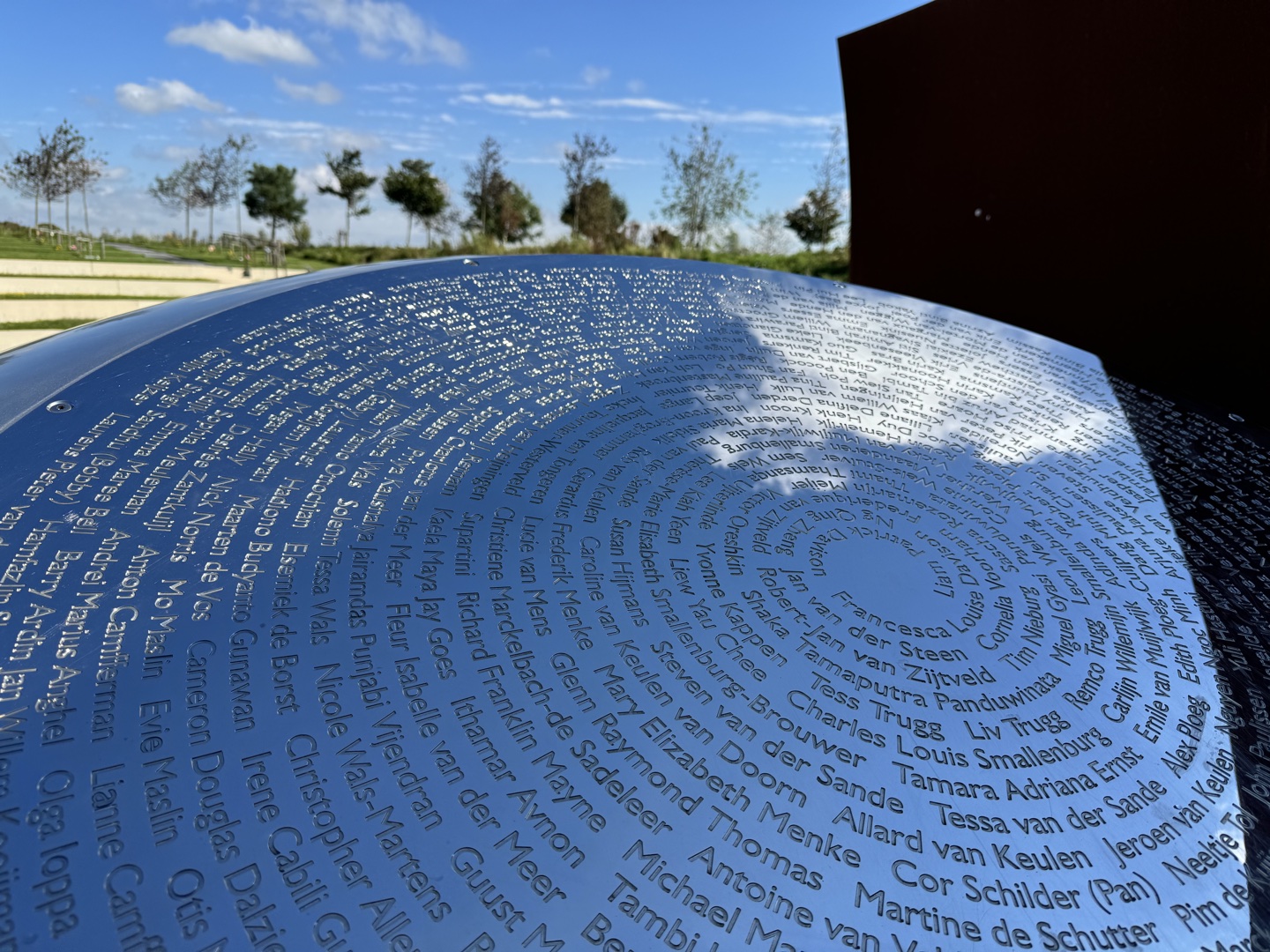
- 17 July 2014: MH17 is shot down over eastern Ukraine; 298 people are killed.
- 13 October 2015: the Dutch Safety Board presents its final report on the cause of the downing and airspace safety.
- 28 September 2016: the JIT presents findings on the Buk system, its route from Russia and the launch field.
- 24 May 2018: the JIT attributes the launcher to Russia's 53rd Anti-Aircraft Missile Brigade.
- 9 March 2020: the Dutch trial of four defendants begins.
- 17 November 2022: three life sentences and one acquittal.
- 1 December 2022: the prosecution announces that it will not appeal.
- 8 February 2023: the JIT presents its report on further investigations and announces their suspension because the evidence needed to proceed is insufficient.
- 31 January 2024: the ICJ decides the separate case concerning the conventions on terrorism financing and racial discrimination.
- 12 May and 30 June 2025: announcement of the ICAO Council vote and reasoned decision respectively.
- 9 July 2025: ECtHR Grand Chamber judgment, including MH17.
- 18 September 2025: Russia appeals the ICAO decision to the ICJ; ICAO identifies this date as the start of its decision's suspension.
- 27 November 2025: the ICJ sets deadlines for the parties' written pleadings. The timetable does not set a date for a final judgment.
Evidence assessment
Each assessment applies to the specific finding and the sources listed.
- The DSB identifies a 9N314M warhead and a 9M38-series missile used by the Buk system.
- The court identifies the launch field near Pervomaiskyi.
- The JIT attributes the launcher to Russia’s 53rd Brigade.
- In 2015, Ukrainian secondary radar data were available, but the area’s primary radar data were not.
- The DSB considered a precautionary closure of the airspace justified.
- The trial ended with three life sentences and Pulatov’s acquittal.
- The court proceeded on the assumption that a civilian aircraft had been mistaken for a military aircraft.
- The JIT’s 2023 report does not establish the entire crew’s identity with certainty.
- The JIT’s 2023 report does not prove an order from Putin to shoot down MH17.
- The ECtHR establishes Russia’s responsibility and violations concerning MH17.
- ICAO decided on a breach of Article 3 bis, but the decision is suspended.
- Russia’s appeal against ICAO is separate from the ICJ’s 2024 judgment.
- The ICJ in 2024 did not need to determine whether MH17 constituted a terrorist predicate act.
Video and transcripts
- Dutch Safety Board technical reconstruction, 13 October 2015. The short version published by NOS opens with an animated flight path. [17]
- JIT presentation, 24 May 2018. The NOS version shows an animation credited to the JIT. Both records describe the same investigation. [18]
- Criminal judgment, 17 November 2022. The NOS video opens with the judge on the bench. The official operative paragraphs establish the sentences. [19]
- JIT press conference, 8 February 2023. In the official transcript the investigators explain why they did not proceed against new suspects. [20]
Frequently asked questions
1. Has it been established that a Buk was responsible?
The DSB technical investigation concluded that a 9N314M warhead on a 9M38-series missile used by the Buk system was responsible. The criminal investigation and court added evidence about the vehicle, route and launch point. The conclusion does not rest solely on a government assertion.
2. Did the DSB identify who fired it too?
No. The safety investigation reconstructed the cause and delineated a possible launch area without assigning criminal responsibility. More precise identification of the site and roles belongs to other proceedings.
3. Were all Ukrainian radars switched off?
No. Primary radar data for the area were missing, with different explanations for civilian and military systems; Ukrainian secondary data were available. Russian materials also changed between the DSB investigation and later criminal proceedings.
4. Why was the flight passing over a war?
MH17's altitude was permitted under the restrictions then in force. The DSB nevertheless concluded that there were sufficient grounds to close the airspace above eastern Ukraine as a precaution. A permitted route was not necessarily a safe route.
5. Were the three convicted men the launcher's crew?
The court did not convict them on the finding that they were the men who physically operated the system. It reconstructed individual contributions and forms of responsibility in the weapon's use, with different reasoning for each defendant.
6. Why was Pulatov acquitted?
The court did not find the contribution and authority necessary to attribute the offences to him proved. Knowledge and contacts were not enough. The acquittal covered every variant of the charges at that trial.
7. Was a civilian aircraft deliberately targeted?
The court considered a knowing choice of a civilian target implausible and proceeded on a reconstruction involving mistaken identification. It nevertheless found a deliberate launch, intent to kill and premeditation proved: the identification mistake did not exclude criminal responsibility. The ECtHR accepted the likely target confusion but found breaches of distinction and precaution rules.
8. Has Putin been convicted over MH17?
No, not in the proceedings described. In 2023, the JIT identified strong indications concerning the decision to supply an air-defence system, but also evidentiary shortcomings and a separate immunity limitation. Decisions concerning Russia's responsibility are not personal criminal convictions of the president.
9. Did the ICJ acquit Russia of the downing in 2024?
No. It was examining obligations under specific conventions, not the same criminal case. It distinguished funds from weapons and explicitly stated that it did not need to resolve the classification of the individual incidents as predicate acts. It found a breach of the Article 9 duty to investigate and dismissed the other claims under the terrorism-financing convention.
10. Is the ICAO decision final and operative?
A reasoned decision dated 30 June 2025 exists, but Russia appealed it. ICAO's annual report states that it has been suspended since 18 September 2025 pending the ICJ's decision on the appeal. The case file consulted for this dossier does not show a final outcome of that appeal.
11. Did the ECtHR rule only on the missile?
No. For MH17, it also found violations concerning the investigation, effective remedies and treatment of relatives. Its judgment concerns the state's obligations under the European Convention.
12. What remains to be clarified?
The crew's complete identity, operational orders and target information remain distinct from facts already established. Enforcement of convictions and developments in international proceedings also require specific updates. Not knowing every individual detail does not make the entire reconstruction indeterminate.
Sources
- Dutch Safety Board · Final report · 13.10.2015
A · C01 · §§10.1–10.2
A · C04 · pp.38–43,113–115
A · C05 · §10.1, point 2(a), p.253; §10.5
B · C05 · pp.259–262
- Dutch Safety Board · Preliminary report · September 2014
- official account of the trial
B · C01 · Reconstruction of technical evidence
B · C02 · Launch location
B · C04 · Radar analysis and alternatives
A · C06 · Outcomes and individual responsibility
- text consulted
A · C02 · §6.2.2.6
A · C07 · §6.2.5.3
- JIT report, February 2023
A · C03 · Chapter 3, pp.20–21
A · C08 · pp.35 and 63–66
B · C08 · Chapter 7
A · C09 · Chapter 5 and p.65
B · C09 · §7.2.2
- official prosecution summary on radar data, 10 June 2020
- European Court of Human Rights · Judgment · 09.07.2025 · §1650, operative points 28–29
B · C07 · §455
A · C10 · §§452–466,500,514,552
B · C10 · Operative provisions
- official operative provisions
B · C06 · Operative provisions
- prosecution statement of 1 December 2022
- ICAO decision, annex 2, pp.A1–A7
A · C11 · Annex 2, A1–A7
- ICAO 2025 annual report
B · C11 · PDFp.14: Settlement of differences
- ICJ case file no.201
A · C12 · Index consulted 17 November 2026
- International Court of Justice · Report A/81/4 · §§225–230
- ICJ judgment of 31 January 2024
A · C13 · §§53,74–75
B · C13 · §§102–111 and 404(1)–(2)
- www.prosecutionservice.nl
B · C03 · Attribution to the 53rd Brigade, presentation conclusion
- icj-web.leman.un-icc.cloud
B · C12 · Order setting time limits
- NOS / Dutch Safety Board · Technical reconstruction · 13.10.2015
- NOS / Joint Investigation Team · JIT animation · 24.05.2018
- NOS · District Court of The Hague · Judgment hearing · 17.11.2022
- Politie · JIT press conference transcript · 08.02.2023
- Kambui / Wikimedia Commons, CC BY 2.0
- Hay Kranen (Husky) / Wikimedia Commons, CC BY 4.0
- Roman Boed / Wikimedia Commons, CC BY 2.0
- Cynthia van Elk / Ministerie van Buitenlandse Zaken / Wikimedia Commons, CC BY-SA 2.0
- Ministerie van Defensie / Wikimedia Commons, CC BY-SA 4.0; colour adjustment: PM3


