
Dossier
Donbass 2014: from protests to war and Russia’s role
In brief
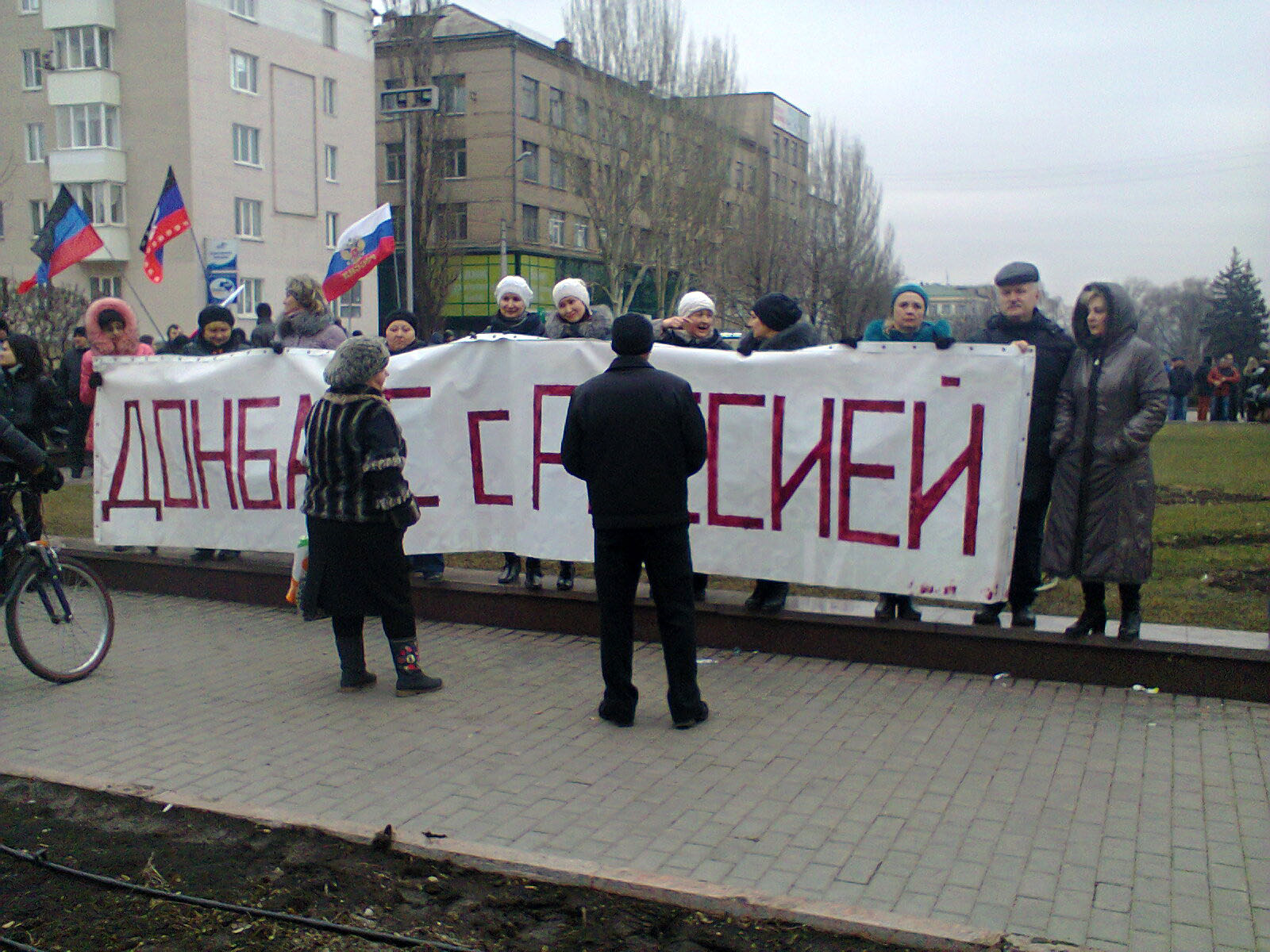
In Donbass in 2014, a region where the 2001 census recorded an ethnic Ukrainian majority and a majority who declared Russian their mother tongue, an electoral stronghold of Viktor Yanukovych and the Party of Regions, moved within months from demonstrations and occupied buildings to a war involving heavy weapons, a civilian aircraft shot down and an encirclement at Ilovaisk. The documents examined, including OHCHR and OSCE reports from 2014, Igor Girkin’s interview with Zavtra, the judgments and decisions of the European Court of Human Rights, The Hague court on MH17 and the International Court of Justice, alongside reports by the Office of the Prosecutor of the International Criminal Court, support neither “everything was spontaneous” nor “everything was directed from Moscow from the first march”. They support a phased chronology: local protests and a power vacuum after Euromaidan; an armed escalation on 12 April in Sloviansk, led by a Russian citizen returning from Crimea; Kyiv’s “anti-terrorist” operation; the “referendums” of 11 May, without international legal effect, the date from which the ECtHR places Russian effective control; weapons and men that, by summer, could no longer be explained solely by captured Ukrainian stockpiles; the Buk used on 17 July, attributed by the JIT to the 53rd Brigade in Kursk; and a large-scale troop deployment in August. Russian statements must be compared with evidence relating to their respective dates, not retrospectively refuted with events that occurred months later.
In 2024, the International Court of Justice (ICJ) did not establish “terrorism financing”: it found a breach of the obligation to investigate under Article 9, paragraph 1, of the relevant Convention and rejected the other claims brought under that Convention.
This dossier mainly reconstructs March–September 2014, with later references explicitly identified. The judicial decisions cited extend to July 2025; this is not an account of current military developments.
Frequently asked questions
Was the 2014 war in Donbass a spontaneous uprising or a Russian operation?
It unfolded in phases. The protests and occupations of March and early April had documented local roots: language, voting patterns, the collapse of the Party of Regions and a power vacuum. On 12 April, a detachment led by Russian citizen Igor Girkin occupied Sloviansk, a contemporaneous event later described by Girkin as the “trigger”. The ECtHR places Russian effective control from 11 May. In August came Ilovaisk and the large-scale deployment. The exclusive formulas “all spontaneous” and “all Moscow from the first march” do not hold up against the original documents.
Did Putin deny the presence of Russian troops?
On 17 April 2014, he denied the presence of Russian units, services and instructors in eastern Ukraine, while acknowledging the deployment of Russian military personnel in Crimea. These are different territories, so the two statements do not by themselves constitute a contradiction. On 17 December 2015, he distinguished people engaged in military matters from regular troops. The ECtHR considered an active Russian military presence from April 2014 established; the denial of 17 April must be compared with evidence relating to that phase, not refuted solely with events in summer 2014.
Do the “referendums” of 11 May 2014 have effect under international law?
OHCHR described them as having no effect under international law. It noted that the official electoral register was not used and that multiple voting was reported: the proclaimed results are therefore not a reliable, independently verified measure of public support. The ECtHR uses that date as the threshold for effective control, which is a different question.
Did the International Court of Justice say Russia financed terrorism?
No. On 31 January 2024, it found a breach of the obligation to investigate under Article 9 of the ICSFT and rejected the other ICSFT claims. It interpreted “funds” as financial resources, not weapons.
Whose Buk was used against MH17?
On 24 May 2018, the JIT attributed it to the 53rd Brigade in Kursk, part of the Russian armed forces. The Hague trial’s official summary describes the TELAR’s provenance from the Russian Federation; the attribution to the brigade cited here is the JIT’s, not a synonym for the court’s conclusion. Girkin, Dubinskiy and Kharchenko were sentenced to life imprisonment; Pulatov was acquitted. The ECtHR found Russia responsible under the Convention for violating the victims’ right to life.
Were the “humanitarian” convoys carrying weapons?
The OSCE Observer Mission had no mandate to open cargo compartments. On 13 September 2014, it recorded quick checks by Russian services on the first 36 of 216 vehicles; the other 180 were not inspected. None was inspected by Ukrainian customs or border guards, or by the ICRC, and the buffer zone was outside the observers’ view. The ECtHR is not persuaded of their purely humanitarian character. There is no inventory. The cargo cannot be deduced from the flag.
Did Kyiv “ban Russian” in February 2014?
The Rada voted to repeal the 2012 language law. Turchynov did not sign it. On 4 April, the OSCE High Commissioner on National Minorities said the 2012 law remained in force. The vote was a political signal; there was no legal ban.
Was Minsk 2014 respected?
In its December report covering November 2014, OHCHR attributed failure to implement key provisions to the armed groups, particularly points relating to the border, elections and withdrawal. This assessment concerns that phase, not every subsequent violation. Crisis Group described the ceasefire as largely ignored. This is not Minsk II of February 2015.
Does the ATO prove that “Kyiv started it”?
Decree No. 405/2014 of 14 April brings into force a National Security and Defence Council decision of 13 April, the day after the armed occupation of Sloviansk. It is a Ukrainian government decision, with a secret annex. It does not erase 12 April or subsequent intervention. “Who started it?” must still be broken down into protests, the first armed acts, the ATO decision, outside intervention, effective control and legal classifications.
Were Borodai and Khodakovsky “Russia”?
In his BBC interview of 24 July 2014, Borodai described himself as a Muscovite and volunteer and denied belonging, or ever having belonged, to the FSB. However, the ECtHR referred to an intercepted conversation of 3 July in which he stated that he was carrying out orders and protecting Russian interests (§592). Khodakovsky, by contrast, came from the SBU’s Alfa unit in Donetsk and became leader of the Vostok battalion: Reuters’ report of 1 June documents the coexistence of former local state personnel and foreign fighters. The ECtHR also cited his October 2014 statement on economic dependence on external assistance (§687). These elements must be assessed alongside structures, weapons and control: a person’s citizenship does not by itself establish who ordered every individual act.
The parties’ accounts
On 17 April 2014, during his annual televised public question-and-answer session, Vladimir Putin denied the presence of Russian units, special services and instructors in eastern Ukraine, maintaining that the activists were local citizens. In the same transcript, however, he acknowledged the deployment of Russian military personnel in support of pro-Russian forces in Crimea. The two statements concern different territories: they do not, by themselves, constitute a logical contradiction. On 21 April, according to Interfax, Sergei Lavrov accused those seeking to provoke a civil war of pursuing a criminal policy and said Moscow would oppose it. On 17 December 2015, Putin acknowledged people involved in military matters, among other activities, in the east, while continuing to distinguish them from regular Russian troops. Between the two statements came the downing of MH17, the capture of Russian paratroopers in August 2014, the publication of NATO imagery of Krasnodon and the battle of Ilovaisk. These subsequent events are not, on their own, proof of the precise situation on 17 April. Transcript of 17 April 2014 [1]; press conference of 17 December 2015 [2].
Kyiv spoke of terrorism from the outset and later of aggression. On 14 April, acting President Oleksandr Turchynov signed Decree No. 405/2014, bringing into force the National Security and Defence Council’s decision of 13 April “on urgent measures to overcome the terrorist threat and preserve territorial integrity”. The annex is secret. The public decree establishes the ATO’s domestic legal framework, not orders to open fire. Petro Poroshenko, elected on 25 May, therefore inherited an operation already under way. In 2016, Ukrainian prosecutors published recordings attributed to Russian presidential adviser Sergei Glazyev: they remain disputed intercepts; In the RBC interview of 23 August 2016, Zatulin acknowledged his own voice but disputed the editing; Glazyev rejected the allegations without answering whether the conversations had taken place. RBC, August 23, 2016 [43] Ukraine brought Russia before the ECtHR and the ICJ; the Netherlands, over MH17, joined the former proceedings.
The self-proclaimed “republics” of Donetsk and Luhansk presented themselves as the popular will of “Novorossiya”. In November 2014, Girkin claimed the role of instigator and, in the same interview, said that ninety per cent in Sloviansk were Donbass locals. Aleksandr Borodai, a Russian, was the DPR’s “prime minister” from mid-May. In his BBC Newsnight interview on 24 July, Borodai described himself as a Russian citizen from Moscow who had arrived as a volunteer, not a native of Donbass. He denied belonging, or ever having belonged, to the FSB, but acknowledged many acquaintances in the security services. The BBC documents these statements, but publishing them does not confirm their truthfulness. In §592 of its admissibility decision, the ECtHR refers to an intercepted conversation of 3 July in which Borodai said he was carrying out orders and protecting the interests of the Russian Federation alone. This is material assessed by the Court; we have not independently verified the original audio. Aleksandr Khodakovsky, previously commander of the SBU’s Alfa unit in Donetsk and subsequently leader of the Vostok battalion, appeared in a Reuters report of 1 June 2014 in the context of foreign fighters arriving and divisions among the rebels. His trajectory is a reminder that separatist structures also included defectors from Ukrainian institutions, not only men arriving from Russia. Reuters, republished by VOA [3]. In §687, the ECtHR also refers to an interview of October 2014 in which Khodakovsky described Russian funding of pensions and public-sector salaries and the territory’s dependence on outside assistance. This is not an accounting-based quantification of supplies.
The OSCE, OHCHR, JIT, European Court of Human Rights, District Court of The Hague and International Court of Justice do not answer the same questions. They operate with different mandates and standards. That distinction is precisely what prevents us from confusing a daily observers’ report, an ICC preliminary examination, a decision on human-rights jurisdiction and a judgment on terrorism financing.
Main sources for the parties’ positions: Ukrainian decree of 14 April [4], BBC interview with Borodai [5], Interfax on Lavrov’s statement [6].
One region, two sets of figures, no mandate to secede
The Ukrainian census of 2001, in the State Statistics Committee’s English-language tables, describes Donbass with a clarity often obscured by subsequent disputes. In Donetsk oblast, Ukrainians accounted for 56.9 per cent and Russians for 38.2; 74.9 per cent reported Russian as their mother tongue. In Luhansk, the figures were 58.0 per cent Ukrainian, 39.0 Russian and 68.8 with Russian as their mother tongue. Among Ukrainians in Donetsk, more than half identified Russian as their mother tongue. These data do not allow language, ethnicity and political orientation to be equated automatically. They show both an ethnic Ukrainian majority and the widespread use of Russian as a mother tongue.
Electorally, the same area was Yanukovych’s stronghold. In the runoff on 7 February 2010, the Central Election Commission credited him with 90.44 per cent in Donetsk and 88.96 in Luhansk. In the parliamentary election of 28 October 2012, the Party of Regions received 65.09 per cent in Donetsk and 57.06 in Luhansk, placing first in both. In a PONARS memo of September 2014, Serhiy Kudelia argued that the party’s collapse after February, together with the low legitimacy of the new authorities in Kyiv and the local police’s failure to exercise coercive power, made an insurgency “feasible”. In a KMIS poll of 8–16 April 2014 cited by Kudelia, roughly half the respondents in Donetsk and Luhansk considered the acting president and government illegal; seventy per cent in Donetsk and sixty-one in Luhansk saw Euromaidan as an armed coup sponsored by the West. These are survey opinions, not a legal entitlement to proclaim a republic. They help prevent the crisis’s local roots from being erased.
On 23 February 2014, the day after Yanukovych fled, the Rada voted to repeal the 2012 language law. On the 24th, the OSCE High Commissioner on National Minorities warned that the decision risked fuelling further unrest. Turchynov did not sign it. On 4 April, the same OSCE office, following visits to Donetsk and Luhansk, clarified that the 2012 law remained in force and that the legal status of languages had not changed. The vote is a fact. A “ban on Russian” as a law in force is a description contradicted by the original documents. That does not mean the vote was harmless: it sent a political signal in an already tense region.
Euromaidan, Crimea and Odessa remain distinct theatres. Here, their relevance is their effect on the crisis in Donbass. On 15 April 2014, OHCHR recorded fears among Russian speakers in the east that they would not be represented, attacks against the ethnic Russian community that were “neither systematic nor widespread”, and allegations, originating with local authorities and confirmed by central authorities, that some demonstrators were not from the region and some came from the Russian Federation. These reports do not identify every participant or, by themselves, establish an order from Moscow.
Sources for the context: census, mother tongue in Donetsk [7], census, mother tongue in Luhansk [8], 2010 runoff [9], 2012 parliamentary election [10], Kudelia, PONARS 351 [11], OSCE on the language law, 4 April [12], OHCHR report of 15 April [13].
From the square to the building, from the building to the gun
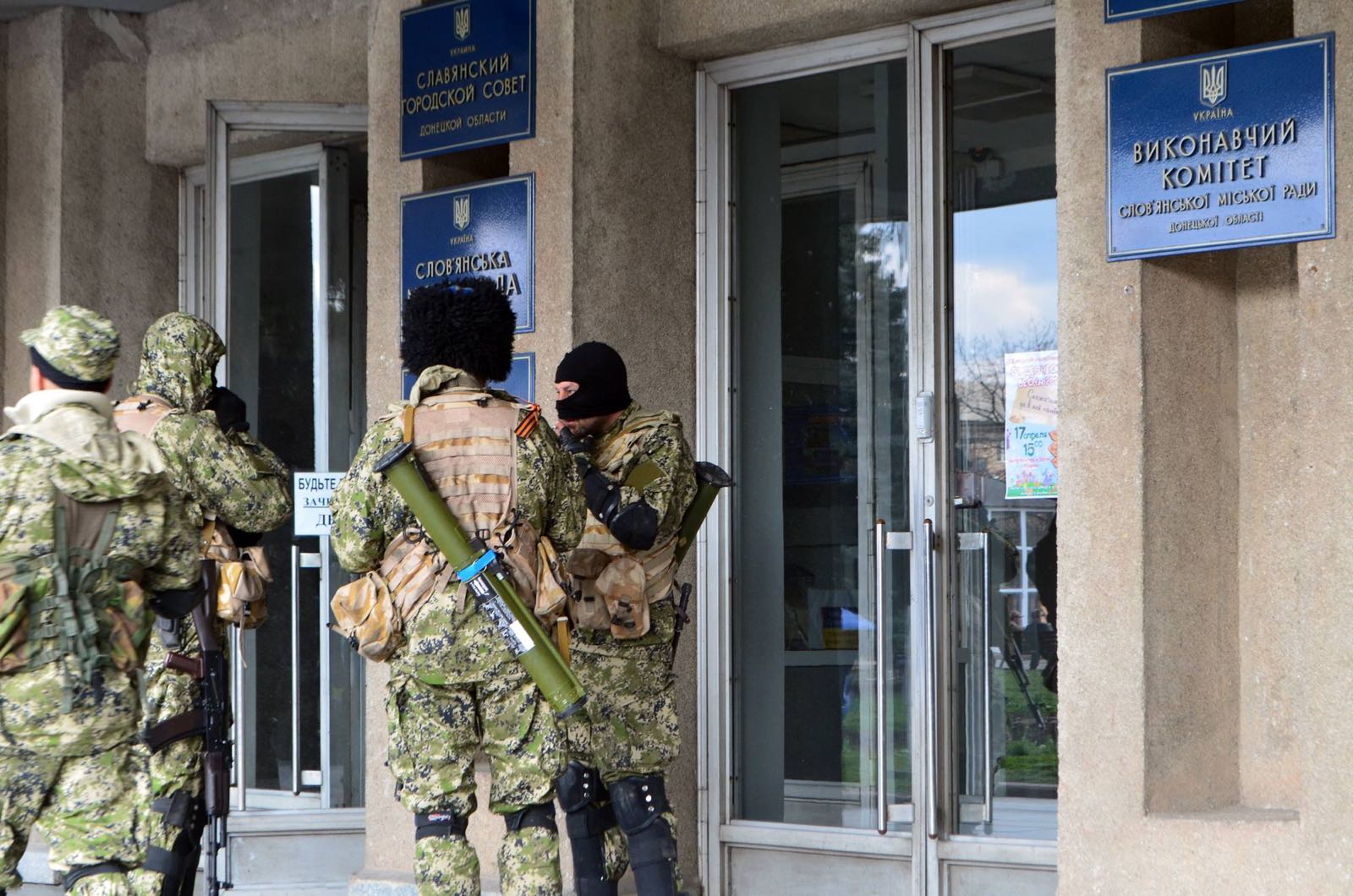
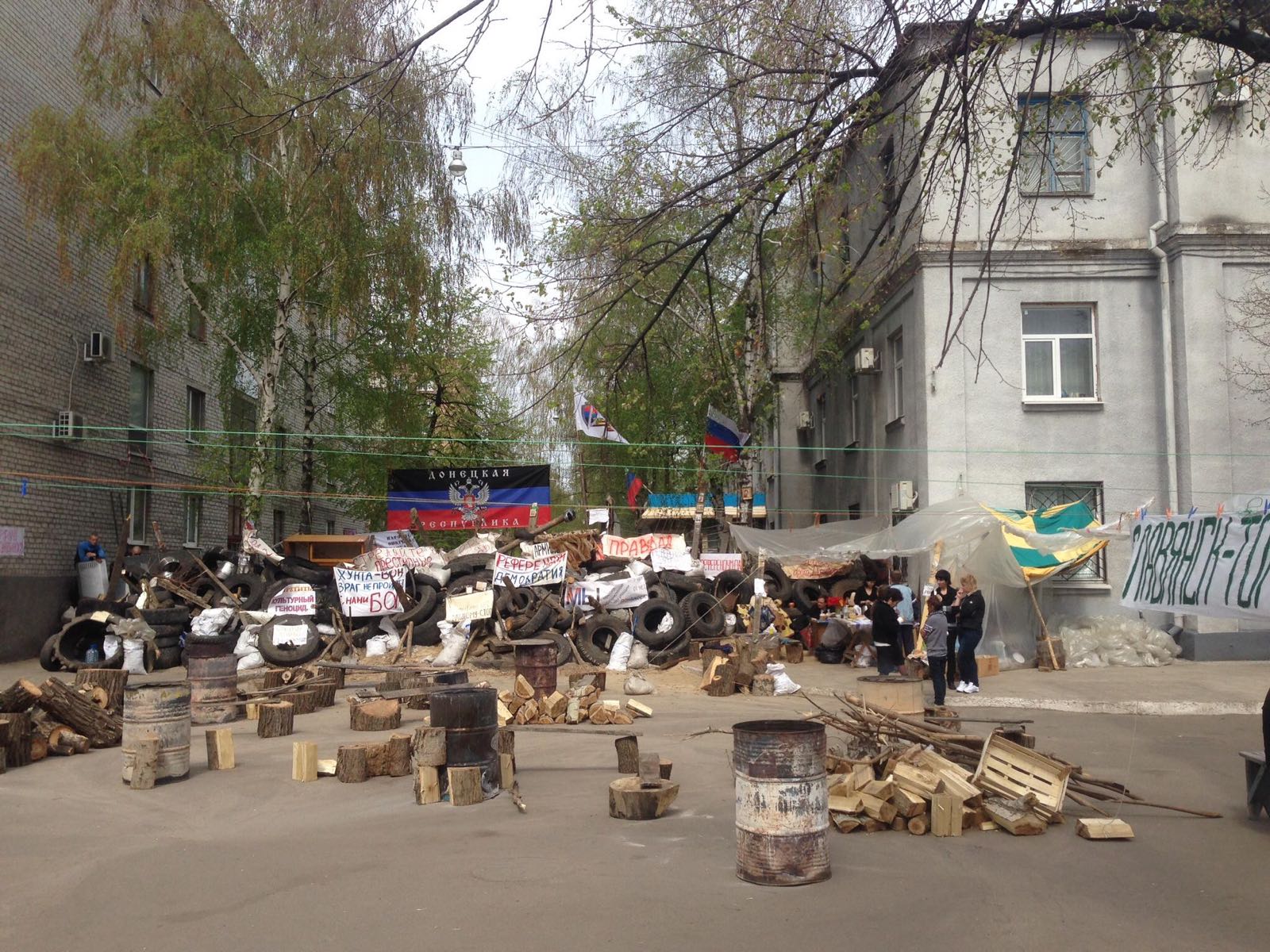
In March, Pavel Gubarev, a resident and advertising entrepreneur in Donetsk, proclaimed himself “people’s governor”. On 6 March, before his arrest, he presented Russian military intervention to the Kyiv Post as a solution that, in his view, would prevent bloodshed; he said he had taken to the streets on 27 February because there were no leaders. The SBU detained him that same day, alleging offences under Articles 110, 109 and 341 of Ukraine’s Criminal Code. The interview documents a local actor calling on Moscow; this source alone does not establish a chain of command. In April, armed and unarmed groups seized the regional administration building in Donetsk and the SBU building in Luhansk. In §90 of its report of 15 May, OHCHR cited credible reports of well-organised armed people and increasing occupations of public buildings, including by unarmed people. Demands included regionalisation and, in some cases, separatism. In §92 it recorded acquiescence by law-enforcement bodies; in §93 it noted a shift in apparent control from the DPR’s political base in Donetsk to the armed operational base in Sloviansk. On its own, this does not establish the nationality or chain of command of all groups. OHCHR report of 15 May, §§90–94 [14].
On 12 April, the ECtHR writes in its admissibility decision made public on 25 January 2023, an armed group led by Russian citizen Igor Girkin occupied public buildings in Sloviansk. More buildings in neighbouring cities, including Kramatorsk, fell in the following days. Girkin, an FSB colonel who said he had retired, a veteran of Transnistria and Chechnya and a former adviser to Sergei Aksyonov in Crimea, described how he got there seven months later to Aleksandr Prokhanov’s newspaper Zavtra. According to his account, in Crimea he had commanded the only local militia unit engaged in combat tasks. Then, with delegates from Odessa, Mykolaiv, Kharkiv, Luhansk and Donetsk asking to repeat the Crimean scenario, he gathered those who had not left and volunteers: fifty-two men. The choice of Sloviansk, he said, had not been planned in advance: they needed a medium-sized city and had been told the local activist network was stronger there. On arrival, between one hundred and fifty and two hundred people were waiting for them. From the local police headquarters, according to his reconstruction, they took around one hundred rifles and between one hundred and one hundred and fifty pistols.
The phrase that travelled around the world is more categorical than the account of choosing the city:
“But I was the one who pulled the trigger of the war.” Girkin maintained that, without his detachment’s crossing of the border, the mobilisation would have ended as it did in Kharkiv and Odessa. That is his retrospective assessment, not an experiment capable of establishing what would have happened without him. Original interview in Zavtra [15].
The testimony appears in a nationalist newspaper and comes from a protagonist claiming his own role and criticising Moscow for not annexing Donbass. It is not a record of the Russian Security Council. It is, however, consistent with the contemporaneous fact of the occupation and with the ECtHR’s assessment, which sees Girkin’s activities as an extension of his role in Crimea under the Russian Federation’s general authority and considers it established, under its own evidentiary standard, that Russian military personnel were operating in an active capacity in Donbass from April. That does not mean it dates effective control over the entire territory of the “republics” from April with the same degree of certainty.
Kyiv responded with the ATO. On 14 April, Turchynov signed Decree 405/2014, comprising three public articles and a classified annex. On 17 April in Geneva, the United States, European Union, Ukraine and Russia signed a declaration calling for the disarming of illegal groups, the return of buildings, an amnesty excluding those responsible for capital crimes, and a leading role for the OSCE Special Monitoring Mission. That same day, in the transcript in which he acknowledged troops in Crimea, Putin denied units, services and instructors in the east. The Easter pause was brief. Following the discovery of the bodies of Volodymyr Rybak and Yuriy Popravko, Turchynov publicly called for the operation to be relaunched on 22 April; the OHCHR report dates its resumption to 24 April. Sources differ on some dates of discovery and identification: these must not be confused with the date of the political announcement. On 2 May, as the Trade Unions House burned in Odessa, the OSCE SMM recorded two Ukrainian helicopters downed in Sloviansk, “reportedly” with shoulder-launched missiles, and barricades in Donetsk. OHCHR recorded abducted journalists, hostages and lists at checkpoints. By then, war was no longer a metaphor.
Contemporaneous documents: interview with Gubarev, Kyiv Post [16], Geneva declaration, EEAS statement preserved by ELIAMEP [17], OSCE report of 2 May [18].
11 May: one date, three legal frameworks
On 11 May 2014, the separatists held their “referendums”. In its June and December reports, OHCHR described them as having no effect under international law and as contrary to Ukraine’s Constitution. (Paragraph 2 of the June report says “11 March”: this is a typo in the document itself; paragraph 160 correctly dates them to 11 May.) The UN report notes that the official electoral register was not used and that multiple voting was reported. The proclaimed results therefore do not offer a reliable, independently verified measure of public support. They register a political act in territory already under armed groups.
In its admissibility decision made public on 25 January 2023, the ECtHR Grand Chamber identified that date as the threshold of effective control for jurisdictional purposes. In its merits judgment of 9 July 2025, it confirmed effective control from 11 May 2014 to 16 September 2022, when Russia ceased to be a party to the Convention. It unanimously found administrative practices involving military attacks, extrajudicial killings, torture and detention, and, for MH17, violations of Articles 2, 3 and 13. The official judgment Q&A [19] clarifies that the Court is not a criminal tribunal and does not examine criminal responsibility for war crimes or aggression. State responsibility for Convention violations must not be confused with individual criminal responsibility.
In the admissibility decision, the Court described a plurality of groups still showing varying degrees of independence in April; it referred to intercepts containing instructions from the GRU, Russian military intelligence, or the FSB, the federal security service. By the “referendums”, according to the Court, the separatist operation as a whole was being managed and coordinated by the Russian Federation. From then onwards, it considered Russian effective control over the areas concerned established on the basis of military presence and decisive military, political and economic influence. This is a conclusion on jurisdiction under Article 1 of the Convention: it entails obligations for Russia to protect rights in areas under its effective control. It is not a conviction for aggression.
The District Court of The Hague, on 17 November 2022 in the MH17 criminal trial, reached a nearby date using different terminology: from mid-May 2014, at least until flight MH17 was shot down, the Russian Federation exercised overall control over the DPR. Leaders with ties to the security services and presidential administration, Russians with military backgrounds, reports and instructions. This is the Tadić standard, which internationalises a conflict for the purposes of international humanitarian law applied in a domestic criminal prosecution.
In 2016, the Office of the Prosecutor of the ICC had used a third timeline. By 30 April 2014, the intensity of hostilities appeared sufficient to trigger a non-international armed conflict. The report also identified indications of a parallel international armed conflict, through direct hostilities between the two states, from 14 July 2014 at the latest. Overall control over the groups remained an open question in that report. This was an assessment of a reasonable basis to proceed in a preliminary examination, not an indictment or judgment.
Three forums, three questions, three timelines. Anyone merging them into a single “Russia invaded on 11 May” or “it was a civil war until February 2022” is making a leap that the original documents do not make.
Distinguishing the forums: ECtHR, admissibility decision published in 2023 [20], MH17 court, official judgment summary [21], ICC Office of the Prosecutor, 2016 preliminary examination, §§168–170, Legal Tools copy [22].
Weapons: what captured stockpiles cannot explain
Girkin described the weapons from the UVD. OHCHR noted access to stockpiles, including the SBU building. Some of the initial small arms were captured. That initial fact does not exhaust the reconstruction of subsequent supplies.
In paragraph 639 of its admissibility decision, the ECtHR considers it established under its evidentiary standard that, from the earliest days of the separatist administrations and throughout the following months and years, the Russian Federation supplied weapons and other military equipment on a significant scale. Paragraph 632 addresses the Buk: during the night of 16–17 July 2014, a Buk-TELAR was transported from Russia in response to separatist requests for air defence, and returned after flight MH17 was shot down. On 17 November 2022, the District Court of The Hague concluded that DPR fighters had delivered a Buk TELAR from the Russian Federation during the night of 16–17 July. In the official judgment summary, the system’s provenance from Russia must be distinguished from its specific attribution to the brigade, announced by investigators. The court sentenced Igor Girkin, Sergei Dubinskiy and Leonid Kharchenko to life imprisonment; it acquitted Oleg Pulatov, whose concrete contribution to the use of the Buk TELAR had not been proven. Attribution to the 53rd Anti-Aircraft Missile Brigade in Kursk, a Russian armed-forces unit, comes from the JIT’s press conference of 24 May 2018, in the original text. Bellingcat had reached that conclusion earlier through OSINT, on 23 February 2016, attributing the supply to the brigade and also hypothesising an operational role, without direct evidence of who operated the weapon in Ukraine; the JIT stressed that it had conducted its own investigation. The ECtHR accepted the weapon’s Russian provenance.
For the period from 14 July to 8 August, the same investigative collective, in its report of 17 February 2015, described craters, satellite imagery and videos that its authors consider compelling evidence that artillery attacks on Ukrainian territory originated in Russian territory. In the crater field south of Amvrosiivka, in an image of 16 July, the team counted 330 craters and traced an average trajectory to a firing position 14.6 kilometres away, inside Russia near the village of Seleznev, around 750 metres from the border. Gukovo is another case: on 16 July, geolocated videos show Grad launchers firing from Russian territory north of that city. The 750 metres and 330 craters do not concern Gukovo. This is not a court. It is a visual analysis with a stated method, not a forensic verification replicated by this newsroom: we have not recalculated trajectories and craters or repeated the geolocations.
On money, two cautions apply. Emails attributed to Vladislav Surkov’s office were examined by the ECtHR. The analysis published by DFRLab in 2016 describes, among other things, a list of losses sent by Denis Pushilin on 14 June 2014 and expense schedules for information structures sent on 16 June. We have not repeated the archive’s digital authentication; its contents must be attributed to the source analysing them. In October, Khodakovsky said that the territory could not sustain itself without outside assistance. On 31 January 2024, the International Court of Justice did something different: it found Russia in breach of the obligation, imposed by Article 9 of the Terrorism Financing Convention, to investigate information received; by ten votes to five it rejected all the other ICSFT claims; and it interpreted the English term funds as resources of a financial character, not weapons or training camps. The violation established concerns the obligation to investigate: it does not amount to a judicial finding of Russian financing of terrorism.
Sources and attribution limits: JIT, presentations at the press conference of 24 May 2018 [23], Bellingcat report on artillery attacks [24], Bellingcat on the 53rd Brigade [25], DFRLab on documents attributed to Surkov’s office [26], ICJ judgment of 31 January 2024, §§49–53 and operative part [27].
An external link to an illustrative reconstruction presented on 28 September 2016, not continuous footage of the events of 2014 or the 2022 judgment. The title, channel and link were checked through the official page and video metadata. Playback, audio and a full viewing were not verified. Official JIT page [44] · External video [45].
White convoys, a narrow mandate
From August 2014, Moscow sent convoys described as humanitarian. The OSCE border Observer Mission, established by a decision of 24 July for just two crossing points on the Russian side, Gukovo and Donetsk, provided for sixteen civilian observers: its mandate did not include checking cargo. On 22 August it reported that the trucks had left the Donetsk crossing without an escort from the International Committee of the Red Cross (ICRC). The report also describes checking procedures on previous days involving customs personnel and, for some batches on 21 August, ICRC representatives: this does not certify the cargo of the entire convoy.
The report of 13 September distinguishes 216 vehicles in total, including 189 trucks. Russian services quickly checked the first 36; the other 180 were not inspected. None of the 216 was inspected by Ukrainian border guards or customs, or by the ICRC. In the buffer zone, the vehicles were also outside the OSCE’s view. These are different categories: a partial Russian check is not a Ukrainian or international inspection of the entire cargo.
In its sixth monthly report, dated 16 September 2014 (§23), OHCHR reported that the Ukrainian–Russian inspection arrangement for the first August convoy at Izvaryne had broken down after just 34 of the 227 vehicles. This was a different convoy and a different observation: do not add or interchange the two counts. These reports document gaps in monitoring, not inventories of crates. In §637, the ECtHR was not persuaded that the convoys had exclusively humanitarian purposes and were not also being used to transport weapons, placing the burden on Russia to provide an explanation. That assessment does not identify the contents of each truck.
Checks and limitations: OSCE border mission mandate [28], OSCE, 22 August [29], OSCE, 13 September [30], OHCHR report of 16 September, §23, ecoi copy [31].
Summer, MH17 and the encirclement at Ilovaisk
Fighting took place at Donetsk airport on 26 May. In July, the Ukrainian army regained ground; Girkin left Sloviansk on 5 July, defying, according to him, a categorical order to hold it. He described exhausted mortar ammunition, two usable tanks and “otpuskniki”, men presented as soldiers on leave, arriving forty days later. That places their arrival in mid-August.
Flight MH17 was shot down on 17 July. For this dossier, the issue is not reconstructing the trajectory to the millimetre: it is the weapon’s supply chain. The investigative attribution to the Russian brigade must be read alongside findings on the system’s transfer and separatist requests for air defence. In its 2025 Q&A on the merits judgment, the ECtHR adds the violation of the right to life, the failure to take measures to identify the target, the dissemination of inaccurate and fabricated information, and the absence of an effective investigation.
On 26 August, the BBC reported the Russian explanation that soldiers captured in Ukraine had crossed the border by mistake. OHCHR’s 2018 Ilovaisk report also records this version from the Russian Defence Ministry, which referred to an unmarked border. On 28 August, NATO published DigitalGlobe satellite imagery and interpreted it as documenting Russian self-propelled artillery units moving and then deployed in firing positions near Krasnodon. General Nico Tak described an increase in the scale and sophistication of the intervention. NATO stated that it had not altered the original images, although it added its own annotations. The imagery must be distinguished from the alliance’s commentary: here we report NATO’s analysis, without claiming independent verification of every vehicle depicted.
For the events at Ilovaisk, OHCHR reports the Ukrainian Prosecutor General’s toll: at least 366 Ukrainian service members killed and 429 wounded by 31 August, mainly on the 29th and 30th. Hundreds were captured. This is not an independent UN count. Paragraph 7 documents at least 36 civilians killed in shelling in Ilovaisk and two nearby villages. Separately, §8 examines four cases of civilian killings, two attributed to Ukrainian battalions. The categories and scopes differ: the four cases are not the overall civilian death toll and the figures must not automatically be added together. The OHCHR report does not classify the nature of the conflict; it refers to the ICC’s assessments. On that reversal of the front, the ECtHR considers a large-scale Russian deployment established. In Zavtra, Girkin distinguished the otpuskniki marching towards Mariupol and an order not to occupy the city. In his polemic he also invoked the precedent of Krajina: this is his interpretation of the halted advance, not an operational order verified here.
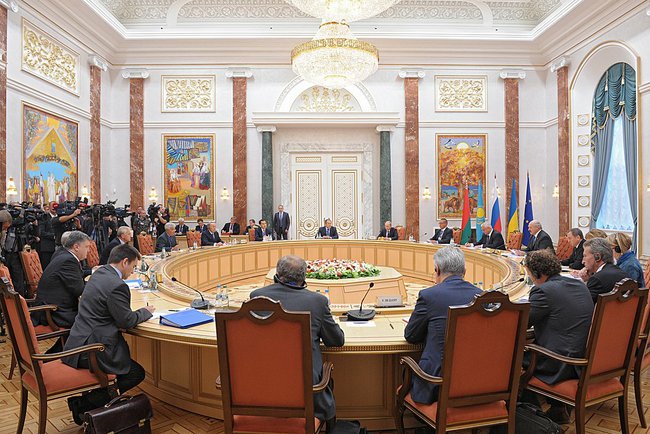
On 5 September in Minsk, the Trilateral Contact Group signed a protocol preserved by the OSCE as a two-page Russian original. In summary, its points provided for an immediate bilateral ceasefire; OSCE monitoring; decentralisation and a law on “special status”; permanent monitoring of the Ukrainian–Russian border with a security zone; hostages; amnesty; national dialogue; humanitarian measures; early local elections; withdrawal of illegal armed formations, military equipment, fighters and mercenaries; an economic programme; and security guarantees for negotiators. The signatories were Heidi Tagliavini for the OSCE, Leonid Kuchma, Russian ambassador Mikhail Zurabov, Aleksandr Zakharchenko and Igor Plotnitsky. It is not a bilateral interstate treaty: it is a Contact Group protocol. On 19 September, the memorandum fixed the line of contact, the withdrawal of weapons above 100 mm by at least 15 kilometres on each side, creating a 30-kilometre zone, and, again, the withdrawal of foreign armed formations. In its report published in December covering November 2014, OHCHR largely attributed continuing clashes to armed groups’ failure to implement key provisions, particularly points 4, 9 and 10. That same month, Crisis Group described September’s ceasefire as largely ignored. The signature had therefore not ensured an actual end to the fighting. This is not “Minsk II” of February 2015.
Sources for the military phase and agreements: BBC on the captured paratroopers [32], NATO imagery of 28 August [33], OHCHR report on Ilovaisk [34], Minsk Protocol, Russian original [35], Memorandum of 19 September [36], Crisis Group, Eastern Ukraine: A Dangerous Winter [37].
“Who started it?” is not a single question
The first March protests had local faces, a shattered party, a language and an electoral record that mattered. The armed seizure of Sloviansk on 12 April had a Russian commander; his subsequent account describes fifty-two men crossing the border and a local group waiting for them. The governmental decision to launch the ATO was Kyiv’s, on 13–14 April, in a country emerging from Maidan and Crimea. Outside intervention, involving men, weapons systems and coordination, is increasingly documented from April to August, with a leap in scale at Ilovaisk. For the ECtHR, effective control begins on 11 May. For the ICC in 2016, internationalisation through direct hostilities begins on 14 July at the latest. For the criminal court in The Hague, overall control over the DPR begins in mid-May and extends at least to MH17.
Distinguishing these thresholds does not make all responsibilities equivalent or justify outside intervention. It helps reconstruct how the crisis changed in nature. The role of Girkin’s group cannot be erased by describing an exclusively popular revolt; equally, local mobilisation, election results and fears recorded by OHCHR cannot be reduced to a staged performance without examining the evidence.
In 2015, Nikolay Mitrokhin framed his title around three stages: infiltration, instruction and invasion, dating the use of regular soldiers from August 2014. The previous year, Kudelia had instead emphasised the insurgency’s domestic causes. In 2023, the ECtHR set out both elements in sequence: disparate groups in April, an operation managed and coordinated by 11 May, large-scale arms supplies from the earliest days of the administrations, and troops visibly present in large numbers in August. This is not a diplomatic compromise. It is a reconstruction distinguishing local factors, outside intervention and successive phases, without mistaking partial convergence among sources for identical conclusions.
For the interpretive comparison: Mitrokhin, Infiltration, Instruction, Invasion [38]. Scholars’ interpretations are distinct from judicial findings.
Key sources
2001 census, Ukrainian statistical and electoral commissions; OHCHR/HRMMU, 15 April, 15 May, 15 June, 16 September and 15 December 2014, and A/HRC/39/CRP.3 on Ilovaisk, 2018; OSCE SMM, 2 May 2014, PC.DEC/1117 and 1130, Observer Mission reports of 22 August and 13 September 2014; Geneva Statement of 17 April 2014, EEAS statement, full copy preserved by ELIAMEP; kremlin.ru [39], Pryamaya Liniya, 17 April 2014, and press conference of 17 December 2015, archived; Ukrainian acting president’s Decree No. 405/2014 of 14 April 2014; Zavtra, interview with Girkin, 20 November 2014; BBC Newsnight, interview with Borodai, 24 July 2014; Reuters report on foreign fighters republished by VOA, 1 June 2014; ECtHR Grand Chamber, Ukraine and the Netherlands v. Russia, admissibility decision dated 30 November 2022 and made public on 25 January 2023, merits judgment of 9 July 2025 and Q&A; ICC OTP, Report on Preliminary Examination Activities 2016; District Court of The Hague / JIT, press conference of 24 May 2018 and MH17 judgment of 17 November 2022; ICJ, Ukraine v. Russian Federation, ICSFT/CERD, 31 January 2024; Bellingcat, Origin of Artillery Attacks, 2015, and 53rd Brigade page, 23 February 2016; NATO SHAPE, 28 August 2014; BBC, 26 August 2014; Crisis Group No. 235, 18 December 2014; Kudelia, PONARS 351, September 2014; Mitrokhin, Infiltration, Instruction, Invasion, 2015.
Claims and limits of the evidence
Documented within the stated scope
Russian military personnel from April, operating in an active capacity.
The ECtHR considers this proven beyond reasonable doubt, starting with Girkin. It is not a quantified personnel roster. [20]
Documented within the stated scope
The ECtHR places Russian effective control over the separatist-controlled areas of eastern Ukraine from 11 May 2014 for the purposes of Convention jurisdiction.
Admissibility decision made public on 25 January 2023, paragraph 695. This is not a criminal judgment. [20] [19]
Documented within the stated scope
Buk from the 53rd Brigade in Kursk, the JIT’s conclusion.
Press conference of 24 May 2018, original text. The Hague court and the ECtHR establish the TELAR’s provenance from the Russian Federation. Attribution to the brigade refers here to the JIT’s investigative conclusion, not a separate criminal finding concerning all its members. [23]
Documented within the stated scope
overall control over the DPR from mid-May 2014, at least until MH17, The Hague court.
An international humanitarian law standard in a domestic criminal trial. This conclusion does not, on its own, extend the finding beyond the downing. [21]
Reconstruction to be distinguished by phase
How much of the 2014 escalation is explained by local mobilisation and how much by Russian intervention?
Both exclusive formulas clash with different phases of the chronology. The March protests had documented local roots; the exclusive claim of “nothing external” does not hold. The analogy with Crimea for Donbass in March is partial. [11] [15] [20]
Partial evidence or unresolved limitation
The Glazyev recordings and the Surkov leaks alone allow a complete reconstruction of Russian direction of operations in Donbass.
The materials have different provenance and assessments. Their citation by the ECtHR does not amount to independent authentication of audio or PST files by the newsroom and is not, by itself, sufficient to reconstruct the direction of operations in full. [26] [20] [42] [43]
Not established
a measured popular majority for independence.
OHCHR documents the absence of the official electoral register and reports of multiple voting. The proclaimed results do not reliably establish a majority for independence; the polls cited here measure different opinions. [41]
Documented within the stated scope
the ICJ found a breach of the obligation to investigate.
The operative part of 31 January 2024 upholds this point under Article 9 of the Terrorism Financing Convention and rejects the other claims under that Convention. It does not determine the entirety of Russia’s military role in Donbass. [27]
Partial evidence or unresolved limitation
Putin’s denial of 17 April 2014 accurately describes the absence of Russian military personnel in Donbass on that date.
The transcript records Putin’s denial of units, special services and instructors in the east on that date. The ECtHR considers an active military presence from April established, but precise dates and roles must be compared. Events in July and August and the December 2015 statement remain temporally distinct. [1] [2] [20]
Documented within the stated scope
Russian military supplies established by the ECtHR.
Paragraph 639 of the admissibility decision describes significant supplies from the earliest days of the separatist administrations and subsequently. This does not identify the origin of every individual weapon. [20]
Documented within the stated scope
incomplete implementation of the September agreements in OHCHR’s December 2014 report.
The report covering November attributes failure to implement key provisions, particularly points 4, 9 and 10, to the armed groups. This limited assessment must not automatically be extended to every violation at every stage of the agreements. [40]
Sources
- Putin, transcript of 17 April 2014
A · Provenance · The passages on Donbass and Crimea and their context were read in the archived original transcript; not the entire broadcast.
B · Content and limitations · Documents Russian statements made on that date. Crimea and Donbass are separate territories; subsequent events do not by themselves establish the exact situation on 17 April.
- Putin, press conference of 17 December 2015
A · Provenance · The relevant question and answer were read in the archived original transcript; not the entire press conference.
B · Content and limitations · This is a statement by a party involved about people also engaged in military matters; it must be distinguished from evidence relating to 2014 and is not independent corroboration.
- Reuters, foreign fighters, republished by VOA, 1 June 2014
A · Provenance · The Reuters report was read in its VOA republication. Statements about funding or a buffer role that are absent from the text consulted are not attributed to this version.
B · Content and limitations · Documents reporting on foreign fighters and divisions among rebels. The statements and testimony reported have not been independently rechecked.
- Ukrainian Presidency, Decree 405/2014, 14 April 2014
A · Provenance · The three articles of the original decree were read; the annex to the decision it refers to is secret.
B · Content and limitations · Establishes the domestic legal framework of the ATO, not the contents of the annex or orders to open fire.
- BBC Newsnight, interview with Borodai, 24 July 2014
A · Provenance · The interview text published by the BBC was read in full; video playback is not attested.
B · Content and limitations · Documents what Borodai said about citizenship, origins and security services, not the independently established truth of his answers.
- Interfax, Lavrov’s statements, 21 April 2014
A · Provenance · The original Interfax report, dated 21 April 2014, was read in full.
B · Content and limitations · An attributed and dated Russian political statement, not an independent finding on military responsibility.
- 2001 Ukrainian census, mother tongue in Donetsk
A · Provenance · The archived original tables on mother tongue and ethnic composition in Donetsk were read. The link leads to the language table.
B · Content and limitations · Mother tongue, ethnicity and political preferences are different categories: the census does not measure a mandate for secession.
- 2001 Ukrainian census, mother tongue in Luhansk
A · Provenance · The archived original tables on mother tongue and ethnic composition in Luhansk were read. The link leads to the language table.
B · Content and limitations · Reported mother tongue does not automatically correspond to everyday language use, ethnicity or political orientation.
- Central Election Commission, 2010 presidential runoff
A · Provenance · The official runoff table for Donetsk and Luhansk was read: 2,435,522 votes and 90.44%; 1,237,922 votes and 88.96%. This check does not extend to the first round.
B · Content and limitations · Documents regional election results, not a vote on Donbass independence or consent to subsequent armed actions.
- Central Election Commission, 2012 parliamentary election
A · Provenance · The official table was read: the Party of Regions received 1,274,915 votes and 65.09% in Donetsk; 579,589 and 57.06% in Luhansk, making it the largest party in both.
B · Content and limitations · The results describe electoral support in 2012, not the views of every resident or a mandate for secession.
- Serhiy Kudelia, PONARS Eurasia Memo 351, September 2014
A · Provenance · The original memo and the relevant passages on domestic causes were read; the KMIS poll cited was conducted from 8 to 16 April 2014.
B · Content and limitations · An academic interpretation of local support. The survey questions do not amount to a measurement of support for independence or a valid vote.
- OSCE HCNM, language law, 4 April 2014
A · Provenance · The original statements of 24 February and 4 April were read in full; the link leads to the latter.
B · Content and limitations · They document concern over the effects of the vote and confirmation that the 2012 law remained in force, not the absence of political tensions.
- OHCHR, report of 15 April 2014
A · Provenance · The summary, §§1–17, and passages §§65–76 of the original report were read; not the entire document.
B · Content and limitations · Distinguishes fears and allegations from findings. Reports of outside participants neither identify every demonstrator nor by themselves establish a Russian order.
- OHCHR, report of 15 May 2014
A · Provenance · The passages at §§90–95 and their context in the official PDF were read; not the entire report.
B · Content and limitations · Reports credible accounts of organised groups and a shift in apparent control towards Sloviansk, not a definitively identified chain of command for all groups.
- Zavtra, interview with Igor Girkin, 20 November 2014
A · Provenance · The passages in the original interview on 52 men, local participants, weapons, servicemen on leave and the triggering of the war were read in context; not the whole interview.
B · Content and limitations · A retrospective account by an involved participant, not a state order or an independent census of fighters.
- Kyiv Post, Pavel Gubarev, 6 March 2014
A · Provenance · The body of the original article was read in full, including the SBU quotation.
B · Content and limitations · Documents statements and the arrest of a local actor; residing in Donetsk does not establish that he was born there or demonstrate a Russian chain of command.
- Geneva Statement, 17 April 2014
A · Provenance · The original two-page EEAS statement 140417/01 was read in full in the copy preserved by ELIAMEP; not through the State.gov link, which proved unreadable.
B · Content and limitations · Documents the commitments stated by the parties, not their implementation on the ground.
- OSCE SMM, report of 2 May 2014
A · Provenance · The original OSCE bulletin was read in full.
B · Content and limitations · The information about the use of MANPADS is presented as a report. The weapon type alone does not identify nationality, operator or supplier.
- ECtHR, questions and answers on the merits, 9 July 2025
A · Provenance · The official Q&A was read in full; a new full reading of the judgment on the merits is not attested.
B · Content and limitations · An official summary within the mandate and period of the European Convention; it does not replace the entire case file or a criminal judgment on every individual.
- ECtHR, admissibility decision published on 25 January 2023
A · Provenance · The relevant passages §§590–594, 610–612, 631–639 and 687–697 were read; not all 230 pages.
B · Content and limitations · Military presence, supplies and effective control are separate findings within the Convention’s jurisdiction. Audio and other materials referred to by the Court have not been independently authenticated by the editorial team.
- The Hague court, MH17 judgment summary, 17 November 2022
A · Provenance · The official summary delivered at the hearing was read, particularly the nature of the conflict and overall control; not a new reading of the entire judgment.
B · Content and limitations · The control standard in humanitarian law and the period up to the downing do not automatically coincide with ECtHR jurisdiction or the responsibility of every serviceman.
- ICC, Office of the Prosecutor, preliminary examinations 2016
A · Provenance · The passages at §§168–170 were read in the copy of the OTP report preserved by Legal Tools; not all 76 pages.
B · Content and limitations · An assessment by the Office of the Prosecutor during a preliminary examination, not a final judgment. The temporal thresholds of the different types of conflict remain distinct.
- JIT, press conference of 24 May 2018
A · Provenance · The original text of Paulissen’s presentation and the passages on the Buk supply chain were read.
B · Content and limitations · Attribution to the 53rd Brigade is an investigative conclusion by the JIT, not a conviction of all its members or an independent identification of the crew by the editorial team.
- Bellingcat, origin of artillery attacks, 2015
A · Provenance · The relevant passages of the original PDF were read, including the Amvrosiivka and Gukovo cases and the conclusions.
B · Content and limitations · A published geospatial analysis: its methods and all the underlying images have not been independently replicated.
- Bellingcat, 53rd Brigade, 23 February 2016
A · Provenance · The original page was read in full; not the hundred-page report or all linked videos.
B · Content and limitations · The system’s provenance and the probabilistic attribution of the crew are different questions; indications do not amount to individual convictions.
- DFRLab, Surkov leaks, 25 October 2016
A · Provenance · The sections on authenticity and findings on the original page were read; the PST files were not reanalysed.
B · Content and limitations · Attributed materials, also discussed in the ECtHR case file, do not amount to independent authentication by the editorial team. The list of 14 June concerns losses, not automatically compensation payments.
- ICJ, ICSFT/CERD judgment, 31 January 2024
A · Provenance · The passages at §§49–53 and the operative part at §404 of the original bilingual PDF were read; not all 275 pages.
B · Content and limitations · Finds a breach of the obligation to investigate and dismisses the other ICSFT claims. It does not establish the financing of terrorism or decide Russia’s entire military role; CERD concerns a separate subject.
- OSCE, Decision PC.DEC/1130, 24 July 2014
A · Provenance · The original decision and annexes on the mission’s mandate at the Gukovo and Donetsk border crossings were read.
B · Content and limitations · The mandate covers two crossings and civilian observers, not cargo inspections. The estimate of about one kilometre out of 2,300 belongs to the attached US statement, not the consensus text.
- OSCE OM, report of 22 August 2014
A · Provenance · The original report was read in full, including the time reference and the limits of the mandate.
B · Content and limitations · Documents observed movements and the absence of the ICRC escort; it does not certify the contents of the entire convoy.
- OSCE OM, report of 13 September 2014
A · Provenance · The revised report was read in full: 216 vehicles, 189 trucks, 36 checked on the Russian side and 180 not inspected.
B · Content and limitations · Partial Russian checks do not amount to Ukrainian or ICRC inspections. The buffer zone was outside the OSCE’s view; the report does not provide a cargo inventory.
- OHCHR, report of 16 September 2014, ecoi copy
A · Provenance · The cover and §§20–24 were read in the ecoi copy of the report dated 16 September; not the entire report.
B · Content and limitations · Paragraph §23 distinguishes 34 vehicles out of 227 in the first convoy from the second convoy of 216 vehicles. The counts must not be interchanged or added together, and do not verify the contents.
- BBC, captured Russian paratroopers, 26 August 2014
A · Provenance · The body of the original BBC article was read in full.
B · Content and limitations · The explanation that they crossed by mistake is attributed to a Russian Defence Ministry source via RIA; its publication does not independently confirm it.
- NATO, satellite imagery, 28 August 2014
A · Provenance · The official NATO text was read in full.
B · Content and limitations · The alliance’s interpretation and annotations must be distinguished from the DigitalGlobe images. Independent verification of every vehicle or all locations is not attested.
- OHCHR, Ilovaisk, 2018
A · Provenance · The summary and passages §§7–11, 75–83 and 90–100 were read through an indexed copy of the original URL; a subsequent direct request returned an error. Not the entire report.
B · Content and limitations · The figures of 366 servicemen killed and 429 wounded are Ukrainian prosecutor’s figures cited by OHCHR. At least 36 civilians killed in shelling and four cases of killing are different categories and must not automatically be added together.
- OSCE, Minsk Protocol, 5 September 2014
A · Provenance · Both pages of the Russian original preserved by the OSCE were read visually, including the twelve points and signatures.
B · Content and limitations · Establishes the signed text and commitments, not compliance; it must not be confused with Minsk II of 2015.
- OSCE, Minsk Memorandum, 19 September 2014
A · Provenance · Both pages of the Russian original preserved by the OSCE were read visually.
B · Content and limitations · Documents the line of contact, distances and withdrawal of foreign formations. The requirements do not establish that they were implemented.
- International Crisis Group, Eastern Ukraine: A Dangerous Winter, 18 December 2014
A · Provenance · The executive summary and relevant passages on Ilovaisk and in section IV.D of the publisher’s original were read.
B · Content and limitations · An analysis containing attributed testimony and assessments; not all testimony or every ceasefire violation has been rechecked.
- Nikolay Mitrokhin, Infiltration, Instruction, Invasion, 2015
A · Provenance · The abstract, introduction and outline of the three phases in the original PDF were read; not all the notes.
B · Content and limitations · An academic reconstruction, distinct from judicial findings and other scholars’ conclusions.
- Russian Presidency, institutional website
A · Provenance · The link is a general reference to the website, not an additional document read in support of a new claim. The specific transcripts consulted are identified separately.
B · Content and limitations · Does not constitute a second independent corroboration of the archived transcripts.
- OHCHR, report of 15 December 2014
A · Provenance · The passages at §§1–12 and footnote 4 of the original PDF were read; not the entire report.
B · Content and limitations · The reporting period is November 2014. The attribution to armed groups of non-implementation of points 4, 9 and 10 must not automatically be extended to every phase or violation of Minsk.
- OHCHR, report of 15 June 2014
A · Provenance · The passages at §§1–3 and 160–162 of the original PDF were read; not the entire report.
B · Content and limitations · Documents irregularities and the absence of international effects of the referendums. The typo March in the summary must be read alongside the reference to May in the text; it does not establish that no one supported independence.
- RFE/RL, commentary on the Glazyev recordings, 26 August 2016
A · Provenance · The original commentary by Brian Whitmore dated 26 August 2016 was read.
B · Content and limitations · This is attributed commentary on disputed materials, not independent authentication of the recordings. The protagonists’ responses are distinguished in the RBC source.
- RBC, responses by Zatulin and Glazyev, 23 August 2016
A · Provenance · The original RBC article dated 23 August 2016 containing both protagonists’ responses was read.
B · Content and limitations · Zatulin acknowledges his own voice but disputes the editing; Glazyev rejects the allegations without answering whether the conversations took place. This is not newsroom authentication of the audio.
- JIT, presentation of MH17 investigation results, 28 September 2016
A · Provenance · The prosecution service’s official page was read and the link chain to the specified video checked.
B · Content and limitations · The reconstruction contains illustrative animations, not exact representations of all findings. It is a JIT investigative source, not an additional independent evidentiary chain.
- Openbaar Ministerie, JIT video on the Buk route, 2016
A · Provenance · The title, channel and link were checked through the official page and video metadata. Playback, audio and a full viewing were not verified.
B · Content and limitations · An external link to an illustrative reconstruction presented on 28 September 2016, not continuous footage of the events of 2014 or the 2022 judgment.