
Dossier
Minsk: what the agreements required and why they failed to stop the war
From the September 2014 protocol to the rupture of February 2022: the signatures, the sequence linking security and elections, Ukraine’s commitments, obstacles on the ground and European leaders’ subsequent statements.
In brief
The Minsk agreements were not a single treaty signed by Putin and Zelensky. They were a succession of documents negotiated in 2014–2015, when Ukraine’s president was Petro Poroshenko, supported by a diplomatic process that continued in subsequent years. They were intended to stop fighting in certain areas of the Donetsk and Luhansk regions and enable a political settlement within Ukraine. They did not provide for those territories’ annexation by Russia.
The project intertwined two problems: making politics possible without the domination of armed force, and building local institutions the parties would accept. Restoring Kyiv’s control of the border was linked to elections and the completion of a political settlement; other military commitments followed different timetables. Reducing everything to “security first” or “elections first” erases crucial passages in the text.
Minsk did not produce lasting peace. There were documented violations, unresolved political conditions and major obstacles to monitoring. But “it did not resolve the war” does not mean “it had no effect”: an additional agreement in 2020 was followed by a sharp reduction in civilian casualties caused by active hostilities. Understanding the failure means holding these two realities together, without using either to conceal the other.
The parties’ positions
Moscow
On 22 February 2022 Vladimir Putin said the agreements no longer existed and blamed Kyiv for their non-implementation. [26]
Kyiv
On 1 October 2019 Volodymyr Zelensky said local elections would not take place at gunpoint. That was his stated position on the Steinmeier formula. [20]
Normandy format
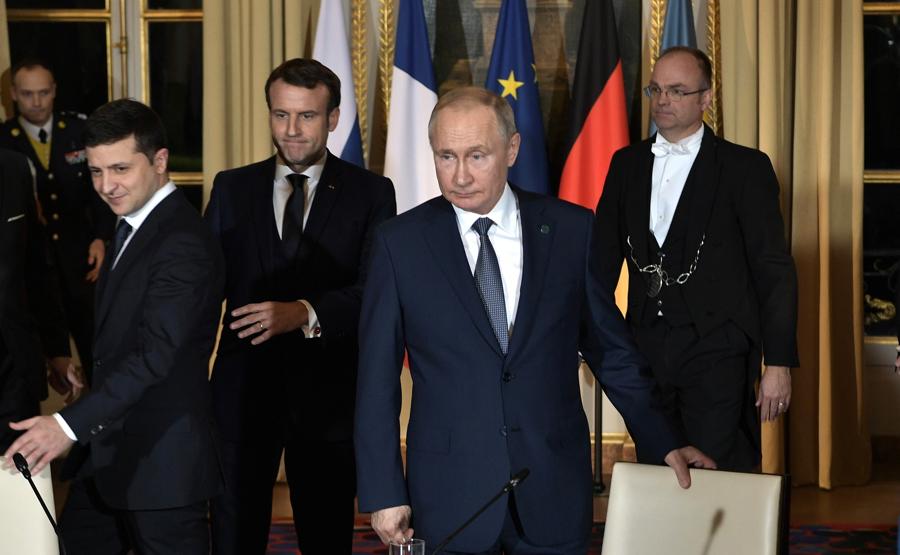
The 9 December 2019 Paris summit statement records joint ceasefire commitments and a reference to the Steinmeier formula. [21]
Contents
- The parties’ positions
- 1. Who sat at the table, who signed and who supported the agreement
- 2. September 2014: the first attempt to stop and settle the conflict
- 3. February 2015: a second package, not recognition of a new border
- 4. The sequence: security, voting and the border were not interchangeable
- 5. Special status: local arrangements within Ukraine
- 6. What Ukrainian legislation changed
- 7. Debaltseve: the truce tested by fighting
- 8. The OSCE could observe, not impose peace
- 9. Steinmeier and Paris: trying to connect voting and status
- 10. 2020: a measurable result that did not become peace
- 11. February 2022: Russian recognition and the rupture of the framework
- 12. Did Merkel, Hollande and Poroshenko admit it was meant to buy time?
- 13. How to understand the failure without inventing percentages of blame
- Essential timeline
- Verification cards
- Frequently asked questions
- Sources
1. Who sat at the table, who signed and who supported the agreement
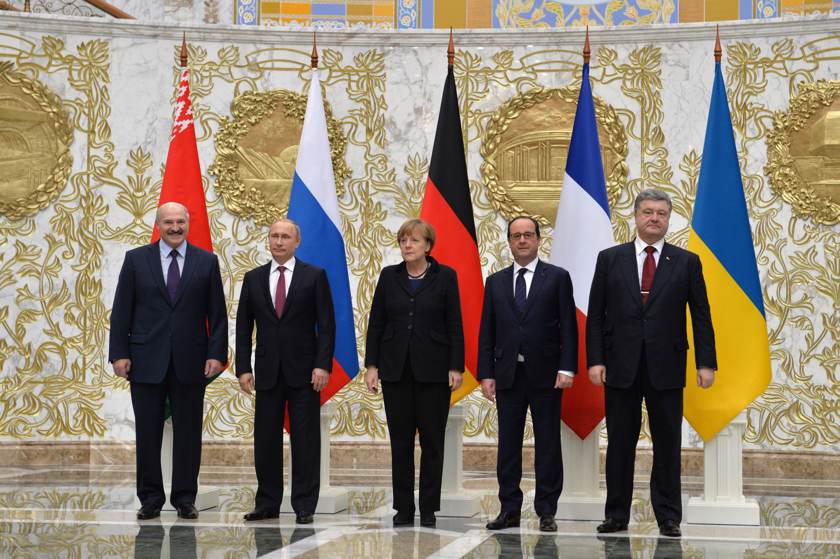
The photograph of the leaders in Minsk has become the symbol of the agreements. It is not, however, a photograph of the signing by the five people whose names appear on the documents.
The Trilateral Contact Group brought together representatives of Ukraine, Russia and the OSCE. The texts bear the names of Heidi Tagliavini, Leonid Kuchma and Mikhail Zurabov, alongside Alexander Zakharchenko and Igor Plotnitsky, representatives of the formations controlling parts of the Donetsk and Luhansk regions. Five signatures therefore do not mean five constituent members of the Trilateral Group. The memorandum expressly distinguishes the Group from the representatives of those areas. Original OSCE protocol [1], original memorandum [2].
Another level was the Normandy format: Ukraine, Russia, France and Germany. Putin, Poroshenko, Hollande and Merkel supported the February 2015 package in a separate declaration. Belarus hosted the meeting but was not a fifth member of that format. The four leaders’ support and the Contact Group’s signatures belong to different documents and functions. Leaders’ declaration, Annex II to UN Resolution 2202 [3].
The distinction also matters for responsibility. The diplomatic title beside a signature does not, by itself, determine a state’s actual military role. Nor does it permit treating a Russian signature as though it did not exist. Verifying conduct on the ground remains a separate step.
2. September 2014: the first attempt to stop and settle the conflict
The protocol of 5 September 2014 contained twelve points. It combined cessation of armed action and OSCE monitoring with decentralisation, special arrangements for certain areas of Donbas, the release of detainees, assistance and economic recovery. It also provided for the withdrawal of illegal armed formations, their equipment, fighters and mercenaries from Ukrainian territory. Protocol, points 1–12 [1].
The memorandum of 19 September sought to make military separation more concrete: stopping offensive operations, restricting heavy weapons and establishing rules for a security zone. The distances were not a single figure applicable to every weapon. The text specified systems and ranges as well as a separation zone. Confusing the zone’s overall width with the withdrawal required on each side changes the measure’s meaning. Memorandum of 19 September [2].
Another distinction often disappears in summaries: the protocol spoke of OSCE monitoring and verification of the border and a security zone on both sides. This was not already the same clause as the 2015 provision restoring Ukrainian government control. Observing a border and administering it are different activities.
The documents did not simply offer a truce while awaiting a decision on the territories’ future. They already sought to link the ceasefire to political, administrative and economic reintegration. That link was precisely what made the negotiations harder than merely separating troops.
3. February 2015: a second package, not recognition of a new border
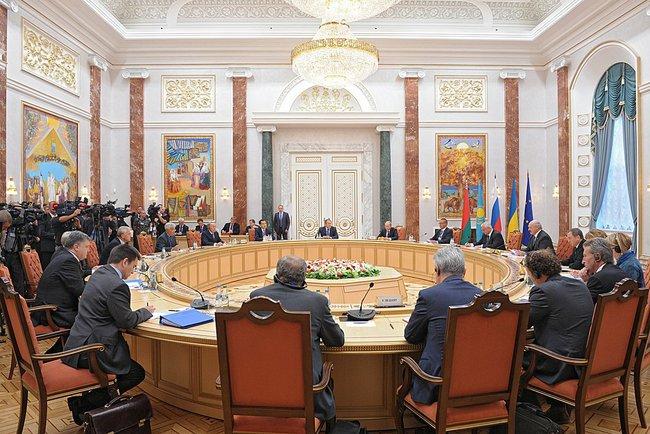
The Package of Measures for the Implementation of the Minsk Agreements was adopted on 12 February 2015, comprising thirteen points and a footnote on special status. On 17 February, five days later, the Security Council endorsed it through Resolution 2202 and called on the parties to implement it. The resolution reaffirmed Ukraine’s sovereignty, independence and territorial integrity. Signed package [4], Resolution 2202 [3].
This international backing did not turn the commitments into materially identical obligations for everyone. Ukrainian constitutional reform, weapons withdrawal and access for observers required different actions by different actors. Nor was the resolution a judgment determining Russia’s status in the conflict.
It is equally inappropriate to dismiss it as legally meaningless merely because it did not mention Chapter VII of the UN Charter. A resolution’s significance depends on its wording and context, not on a single formula. The useful point here is more concrete: the Council supported that path, but supporting it was not the same as possessing a mechanism on the ground capable of enforcing every step. International Court of Justice, general criterion in paragraphs 113–114 of the Namibia advisory opinion [5].
4. The sequence: security, voting and the border were not interchangeable
The ceasefire was to begin at midnight on 15 February, Kyiv time. Heavy-weapons withdrawal was to start no later than the second day of the ceasefire and be completed within fourteen days; monitoring was to accompany it. Separation involved different zones according to the systems concerned. For Ukrainian troops, the reference was the actual line of contact; for formations in separatist-held areas, it was the line in the September 2014 memorandum. This was therefore not a symmetrical snapshot of positions on the day of signing. Original package, points 1–3 [4].
The political issue cannot be resolved by saying the text was entirely ambiguous. Point 9 linked the start of restoring government control over the border to the day after local elections; completion was tied to the comprehensive political settlement, by the end of 2015, and to implementation of point 11. The latter provided for reform and a new constitution entering into force by the end of 2015, with decentralisation and the specific features of the areas concerned, as well as permanent special-status legislation by the same deadline. The text required consultation and agreement with representatives of the affected areas in the Contact Group; electoral issues were also to be discussed and agreed there. Point 12 required elections under Ukrainian legislation, OSCE standards and ODIHR observation. Package, points 9, 11 and 12 [4].
Not every unilaterally organised vote could therefore count as fulfilment of the agreement. Nor did every security measure have the same deadline: point 10 required the withdrawal of foreign formations and mercenaries and the disarmament of illegal groups, but set no date of its own. The numerical order is not enough to invent a chronology that the text does not state.
A discrepancy between language versions
Point 4 links the start of electoral dialogue to weapons withdrawal, but the versions consulted do not match perfectly. The signed Russian text specifies the first day after withdrawal; the English and French annexes to the UN resolution specify the first day of withdrawal. This is a real difference, not a reason to ignore the rest of the sequence. Above all, it does not, by itself, explain why the process failed. Russian original [4], UN English version [3], UN French version [6].
5. Special status: local arrangements within Ukraine
Ukrainian Law 1680-VII, adopted in September 2014, initially provided for a temporary three-year regime in certain areas. Its content was not limited to language: it covered relations between central and local authorities, economic development, cross-border cooperation and local participation in certain appointments. Language protection covered Russian and other languages. Original law in the parliamentary newspaper Golos [7].
The provision on a people’s militia concerned public order, resident Ukrainian citizens and powers exercised under Ukrainian law. It was not blanket legalisation of any separatist army. Guarantees against prosecution also had to be read with their references to law, not as automatic cancellation of all possible individual responsibility.
The 2015 package, by contrast, required permanent legislation. A temporary law already adopted did not automatically satisfy the entire subsequent process. But its content demonstrates why “Kyiv did absolutely nothing” is too crude a summary: there were real measures whose scope and operation must be examined separately.
6. What Ukrainian legislation changed
In March 2015, amendment 256-VIII made the operation of the core special-status provisions conditional on elected bodies taking office under specific conditions: a proper vote, observation, freedom to campaign, security and absence of armed interference, as well as the withdrawal of illegal formations and mercenaries. These conditions must not be projected backwards onto the original Article 10 of 2014. Amendment published on 20 March 2015 [8].
This reveals the substance of the dispute over sequence: a law can formally be in force while the application of some of its provisions depends on conditions that have not been met. Speaking generally of “status approved” or “status denied” without this distinction deprives the reader of essential information.
On the constitutional side, on 31 August 2015 the Rada gave preliminary approval to draft 2217a, concerning decentralisation and referring the particular arrangements for areas of Donetsk and Luhansk to separate legislation. Preliminary approval does not mean promulgation of a new constitution. It was nevertheless an actual step, not merely the announcement of a commission. The draft did not complete the process: a Council of Europe opinion from February 2020, reproduced in a later document, recalled that it had not been submitted for a second reading. This concerns that draft, not the absence of every Ukrainian reform. Council of Europe, Appendix I, paragraphs 5–7 [9]. Rada statement of 31 August [10].
Amnesty requires the same caution: on 16 September 2014 the Rada also adopted a text on non-prosecution relating to events in the two regions. A parliamentary vote and the actual application of an amnesty are not equivalent. The February 2015 package still called for legislation to be made operative for that purpose. In April 2016, a Parliamentary Assembly of the Council of Europe report still recorded the absence of the presidential signature. PACE, report Doc. 14015, paragraphs 54–55 [11]. Parliamentary record of 16 September 2014 [12].
7. Debaltseve: the truce tested by fighting
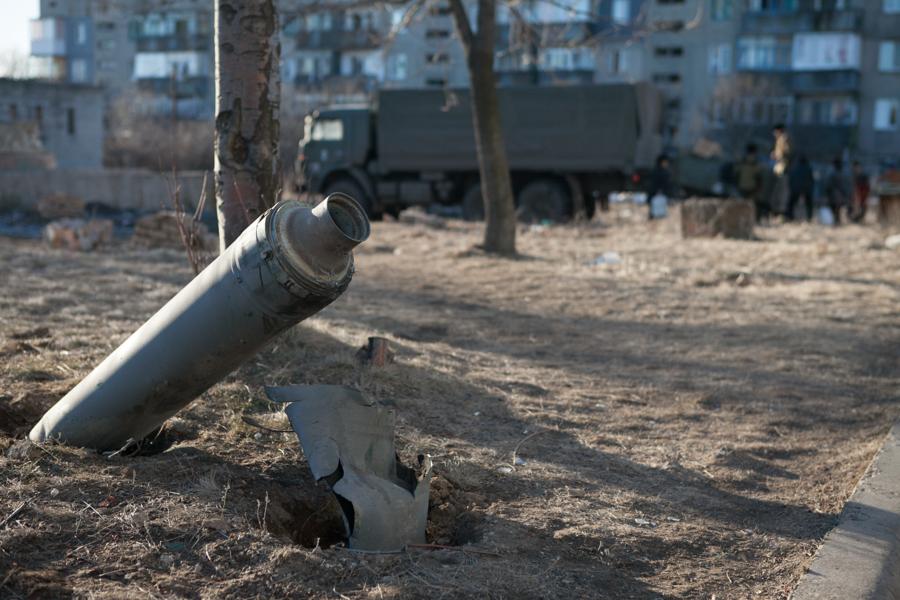
The cessation of armed action was to begin on 15 February. OSCE reports in the days immediately afterwards instead document the problem of Debaltseve. An update based on information from 16 February described a truce largely respected elsewhere, with important exceptions at Debaltseve and Horlivka. Not every observed explosion could be attributed to an identified shooter. SMM report based on 16 February information [13].
A spot report of 18 February, referring to discussions the previous day, recorded representatives of the DPR and LPR formations refusing to accept a cessation at Debaltseve, while the Ukrainian side expressed willingness. The SMM described this as contrary to the agreements and an impediment to its own access. This is a specific finding, not a general assertion that all parties were always indistinguishable. OSCE spot report [14].
The OHCHR report covering 16 February–15 May 2015 also reconstructs armed-group attacks on Ukrainian troops until 19 February and the Ukrainian withdrawal order on the 18th. It nevertheless documents a subsequent period in which the cessation was generally respected, with isolated clashes. The parties claimed to have withdrawn weapons, which the SMM could not fully verify. OHCHR report, paragraphs 6 and 20–21, complete copy hosted by ecoi.net [15].
Debaltseve shows a concrete violation at the start of the process. It does not justify turning all subsequent years into a single undifferentiated episode, or deducing from one report the chain of command behind every individual attack.
8. The OSCE could observe, not impose peace
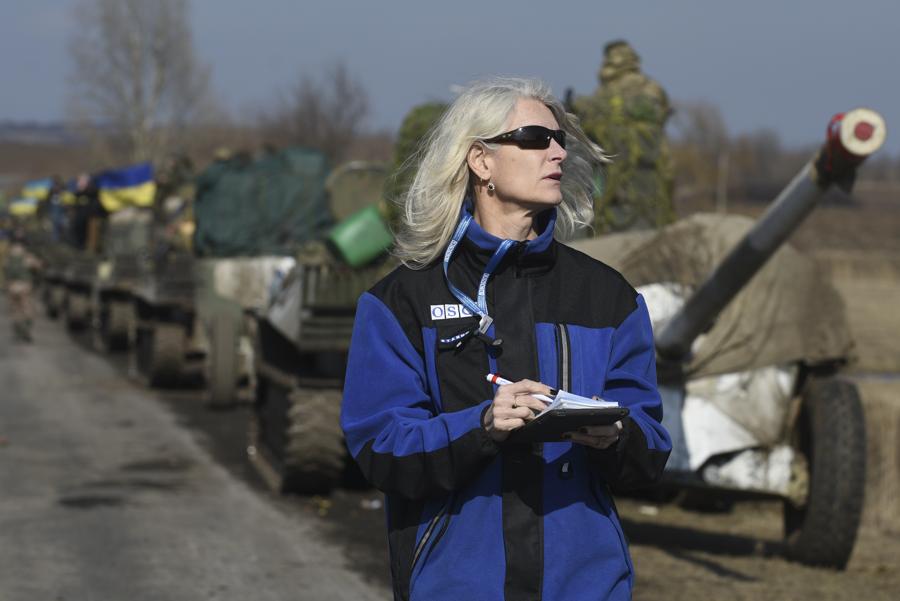
Observation is essential to verifying an agreement, but it depends on access. In the first six months of 2016, the SMM recorded 692 restrictions: 552 in areas controlled by DPR/LPR formations, 99 in government-controlled areas and 41 in undetermined or other categories. The approximately 80% therefore concerns the location of recorded restrictions, not 80% of all ceasefire violations or a percentage of responsibility for the entire war. SMM thematic report, January–June 2016 [16].
The report for the first half of 2017 counted about 480 restrictions, more than three quarters in non-government-controlled areas. It would be wrong, however, to interpret the numerical decline as an automatic improvement: patrolling had been reduced after a monitor’s death in April, while some everyday obstacles caused by mines and unexploded ordnance were not included in the count. Fewer opportunities to observe can mean fewer recorded incidents, not necessarily fewer actual impediments. SMM report for 2017 [17].
The SMM must also be distinguished from the observer mission at the two Russian border checkpoints of Gukovo and Donetsk. The latter’s initial mandate covered those two checkpoints, not the entire border. A failure to observe a crossing there does not demonstrate that crossings did not occur elsewhere. OSCE Decision 1130 of 24 July 2014 [18].
The limits of observation do not make the collected data useless. They require using them for what they document: places, periods, access, movements and observed incidents, without automatically filling blind spots with a politically preferred conclusion.
9. Steinmeier and Paris: trying to connect voting and status
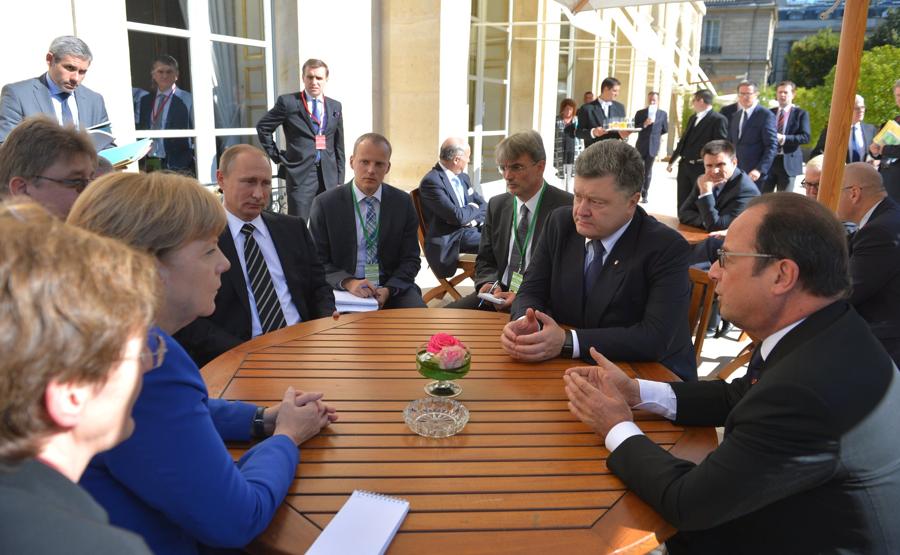
In 2019, the Steinmeier formula sought to make the relationship between elections and special status workable. On 1 October, the OSCE announced confirmations received through separate letters from the participants concerned. This should not be presented as a new single treaty replacing Minsk. Statement by Martin Sajdik [19].
In Ukraine’s public explanation, the status would become permanent following elections complying with Ukrainian law and OSCE standards. Zelensky reiterated security conditions and rejected elections under armed threat. His public conditions concerning the border were Kyiv’s position: that did not make them an already agreed amendment to point 9 of the package. Ukrainian presidency statement [20].
The Paris summit of 9 December 2019 confirmed Minsk as the basis of the process and identified concrete measures: cessation of armed action, disengagement, exchanges, humanitarian access and work on the Steinmeier formula. This was not proof that those results had already been achieved. It was a relaunch of commitments still awaiting implementation. Summit conclusions published by the Élysée [21].
10. 2020: a measurable result that did not become peace
In July 2020 the Contact Group agreed additional measures to strengthen the ceasefire, effective from 27 July. They included public orders, discipline and restrictions on actions and return fire. They were not an abstract prohibition on any response under all circumstances. OSCE communication of 23 July 2020 [22].
The humanitarian result deserves a precise figure. According to OHCHR, in the twelve months from 27 July 2020 to 26 July 2021, active hostilities caused 18 civilian casualties, comprising 5 killed and 13 injured, against 93, comprising 9 killed and 84 injured, in the preceding twelve months: an 81% reduction. The comparison excludes other causes, such as mines and explosive remnants. It must not be presented as the total of all civilian casualties in Donbas. OHCHR report of 23 September 2021, paragraph 26 [23].
The reduction does not amount to an achieved political settlement. In 2021 the SMM was already reporting renewed intensification, although it described levels still below those preceding the July 2020 measures. Address by the head of the SMM on 22 April 2021 [24].
For a family that does not lose a relative, a partial ceasefire is no small matter. For a peace process, however, a temporary reduction in violence is not enough unless it consolidates into sustainable political and security conditions. That is the difference between recognising a result and declaring Minsk a success.
11. February 2022: Russian recognition and the rupture of the framework
On 21 February 2022 Putin announced Russia’s recognition of the separatist entities. The following day he declared that the Minsk agreements no longer existed and blamed Kyiv for their earlier demise. The two things must be distinguished: recognition is a documentable act; assigning exclusive blame is the Russian president’s position. Speech of 21 February, archived Kremlin copy [25], questions and answers of 22 February, archived English version [26].
The architecture of Minsk concerned arrangements for the affected areas within Ukraine. Russia’s recognition of independent entities took a different direction. Identifying this rupture does not retroactively resolve every dispute over Ukrainian implementation, fighting or the conduct of separatist representatives. It does, however, prevent describing recognition as simple implementation of the special status envisaged in 2015.
12. Did Merkel, Hollande and Poroshenko admit it was meant to buy time?
The statements made in 2022 matter and must not be stripped of their meaning. Merkel retrospectively described Minsk also as an attempt to give Ukraine time. She was not merely describing a chance effect discovered years later: the wording reproduced in a subsequent Die Zeit article expresses a purpose. That wording is reported in a later article by the same weekly. Die Zeit article reproducing the statement [27].
Hollande, interviewed by the Kyiv Independent, shared the assessment about time and Ukraine’s strengthening, also recalling the interruption of the offensive and subsequent diplomatic work. His interpretations of Putin’s intentions are the interviewee’s political testimony, not an independent window into the Russian president’s thoughts. Interview published on 28 December 2022 [28].
Poroshenko had already highlighted, in a DW interview recorded on 15 June and published on 16 June 2022, the time gained for the army, the economy and reforms. In the same answer he referred to withdrawal, disarmament and sovereignty. The text consulted is DW’s Ukrainian translation of an interview in English. DW interview [29].
These statements support a precise conclusion: some participants subsequently claimed credit for the time gained and Ukraine’s strengthening. They do not, by themselves, demonstrate a secret agreement shared by all signatories in 2014–2015 to implement none of the points. Reconstructing any such intention would require further contemporary evidence. Denying the words spoken would be wrong; automatically turning them into proof of a collective conspiracy would be equally wrong.
13. How to understand the failure without inventing percentages of blame
A serious examination asks at least three questions. What did the individual point require? What happened in the period and place being examined? Which actor had the power to carry out or prevent that action? A documented military violation, an incomplete parliamentary procedure and a restriction imposed on observers are not interchangeable.
There is no need to presume moral equivalence between all conduct. Debaltseve and access restrictions have specific supporting evidence; Ukrainian legislative choices have texts and dates; Russian recognition has public statements. Evidence must be allowed to produce different assessments, rather than being forced into a predetermined arithmetical balance.
But no narrowly defined count warrants an overall percentage of responsibility for the failure. The number of denied accesses does not measure every military violation; passage of a law does not prove its application; a statement from 2022 does not automatically certify everyone’s intentions in 2014.
Minsk was a structure seeking to combine a truce, reintegration and guarantees in a conflict that remained armed. Documenting its partial results does not mean absolving its violations. Documenting its failure does not mean every attempt was fictitious. It is between these two errors that understanding what was truly missing becomes possible.
Essential timeline
- 5 September 2014: twelve-point protocol in Minsk.
- 19 September 2014: memorandum on military and separation measures.
- 12 February 2015: thirteen-point package, supported by the Normandy-format leaders.
- 15 February 2015: scheduled start of the ceasefire; fighting at Debaltseve continues.
- 17 February 2015: Security Council Resolution 2202.
- 17 March 2015: Ukrainian amendment on conditions for special status to operate.
- 31 August 2015: preliminary approval of the constitutional draft on decentralisation.
- 1 October 2019: the OSCE announces confirmations of the Steinmeier formula.
- 9 December 2019: Normandy summit in Paris.
- 27 July 2020: additional ceasefire measures enter into operation.
- 21–22 February 2022: Russia recognises the separatist entities; the following day Putin declares Minsk no longer exists.
Verification cards
Green · Documented.
1. The documents bear five signatures, but the Contact Group was trilateral
The originals distinguish the Group’s three constituent components from representatives of the separatist areas. The leaders’ photograph does not document these signatures. Protocol and signatures [1], memorandum and preamble [2].
Green · Documented.
2. Restoring border control was linked to elections and the political settlement
Point 9 specifies the beginning and completion; it is not a clause requiring full government control before any vote. This does not remove the other military and electoral requirements. Package, point 9 [4].
Green · Documented within the historical sources cited.
5. The 2015 constitutional reform did not complete the required process
The Rada confirms preliminary approval; in 2020 the Council of Europe records that it was not submitted for a second reading. This is not a judgment on all Ukrainian reforms. Rada [10], Council of Europe [9].
Green · Documented for that date.
6. The amnesty adopted in 2014 still lacked the presidential signature in April 2016
The PACE report connects the adopted text with the failure to complete the next step. PACE, paragraphs 54–55 [11].
Green · Documented in the report of 18 February 2015.
7. The SMM documented DPR/LPR representatives’ refusal of a cessation at Debaltseve
The finding concerns that discussion and the mission’s access, not attribution of every individual projectile. OSCE spot report [14].
Green · Limited-scope figure.
8. About 80% of SMM restrictions in the first half of 2016 were recorded in non-government-controlled areas
The denominator is 692 recorded restrictions, of which 552 were in DPR/LPR areas. This is not a percentage of blame for the entire conflict. SMM report [16].
Green · Limited-scope OHCHR figure.
9. Civilian casualties from active hostilities decreased after July 2020
The annual comparison is 18 against 93 killed and injured; mines and other remnants are not included in this category. It does not certify lasting peace. OHCHR, paragraph 26 [23].
Green · Documented statements.
10. In 2022 some participants claimed credit for the time Ukraine had gained
Merkel, Hollande and Poroshenko described the time gained and Ukraine’s strengthening; Merkel’s words also express a retrospectively claimed purpose. This does not by itself demonstrate a shared original intention to implement none of the points: that is the limit of the inference, not a denial of the statements. Die Zeit [27], Hollande [28], Poroshenko [29].
Frequently asked questions
Were Minsk I and Minsk II the same agreement?
No. A protocol and memorandum were adopted in September 2014; in February 2015 a new package sought to make the settlement operational with more detailed measures and deadlines. The subsequent process continued to refer to these documents.
Did Putin and Zelensky sign Minsk?
Zelensky was not president in 2014–2015. The Contact Group’s documents bear five signatures different from those of the Normandy-format leaders. Putin and Poroshenko, with Merkel and Hollande, supported the package through a separate declaration.
Did Minsk recognise the independence of the separatist entities?
No: it envisaged particular arrangements for certain areas within Ukraine. This is not the same as Russia’s recognition of independence announced in February 2022.
Was border control supposed to return before or after elections?
Point 9 linked the beginning to the day after elections and completion to the political settlement. Other points imposed security and electoral-integrity conditions. This whole cannot be replaced with a single sentence assigning absolute priority to one side.
Was special status permission to retain any separatist army?
The Ukrainian text envisaged a local public-order structure under Ukrainian law. It did not indiscriminately authorise every armed formation; the package required illegal groups to disarm.
Did Ukraine adopt no measures at all?
It adopted a law on the special regime, an amendment and a preliminary stage of constitutional reform. These measures are not equivalent to completing the entire process: conditional operation, temporary duration and unfinished procedure are essential distinctions.
Did the OSCE control the entire Russian-Ukrainian border?
No. The mission at the two Russian checkpoints had a limited mandate; the SMM also faced restrictions. Not observing a movement at a specific point does not demonstrate that it did not occur elsewhere.
Why did fighting continue at Debaltseve?
The reports document continued fighting and the refusal of a cessation expressed by DPR/LPR representatives in the recorded discussions. They do not therefore provide a complete reconstruction of the intentions and orders behind every attack.
Were Merkel’s words about buying time invented?
No. The wording reproduced by Die Zeit also speaks of purpose. Recognising this does not require treating it, alone, as proof of a secret agreement shared by all signatories to sabotage implementation.
Did Minsk produce no benefit?
It did not achieve lasting peace, but strengthening the truce in 2020 was followed by a documented reduction in civilian casualties from active hostilities. The result is limited in scope and does not include every cause of death and injury.
Can a percentage of responsibility for the failure be established?
Not by adding incompatible data. Restrictions on observers, legislative deadlines and military violations measure different things. This dossier distinguishes conduct and evidence without turning them into a numerical ranking lacking a method.
Were the Russian statements of 21 and 22 February 2022 the same event?
No. Recognition of the separatist entities was announced on the 21st; the following day Putin declared that Minsk no longer existed. His assignment of responsibility to Kyiv remains a position to distinguish from documentary facts.
Sources
- Original OSCE protocol
A · The signed OSCE texts were compared with United Nations documents.
B · The documents establish signatures, commitments and sequencing. Copies and language versions of the same agreement are not independent corroboration of implementation.
- original memorandum
A · The signed OSCE texts were compared with United Nations documents.
B · The documents establish signatures, commitments and sequencing. Copies and language versions of the same agreement are not independent corroboration of implementation.
- Leaders’ declaration, Annex II to UN Resolution 2202
A · The signed OSCE texts were compared with United Nations documents.
B · The documents establish signatures, commitments and sequencing. Copies and language versions of the same agreement are not independent corroboration of implementation.
- Signed package
A · The signed OSCE texts were compared with United Nations documents.
B · The documents establish signatures, commitments and sequencing. Copies and language versions of the same agreement are not independent corroboration of implementation.
- International Court of Justice, general criterion in paragraphs 113–114 of the Namibia advisory opinion
A · The signed OSCE texts were compared with United Nations documents.
B · The documents establish signatures, commitments and sequencing. Copies and language versions of the same agreement are not independent corroboration of implementation.
- UN French version
A · The signed OSCE texts were compared with United Nations documents.
B · The documents establish signatures, commitments and sequencing. Copies and language versions of the same agreement are not independent corroboration of implementation.
- Original law in the parliamentary newspaper Golos
A · Acts and institutional reports were consulted for the passages cited.
B · They document measures or legislative steps on the dates stated. They do not establish current legal status.
- Amendment published on 20 March 2015
A · Acts and institutional reports were consulted for the passages cited.
B · They document measures or legislative steps on the dates stated. They do not establish current legal status.
- Council of Europe, Appendix I, paragraphs 5–7
A · Acts and institutional reports were consulted for the passages cited.
B · They document measures or legislative steps on the dates stated. They do not establish current legal status.
- Rada statement of 31 August
A · Acts and institutional reports were consulted for the passages cited.
B · They document measures or legislative steps on the dates stated. They do not establish current legal status.
- PACE, report Doc. 14015, paragraphs 54–55
A · Acts and institutional reports were consulted for the passages cited.
B · They document measures or legislative steps on the dates stated. They do not establish current legal status.
- Parliamentary record of 16 September 2014
A · Acts and institutional reports were consulted for the passages cited.
B · They document measures or legislative steps on the dates stated. They do not establish current legal status.
- SMM report based on 16 February information
A · Relevant passages in monitoring and observer reports were consulted.
B · The findings apply to the stated locations, periods and access. They cannot attribute each incident to a perpetrator.
- OSCE spot report
A · Relevant passages in monitoring and observer reports were consulted.
B · The findings apply to the stated locations, periods and access. They cannot attribute each incident to a perpetrator.
- OHCHR report, paragraphs 6 and 20–21, complete copy hosted by ecoi.net
A · For the 2015 OHCHR report, relevant paragraphs were consulted in a full copy hosted by ecoi.net.
B · The quoted passages corroborate the events described, without systematic attribution of individual shots.
- SMM thematic report, January–June 2016
A · Relevant passages in monitoring and observer reports were consulted.
B · The findings apply to the stated locations, periods and access. They cannot attribute each incident to a perpetrator.
- SMM report for 2017
A · Relevant passages in monitoring and observer reports were consulted.
B · The findings apply to the stated locations, periods and access. They cannot attribute each incident to a perpetrator.
- OSCE Decision 1130 of 24 July 2014
A · Relevant passages in monitoring and observer reports were consulted.
B · The findings apply to the stated locations, periods and access. They cannot attribute each incident to a perpetrator.
- Statement by Martin Sajdik
A · Institutional statements were consulted. The signed facsimiles of the Steinmeier letters were not examined.
B · The statements document announcements and commitments. They do not on their own prove implementation.
- Ukrainian presidency statement
A · Institutional statements were consulted. The signed facsimiles of the Steinmeier letters were not examined.
B · The statements document announcements and commitments. They do not on their own prove implementation.
- Summit conclusions published by the Élysée
A · Institutional statements were consulted. The signed facsimiles of the Steinmeier letters were not examined.
B · The statements document announcements and commitments. They do not on their own prove implementation.
- OSCE communication of 23 July 2020
A · Institutional statements were consulted. The signed facsimiles of the Steinmeier letters were not examined.
B · The statements document announcements and commitments. They do not on their own prove implementation.
- OHCHR report of 23 September 2021, paragraph 26
A · Relevant passages in monitoring and observer reports were consulted.
B · The findings apply to the stated locations, periods and access. They cannot attribute each incident to a perpetrator.
- Address by the head of the SMM on 22 April 2021
A · Relevant passages in monitoring and observer reports were consulted.
B · The findings apply to the stated locations, periods and access. They cannot attribute each incident to a perpetrator.
- Speech of 21 February, archived Kremlin copy
A · Relevant passages were consulted in archived Kremlin copies.
B · They document the date and stated position of the Russian president. His attribution of blame is a party statement.
- questions and answers of 22 February, archived English version
A · Relevant passages were consulted in archived Kremlin copies.
B · They document the date and stated position of the Russian president. His attribution of blame is a party statement.
- Die Zeit article reproducing the statement
A · Interviews and editorial accounts from 2022. For Merkel, the quotation published by the same outlet was consulted, without access to the full original interview.
B · These record retrospective statements. In themselves they do not establish a joint plan in 2015.
- Interview published on 28 December 2022
A · Interviews and editorial accounts from 2022. For Merkel, the quotation published by the same outlet was consulted, without access to the full original interview.
B · These record retrospective statements. In themselves they do not establish a joint plan in 2015.
- DW interview
A · Interviews and editorial accounts from 2022. For Merkel, the quotation published by the same outlet was consulted, without access to the full original interview.
B · These record retrospective statements. In themselves they do not establish a joint plan in 2015.
- 11 February 2015 · Presidential Press and Information Office / Kremlin.ru · CC BY 4.0
- 24 February 2015 · UNICEF Ukraine · CC BY 2.0
- 27 February 2015 · Evgeniy Maloletka / OSCE Special Monitoring Mission to Ukraine · CC BY 2.0
- 9 December 2019 · Presidential Press and Information Office / Kremlin.ru · CC BY 4.0
- 26 August 2014 · Presidential Press and Information Office / Kremlin.ru · CC BY 4.0
- 2 October 2015 · Presidential Press and Information Office / Kremlin.ru · CC BY 4.0
- ARD-Mittagsmagazin · German Historical Institute
- BFMTV · Ukraine : un accord de paix conclu à Minsk · 12/02/2015


