
Bucha massacre 2022: satellite images and the Russian withdrawal
Frequently asked questions
What do the satellite images show?
Does the evidence support the claim that the bodies were staged after the withdrawal?
When did Russian troops leave Bucha?
At a glance
The proposed assessment is strong for several matched positions on Yablunska Street. AFP and CIR date the Maxar scene to 19 March 2022. CIR credits a second scene to Planet, dated 21 March. The dossiers compare those images with drone footage and April photographs from the ground. Both satellite dates precede the reported local withdrawal window of 29–31 March. [19] [20]
The finding concerns presence at specific positions: the staggered side streets near the roundabout and AFP’s point 5 beside a damaged car and a sign. The evidence gives a latest date by which several bodies were already there. The timing of other bodies, identity, cause of death and responsibility require separate evidence.
What the parties said
Russia
On 3 April the Russian Defence Ministry said its forces had left Bucha on 30 March, denied violence against residents under Russian control and described the footage as staged. On 5 April, Russia’s UN ambassador Vassily Nebenzia said the purported evidence surfaced only on 3 April. He cited a Ukrainian clearance operation and a video he said showed instructions to shoot people without blue armbands. The Russian mission’s separate letter alleged that Ukrainian radicals had killed civilians and blamed Russia. These records establish the official positions. The staging allegation needs evidence tied to the same places and dates as the bodies it seeks to explain. [1] [2] [3]
Ukraine
Mayor Anatolii Fedoruk named 31 March as the day of liberation in a video published by the council on 1 April, as reported by Ukrainska Pravda. Earlier that day, the council secretary warned that Russian personnel might remain despite a partial pullout. Ukraine’s National Police announced a clearance operation on 2 April. On 3 April, President Volodymyr Zelenskyy reported bodies in the streets and attributed the killings he described to Russian troops. The statements describe the citywide transition, the announced operation and official attribution. They give no time for the last departure from each block of Yablunska. [4] [5] [6] [7]
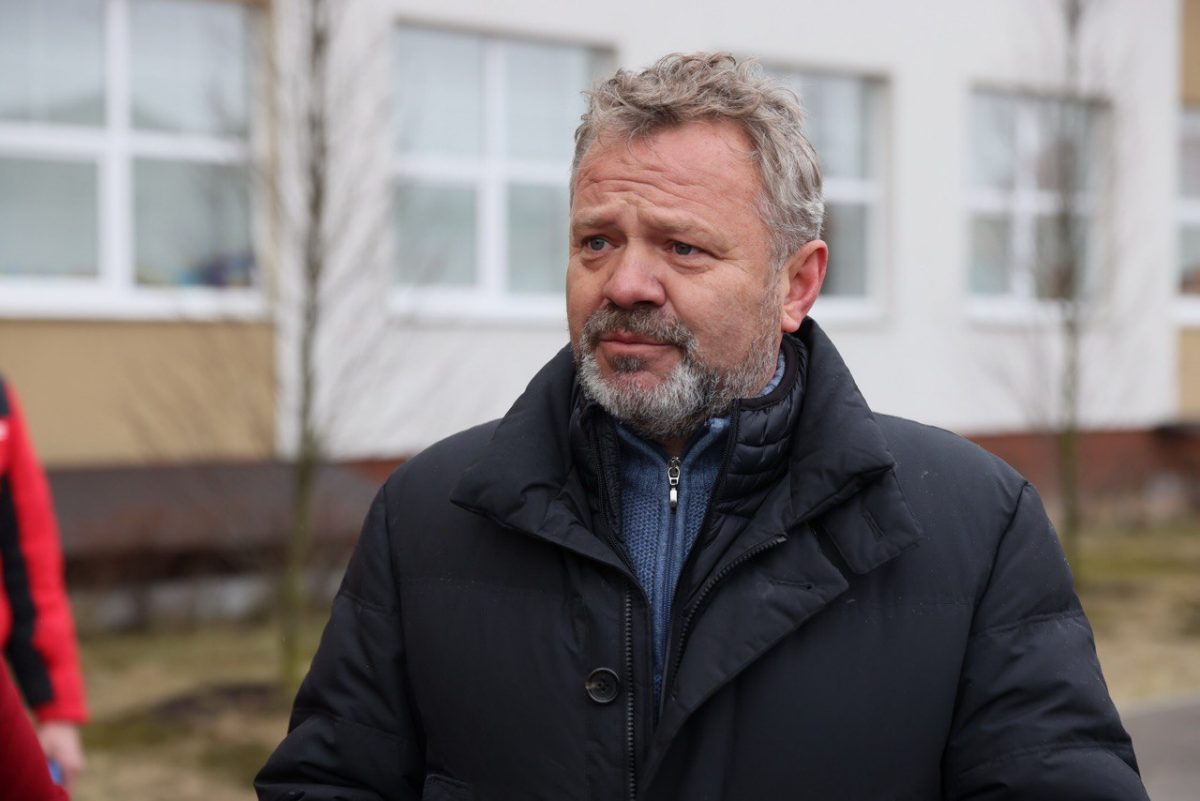
Context photograph
Anatolii Fedoruk, mayor of Bucha
Portrait published by ArmyInform on 6 April 2022. The source identifies Anatolii Fedoruk. The portrait accompanies his account of conditions in the city after the withdrawal.
ArmyInform / Vitalii Sarantsev, Roman Drapak · News agency of Ukraine’s Ministry of Defence · CC BY-NC-ND 4.0 · Publisher’s file, unchanged. [15]
Evidence and chronology
Three clocks for the same evidence
The 19 and 21 March dates refer to reported satellite acquisitions. The 2 and 3 April dates refer to observations and photographs on the ground. Bellingcat’s 1 April timestamp refers to a public upload. AFP published its comparison on 6 April and Meduza published its drone report on 7 April. The research dossiers are dated 14 November 2026. Those dossier dates record the later assessment, and the checks below describe what each dossier says it examined. A later publication can document an earlier capture, while an upload time sets a latest possible time for filming without establishing the actual camera time. [19] [20] [22] [11] [28] [29]
Roundabout sector: the strongest match is a pattern
Dossier A starts with CIR page 8, lower panel. One side-road mouth lies next to a pale blue or white roof. Across the road, an offset opening lies next to a reddish construction footprint. Seven candidate features are outlined in that crop. The February 28 Maxar panel above it lacks the later pattern at the marked positions, a limited comparison within that published crop. On page 9, the roundabout, long blue roof and the shape of the main road help place the wider Planet image before interpreting any small dark mark. The geography explains why several positions taken together are stronger evidence than an isolated spot that could be shadow or debris. The seven outlines are candidate features, not seven independently identified people. [19] [28]
CIR’s upper-left ground still on page 9 shows two bodies ahead of and to the left of the lead vehicle. The traffic direction and the side of the road can be compared with the satellite view. CIR’s line leads to the cluster southwest of the roundabout rather than to two separately surveyed points. In another still, a solitary marked object by a gabled building can be placed using the kerb and the offset access. Dossier A rates the match of that individual object only moderate in the reduced Planet print. This is evidence for a cluster on the road segment, with uneven certainty about individual objects. [19] [28]
Dossier B records checking BBC’s published Maxar graphic. Its first paired view compares a car and three marked positions, and its second a van and four. The order of the marks, their spacing and their side of the road help make sense of the comparison. Both views draw on the same Maxar scene, and the marks cannot be added to the CIR boxes as a separate count. Dossier B did not examine CIR’s Planet image or the full-resolution ground imagery. [24] [29]
CIR satellite comparison
Maxar, 19 March 2022, and Planet, 21 March 2022, as attributed by CIR. See the offset intersections and the long blue roof. Published crops support location matching. Native files and permission to reproduce these scenes were unavailable for this article.
Sensitive material: images of people who died.
CIR report · pp. 8–9. The satellite images are in the source PDF. [19]
SatNews republishes four Maxar panels of Yablunska Street. The fourth shows the street from a rotated view. The panels are credited © 2022 Maxar Technologies. Permission to reproduce them in this article was not verified. [13]
AFP point 5: a chain from April photographs to March imagery
AFP first ties the convoy still to AFP’s 2 April photographs using a damaged car, an upright sign and the edge of the pavement. AFP photographer Sergei Supinsky photographed municipal workers recovering the body on 3 April. This sequence is evidence from the ground and did not originate with Maxar. In the satellite and ground comparison published on 6 April, AFP explicitly places that same body at marker 5 in the scene dated 19 March. The car and pavement supply the local anchors. Dossier A rates this individual match strong, with contrast and shadow limiting what the satellite crop alone can show. The ground evidence establishes a body at the point by 2 April. The March date depends on the satellite match and date attribution. [20] [28]
AFP photographs and point 5
AFP’s own photographs of 2–3 April and its comparison with Maxar imagery dated 19 March. The car, sign and kerb anchor the match. The original AFP page shows the photographs behind its content warning. Reuse rights were not verified.
Sensitive material: images of people who died.
AFP website · reveal the photographs beneath AFP’s content warnings. [20]
Sky’s second comparison links three positions using relative spacing, walls, kerbs and roadside access. Dossier A assesses the pattern as strong and its least distinct individual target as moderate. In Sky’s third comparison at the roundabout, the dossier supports one match by the road edge near stacked material and poles. Two others remain open because of shadow and low contrast. Sky offers a separate reading of Maxar, while AFP’s ground photographs and the drone series supply different material. None of these counts can be summed without checking for overlap. [21] [28]
CIR labels its 21 March roundabout reproduction Planet. It remains unclear whether the Maxar image dated 21 March cited by AFP/France 24 and noted in Dossier B is the same scene that CIR credits to Planet. Dossier A examined CIR’s reproduction. Dossier B examined the BBC’s Maxar comparison and did not inspect CIR’s Planet crop. Neither had the native satellite files or their metadata. The Maxar comparison dated 19 March, the ground photographs and the separately acquired drone footage can each be assessed on their own evidence. [19] [29] [24] [11] [28]
Why the 19 March date holds in the available record
CIR reports a catalogue acquisition time of 09:08:31 UTC on 19 March, 11:08:31 in Bucha. Dossier B notes that the local time inferred in a challenge published by Rybar is close to that catalogue time after correcting the time zone. CIR also reports that a filter for the viewing angle hid the scene in the public catalogue search. Dossier B’s azimuth calculation is consistent with CIR, but the dossier also notes that the solar direction at that hour is similar at the end of March and it did not measure shadow lengths. The reported acquisition time, the comparisons of shadow lengths described by the BBC and the other recorded views together carry more weight than the angle alone. The native file and its acquisition metadata remain unavailable to the dossiers. [19] [24] [29]
What the drone footage adds
Meduza published the footage on 7 April and dates the series to 23–30 March based on the distributed files’ metadata. The footage came from a group fighting on Ukraine’s side. Dossier A identifies the offset junctions and reddish construction site around seconds 5–10 of the clip labelled 25 March. The files’ creation tags can be changed, and Dossier A had no original drone controller logs. The exact filming date remains unauthenticated. [11] [28]
Dossier A notes that the model-dependent shadow estimates in Meduza’s Russian edition point to dates earlier in March than the file labels suggest. The two analysts examined the same footage. Meduza reports that the first footage showing bodies could have been filmed no later than 26 March. That is an upper bound from Meduza’s analysis. The drone gives a separate viewpoint that supports the broader pre-withdrawal chronology. The satellite comparisons do not depend on the exact filming day. [11] [28]
Meduza drone footage
Published 7 April 2022. Dossier A locates the offset junctions around seconds 5–10 in the clip labelled 25 March in Meduza’s archive. The label identifies the file. The exact filming date remains unauthenticated. The footage cannot establish identity or responsibility.
Sensitive material: images of people who died.
Graphic cover · not a video still Play Meduza video Loads the YouTube player here. Close player
Meduza [11]
Ground footage, first circulation and conflicting claims
Bellingcat records an upload by 20:18 on 1 April, Bucha time. That timestamp concerns publication. AFP independently observed bodies on the street on 2 April, before the date cited by Nebenzia. The clearance announcement on 2 April gives no link to the deaths at the matched points. The March imagery, if matched and dated as reported, cannot be explained by an event after the withdrawal. [22] [10] [6]
Provereno.Media and AFP examine the alleged movements in circulating footage. They identify visual effects involving a windscreen and a mirror. Repeated analyses of the same clip are dependent. Dossier A also records examining the longer file provided by Ilya Novikov. An MP4 creation tag alone cannot determine the time of filming, and the longer recording is distinct from the documented 1 April upload. [23] [20] [12] [28]
In the separate Novikov ground file, Dossier A reports a match at 00:09 to the CIR convoy still using a pickup, the yellow and white edge of the right kerb, the houses and the utility lines. CIR’s geolocation places a point on the convoy’s route. It cannot be treated as a surveyed location for an individual body. The dossier rates route geolocation strong and individual assignment to the small Planet shapes only moderate. The apparent movement review serves a different purpose: matching the windscreen and mirror effects answers a claim about a video, while the chronology comes from the March imagery and separately dated observations. [19] [23] [12] [28]
Ground video and frame analysis
Provereno.Media, 4 April 2022. Its article links or displays video used to examine apparent movements and discusses the longer recording supplied by Novikov. The clip cannot establish the time of death. Permission to re-embed the footage was not verified.
Sensitive material: images of people who died.
Direct MP4 · file supplied by Novikov and hosted by Provereno.Media. Its creation tag does not authenticate the filming time. [12] [23]
The public upload time also does not establish that the Novikov file is the original April 1 recording. Dossier A records an MP4 creation tag equivalent to 11:42:11 local time on 2 April for the longer file. That tag could reflect recording, encoding or export. AFP’s observation that afternoon is separate: its count refers to roughly 400 metres on 2 April and cannot establish the number of bodies present in March. These distinctions limit what each item can bear in response to the UN ambassador’s claim. [23] [22] [20] [28]
Withdrawal by date and by block
The local window supported by the dossiers is 29–31 March. The Defence Ministry’s 30 March and the mayor’s 31 March are town-wide dates, while the reported 19 and 21 March acquisitions precede either one. [1] [4] [19]
Meduza identifies Russian-type vehicles at points in footage labelled 28 March. That equipment is absent from the same monitored positions in footage labelled 29 March. OHCHR separately reports soldiers in a Yablunska yard around 09:00 on 29 March and witnesses cited by AFP describe a column leaving that evening. These accounts can be true together because they refer to different physical locations and times. Dossier B draws on a witness reported by HRW for an early 31 March time in one locality. It is a local observation, rather than a timestamp for the entire city. An image dated 29, 30 or 31 March documents what was in frame at capture. Establishing its relation to withdrawal from that block would require a collection time and separate evidence of local control. [11] [8] [20] [14] [29]
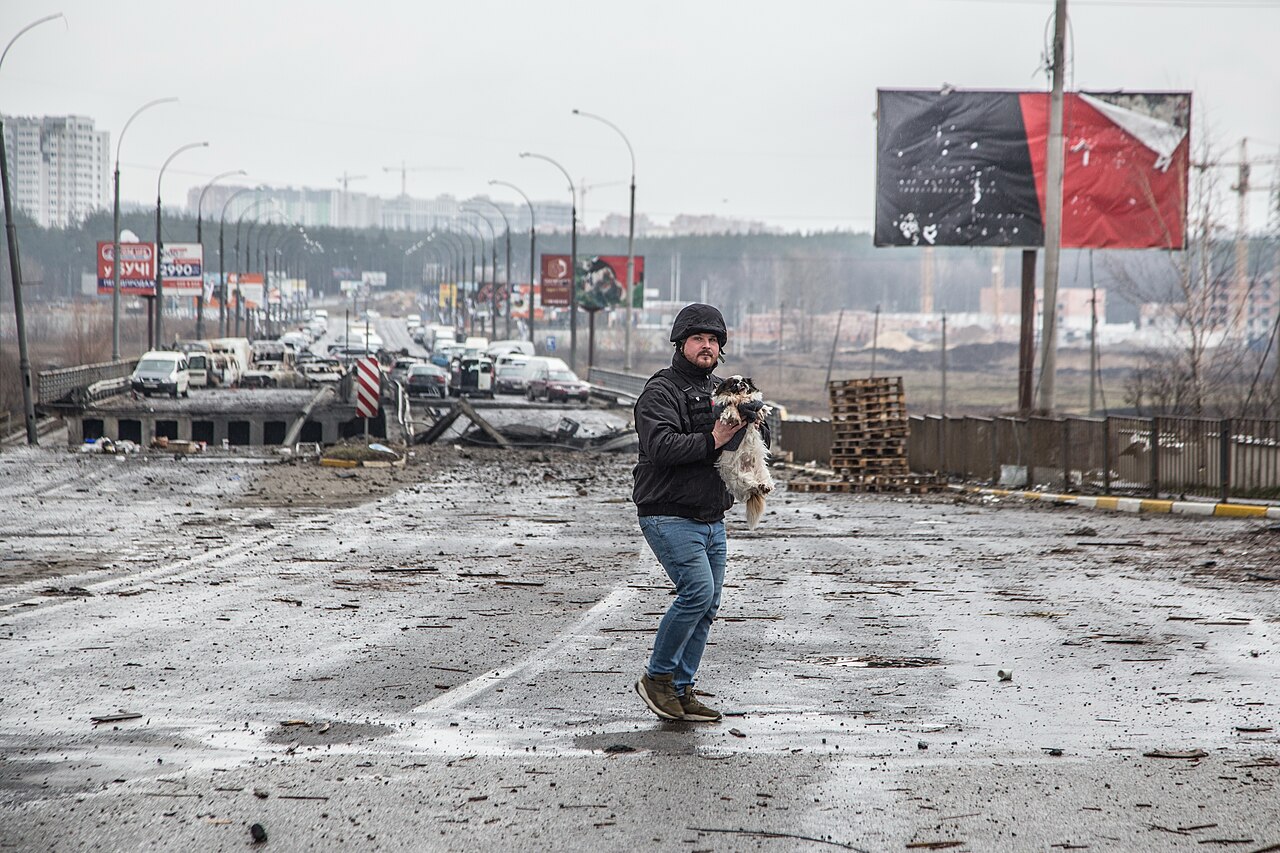
Context photograph
Road scene · 30 March
Oleksandr Ratushniak’s photograph, titled Bucha after Russian invasion of Ukraine and dated 30 March 2022 by the author. It shows a man carrying a dog on a road strewn with debris. The exact location is unconfirmed.
Oleksandr Ratushniak · CC BY-SA 4.0 · Resized, uncropped. [18]
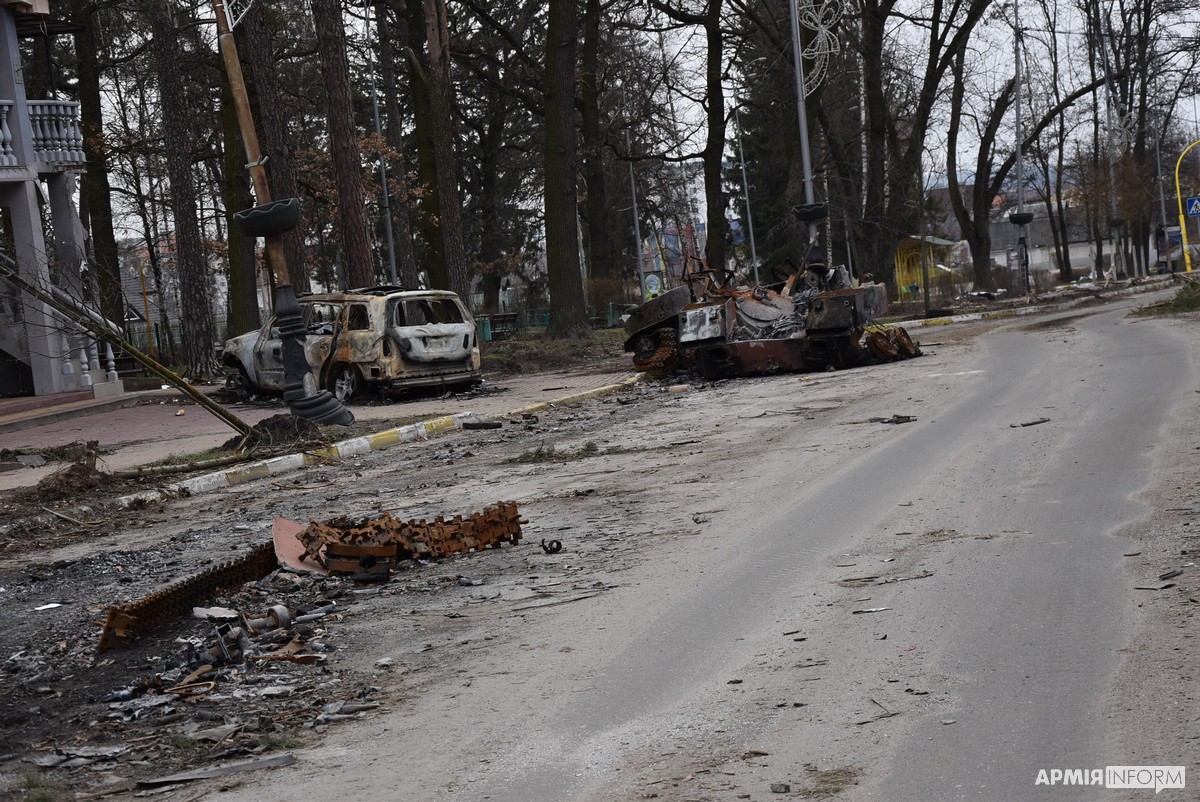
Context photograph
Street damage after the occupation
Burnt vehicles and debris on a street in Bucha, in the ArmyInform report published on 6 April 2022. This photograph documents visible damage. It does not show AFP point 5 or establish when the bodies appeared on Yablunska Street.
ArmyInform / Vitalii Sarantsev, Roman Drapak · News agency of Ukraine’s Ministry of Defence · CC BY-NC-ND 4.0 · Publisher’s file, unchanged. [15]
Separate cases at Yaremchuka and No. 144
At Yaremchuka, OHCHR §103(c) reports that Russian soldiers shot three bound men around 10:00 on 10 March and their bodies remained until April. Witness accounts and a recording of the moments before the shooting support that case. The published report can be consulted, while the underlying interviews and restricted footage were unavailable in the dossiers. No satellite marker in this report is assigned to those men. [8]
At No. 144, the NYT investigation reports CCTV and a resident’s recording of captives being led to the site on 4 March. It dates a separate drone view of bodies beside the building to 5 March. Dossier A describes a bright blue garment visible in both sequences as one additional link. Survivor and neighbour testimony and an April courtyard photograph provide other material. The UN Commission partly draws on media work and adds testimony and crime-scene material. HRW records a separate witness’s April observation at the site. This chain supports case-specific findings at the courtyard. Responsibility reported for this case cannot be assigned to every public-road body by a satellite match. [27] [9] [14] [28]
Open matches and evidence that could change the assessment
For the claim that no resident was harmed during Russian control, the OHCHR and No. 144 case records supply specific contrary evidence. The Russian mission’s clearance and armband allegations do not show the matched bodies being put there. Ukrainian official statements attribute killings to Russian troops. The case files can substantiate such attribution for particular deaths, while the street-wide claim requires additional person-by-person evidence. [8] [27] [9] [2] [3] [7]
The northeast group is documented in April, but HRW’s eyewitness accounts and recordings do not establish a March match for that group as a whole. Dossier B treats the point beside two abandoned cars as provisional. The 20–21 March appearance window rests on one published NYT analysis that it could not reproduce. That point should not be conflated with AFP’s damaged-car match. Counts from different stretches and dates can overlap. [14] [25] [26] [20] [29]
Dossier B reports that earlier Maxar views, including the 9–11 March sequence discussed by NYT and BBC, were not available to it as a native series. The published 11 March reference is less clear than 19 March and does not independently establish the early count. To change the proposed assessment for a matched point, a new record would need to address the same place and time. Examples are a native scene with traceable acquisition metadata, a higher-resolution and convincingly dated view showing an unobstructed empty location, or an original ground recording with authenticated timing and a demonstrably different match. Local withdrawal records could refine the sequence for a particular block. Identity, cause of death and responsibility would require evidence tied to a person or case, such as recovery records or independently corroborated testimony. [19] [24] [25] [8] [29]
Bucha in photographs
Context photograph
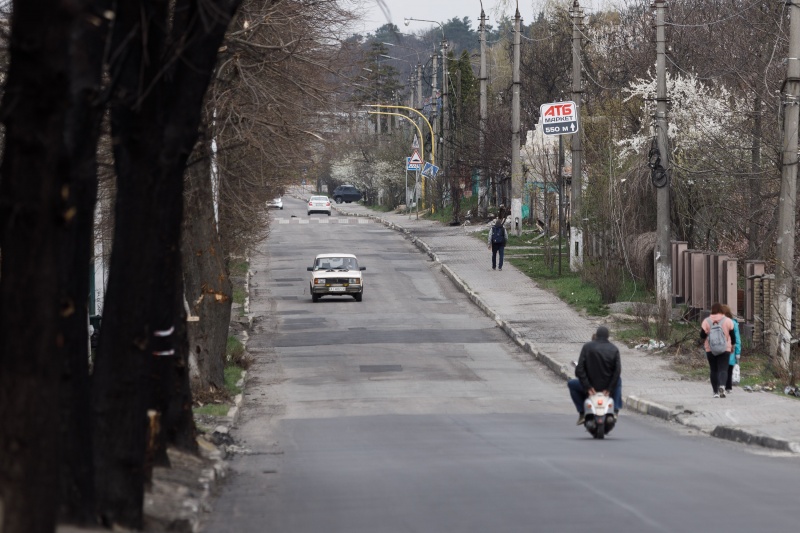
Vokzalna Street
Cars and pedestrians on Vokzalna Street in the follow-up published by RBC-Ukraine on 26 April 2022. The photograph documents the street after the withdrawal. The exact shooting date is unconfirmed.
RBC-Ukraine / Vitalii Nosach · CC BY 4.0 · Publisher’s file, unchanged. [16]
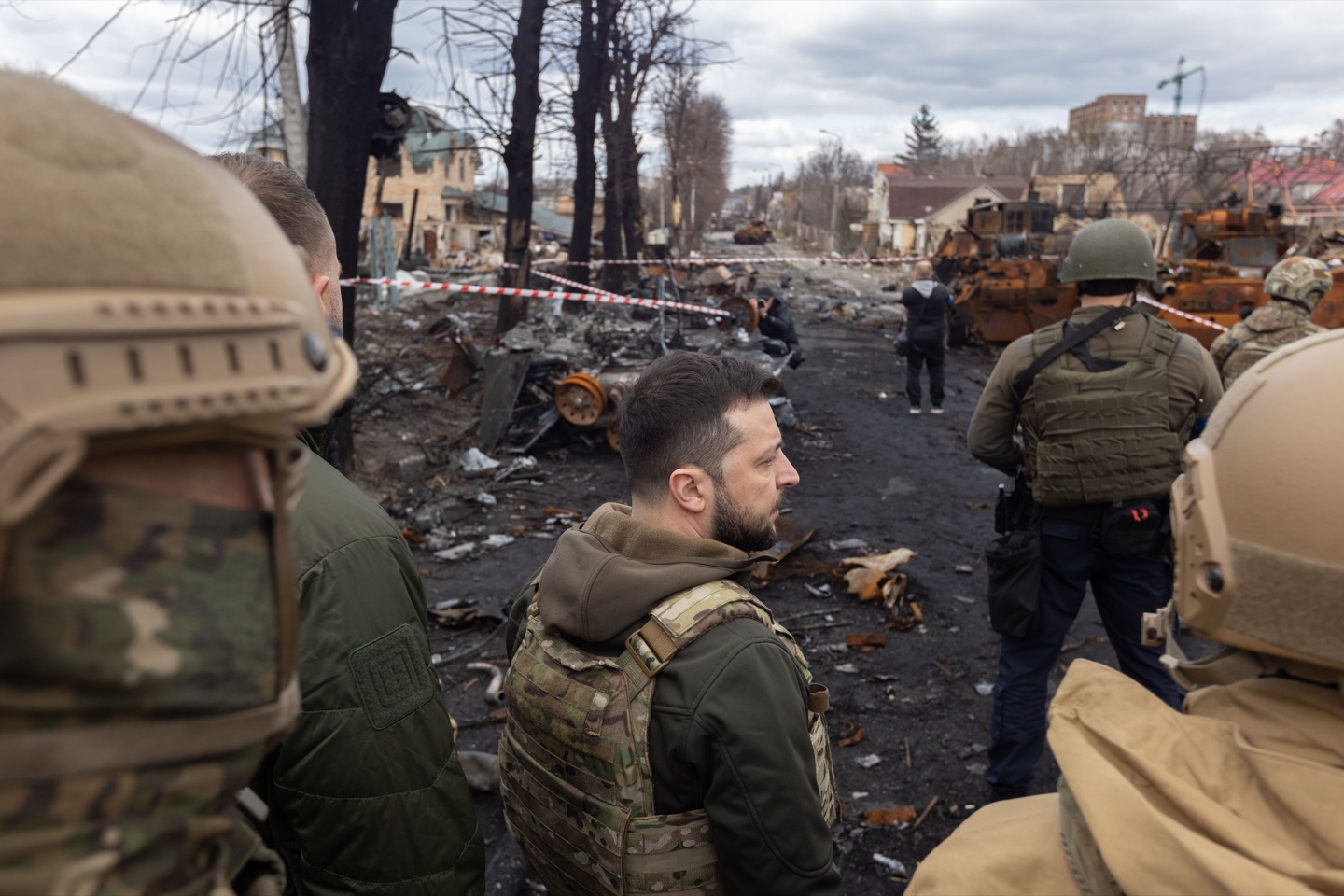
Presidential visit
Bucha, 4 April 2022, during Volodymyr Zelenskyy’s visit. Context photograph, separate from the Yablunska Street comparison.
Oleksandr Ratushniak · CC BY-SA 4.0 · Resized, uncropped. [17]
Source register
The numbered references lead to documents, original publications, media, licences and attributed analyses. The dossier notes describe how the materials were accessed and what they substantiate. Some links contain images of people who died.
-
Russian Defence Ministry
- A · Provenance and access
- Russian Defence Ministry statement in its Telegram channel. The dossiers use the channel material to attribute the statement.
- B · Evidentiary value, limits and dependencies
- Attribution only. Establishes the ministry’s position. The statement supplies no independently authenticated evidence for staging at the matched positions.
-
Russian UN Mission
- A · Provenance and access
- The mission’s official English version of its Security Council remarks. The UN record documents the same meeting.
- B · Evidentiary value, limits and dependencies
- Attribution only. Records the claim about the date evidence appeared and the references to clearance and armbands. These do not explain the earlier matched positions.
-
Letter to the Security Council S/2022/286
- A · Provenance and access
- Russian Permanent Mission letter, published by the UN. Dossier A records consultation of the official English document and Russian translation.
- B · Evidentiary value, limits and dependencies
- Attribution only. Documents the mission’s allegation about Ukrainian killings. The letter gives no body-specific evidence for the matched positions.
-
Mayor’s statement
- A · Provenance and access
- Secondary source. Ukrainska Pravda’s contemporaneous report relays Mayor Fedoruk’s statement. Dossier A records use of contemporary transcripts because the original municipal video was blocked.
- B · Evidentiary value, limits and dependencies
- Supports the mayor’s wording about the 31 March town-wide milestone. Transcripts report the same statement. The last departure from specific blocks is unresolved.
-
Earlier municipal warning
- A · Provenance and access
- Secondary source. Ukrainska Pravda’s contemporaneous report relays the council secretary’s warning about a partial pullout. This is the newspaper report linked by the Word master.
- B · Evidentiary value, limits and dependencies
- Attribution only. Records a warning of possible remaining personnel. It does not establish their location or the last departure from a particular block.
-
National Police of Ukraine
- A · Provenance and access
- Official police release. Dossier A records consultation of the original Ukrainian text.
- B · Evidentiary value, limits and dependencies
- Establishes the announcement and stated purpose of the clearance operation. It supplies no link between the operation and the deaths at the matched positions.
-
President of Ukraine
- A · Provenance and access
- Official presidential address linked in the English master.
- B · Evidentiary value, limits and dependencies
- Attribution only. Records the president’s account and attribution. The address does not provide a separate observation at each matched position.
-
UN Human Rights Office
- A · Provenance and access
- OHCHR report, §103(c) and §103(e). Dossier A records inspection of the report. The underlying restricted footage was unavailable.
- B · Evidentiary value, limits and dependencies
- Case-specific findings at Yaremchuka and evidence of soldiers in a Yablunska yard on 29 March. They do not identify the people at the satellite markers or fix control of each block.
-
UN Commission findings
- A · Provenance and access
- Commission findings reproduced in the ECHR-hosted annex. Dossier A records consultation of the annex quoting §§323–328.
- B · Evidentiary value, limits and dependencies
- Adds corroboration at No. 144 where based on its own witness testimony or supplied scene material. The dossiers identify partial overlap with media investigations.
-
AFP · on-the-ground report
Sensitive material: images of people who died.
-
Meduza
- A · Provenance and access
- English edition of Meduza’s report. A group fighting on Ukraine’s side supplied the drone footage. Dossier A examined the distributed files and their editable creation tags. Original drone controller logs were unavailable. Meduza links to the public video.zip archive on Google Drive from its own report.
- B · Evidentiary value, limits and dependencies
- The drone supplies a viewpoint separate from the satellite images. Meduza reports 23–30 March from the metadata and gives 26 March as the latest possible date for the first footage showing bodies. Dossier A notes tension between the file labels and earlier dates suggested by the shadow models. The exact day remains unauthenticated.
Meduza · EN · Meduza · RU · Watch on YouTube · Open Meduza’s source archive
-
Ilya Novikov · MP4
Direct MP4 · file supplied by Novikov and hosted by Provereno.Media. Its creation tag does not authenticate the filming time.
Sensitive material: images of people who died.
-
Maxar Technologies · SatNews
SatNews republishes four Maxar panels of Yablunska Street. The fourth shows the street from a rotated view. The panels are credited © 2022 Maxar Technologies. Permission to reproduce them in this article was not verified.
-
Human Rights Watch
-
ArmyInform / Vitalii Sarantsev, Roman Drapak
News agency of Ukraine’s Ministry of Defence
Portrait published by ArmyInform on 6 April 2022. The source identifies Anatolii Fedoruk. The portrait accompanies his account of conditions in the city after the withdrawal.
Burnt vehicles and debris on a street in Bucha, in the ArmyInform report published on 6 April 2022. This photograph documents visible damage. It does not show AFP point 5 or establish when the bodies appeared on Yablunska Street.
-
RBC-Ukraine / Vitalii Nosach
Cars and pedestrians on Vokzalna Street in the follow-up published by RBC-Ukraine on 26 April 2022. The photograph documents the street after the withdrawal. The exact shooting date is unconfirmed.
-
Oleksandr Ratushniak
Bucha, 4 April 2022, during Volodymyr Zelenskyy’s visit. Context photograph, separate from the Yablunska Street comparison.
-
Oleksandr Ratushniak
Oleksandr Ratushniak’s photograph, titled Bucha after Russian invasion of Ukraine and dated 30 March 2022 by the author. It shows a man carrying a dog on a road strewn with debris. The exact location is unconfirmed.
-
Centre for Information Resilience
- A · Provenance and access
- CIR report, pp. 7–10. CIR credits its published reproductions to Maxar (19 March 2022) and Planet (21 March 2022). Dossier A records inspection of those reproductions. Dossier B did not examine the CIR reproduction. It remains unclear whether the Maxar image dated 21 March cited by AFP/France 24 is the same scene that CIR credits to Planet.
- B · Evidentiary value, limits and dependencies
- The two reported acquisitions support the alignment of several positions. Neither dossier had access to the native scenes. Comparisons by BBC, NYT and Sky reuse the 19 March Maxar scene.
CIR · 6–7 · CIR · 8 (Maxar) · CIR · 9 (Planet) · CIR · 14–19
-
AFP Fact Check
- A · Provenance and access
- AFP fact check, with its own 2–3 April ground reporting and photos. Dossier A records inspection of the account and photo reproductions.
- B · Evidentiary value, limits and dependencies
- Point 5 aligns ground features with the 19 March image. AFP's ground reporting is a separate observation. The satellite input is the same Maxar acquisition used in other analyses.
-
Sky News
- A · Provenance and access
- Sky News road comparisons. Dossier A records consultation of the Sky News article and inspection of the published comparison figures.
- B · Evidentiary value, limits and dependencies
- Supports the comparison at specific positions using the shared Maxar acquisition. Shadows prevent two matches in one roundabout frame.
-
Bellingcat
- A · Provenance and access
- Bellingcat’s account of a Telegram upload. Dossier A records inspection of the original article and comparison still. The underlying MP4 was not recovered there.
- B · Evidentiary value, limits and dependencies
- Documents reported circulation by 20:18 on 1 April. Upload and capture times are distinct. AFP’s observations on 2 April are separate.
-
Provereno.Media
- A · Provenance and access
- Original analysis and embedded longer Novikov convoy recording. Dossier A records inspection of frames and the distributed MP4’s creation tag.
- B · Evidentiary value, limits and dependencies
- Supports frame and landmark checks. The creation tag alone cannot authenticate filming time. This recording is distinct from the documented 1 April upload.
-
BBC Reality Check
- A · Provenance and access
- Third-party mirror at bbcinsight.pages.dev. Dossier A records consultation of that copy of the BBC article. Its accessible comparison graphic uses the scene dated 19 March by Maxar. The link now points to the equivalent BBC version, first published on 5 April and updated on 11 April 2022.
- B · Evidentiary value, limits and dependencies
- The article reports a less clear image dated 11 March. Dossier A records that the underlying early March series was unavailable for direct review. BBC’s comparison of the 19 March scene shares the Maxar acquisition used by NYT and Sky.
-
The New York Times
-
Ukrinform · The New York Times
Satellite images show Bucha killings occurred during Russian occupation
-
New York Times, May investigation
- A · Provenance and access
- Third-party mirror at unvis.it of the New York Times investigation. Dossier A records consultation of the reproduction. Access to the mirror does not establish direct inspection of the underlying CCTV and drone originals. The publisher’s page could not be verified for this update.
- B · Evidentiary value, limits and dependencies
- Case-specific material for No. 144, including CCTV, drone footage and witnesses. It should not be generalized to other bodies in the satellite comparison.
-
Dossier A · Yablunska
Internal working dossier. The sources available to readers are listed in this register.
-
Dossier B · Yablunska chronology
Internal working dossier. The sources available to readers are listed in this register.

