Gaza, the genocide allegation beyond the images: evidence, objections and courts
What do open shops and ruins prove? We examine the genocide allegation in Gaza, Israeli responses and the status of international proceedings.
Documentary research, not on-site reporting
In brief
An open shop is not enough to rule out genocide; a destroyed neighbourhood cannot, on its own, prove it. Images must be placed in space and time.
Investigative findings characterise the conduct as genocide, and Israel disputes those findings. The author, method and period of each assessment matter.
The International Court of Justice case file checked on 16 November 2026 contains no final judgment on the merits. That does not amount to an acquittal.
The essential questions
Must 100% of Gaza be destroyed for genocide to occur?
No. The definition requires at least one of the acts specified in the Convention and intent to destroy a protected group, in whole or in part, as such. Not a percentage of destroyed buildings. [1]
Has the Court already issued a final judgment in this case?
If there is no judgment, has the allegation been rejected?
No. Proceedings without a final decision amount neither to an acquittal nor to confirmation of every allegation. [2]
Are the ICJ and ICC the same court?
Can footage of people shopping refute the allegation?
Not on its own. If authentic, it can document that scene, but it does not establish conditions for the entire population or the intent behind the alleged conduct.
What does Israel dispute in the Commission’s report?
The official response criticises its mandate, impartiality and selection of sources, invoking Hamas and military objectives. This is the position of an interested party. [7]
Why not use a photograph of ruins as definitive proof?
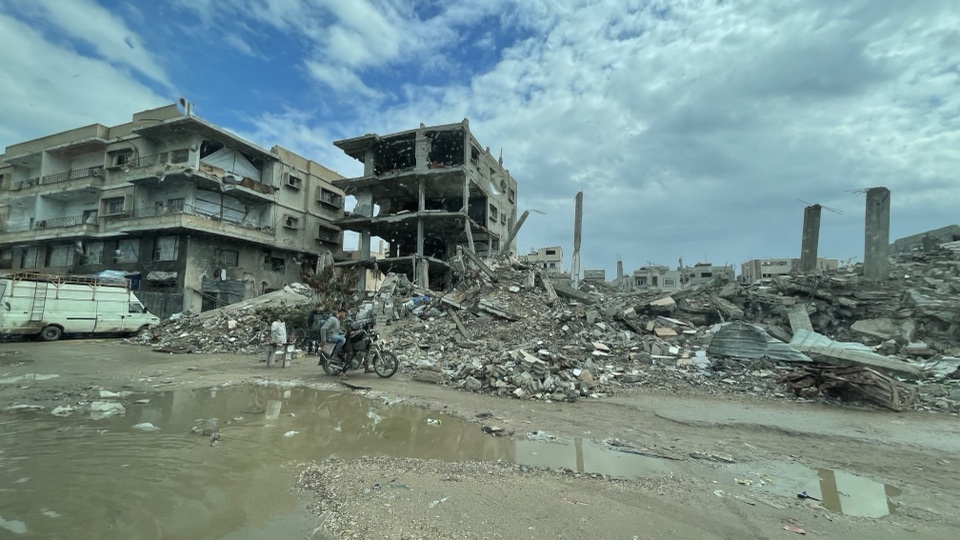
It may document damage, but further evidence is needed to attribute it, reconstruct the circumstances and demonstrate intent. A caption cannot fill those gaps.
A supermarket does not erase a destroyed street
A stocked supermarket and a street reduced to rubble can exist in the same territory. The images are not necessarily incompatible. Yet in the debate on Gaza, they are often set against one another as though one should cancel out the other: the shop supposedly shows that the catastrophe is exaggerated; the ruins supposedly make any scene of everyday life irrelevant. This shortcut prevents us from understanding both the photographs and the larger issue to which they are attached.
This article grew out of our investigation into open businesses and the distribution of destruction in Gaza. Here, the question changes. We are not asking how much territory appears damaged in a shot, but what evidence supports the genocide allegation, what is disputed and what decisions have actually been made. Linking the two articles is useful precisely because it identifies the moment when an observable fact becomes a much broader assertion.
An authentic video might document people buying products on a particular afternoon. It would not automatically tell us how many other people can reach that shop, at what prices, how consistently or under what conditions. Similarly, footage of a destroyed building does not by itself identify who was responsible, the target of the attack or the intention behind it. This does not make images useless: it means asking them to establish only what they can demonstrate.
What must be proved
Article II of the Convention, reproduced in the ICJ order of 26 January 2024, requires at least one of the specified acts against a national, ethnic, racial or religious group, accompanied by the intent to destroy it, in whole or in part, as such. These acts include killings, serious bodily or mental harm, conditions of life aimed at physical destruction, measures intended to prevent births and forcible transfers of children. It does not define the crime through a percentage of destroyed buildings. [1]
In the UN Commission of Inquiry’s September 2025 report, intent is examined through both statements and the overall pattern of conduct. The Commission also discusses alternative military explanations: its conclusion is that genocidal intent is the only reasonable inference from the evidence assessed. This is that body’s reasoning, distinct from a judicial decision. [4]
For readers, the important distinction is between the existence of harm and its legal explanation. A serious account must address both steps. There is no need to choose a label in advance to acknowledge victims’ suffering; acknowledging that suffering is not enough to settle every evidentiary question. Reducing everything to the final label risks obscuring the very people and facts that should be at the centre of the investigation.
What the Court has decided, and what it has not
In its order of 26 January 2024, the International Court of Justice considers some of the rights invoked plausible, including protection of Palestinians in Gaza from acts prohibited by the Convention. It orders provisional measures, assessing urgency and the risk of irreparable harm. It specifies, however, that at that stage it is not determining whether violations have occurred. Presenting the order as a final judgment against Israel changes the meaning of the decision. [1]
The official case file consulted on 16 November 2026 contains no final judgment on the merits. Among recent developments, it lists the withdrawal of Colombia’s intervention, announced on 22 September 2026. The docket is the source used to describe the case’s status, rather than a commentary article published months earlier. [2]
The order of 21 May 2026 records the filing of South Africa’s Memorial and Israel’s Counter-Memorial. It orders a further written exchange: South Africa’s Reply by 22 November 2027 and Israel’s Rejoinder by 22 May 2029. These are procedural deadlines, not indications of the outcome. [3]
The opposite statement, “there is no judgment against Israel, so the allegation is false”, also makes a logical leap. The absence of a final outcome in the file cannot be turned into that outcome. Equally, a future decision must be read for what it actually establishes, without automatically attributing answers to every assertion circulated during the war.
ICJ and ICC: two courts, two different questions
The South Africa v. Israel case before the International Court of Justice, or ICJ, concerns a dispute between states under the Convention. It is not a criminal trial of an individual defendant. The International Criminal Court, or ICC, has jurisdiction over natural persons: Article 25 of the Rome Statute expressly distinguishes this individual responsibility from state responsibility. [2] [10]
An act of one court must therefore not be attributed to the other. This article does not reconstruct the current status of individual ICC proceedings: the documentary checks completed here concern the interstate case and the reports identified. This distinction defines the scope of the work; it does not deny the existence of other proceedings.
The UN Commission: a specific investigative conclusion
Document A/HRC/60/CRP.3 of 16 September 2025 examines the period from 7 October 2023 to 31 July 2025. Applying the reasonable-grounds-to-conclude standard, the Commission identifies four categories: killings, serious bodily or mental harm, the imposition of destructive conditions of life and measures intended to prevent births. It examines state responsibility, not the criminal guilt of individual defendants. [4]
The conclusion belongs to this investigative Commission. It is neither an ICJ judgment nor an independent verdict by SINE VELO; nor, however, can it be removed from the documentary record simply because it is not judicial.
Amnesty and Human Rights Watch are not a single voice
Amnesty International concludes that genocide has occurred in its report published on 5 December 2024. It describes research involving interviews with 212 people and an analysis of conduct and statements. In its discussion of state intent, it disputes a reading of case law that would rule out military objectives and genocidal intent coexisting. This is a substantive part of its argument, not a detail to conceal behind the report’s title. [5]
For example, Amnesty re-examines 15 air strikes between October 2023 and April 2024, in which at least 334 people were killed, including 141 children. The organisation concludes that the victims were civilians and characterises the attacks as directed at civilians or indiscriminate: these are the report’s conclusions, not independent findings by this article (pp. 106 and 111). [5]
Human Rights Watch, by contrast, focuses its document of 19 December 2024 on water deprivation. Its research combines testimony, information from operational organisations and infrastructure data; it discusses extermination and acts of genocide, and the inference of intent. Automatically attributing every Amnesty conclusion to it would make the account less accurate. [6]
HRW compares satellite imagery and photographs of the central Gaza wastewater treatment plant: it describes damage to solar panels in October 2023 and the destruction of those remaining in November. This illustrates the report’s evidentiary process; the underlying satellite images have not been independently rechecked here (pp. 68–70). [6]
Agreement between organisations should not be counted as a vote. Two dossiers may be robust but use, in some passages, the same testimony or dataset. Understanding how much they reinforce one another requires tracing the information. A figure repeated five times does not become five independent observations. This is also why the documents remain separate in the final source list.
Israel’s position and the objections to examine
In its official response to the Commission on 16 September 2025, Israel’s mission in Geneva rejects the findings and challenges impartiality, mandate and selection of sources. It invokes Hamas’s role, military objectives and measures to reduce civilian harm. The page documents Israel’s defence; it does not, on its own, independently verify each assertion. [7]
Another objection appears in an analysis published by the BESA Center on 2 September 2025. Its authors present it as a historical-statistical review, not a legal or ethical judgment. The page also describes a chapter on the distribution of casualties as a speculative scenario. We do not adopt its quantitative estimates here: noting it distinguishes criticism of data from a judicial conclusion. [8]
Listening to the defence means comparing it with specific allegations, not merely quoting a denial. If the dispute concerns a number, definitions and periods must be compared. If it concerns an episode, chronology and documents are needed. If it concerns a statement, the original context is necessary. Giving two positions the same visual space does not automatically make their evidentiary foundations equivalent; denying space to a relevant response does not improve verification.
A translated statement can change the argument
On 25 December 2023, the IDF published a clarification of Daniel Hagari’s statement of 10 October: it maintains that the reference to damage concerned Hamas’s military capabilities and disputes a translation from Hebrew. This is a subsequent explanation from the same interested party. Without the full recording and independent linguistic review, we treat it neither as a definitive rebuttal nor as conclusive evidence of the opposite intent. [9]
The problem also concerns how readers receive these statements. A clip may lose the preceding question, its referent or the distinction between a personal statement and an operational instruction. This does not absolve a statement: it allows its meaning to be correctly attributed. A fact-check should be able to correct itself when faced with complete footage, without having to defend its first interpretation at all costs.
What photographs and videos can actually add
Different images can answer different questions. A recognisable sequence of a street may help locate a business; photographs of the same building at different times may document its transformation. Comparing them requires compatible dates. Combining a recent reopening with a description from months earlier may create a contradiction that does not exist.
In our linked article on shops, the subject is the scene shown and how representative it is. Here, the subject is the meaning attached to that scene in reasoning about genocide. This second article does not use the first as legal proof: it refers to it to show why visual verification and legal characterisation are not the same exercise.
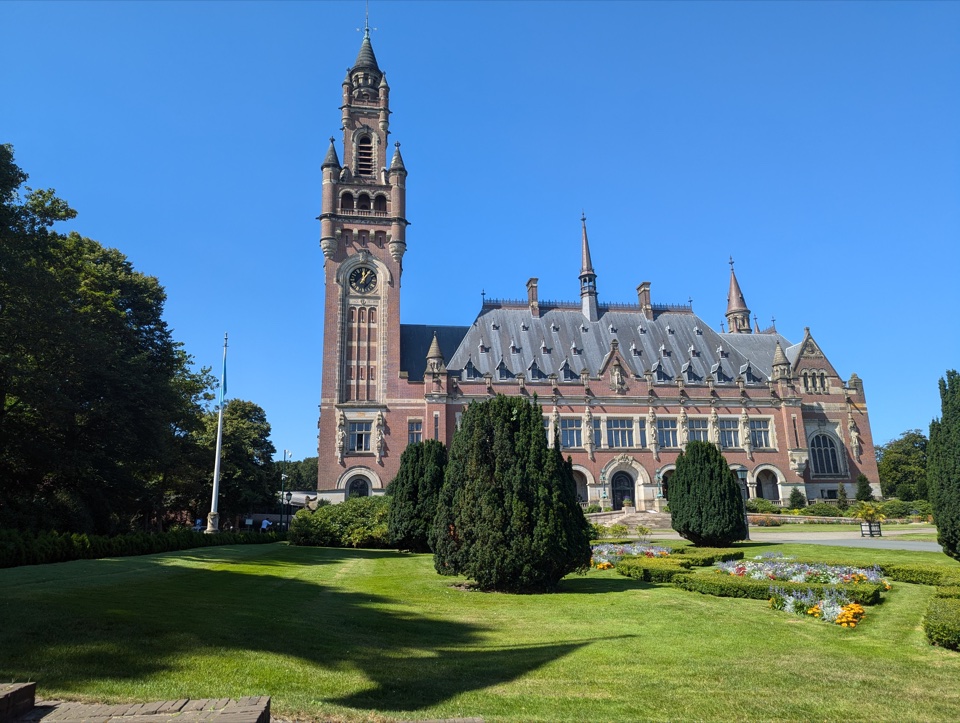
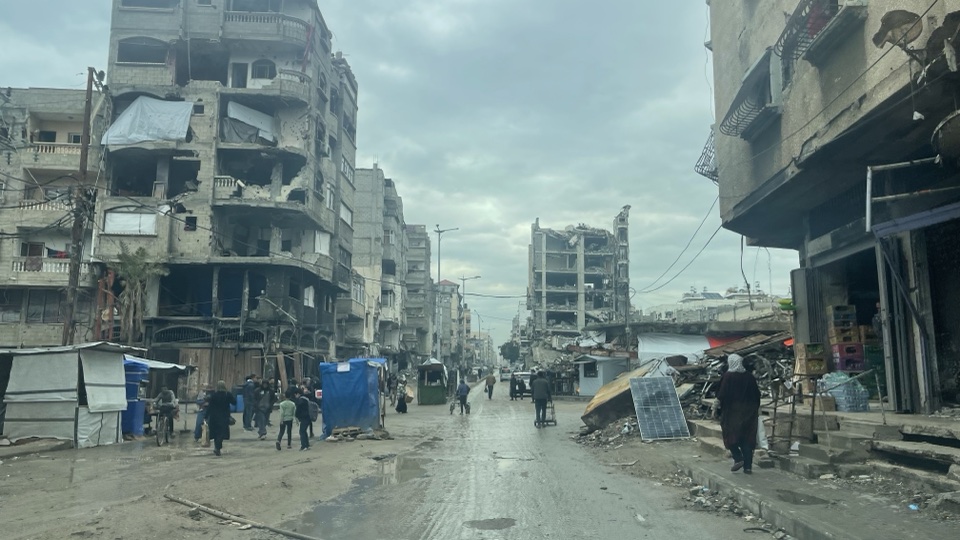
A contextual photograph must therefore be presented as such. A view of Gaza does not prove the origin of a particular attack; a photograph of the Court helps identify the institutional setting, not the validity of the allegation. Clear captions allow useful images to be used without making them appear to witness something they did not document. Illustrative reconstructions must not replace evidence of the event.
The answer, without shortcuts
To the question “are open shops enough to rule out genocide?”, the answer is no: a local scene is being asked to resolve a different question. For the opposite question, “are ruins enough to prove it?”, the step concerning conduct and intent is still missing. These are not two half-truths to reconcile; they are two inferences to examine.
The result of this examination is a map of assertions, not a colour applied indiscriminately to the entire war. The traffic lights below concern specific propositions. Red means that an assertion is not supported in the terms in which it is made, not that every associated document is false. The organisations’ conclusions remain attributed, and the disputes remain identifiable.
Readers should not have to choose between believing every image and distrusting all of them. They should be able to understand who advances a conclusion, on what evidence and with what limitations. This is where the article on shops and this investigation meet: not to artificially diminish or amplify events, but to prevent a fragment from becoming a complete answer.
Claims put to the test
Red marks an unproven conclusion, not automatically a falsehood. Green applies only to the stated claim and scope.
An open shop rules out genocide.
Conclusion not demonstrated · A local scene does not settle the characterisation of the overall conduct.
Ruins alone prove genocide.
Conclusion not demonstrated · Visible damage does not by itself establish specific intent.
The UN Commission of Inquiry concluded that genocide had occurred in its September 2025 report.
Document confirmed · This is an attributed investigative conclusion, not a judgment. [4]
There is already a final ICJ judgment on the merits of this case.
Not found in the case file · None appears in the docket consulted on 16 November 2026. [2]
Sources and credits
- ICJ, order of 26 January 2024
Original text: definition and provisional measures; no final decision in this act.
- ICJ, South Africa v. Israel case file
Docket rechecked on 16 November 2026.
- ICJ, order of 21 May 2026
Original concerning deadlines for further written pleadings.
- UN Commission, A/HRC/60/CRP.3
Original preserved by Refworld: methodology and conclusions read.
- Amnesty International, report of 5 December 2024
Original; relevant methodological and legal passages checked.
- Human Rights Watch, Extermination and Acts of Genocide
Original of 19 December 2024 on water deprivation.
- Israeli mission in Geneva, response of 16 September 2025
Primary source for Israel’s position, not an independent finding.
- BESA, Debunking the Genocide Allegations
Authors’ page. No quantitative estimates from the report adopted.
- IDF, clarification of 25 December 2023
Primary source for a subsequent explanation; not an independent verification of the recording.
- Rome Statute, Article 25: individual criminal responsibility
Text published by the United Nations, Article 25 read. Used to distinguish individual criminal jurisdiction from state responsibility, not to describe the status of particular proceedings.
- CIRISORG, The Peace Palace, 7 August 2024
Original file page and photograph checked: CC BY-SA 4.0, unchanged file. Institutional context image, not a photograph of the hearing.
- Creative Commons Attribution–ShareAlike 4.0
Photograph licence: attribution and licence link; indication of changes and share-alike terms for any adaptations.
- Jaber Jehad Badwan, Gaza City, 23 February 2025
Archive photograph, CC BY-SA 4.0, unchanged file. Date, author, licence and image checked; not independent proof of the legal characterisation.
- Jaber Jehad Badwan, Khan Yunis, 20 February 2025
Archive photograph, CC BY-SA 4.0, unchanged file. Does not establish current conditions, responsibility for an attack or intent.


