
Dossier
Aid to Ukraine: where the money goes and where oversight falls short
In brief
An announcement of billions is not a bank transfer to Kyiv. An accounting anomaly is not yet fraud. But incomplete oversight is a documented problem, not a propaganda invention.
The question “where did the aid go?” seems to call for a single figure. A serious answer instead requires separating at least three questions: how much donors authorized, how much was actually transferred, and who received the final goods or payment. These are different stages. Confusing them can make money appear to have vanished when it was never intended to be paid to Ukraine’s government, or conceal real reporting weaknesses behind a very large total.
This dossier primarily examines public budget support through the World Bank and US oversight. It is not a comprehensive inventory of every European, American or private contribution. The figures have a date and a defined scope: they are not an up-to-date total of all wartime assistance.
Frequently asked questions
So is all aid monitored?
There are multiple layers of oversight, but the cited audits document limitations and delays. “Monitored” does not mean individually verified at every stage or free from risk.
How much money has been stolen overall?
These sources do not establish a general total. Adding suspicious amounts, duplicates, amounts under review and the value of aid would produce a misleading number.
Do duplicate payments prove organized fraud?
They prove an irregularity that needs to be reconstructed. Intent and responsibility require further investigation.
Why continue financing if there are gaps?
The political choice requires assessing objectives, results and risks. This dossier does not replace that decision: it identifies which checks remain necessary to make it on a documented basis.
What could change this analysis?
New audits, reconciliations, recoveries, judicial records and data on final beneficiaries. A reliable analysis must be updated both when wrongdoing emerges and when a concern receives a verifiable explanation.
1. Five stages that must not be confused
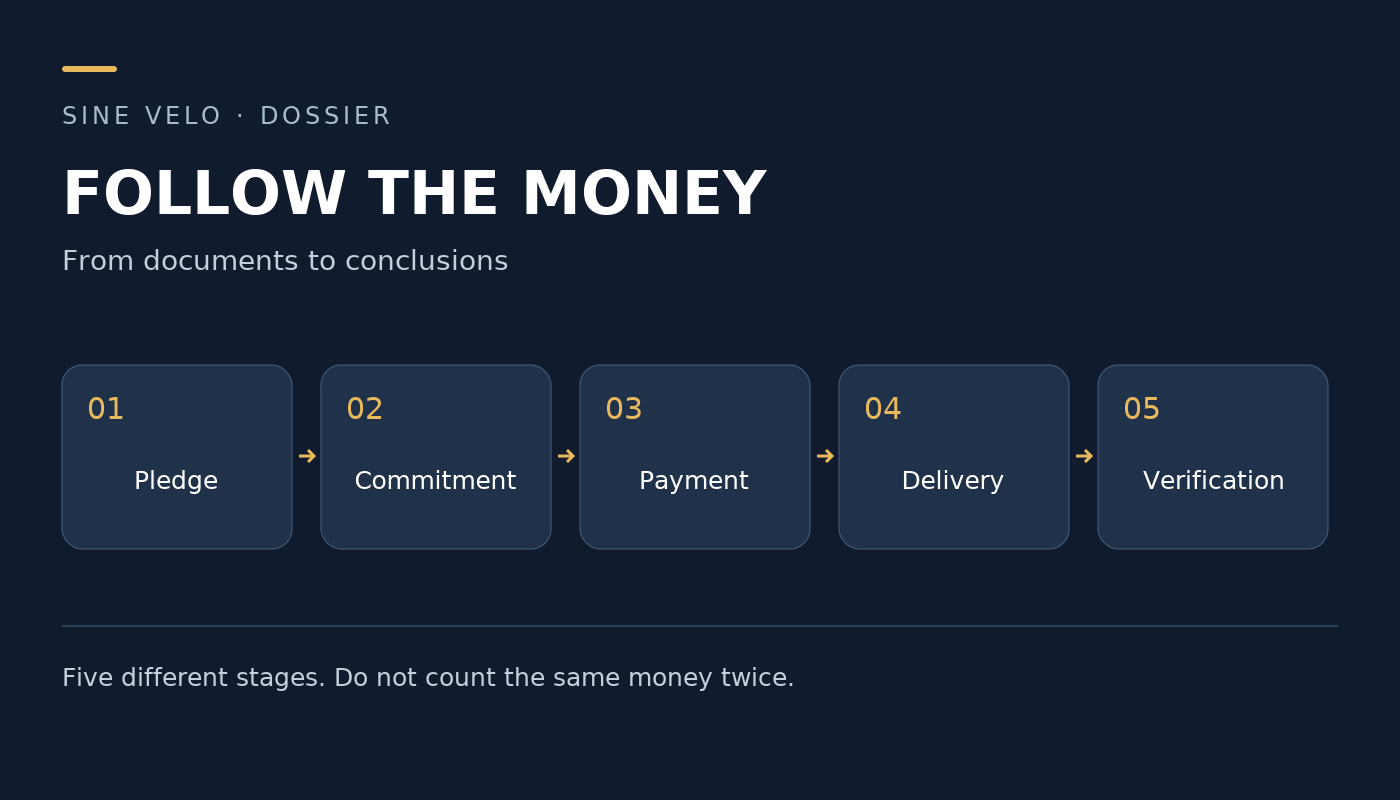
To follow funding, we propose a five-column record:
- Announcement: a political pledge, potentially subject to conditions.
- Appropriation and commitment: authorized resources and obligations undertaken.
- Disbursement: money paid to the organization administering the program, which may differ from the final recipient.
- Delivery or reimbursement: goods arrive or an eligible expense is reimbursed.
- Verified use: documentation and checks linking expenditure to its intended outcome.
This is an analytical framework, not an identical description of every program. A military supply and reimbursement of a teacher’s salary do not follow the same route. Before adding two figures, we must establish that they are not two stages through which the same money passed.
2. PEACE: what it finances and how it works
PEACE is a World Bank project supporting civilian state functions. The fact sheet dated September 25, 2025 lists salaries for civilian public employees, teachers, healthcare and emergency personnel, alongside transfers to vulnerable groups. It describes a reimbursement mechanism: the Ministry of Finance collects expenditure data, the Bank checks eligibility and reimburses it. Amounts found to be ineligible must be recovered.
The same fact sheet reports over $41 billion disbursed by the project, of which $32 billion was financed by the United States: a snapshot from September 2025, not today’s figure. The Bank cites independent audits without material findings, additional checks and channels for reporting fraud. This is the program administrator’s account and must be read alongside external oversight assessments, not instead of them. World Bank, PEACE fact sheet [1].
3. What the GAO criticized
The Government Accountability Office, the US congressional watchdog, published a critical review of budget support on September 24, 2025. USAID was not routinely using all the detailed data available. The GAO identified 161 anomalous increases among 5,121 expenditure changes analyzed and requested further examination: it did not automatically classify them as embezzlement.
The report also identified weaknesses in Ukrainian controls, with 56 recommendations issued by a contractor. Cancellation of an oversight contract in February 2025 and the transfer of functions to the State Department the following July reduced American oversight. The updated page keeps the GAO’s five recommendations open, reporting State Department responses from April 2026. The documented problem is therefore concrete and not fully resolved. GAO-25-107057 [2].
Journalistic scrutiny must ask what resulted from each flag: a satisfactory explanation, correction, reimbursement, recovery, penalty or investigation. Stopping at the word “anomaly” is insufficient, but erasing it because there is no conviction would be the opposite mistake.
4. Audit delays and duplicate payments
A USAID inspector general audit dated March 3, 2026 makes the shortcomings more tangible. Almost a third of the oversight deliverables required from Deloitte arrived late. The six audits required from KPMG were not delivered by their deadlines, even after extensions.
The inspector general also established that duplicate payments to four displaced people had been reimbursed and that checks on beneficiaries who had moved abroad were incomplete. The sample was not statistically generalizable: it cannot be used to calculate the share of the entire program affected by irregularities. The overall amount of ineligible payments remained to be determined. USAID OIG, audit 9-121-26-001-P [3].
These findings justify neither “there is no problem” nor “all the billions have vanished.” They justify precise questions: how many payments have been reconciled, how much has been recovered, and which controls prevent the weakness from recurring?
5. Why two watchdogs can reach different assessments
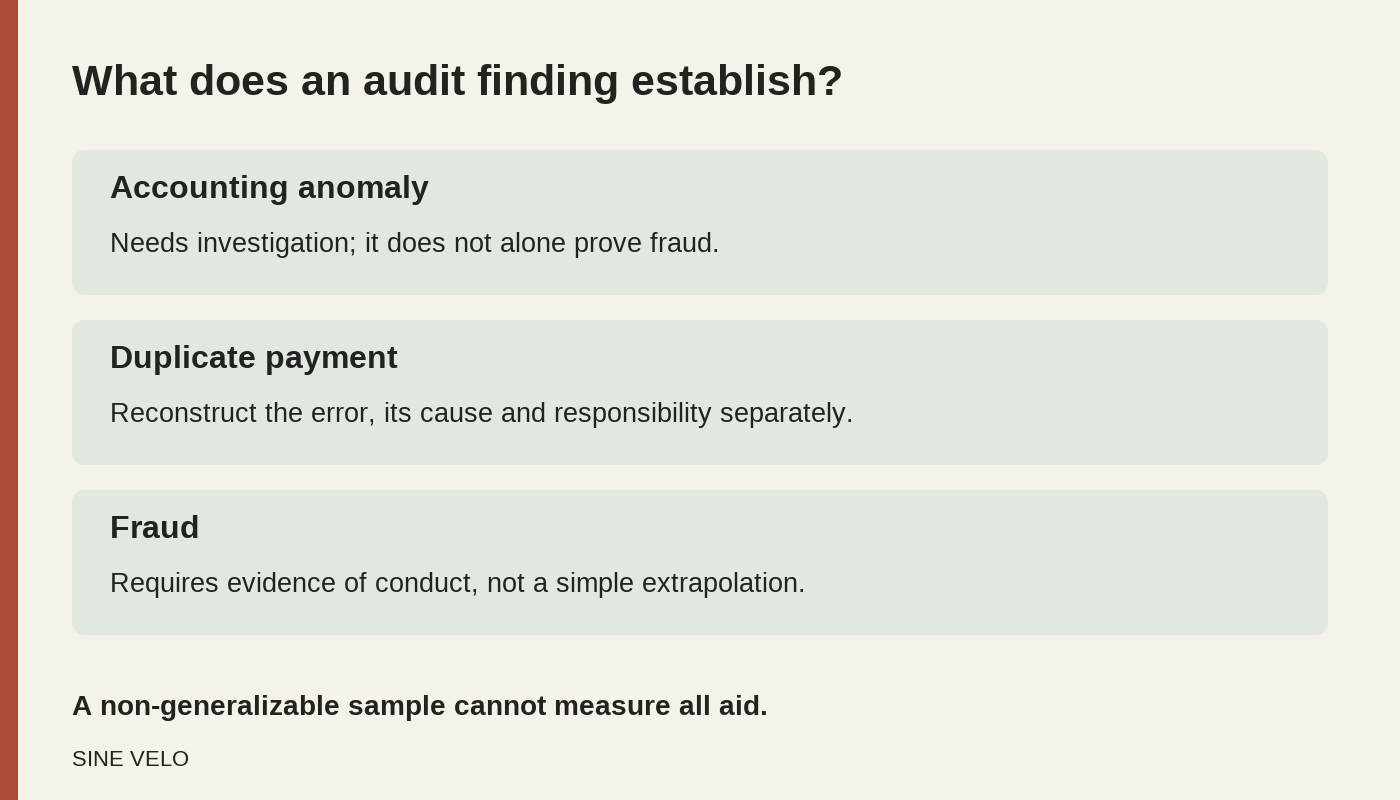
An audit of financial statements, a review of individual beneficiaries’ eligibility and a criminal investigation look for different things. A document can have consistent totals while still containing errors in the details. A system can have formally sound procedures but apply them late. An economic loss can result from error, negligence or deception: establishing criminal responsibility requires reconstructing the conduct too, not just the number.
This is why a broadly positive World Bank assessment does not automatically erase the shortcomings identified by inspectors. Nor does criticism of a control prove that every program expense is irregular. A proper review compares the objective, period, sample, documents and conclusions of each examination.
6. Weapons follow a different route
In March 2024, the GAO also described problems tracking military articles: some deliveries were recorded while equipment was still in transit; some data were incomplete, and some checks relied on Ukrainian self-reporting. The recommendations page shows subsequent corrective measures: four are listed as implemented and four as still open in the version consulted.
This is a useful example of how the picture changes. It is untenable to claim that nothing has improved since 2024, but equally untenable to claim that every gap has been closed. And a problem recording a delivery does not, by itself, prove a black-market sale. GAO-24-106289, report and recommendation status [4].
7. Money is fungible: a legitimate question, not a shortcut
One may argue that financing civilian services allows a government to allocate other resources to defense. That is an economic question distinct from an allegation that a specific reimbursement was stolen. The former concerns the effect on the overall budget; the latter requires a concrete documentary trail.
Likewise, discovering bribes at a state-owned company does not automatically prove that those bribes came from the PEACE program. Establishing that requires contracts, accounts, transfers and beneficiaries. The fact that aid receipts and a scandal occurred at the same time cannot substitute for the link.
8. How to read the next headline about “missing billions”
Before accepting it, ask:
- Is the amount pledged, committed, disbursed or actually spent?
- Is it money transferred to Ukraine or a cost borne by the donor?
- Is the period the same as the one used for comparison?
- Does it refer to unaccounted-for amounts, ineligible expenses, estimated losses or proven theft?
- Is it a sample, a national estimate or a single investigation?
- Are recoveries, corrections and subsequent judicial decisions stated?
Demanding transparency does not require inflating the numbers. It becomes stronger when it specifies where a document is missing and who must produce it.
Claims and limits of the evidence
A indicates provenance; B indicates content and limitations. They are not two independent checks. Green applies only to the narrowly defined proposition stated, not to innocence or guilt.
Documented distinction
The 161 anomalous increases identified by GAO do not amount to 161 established cases of fraud.
The report identifies increases requiring further examination among 5,121 changes analysed; it does not automatically classify them as embezzlement. [2]
Archive video: preparing the cargo
U.S. Air Force / DVIDS archive, Dover, 11 April 2022: preparation of military cargo bound for Ukraine, according to the official source. The footage documents a logistics stage, not final delivery or any trafficking to Africa.
Clicking connects your browser to DVIDS, an external service with its own terms and privacy policy. No external loading before the click; no autoplay.
Open video at the official source
Published April 14, 2022. An institutional source involved in the operation, not an independent investigation. The player was started and five visual samples checked; not a full viewing or listening review. Container contents were not independently identified by model or serial number.
Airman 1st Class Cydney Lee / U.S. Air Force / DVIDS · U.S. government work in the public domain, subject to DVIDS restrictions.
The appearance of U.S. Department of War (DoW) visual information does not imply or constitute DoW endorsement.
Sources
- World Bank, PEACE fact sheet
A · Provenance · World Bank factsheet dated 25 September 2025; a primary source from the administrator of the PEACE programme.
B · Content and limitations · It describes reimbursements, eligible categories, controls and more than $41 billion disbursed, including $32 billion financed by the United States. A dated snapshot, not the current total of all aid; the administrator’s assessment does not replace external audits.
- GAO-25-107057
A · Provenance · GAO report dated 24 September 2025 and the official recommendations page consulted for the dossier.
B · Content and limitations · It documents 161 anomalous increases among 5,121 changes, weaknesses in controls and reduced oversight. In the version consulted, the five recommendations remain open, with State Department responses from April 2026. An anomaly does not automatically mean fraud.
- USAID OIG, audit 9-121-26-001-P
A · Provenance · USAID inspectorate audit 9-121-26-001-P, published on 3 March 2026; a primary oversight source.
B · Content and limitations · It describes delays involving Deloitte and KPMG, duplicate reimbursements to four displaced people and incomplete checks. The sample is not generalisable; these findings do not determine the overall amount of ineligible payments.
- GAO-24-106289, report and recommendation status
A · Provenance · GAO report from March 2024 and the subsequent official status of recommendations on military items.
B · Content and limitations · It describes problems with recording and verifying deliveries. On the page consulted, four recommendations are listed as implemented and four as open. An incomplete record does not prove a black-market sale; the military report does not measure irregularities in the civilian PEACE programme.