
Dossier
The Ukrainian army’s “golden eggs”: procurement, inflated prices and money to trace

In brief
The case has reached court. But “waste”, “suspected embezzlement” and “stolen Western aid” are not three interchangeable ways of describing the same thing.
In a war, feeding the army is as tangible a necessity as supplying it with ammunition. That is precisely why food contracts deserve scrutiny: large volumes, urgency, complex distribution and a service that cannot stop. The Ukrainian case nicknamed the “golden eggs” offers a way to move beyond symbolic images and ask how a tender can be manipulated even when the overall price looks normal.
It should not be confused with Midas, the investigation into alleged kickbacks in the energy sector. These are separate proceedings, involving different amounts, periods and mechanisms.
Frequently asked questions
Is this the same scandal as the “golden toilets”?
No. This concerns military food supplies. Midas concerns the energy sector. Mixing the case files and their amounts creates confusion.
Is the 733 million figure something invented on social media?
No: it is the prosecution’s assessment published by NABU, which cites an expert examination. It is not yet damage definitively established by a judgment.
Why not write that 1.5 billion was stolen?
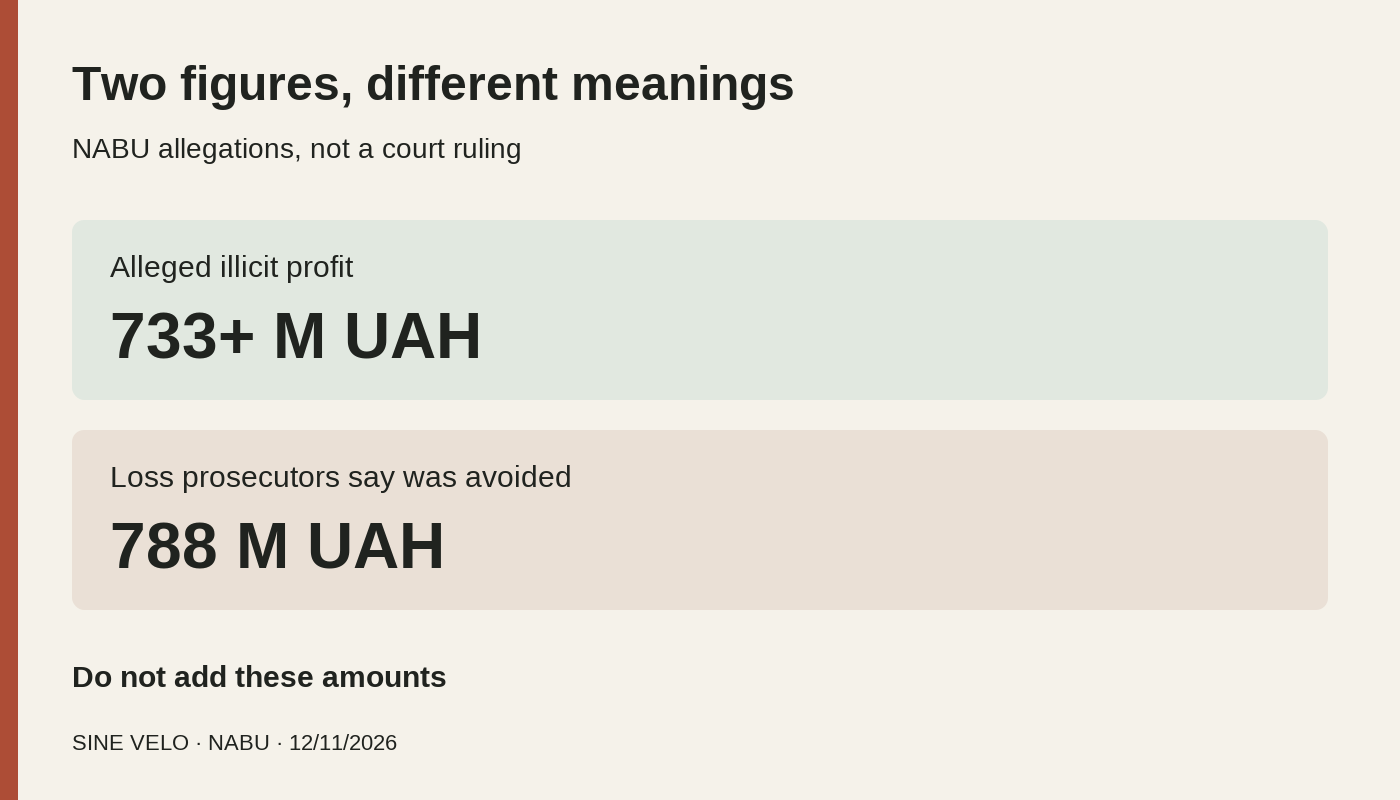
Because that would add the alleged illicit profit to a loss that investigators say was avoided. They are different categories.
Has the reform solved everything?
The announcement alone does not establish that. Results and contract performance need to be checked.
Was the press useless because investigators exist?
The official chronology acknowledges the effect of reporting alongside the investigation on the subsequent reduction in prices. Assessing criminal responsibility remains the task of the courts.
1. The legal position: what happened in November 2026
On 12 November 2026, NABU and the specialised prosecutor’s office SAPO announced that the military food supply case had been sent to court, following the completion of the investigation in September 2025. NABU, referral of the case to court [1].
This is a substantive step, not a final conviction. The existence of the proceedings can be verified; individual responsibility must be determined at trial. Describing the investigation’s allegations as allegations does not deny them: it places them at their actual procedural stage.

2. The mechanism: cheap on paper, expensive in the basket
According to the account published by NABU in April 2025, supplies were based on a catalogue of 409 products. The most frequently used items represented roughly one tenth of the range. The package price also took account of products rarely requested or unavailable in certain seasons.
Investigators allege that suppliers raised the prices of foods purchased in large quantities and lowered those of items almost never ordered. The catalogue’s apparent balance could thus conceal high costs for actual deliveries. The allegations also involve a ministry official who allegedly allowed the contracts to be concluded despite these anomalies. NABU, description of the scheme [2].
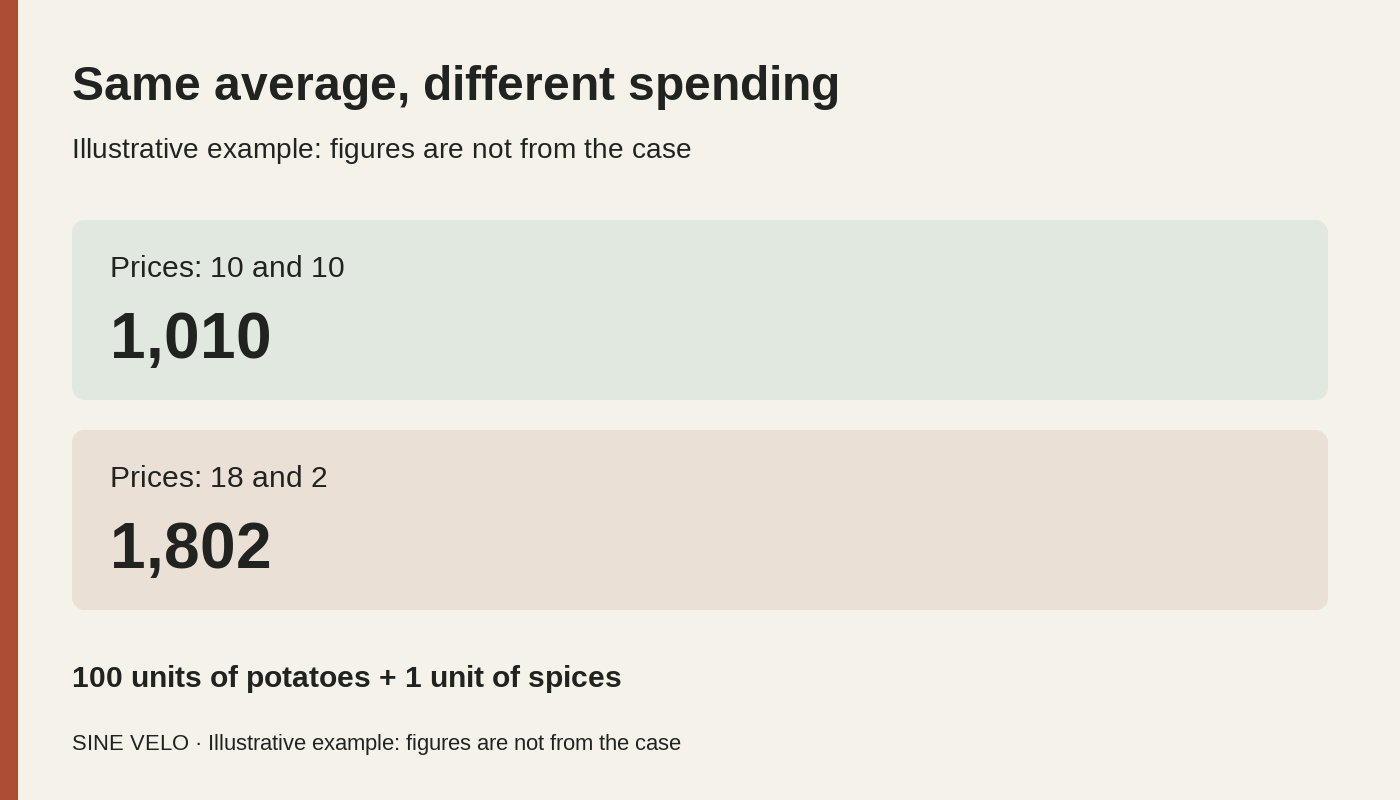
An illustrative example, not a real invoice
Imagine a catalogue with two products: potatoes priced at 10 and spices at 10. The average is 10. An offer with potatoes at 18 and spices at 2 maintains the same average. But if the kitchen buys one hundred units of potatoes and one of spices, spending rises from 1,010 to 1,802.
This example does not reconstruct the investigation’s accounts. It shows why assessing an offer using an average not weighted for actual purchases can produce a misleading result. Verifying the loss requires quantities delivered, prices, contractual conditions and an appropriate benchmark.
3. The figures: do not add alleged damage to avoided losses
The prosecution puts the alleged illicit profits of two companies between August and December 2022 at more than 733 million hryvnias. A figure of 788 million hryvnias also appears. This is not a second amount already stolen that should be added to the first. NABU describes it as money allegedly preserved after prices for eleven products were reduced, following the opening of the investigation and press reporting.
The same update identifies a financial trail: some of the money allegedly passed through dividends and financing to related companies, with possible property purchases, including hotels in Croatia. The circumstances of those acquisitions remain to be established. It is not accurate to turn this lead into a list of assets conclusively bought with stolen money. NABU, update of 12 November 2026 [1].
We retain the amounts in hryvnias: conversion to dollars would require specifying the exchange rate and date. A value converted at today’s rate is not necessarily the value of the original transaction.
4. Why the egg label is itself disputed
The public defence by the then minister, Oleksii Reznikov, was emphatic. On 23 January 2023, in a statement carried by ArmyInform, he argued that the egg figure resulted from an error in units of measurement, denied purchases at 17 hryvnias apiece and said the contract being discussed had not yet generated payments. He also pointed to the cost of a delivery service, rather than simply a supermarket product price. Reznikov’s January 2023 statement [3].
In a 2026 interview with Radio Svoboda, the former minister continued to challenge the symbolism of “eggs at 17”, principally acknowledging a communication problem of his own. This is his public position, not a judicial decision. Interview with Reznikov [4].
The important distinction is this: a dispute about one item in a contract for 2023 does not exhaust the allegations about a pricing system and supplies in 2022. Conversely, the journalistic nickname of the case does not justify personally attributing to Reznikov offences alleged against others. Establishing responsibility requires the documents concerning each individual.
5. When a high price is waste, and when it may be fraud
Comparing a military purchase price with a shelf price can raise an alarm, but it does not complete the investigation. The comparison must involve the same unit, quality, quantities and delivery obligations. Transport, storage and reliability of supply may be elements of the contract: it is necessary to establish which are included and how much they contribute.
For this analysis, we use operational distinctions:
- Inefficiency: the same result could be obtained using fewer resources.
- Waste: resources consumed without proportionate benefit, or on goods left unused.
- Irregularity: a breach of procedures or conditions whose nature needs to be established.
- Fraud or embezzlement: deceptive or unlawful conduct that must be demonstrated, not merely a synonym for a high price.
A trial can establish several elements together. But immediately calling every expensive purchase “theft” also obscures cases in which serious evidence of manipulation emerges.
6. What has changed in procurement
In May 2025, the Ministry of Defence presented a revision of the catalogue, which it then described as containing 360 items, proposing to reduce them to around 340. The statement explicitly recognised the risk of price manipulation associated with rarely consumed products. It was a proposal: it should not be presented as an automatically completed reduction. Ministry of Defence, catalogue proposal [5].
The ministry’s explanation of 16 November 2026 still lists 360 items, with updated descriptions, and describes the requirement, from that month, to process food documentation through DOT-Chain Food. The system connects requests, deliveries, acceptance documents, complaints and payments. This is a change reported by the administration, not independent proof that every supply is compliant. Ministry of Defence, supply arrangements in November 2026 [6].
Assessing the reform’s effectiveness requires results: comparable prices, competition, quality discrepancies, delays, penalties actually collected and recoveries. Digitising a procedure can make it more auditable; it does not by itself eliminate incentives and collusion.
7. Is this Western aid money?
The sources on the proceedings examined here concern public resources and Ministry of Defence procurement. They do not provide a documentary chain attributing the disputed sums to a specific Western donor.
The question remains legitimate, but requires additional documents: the budget source, any earmarked financing, the paying account, contract, beneficiary and subsequent transactions. A country receiving aid while incurring expenditure does not prove that every euro or hryvnia of the latter comes directly from the former.
Nor does the broader political question of whether aid frees up national resources for use elsewhere substitute for this evidence. The effect on the overall budget and tracing alleged misappropriation are two different levels of analysis.
8. The scrutiny that matters beyond the headline
Following the case requires more than counting arrests or repeating its nickname. Useful indicators are which charges go to trial, what the defence teams say, how the damage is calculated, which assets are seized, what sums are recovered and what the court ultimately establishes.
Procurement reform and a criminal investigation are not substitutes for one another. The former must reduce the system’s vulnerability; the latter must establish specific responsibility. Assessing both avoids either a premature acquittal or the collective guilt of an entire country.
Claims and limits of the evidence
A indicates provenance; B indicates content and limitations. They are not two independent checks. Green applies only to the narrowly defined proposition stated, not to innocence or guilt.
Documented procedural step
NABU and SAPO announced the referral of the food supply case to court on 12 November 2026.
The official statement documents the referral of the case to court, not a final conviction of those involved. [1]
Distinction documented in the allegations
733 million and 788 million hryvnias represent two different categories and must not be added together as money already stolen.
The first amount is the alleged illicit profit quantified by investigators; the second is the loss they say was avoided after prices were reduced. Responsibility remains to be determined at trial. [1] [2]
Link not established here
The amounts at issue came from a specific Western aid programme.
The sources examined in the proceedings describe procurement and public resources, but not a documentary chain from a particular donor to the disputed payment. This limitation does not prove the absence of any connection. [1] [2]
Sources
- NABU, update of 12 November 2026
A · Provenance · Official NABU/SAPO statement dated 12 November 2026; a primary source from the investigators.
B · Content and limitations · It documents the referral to court and reports amounts and alleged financial pathways. Property acquisitions, including hotels in Croatia, remain lines of inquiry to be established; the statement is not a judgment and does not in itself document misappropriated Western aid.
- NABU, description of the scheme
A · Provenance · Official NABU statement from April 2025 concerning the allegations over military supplies.
B · Content and limitations · It describes the catalogue of 409 products and the alleged shift in pricing towards the most consumed goods, alongside the amounts alleged by the prosecution. This is the investigators’ account, not a verdict or an independent check of every invoice.
- Reznikov’s January 2023 statement
A · Provenance · ArmyInform, the Ukrainian Ministry of Defence’s information outlet, reported Reznikov’s statement on 23 January 2023.
B · Content and limitations · It documents his position: an error in the units, denial of eggs costing 17 hryvnias and no payments under the contract being discussed. It is a statement by an interested party about the 2023 contract; it does not resolve the allegations concerning the 2022 supplies.
- Interview with Reznikov
A · Provenance · Radio Svoboda’s 2026 interview with former minister Reznikov.
B · Content and limitations · It documents his public challenge to the symbol of eggs priced at 17 and his assessment of his own communication. The interview is not a judicial decision and does not prove that the entire case is unfounded.
- Ministry of Defence, catalogue proposal
A · Provenance · Ministry of Defence communication from May 2025 on DOT’s proposal to update the catalogue.
B · Content and limitations · It describes the proposal to move from 360 to around 340 items and acknowledges the risk of manipulation involving less-consumed products. It is an announced plan, not evidence that the reduction was completed.
- Ministry of Defence, supply arrangements in November 2026
A · Provenance · Official Ministry of Defence explanation of food supplies, published on 16 November 2026.
B · Content and limitations · It still lists 360 items and describes mandatory document management through DOT-Chain Food from November 2026. It describes the procedure stated by the administration, not an independent audit of quality or the absence of fraud.