
Myanmar: schools, hospitals and displaced people under bombardment. What the evidence documents
Kyauktaw, Mrauk-U, Htee Lin and Byarla: the parties’ accounts, UN evidence, casualty figures and the limits of verification, case by case.
In one minute
The 2026 report of the UN Independent Investigative Mechanism for Myanmar, IIMM, describes a pattern of air attacks on civilian infrastructure. The military authorities reject the allegation: they say they strike military targets and accuse insurgents of using schools and hospitals. But the strength of the evidence varies from one incident to another. [1] [2]
At Mrauk-U, the military acknowledges the operation against the hospital buildings. What remains contested is how they were being used and who the victims were. At Kyauktaw, numerous sources report students killed at boarding schools, but the casualty count and the type of bombs are not equally well established. At Htee Lin, verified imagery locates a violent event and victims: by itself, it does not prove who struck or that there were two successive attacks. [3] [4] [5] [6] [7] [8] [9] [10] [11] [12] [13] [14] [15] [16] [17] [18]
The traffic light does not assign a colour to a country or a side in the conflict. It applies to a specific claim: green, confirmed; yellow, partly verified or with unresolved elements; red, insufficiently confirmed. Red does not mean false.
Frequently asked questions
What does the 2026 UN report say?
Did the military acknowledge the attack on Mrauk-U hospital?
What does the Htee Lin imagery establish?
CIR’s verification supports the location and timing of imagery of the aftermath. By itself, it does not establish the delivery system, perpetrator, total number of victims or a second attack. [17]
The accounts, before the assessment
The military authorities. In its response to the IIMM report, published by its Geneva mission on 15 August 2026, Myanmar disputes the body’s impartiality and the quality of the information gathered. It describes the raids as limited and directed at military targets. It argues that insurgent groups have put normally civilian buildings to military use. However, the statement does not document each of the incidents examined here. [2]
The armed organisations controlling the affected areas. The Arakan Army and the Kachin Independence Army attribute attacks on civilians to the military. Their statements matter because they come from actors present in those territories, but they are also statements by parties to a war. Testimony collected through these organisations does not become independent simply because several newspapers republish it. [7] [16] [18]
Investigators and humanitarian organisations. IIMM, OHCHR, UNICEF, WHO, MSF and Amnesty do not all perform the same function. Some statements express alarm about reports received; others set out investigative findings; others describe facilities they have supported or footage they have examined. That distinction, not the sheer number of institutional logos, determines the weight of corroboration. [1] [3] [4] [9] [12] [13] [14] [15] [19]
Images and audiovisual documents
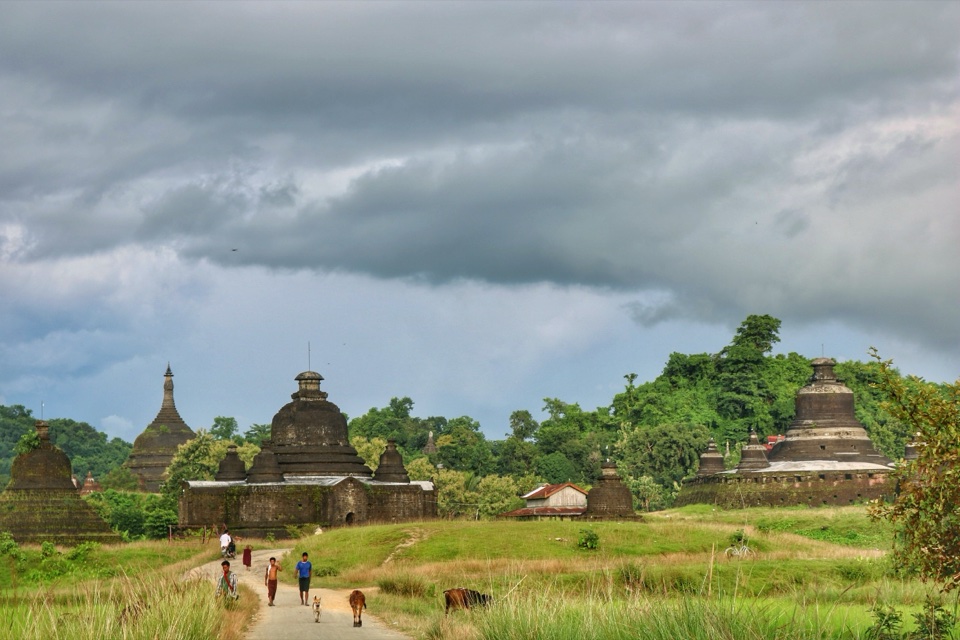
The UN briefing of 11 December 2025 records the organisation’s public position on Mrauk-U. The Myanmar Now report is a separate journalistic document and may contain sensitive imagery. These are links to the original sites, not footage independently authenticated by SINE VELO; the footage examined by Amnesty is not reproduced here.
The archive photographs provide context. Videos open on the source site.
Go to video sources · United Nations · Noon briefing · 2025-12-11 · Myanmar Now News · Mrauk-U hospital report
What we are checking
The question is not whether there is a devastating war in Myanmar. It is what evidence allows specific attacks against a school, a hospital and a village sheltering displaced people to be reconstructed, and how far the conclusions can go.
For each case, we separate four questions: did a destructive event occur? Who caused it? Who or what was hit? What evidence allows intent, weapon and sequence to be reconstructed? A solid answer to the first does not automatically resolve the other three.
The IIMM annual report accounts for the Mechanism’s activities from 1 July 2025 to 30 June 2026: this does not mean that all the events under investigation fall within that interval. The incidents in this article were chosen because they feature in the Mechanism’s investigations or because a verifiable analysis of imagery exists. They are not a census of every attack. This selection cannot establish the overall frequency of events or attribute every instance of damage to the same process.
The UN report and the military response are not saying the same thing
The IIMM describes investigations indicating deliberate attacks on civilian locations and notes increased use of aerial operations. In the document, however, an assessment of an overall pattern sits alongside ongoing investigations into individual incidents. Paragraph 33 specifically cites Kyauktaw and Mrauk-U as cases the Mechanism is investigating. For these attacks, the report does not publish a complete file identifying orders, pilots, munitions and the chain of command. [1]
The distinction matters: “the IIMM described this pattern” is a statement that can be checked in the document. “Every attack described here has been established in all its details” is not. The existence of confidential evidence does not entitle SINE VELO to present it as evidence it has directly examined.
The military response takes the opposite position. It says the report relies on unreliable opposition information and invokes counterterrorism operations and rules of engagement. But a general justification does not establish that a particular building was being used militarily when it was hit. Nor does it resolve the status of the people killed inside. [2]
This method avoids two opposing shortcuts: turning every UN statement into a court judgment, or treating a government denial as if it were already proof to the contrary. A source can be authoritative without having verified a particular number; a partisan source can admit a decisive fact without proving the justification it attaches to it.
Kyauktaw: what we know about the boarding schools
During the night of 12 September 2025, explosions were reported at Thayet Ta Pin, in Kyauktaw township, Rakhine. Local accounts place the attack shortly after 1 a.m. and identify two educational facilities, Pyinnya Pan Khinn and Amyin Thit. Narinjara, republished by BNI, names journalists at the scene, provides information about damage and gives a partial list of victims with their ages or school grades. [5]
These details are more specific than a generic social-media report: they help identify the location, the buildings’ stated function and some of the people involved. They do not, however, amount to a complete, consolidated list. The account of the losses itself changes in the hours that follow.
On 12 September, UNICEF publishes a statement about reports of children killed and injured while sleeping in a boarding school. It identifies no perpetrator and provides no definitive count. On 16 September, the IIMM appeals to anyone able to provide information, citing reports of at least 22 people killed, mostly students, and at least 20 injured. Both interventions matter, but both must be read for what they say they are: responses and investigative appeals based on the reports then available. [3] [4]
The Arakan Army accuses the junta; local outlets describe an area where no ground fighting was taking place. No official military response to this specific incident was found in the material gathered. Pro-military social-media posts about the training of fighters do not fill that gap: we do not know who produced them or what corroboration they offer. [6] [7]
In the republication consulted on NBC, Reuters makes a substantial obstacle explicit: it could not independently verify the account because communications were disrupted. Reproducing only the headline and omitting that qualification would make the story appear more firmly verified than the agency itself says it is. [8]
Why the death toll and the type of bomb remain separate questions
The sources consulted give differing counts and a toll reaching 22 dead. They support a loss of life in the tens, but do not provide a definitive reconciliation of names. It is not sound to choose the highest figure because it appears more complete, or the lowest because it appears more cautious.
The report of two 500-pound bombs is a further issue. A munition’s weight cannot be reliably inferred from the severity of the damage alone. Identifiable remnants, a technical reconstruction or other specific evidence would be needed. Local sources give that weight, but the material consulted contains no public verification of the fragments.
Mrauk-U: the attack acknowledged, its justification disputed
The case of Mrauk-U general hospital has something the other two lack: an official admission. The Tatmadaw Information Team statement, published on 13 December 2025 through the state channels GNLM and the Ministry of Information, says an operation was conducted against the hospital buildings on 10 December. The military claims they were an Arakan Army and PDF base, that the authorities had closed the facility, and that those hit were not civilians. [10] [11]
The two websites do not provide two independent confirmations. Their text matches: it is the same statement on two channels. The duplication helps check provenance and attribution, not multiply the number of witnesses.
The admission nevertheless settles a central issue: the allegation that the military struck those buildings is not coming only from outside. The explanation given by the force conducting the operation still needs assessment. “We struck” and “it was a military target” are two different statements; the first does not prove the second.
Evidence about the hospital and the people present
On 11 December, MSF describes Mrauk-U as one of the few facilities still functioning in the area and reports at least 30 dead and more than 70 injured. The organisation had supported the hospital; that makes its knowledge of the facility relevant, but its statement should not be turned into eyewitness testimony by staff present during the raid. [13]
On the same day, WHO Director-General Tedros Adhanom Ghebreyesus reports at least 33 dead and 20 injured, including health workers, patients and relatives. He describes damage to the inpatient ward and operating theatres. The original post confirms that this is the count communicated by WHO; it does not publish the list of names or the method used to count the dead. [14] [15]
Amnesty International says its Evidence Lab verified footage of damage consistent with an airstrike. This is verification of visual material, not automatic validation of every figure in the statement: the death toll Amnesty reports is attributed to the Arakan Army. [12]
A later source is OHCHR report A/HRC/62/51 of 21 May 2026. Paragraph 12 attributes the destruction of the hospital to the military and reports 33 civilians killed, including 17 women and a three-month-old infant. Interviewees describe two munitions, one hitting a ward and the other near the guardhouse, where four volunteers died. Paragraphs 5–8 explain that the research was conducted remotely, with 80 interviews overall during the reporting period and limitations on access and resources. These were not 80 witnesses to Mrauk-U. The document strengthens the reconstruction, but does not publish a complete victim list or establish that its counts are independent of WHO’s. [19]
A photograph of uniforms does not resolve the status of everyone killed
The military statement refers to social-media photographs of people carrying the wounded. SINE VELO has not authenticated this material, and there is no verifiable reconstruction of when, where and under what circumstances it was recorded.
Even if one person in uniform were correctly identified, the inference would remain insufficient: that alone would not prove that the entire facility was a base, that everyone present was a fighter, or that treatment was not taking place. The claim must be established in its entirety, not replaced with a suggestive image.
The administrative declaration that the hospital was closed and its actual functioning are also separate issues. A building may not be recognised as operational by the authority that has lost control of it and still host medical activity. Establishing what was happening at Mrauk-U when the raid took place requires evidence of actual activity, not merely the labels used by the parties.
Htee Lin: locating imagery does not identify the perpetrator
On 22 January 2026, a violent event strikes a village in the Bhamo area of Kachin State. The following day, Kachin News Group, republished by BNI, reports the account of KIA spokesperson Naw Bu: 22 dead, 28 injured, and an attack at about 4 p.m. during funeral preparations in a place sheltering displaced people. This is an attributed account, not a site inspection by SINE VELO. [18]
The Myanmar Witness/CIR analysis of 12 February 2026 geolocates and establishes the timing of imagery of the event at Htee Lin. Its summary says the footage appears to show ten of the reported fatalities; the forensic section instead describes eight apparently deceased people in the footage analysed and specifies that another two are not shown. This is therefore not a minimum of ten deaths independently established by SINE VELO. Injuries consistent with a large-scale violent event do not, however, identify the delivery system or perpetrator. The alleged second attack remains a report from other sources: the satellite trace alone does not establish a “double tap”. [17]
This distinction prevents a common error: presenting verification of a video as certification of the entire caption accompanying it. Footage can be authentic and located while the explanation attached to it remains partly unproven.
Three coordinates, three functions
CIR publishes three nearby points with different functions: a summary reference, the location of the victim imagery, and the location of user-generated content and the temporal comparison. These coordinates were not produced by SINE VELO and do not indicate three separate attacks. [17]
The relationship between the names Htee Lin and Kawngjar/Kong Ja also remains unresolved. Geographical proximity, the date and the context make a connection plausible, but without clarifying whether these are a village, a neighbourhood or alternative names, it would be wrong to erase the discrepancy.
Byarla: an update, not retrospective confirmation
On 13 November 2026, a new attack is reported on a camp for displaced people at Byarla in the Ponnagyun area. The AFP dispatch of 14 November, republished by CNA, reports twelve dead and eighteen injured, gathers named testimony and describes a visit to the scene. This is important evidence, but it postdates the close of the IIMM report: that document cannot have verified this incident. [22]
DMG and a republication of Narinjara give a similar toll. The matching figures nevertheless require scrutiny of the sourcing chain. The relief foundation cited by AFP also appears as DMG’s photographic source: on the death toll, it is not prudent to count the two publications as fully independent confirmations. Agreement among several outlets therefore does not, on this point, multiply the corroboration. [23] [24]
The account of “two 500-pound bombs” remains a local version without a public analysis of the munitions in the material gathered. It is separate from the reports of damage, deaths and injuries at the scene. Here too, the gap does not justify denying the event; it simply prevents a technical detail from being turned into certainty.
The essential chronology
12 September 2025: reported attack on schools at Thayet Ta Pin; UNICEF statement. 16 September: IIMM appeal for information about Kyauktaw. 10 December: attack on Mrauk-U hospital. 11–13 December: responses from health and human-rights organisations; IIMM appeal; official military statement. 22 January 2026: violent event at Htee Lin/Kawngjar. 12 February: Myanmar Witness publishes its imagery analysis. 21 May: OHCHR report including the reconstruction of Mrauk-U. 30 June: end of the activity period covered by the IIMM annual report. July–August: IIMM report and response from the military mission in Geneva. 13–14 November: reported attack at Byarla and initial evidence. 15 November: editorial update, correction of the coordinates and sourcing dependencies.
What holds up and what remains unresolved
Taken together, the sources document facts of differing evidential weight: an acknowledged operation against a hospital, detailed reports of students killed, located imagery of victims and international investigations. This body of material is not empty because some data are missing; nor is it a complete case file because many sources converge.
The strongest finding is that at Mrauk-U the debate cannot be reduced to “who says the military struck”: the military says so too. The dispute concerns the justification and the people involved. At Htee Lin, by contrast, the gap between verified imagery and verified responsibility still needs to be bridged. At Kyauktaw, convergence on the event is stronger than precision about numbers and weapons.
That is why traffic-light assessments must remain attached to individual claims and include an intelligible explanation. Readers should be able to understand not only which conclusion we offer, but which new document could change it.
The assessments, claim by claim
Red indicates insufficient evidence. Each assessment applies to the statement shown.
Partial support
A violent event caused casualties at Htee Lin; the reported toll is 22 dead.
CIR locates the imagery. Its forensic section describes eight apparently deceased people and another two not shown; this is not an independent count of ten dead. Perpetrator, delivery system and total remain to be established. [17] [18]
Sources and credits
- IIMM, Rapporto annuale A/HRC/63/19
- Missione del Myanmar a Ginevra, «Myanmar’s Position…»
- UNICEF, statement 12/9/2025
- IIMM, appello informazioni Kyauktaw
- BNI/Narinjara, «Death toll … rises to 22»
- The Irrawaddy, «22 People, Mostly Children, Dead…»
- The Irrawaddy, «Rakhine School Massacre Met With Chorus…»
- NBC News (testo Reuters)
- IIMM, appello informazioni Mrauk-U
- Global New Light of Myanmar, «Statement on MraukU case»
- Myanmar Ministry of Information · Statement on MraukU case
- Amnesty International, 11/12/2025
- MSF, «Deadly airstrike on a hospital in Mrauk-U»
- France24 (dispaccio AFP Ginevra)
- WHO / Tedros Adhanom Ghebreyesus · Mrauk-U · 2025-12-11
- Al Jazeera, 13/12/2025
- CIR / Myanmar Witness, «Alleged funeral gathering struck twice in Kachin State»
- BNI/Kachin News Group, «Casualties rise to 50 in Kawngjar Village airstrike»
- OHCHR · A/HRC/62/51, §12 · advance edited version
- United Nations · Noon briefing · 2025-12-11
- Myanmar Now News · Mrauk-U hospital report
- CNA (testo AFP), «Myanmar airstrike on displaced persons camp kills 12»
- DMG, «Death toll … Ponnagyun IDP camp rises to 12»
- CRPH Support Group (testo Narinjara)
- Arezarni · Wikimedia Commons
- CC BY-SA 4.0
