
Dossier
Grozny and the two Chechen wars: what the record shows
From the first siege under Yeltsin to the Russian recapture under Putin: the evidence on Grozny’s destruction, civilian harm and state responsibility.
In brief
Both the 1994–1996 war and the war that began in 1999 devastated parts of Grozny. Field investigations and archives document extensive damage to neighbourhoods and civilian services. Strasbourg judgments found Russia responsible in specific cases and for ineffective investigations. None of those sources, on its own, provides a total for both wars or establishes who gave every order.
Contradicted by the text
The 1997 treaty explicitly recognised Chechen independence.
There is no recognition clause. This rating concerns the treaty text, not all political readings of the settlement. [8]
Attribution not verified
The UN ranked Grozny the world’s most destroyed city.
The UN release describes extensive damage; no original ranking confirming the attribution was found. [12]
1. How the first war began
As the Soviet Union broke apart in 1991, the Chechen separatist leadership under Dzhokhar Dudayev declared independence. Moscow did not recognise the secession. In December 1994, during Boris Yeltsin’s presidency, Russian federal forces entered Chechnya. Grozny, its capital and the seat of the separatist leadership, became the centre of the first offensive. The war extended beyond the battle for the capital, reaching other Chechen communities and people already displaced by the fighting. [1] [2]
2. The first siege: what investigators saw
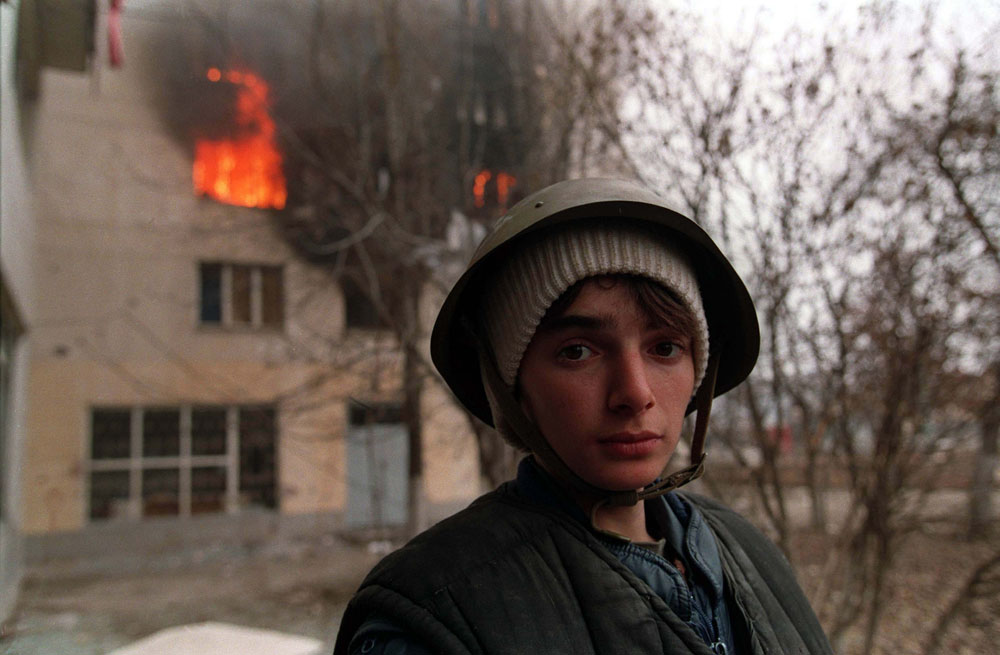
In 1995, Human Rights Watch/Helsinki and Memorial gathered accounts from residents and displaced people in Grozny and Ingushetia. Their field reports describe damage to homes, hospitals and other civilian buildings during the federal campaign. The civilians who stayed were not a uniform group: some lacked transport or somewhere to go. As early as February 1995 the OSCE expressed concern about disproportionate force by Russian troops and called for a humanitarian ceasefire in Grozny. Its Assistance Group began working in the city on 26 April 1995. [2] [3] [4]
Responsibility follows conduct, not ethnicity. Human Rights Watch also documented civilian hostage-taking in Budyonnovsk, outside Chechnya, by the armed group led by Shamil Basayev in June 1995. That episode is distinct from Moscow’s responsibility for the bombardment of Grozny and does not cancel it out. [5]
3. The 1996 peace accord and the 1997 treaty are different texts
In August 1996, fighting returned to Grozny. In the Khasavyurt document dated 31 August 1996, Alexander Lebed and Aslan Maskhadov agreed principles to end hostilities. They left the basis for mutual relations to a future agreement to be reached by 31 December 2001. The date here follows the signed text rather than a retrospective summary. The document does not expressly recognise Chechen sovereignty. [1] [6] [17]
After Maskhadov’s election in January 1997, Yeltsin and Maskhadov signed a separate peace treaty in Moscow on 12 May 1997. They renounced the use or threat of force and agreed to base relations on generally recognised principles of international law. The document set a foundation for further agreements. It did not expressly recognise independence either. The break in hostilities was real, but the status dispute remained unresolved. [7] [8]
4. The second war and the Yeltsin–Putin transition
In August 1999, armed groups from Chechnya entered neighbouring Dagestan. Moscow resumed its military campaign in Chechnya that autumn and called it a counter-terrorism operation. Apartment buildings in Russia were also bombed in September 1999. The timing alone cannot establish responsibility for the bombings or identify a single cause of the war. The Council of Europe delegation’s report distinguishes what it saw from what Russian officials told it. [1]
Yeltsin was still president when the second war began, with Vladimir Putin as prime minister. Putin became acting president at the end of 1999. Federal forces regained Grozny in February 2000, during his acting presidency. The fall of the city did not end the conflict. In 2002 the UN still reported displacement, security concerns and the need to rebuild. On 16 April 2009, Moscow lifted the counter-terrorism regime in Chechnya. That administrative date does not show that all violence ended that day. [1] [9] [12] [13]
After a visit to the region, the Council of Europe Commissioner’s 2009 report described reconstruction in the city while noting new allegations of disappearances and continued problems with investigations. Rebuilding alone did not answer the families’ questions. In 2012, in Aslakhanova and Others, Strasbourg identified a systemic problem with investigations into disappearances in the North Caucasus, separate from the three cases described here. [13] [18]
After the recapture of Grozny, Putin appointed Akhmad Kadyrov to lead a Moscow-backed civilian administration. By 2009 Ramzan Kadyrov headed the Chechen Republic. This political shift is distinct from both the initial recapture and the formal end of the special security regime. [9] [13]
5. Three incidents, three sets of records
| Incident | What the records establish |
|---|---|
| 29 October 1999, civilians fleeing Grozny | In Isayeva, Yusupova and Bazayeva v. Russia, the European Court of Human Rights examined a Russian air attack on vehicles travelling on a road used by fleeing civilians. Two of Isayeva’s children were killed. The court found violations of the right to life and of the duty to investigate effectively. This was not a case of killings in central Grozny. [10] |
| January 2000, Grozny’s Staropromyslovsky district | In Khashiyev and Akayeva v. Russia, the court held Russia responsible for the deaths of the applicants’ relatives at the hands of federal servicemen. It found a separate violation for the failure to investigate effectively. The court did not find torture of the relatives proved to the required standard, but found that the allegations had not been investigated effectively. [10] |
| 5 February 2000, Novye Aldy and Chernorechye | Human Rights Watch documented the killing of at least 60 civilians across the two localities. In a separate proceeding, Musayev and Others v. Russia, Strasbourg found Article 2 violations in the deaths of 11 of the applicants’ relatives and in the failure to investigate effectively. The figures have different scopes and should not be added together. [11] [14] |
These judgments concern state responsibility under the European Convention on Human Rights. They are not individual criminal convictions of Yeltsin, Putin or the people who carried out the acts. Finding responsibility in a specific case does not automatically establish the chain of command for the entire campaign. [10] [11]
6. How much of Grozny was destroyed?
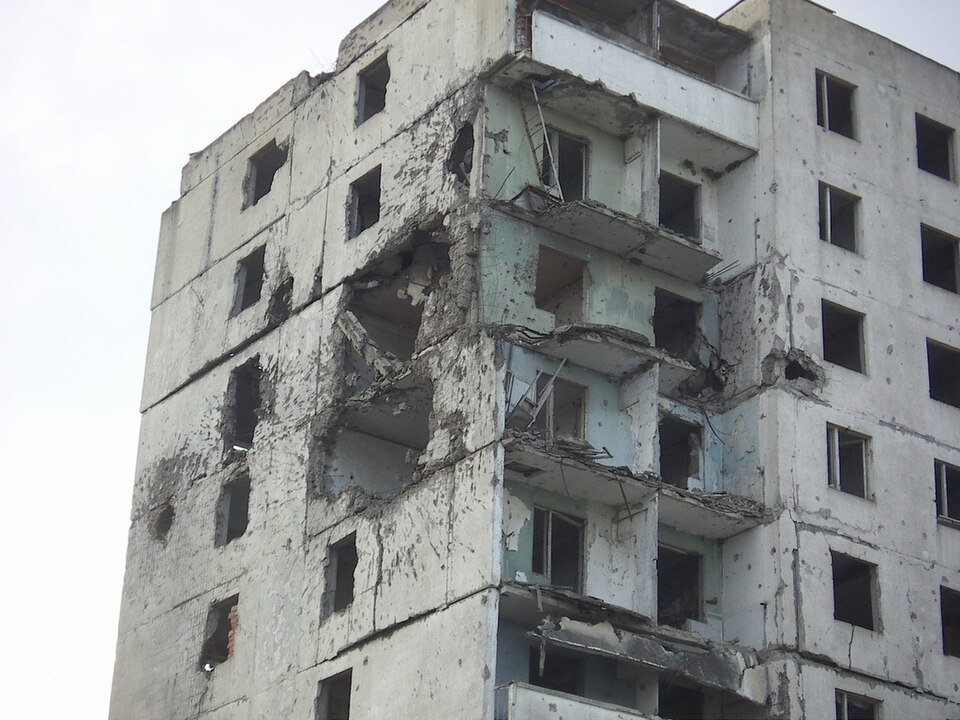
The sources agree that damage was extensive, not on a single percentage. In June 1996 the International Committee of the Red Cross (ICRC) filmed ruined streets and homes and food assistance. The footage documents the locations filmed before the second war. In June 2002, UN Special Representative Olara Otunnu reported seeing extensive destruction first-hand. The ICRC/CNN catalogue entry for June 2003 estimated more than half of the buildings had been damaged, but provides no published method or checkable inventory. It is a dated, attributed estimate, not a census. [12] [15] [16]
A photograph shows one place and moment, not every destroyed building. An estimate of urban damage does not count civilian deaths across Chechnya. And observations made years apart do not isolate the damage caused by each war. We do not use the superlative “the world’s most destroyed city,” often attributed to the UN: the UN source checked here describes extensive damage but does not publish that ranking. We do not compare the 2003 estimate with percentages for other cities assessed using different boundaries and methods. [12] [15] [16]
In 2004, the UN representative on internally displaced persons, Francis M. Deng, reported that he visited Grozny for one day in September 2003 and saw extensive destruction. His report describes what the mission observed; it gives no global ranking. [19]
ICRC archival footage
Timeline
- 1991 · Independence proclaimed. [1]
- Dec 1994 · First federal intervention. [1]
- 31 Aug 1996 · Khasavyurt text. [6]
- 27 Jan 1997 · Maskhadov elected. [7]
- 12 May 1997 · Moscow peace treaty. [8]
- 1999 · Second war begins. [1]
- Late 1999 · Putin becomes acting president. [1]
- Feb 2000 · Federal forces regain Grozny. [9]
- 16 Apr 2009 · Special security regime lifted. [13]
Frequently asked questions
When were the two Chechen wars?
The first began in December 1994 and ended with the August 1996 agreements. The second began in 1999. Russian forces regained Grozny in February 2000, years before the counter-terrorism regime was lifted on 16 April 2009.
Did the Khasavyurt agreements recognise an independent Chechnya?
No. The 1996 text left the basis for relations to further negotiation. The 1997 treaty renounced force but did not expressly recognise independence.
Who led Russia when Grozny came under attack?
Yeltsin was president during the first war and when the second began. Putin, prime minister in 1999, became acting president at the end of that year, before federal troops regained Grozny.
What did the Strasbourg court establish?
It held Russia responsible for deaths, violations of the right to life and ineffective investigations in the cases it heard. It did not issue individual criminal convictions or establish an overall death toll for the wars.
How many people died, and how many buildings were destroyed?
These sources do not support a single verifiable total. Court cases count victims of particular incidents, while urban damage sources cover different years and use different methods. They cannot be added together or converted into a citywide total.
Related: Chechens on both sides of the Russia–Ukraine war
Sources, licences and limitations
Source 7 is a university copy of the UN report. Sources 15 and 16 are archive records with film and catalogue descriptions, and lead to the original players.
- Consiglio d’Europa / Council of Europe, PACE Doc. 8630 (2000), relazione e cronologia
- Human Rights Watch/Helsinki–Memorial, Russia: War in Chechnya — New Report from the Field (Jan 1995)
- OSCE Permanent Council, Decision on Chechnya (3 Feb 1995)
- OSCE Assistance Group starts work in Grozny (26 Apr 1995)
- Human Rights Watch, field reporting on the Chechen war and Budyonnovsk
- Khasavyurt Joint Declaration and Principles for Mutual Relations (31 Aug 1996), original agreement text / PA-X
- UN Secretary-General, E/CN.4/1997/10, introduction §§ 4–7 (copy, University of Minnesota)
- Peace Treaty and Principles of Interrelation (12 May 1997), original agreement text / PA-X
- UK House of Commons Foreign Affairs Committee, Seventh Report, §§ 306–309 (2004)
- ECtHR, Chamber judgments concerning Russia (24 Feb 2005), official case release
- ECtHR, Musayev and Others v. Russia (26 Jul 2007), judgment
- UN SRSG for Children and Armed Conflict, Olara Otunnu’s visit (24 Jun 2002)
- Council of Europe Commissioner for Human Rights, CommDH(2009)36, § 8 and following
- Human Rights Watch, February 5: A Day of Slaughter in Novye Aldi (Jun 2000)
- ICRC Archives / Roland Sidler, Grozny, Chechnya (Jun 1996), V-F-CR-F-00455
- ICRC/CNN Archives, Chechnya: Living in War-Scarred Grozny (Jun 2003), V-F-CR-F-00779-N
- Human Rights Watch World Report 1997, Helsinki section: Russia and Chechnya in 1996
- ECtHR, Aslakhanova and Others v. Russia (18 Dec 2012), judgment
- Francis M. Deng · E/CN.4/2004/77/Add.2 · §§ 7, 36 · 24.02.2004