
Gaza: aid gets in, but does it reach the population?
Offloading, collection and distribution are different stages. UN and Israeli sources, comparable data and the limits of Gaza aid figures.
Translated from the Italian original
In one minute
A shipment entering, being offloaded at a crossing and being delivered to a family are different events. The documents examined show both distribution activities and obstacles along the supply chain. However, they do not allow us to calculate what percentage of all aid entering Gaza during the week of 2–8 November reached the population.
The available weekly comparison covers a narrower group: UN and partner humanitarian trucks offloaded at Kerem Shalom. The decrease reported by OCHA is neither the percentage of aid delivered nor the share stolen. For the Israeli perspective, we found a contemporary government position, not a compatible dataset. The conclusion is not that nobody knows anything: it is that some stages are better documented than others, and confusing them produces wrong answers.
Frequently asked questions
Does aid entering Gaza actually reach the population?
The documents examined report actual deliveries: UNOPS describes checks on 400 pallets reaching communities in September; UNICEF and Anera report subsequent distributions. These accounts cover different periods and populations and cannot be added together. They do not establish what percentage of all aid in the week of 2–8 November 2026 reached the population.
Does the 42.6% drop mean that this share of aid was stolen?
No. The calculation compares 397 and 228 UN and partner humanitarian trucks offloaded on the Israeli side of Kerem Shalom in successive weeks. It measures a decline in offloading, not theft or deliveries to families. Even the difference between scheduled and offloaded loads requires records of individual outcomes: it cannot automatically be classified as theft.
Why do we not directly compare Israeli and UN figures?
A valid comparison requires the same period, crossing, logistical stage, units and cargo categories. This research did not find an Israeli series compatible with the UN and partner count for 2–8 November 2026. The available government communications describe other periods or categories: they document the Israeli position but do not support a like-for-like numerical comparison.
1. The parties’ accounts, before the verdict
The Israeli position emphasizes facilitating entry and the winter plan. A newsletter from the Israeli embassy in Australia, dated 13 November, reports seasonal quantities of tents and trucks and water and sewage interventions. It is a government communication relevant to the period examined, but neither a daily accounting nor an independent verification. It also presents two truck figures whose timeframes have not been clearly reconciled, recorded in the documentary note at the end. We have neither established that they contradict each other nor arbitrarily selected one of them. [9]
In its June FAQ, COGAT claims to facilitate 600 trucks daily and attributes distribution obstacles in part to Hamas and other groups. This document establishes that the Israeli authority makes these claims; it does not provide a verifiable reconstruction of each diversion incident. It predates our week and uses a population that cannot automatically be equated with UN/partner shipments alone. [8]
Aid operators describe a problem that does not end with permission to cross. The Logistics Cluster documents collection and transport arrangements, the need to confirm receipt and operational constraints. In October, WFP announced assistance cuts because of funding shortages. These explanations are not interchangeable: an access restriction, an unfunded purchase and an interrupted delivery require different remedies. [5] [6] [7] [10]
The Palestinian perspective is not a single voice. Political authorities, municipal services, local organizations and aid recipients have different roles and information. In the available documentation, WAFA reports Social Development Minister Samah Hamad’s statements on the winter response. Hamad calls for timely entry of shelter supplies, fuel and equipment and argues that funding alone does not resolve restrictions. We attribute these statements to her without turning them into an independent measure of all entries. Local experiences help frame questions about availability and accessibility; they do not replace a complete shipment register. [13]
These accounts deserve to be heard, but the method does not consist of taking a figure from each side and averaging them. Editorial balance means applying the same test to every claim: what event does it describe, when, for which population and with what evidence?
2. The journey hidden by a single word
To understand the problem, imagine a single shipment rather than an anonymous convoy. Someone must first buy or donate it. Then we need to know whether it is ready, whether the documentation is complete, whether the authorities have authorized transit and whether it has been included in a shipping schedule. Even after these steps, the goods may not yet have left their country of origin.
The next stage is physical: the vehicle reaches the entry point, undergoes checks and unloads. What continues onward may be the pallet, not the original truck. Talking about “trucks entering” without knowing whether the count refers to vehicles, equivalent loads or transfers can therefore cause confusion. We propose no universal truck-to-tonnage conversion: without weights and composition, it would be invented.
Then comes collection. An organization takes charge of the goods and moves them from the entry point to a warehouse or another destination. Logistics documentation must distinguish dispatch from receipt. The Logistics Cluster’s procedures specify that its custody begins at collection; they provide for transport to common or partner warehouses and set access and security conditions. They do not promise that every authorized shipment will automatically be distributed. [6]
Finally, answering the headline question requires observing use: a parcel collected by a family, medicine available to a patient, fuel actually used in a service. Here too, the endpoint must be defined. Delivering a pump to a warehouse is not the same as installing it; installing it is not the same as ensuring a regular service. For bread, flour delivered to a bakery does not by itself tell us who can buy or receive the finished product.
This distinction does not diminish a successful entry. It avoids asking that entry to prove something it does not measure. A functioning crossing is necessary for a flow passing through it, but it is not enough to establish that assistance reaches everyone who needs it.
A key for reading any figure
| Stage | The right question | Evidence to seek | What it does not establish by itself |
|---|---|---|---|
| Approved | May the shipment proceed? | Authorization linked to the shipment | That it has departed |
| Scheduled/manifested | Is it included in the shipping plan? | Dated manifest and identifier | That it has reached the crossing |
| Offloaded | Have the goods been deposited at the stated point? | Offloading record, unit and side of the crossing | Collection and distribution |
| Collected | Have they been taken into custody for internal transport? | Transport document and custody record | Intact receipt at the destination |
| Received | Has the logistics recipient received them? | Confirmation and condition of the goods | Coverage of all beneficiaries |
| Distributed/used | Have they reached people or services? | Distribution records and corroboration | Adequacy of the entire response |
The table is our analytical framework, not a quotation from a single organization. For each data series, the producer’s definition takes precedence and must be made explicit to readers.
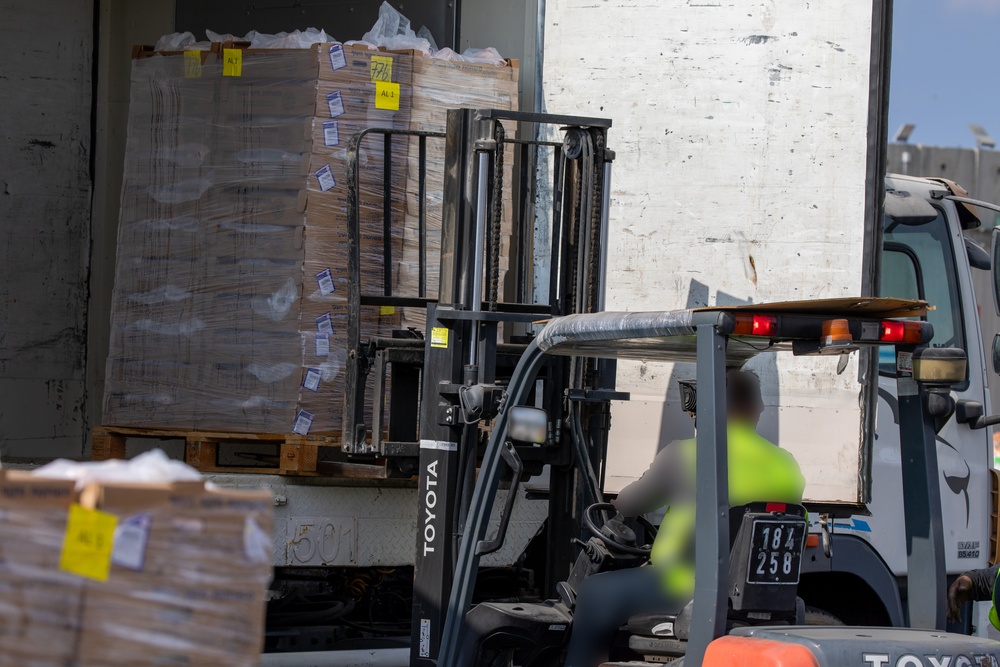
Spc. Aiden Griffitts / U.S. Army, DVIDS — Public domain · Unmodified file [17] [18]The appearance of U.S. Department of War (DoW) visual information does not imply or constitute DoW endorsement.
3. The week we can compare
The two OCHA reports cite the Logistics Cluster and allow this like-for-like comparison in terms of stages and population covered. [1] [2]
| Period | UN/partner trucks manifested | Offloaded on the Israeli side of Kerem Shalom | Offloaded/manifested, our calculation |
|---|---|---|---|
| 26 October–1 November 2026 | 466 | 397 | 85.2% |
| 2–8 November 2026 | 262 | 228 | 87.0% |
The change from 397 to 228 is a 42.6% decrease, calculated from the published numbers; OCHA describes it as approximately 42%. The ratio of offloaded to manifested trucks is a different measure. That is why “offloading falls” and “the offloaded share of scheduled loads rises” can both be true without contradiction.
The denominator determines the meaning. The first measure tracks volume; the second describes a ratio between two recorded counts. Neither is a percentage of families reached. Nor is subtracting offloaded trucks from manifested trucks enough to derive “blocked trucks”: there may be postponements or other outcomes, and records are needed to classify them.
The 13 November report attributes the contraction primarily to the suspension of the Egyptian corridor by the Israeli authorities, reportedly citing smuggling concerns, and to lower available volumes because of funding problems. This is an attributed analysis, not a causal breakdown assigning percentages to each factor. [1]
The truck reporting window does not match the report’s overall window. The document date, the date of events and the statistical period are not synonymous. A report published on 13 November may contain the previous week’s data, a monthly assessment and subsequent updates: mixing them in a table creates an appearance of precision.
4. Why we do not place an Israeli figure beside the UN figure
The desired comparison would be possible with records sharing at least the period, crossing, stage, unit and categories included. We did not retrieve an Israeli series meeting these requirements for 2–8 November. This is a limitation of the research conducted, not proof that such a series does not exist.
Instead, we have public communications documents. They help describe the authorities’ position, but do not justify dividing their total by our weekly total. A seasonal quantity of winter supplies does not correspond to a week’s humanitarian trucks. Multiplying a daily claim by seven does not resolve the incompatibility either.
The opposite error would be to ignore Israeli information because it differs from UN information. An interested source can provide checkable data, and a humanitarian source can have gaps. The criterion is not sympathy for an institution but the traceability of the claim. Here, the Israeli perspective is reported and qualified; a numerical comparison is not simulated.
There is also a difference between humanitarian aid and commercial goods. A product available for purchase can contribute to supply, but does not automatically measure free assistance. And a humanitarian count is not necessarily the total of all goods entering. For a family without resources, the presence of a product and the ability to obtain it remain separate questions.
5. Even “delivered” can mean offloaded
The September UN2720 bulletin explicitly uses “delivered (offloaded)” for tonnage at the crossing: 17,765 tonnes during the month. Its final note limits the document to aid passing through the Mechanism, warns that data may change and notes data cleaning in September. That figure must not be rendered as tonnes delivered to families. [4]
This is not a linguistic nicety. An apparently intuitive English label can have a specific operational meaning. Before comparing charts using the same word, we must read the notes, not just the heading.
The UN2720 portal describes monitoring offloading, collection, destination and interceptions for UN-manifested aid. This indicates a system capable of following different stages, not a guarantee that every figure on the page concerns the final stage. To calculate a rate, we must know that numerator and denominator follow the same shipments, within the same window, treating delays in the same way. [3]
Comparing a monthly entry total with a sample of observed deliveries would produce a fraction that is arithmetically correct but editorially false. The same applies when a monthly flow is compared with goods already in warehouses at the start of the month. Transit times and stocks prevent us from assuming that everything leaving today entered today.
That is why we kept September separate from the November weekly comparison. The former documents terminology and method; the latter the observable change in scheduled and offloaded shipments.
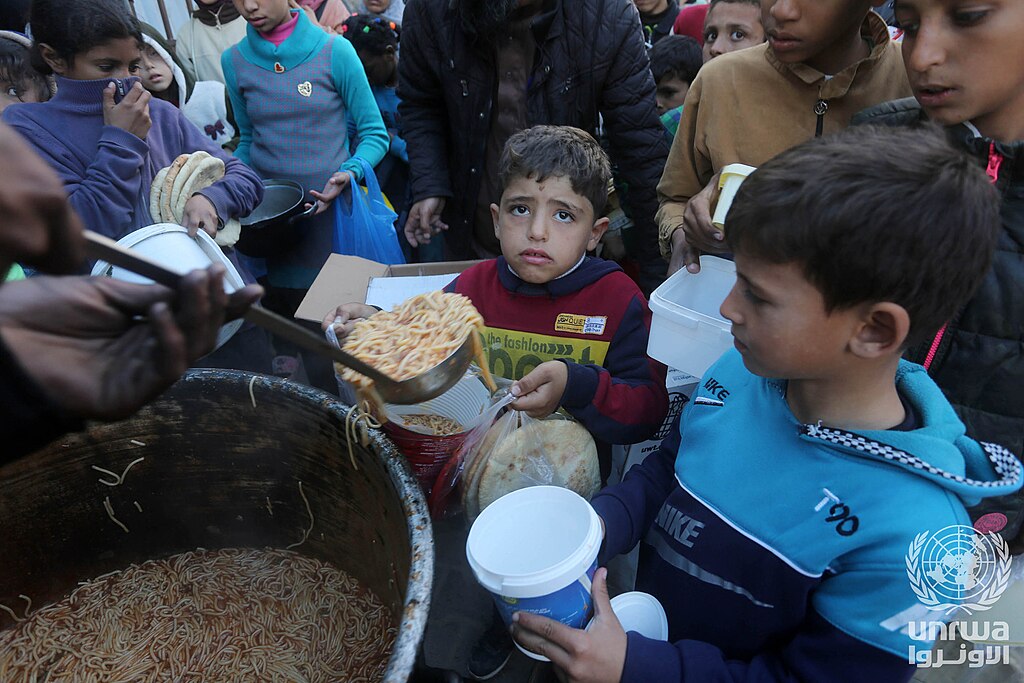
© UNRWA / Ashraf Amra · CC BY-SA 3.0 IGO · Wikimedia Commons · Unmodified file [21] [22]
6. Evidence that goes beyond the crossing
The material examined does not stop at entries. The UNOPS update of 9 October, concerning September, describes visits to warehouses and distribution sites and verification of 400 pallets reaching communities. This is evidence closer to the recipient than a crossing count. However, it is neither the total distribution across Gaza nor the figure for the November week. [11]
Its value is precise: it documents the existence of downstream checks and observed deliveries. Its limitation is equally important: without knowing the complete cohort and the monitoring coverage, those pallets cannot become a universal percentage of success or loss.
A second example comes from UNICEF, which reported on 9 November that it had reached at least 10,000 children with winter clothing and thermal blankets during the preceding week, alongside other response activities. This is an operational account attributed to the organization providing assistance; it is not an independent census of every organization’s beneficiaries. [12]
We do not add these examples together. Their periods and units differ, and operators’ activities may overlap. A person may receive a tarpaulin from one organization and a kit from another: two services do not make two distinct people. A photograph or a partial register may attest to an episode, not by themselves to population coverage.
This also answers two opposing generalizations. “Nothing gets through” goes beyond the available evidence. “Aid arrives, therefore needs are met” goes just as far beyond it. Real deliveries and insufficient assistance can be documented simultaneously.
A local operator within the same window: the Anera diary
Anera’s operational diary documents activities dated within the week studied: entries for 2, 4, 5, 7 and 8 November describe drinking-water distribution at displacement sites in several areas of Gaza. This is a concrete downstream element, not merely a border statistic. The 24 October–5 November summary also reports food assistance to 3,421 households through the WFP program. [16]
This source improves the dossier’s coverage but does not resolve the headline question. We have not checked individual records or followed the water or parcels from the crossing; the distributed water must not be assumed to have been imported. Anera is a distinct organization, but states that it works with WFP on the food program: it is not a second independent confirmation of WFP totals. The page may receive retrospective additions, as the archive warns.
The added value is therefore an account closer to the operation, with identifiable dates and activities. Moving from this to the overall delivery rate still requires a link between upstream and downstream records.
Essential timeline: when events happen and when we read about them
| Event date or period | Document | How it affects interpretation |
|---|---|---|
| September 2026 | UNOPS, 9 October update; UN2720 September monthly overview | Historical monitoring and definitions, not the November week |
| 19 October | WFP announcement | Financial constraint preceding the comparison |
| 27 October | Cluster minutes published 4 November | Procedures and tracking requests |
| 26 October–1 November | OCHA report titled 5 November | Comparison week |
| 2–8 November | OCHA 13 November and Anera entries | Offloading and downstream activities, but without a shared cohort |
| 9 November | UNICEF and conference reported by WAFA | Operational response and institutional requests |
| 13 November | Israeli government newsletter | Contemporary position, non-comparable seasonal figures |
The sequence separates three things: events, observations and publications. Two articles published on the same day may concern different periods; two documents published days apart may use the same observation. An update does not automatically become new independent evidence.
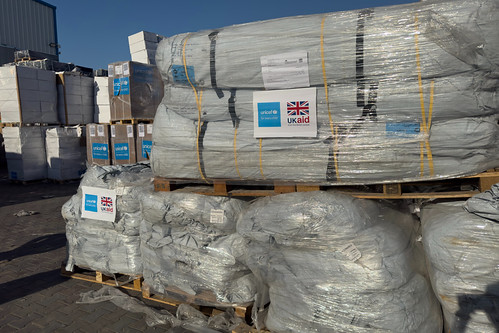
Foreign, Commonwealth & Development Office — CC BY 4.0 · Unmodified file [19] [20]
7. The bottleneck is not always in the same place
The Logistics Cluster’s October operational update distinguishes offloaded shipments, collection services, storage and dispatches to partner sites. It also reports limited availability of ready-to-ship loads, linked to funding and procurement. These are details about different operations, not automatically additive segments of a single cohort. [7]
On 19 October, WFP announced a reduction in food assistance of approximately one third because of funding shortages. This adds a concrete factor to the explanation of the crisis: authorizing a shipment does not create the money needed to buy it. But a financial problem does not establish that access restrictions are irrelevant. Both conditions can operate together. [10]
To attribute responsibility for a specific delay, the useful question is: where is the shipment, and what decision prevents its next step? Is authorization, a vehicle, a receipt, a usable route or funding missing? Knowing that something is “in the pipeline” is not enough: the phrase can include goods at very different stages.
The Logistics Cluster’s 27 October minutes ask partners to confirm, through the waybill, the dispatch date and the status of receipt at their warehouse for shipments carried by the Cluster’s common services. The request does not automatically cover all distributions to civilians. The minutes also explain that loads not offloaded as planned may be rescheduled or cancelled for different reasons. This is the kind of detail needed to avoid classifying every numerical difference as theft. [5]
Likewise, finding a single diverted shipment does not quantify a general share. Claiming that a particular cause explains “most” failed deliveries would require a broader basis, with stated definitions and coverage.
A concrete example of the distinction between a plan and its outcome is CARE’s 11 November account: it includes 314 tents in transit among response priorities. We have not rewritten “in transit” as “distributed.” The page also includes accounts from displaced people whose names have been changed to protect them: these are accounts collected by the organization, not interviews conducted by us. Their human value does not authorize their use to quantify the entire aid system. [14]
8. From quantities to needs: what a count leaves out
Even a perfectly traced supply chain cannot, by itself, answer the question of adequacy. Assessing that would require comparing goods actually available with needs, taking composition, quality, duration and accessibility into account.
A tonne of food, a tonne of shelter materials and a tonne of equipment do not serve interchangeable functions. Total volume can rise while an essential item remains scarce. A tent count does not tell us how many remain usable, are suitable for the location or are sufficient for everyone needing shelter. We therefore do not derive a verdict on nutrition or famine from truck traffic alone.
UNICEF describes drainage problems and requests equipment to restore water and sanitation services. These are functional problems, not just questions of accumulated quantities. The case shows why checking a delivery should extend as close as possible to the effect being measured. [12]
For an investigation into trucks, the supportable conclusion concerns the aid’s journey. An investigation into hunger would require other indicators and a specific methodology. Confusing these levels can lead both those denouncing and those denying the crisis to overstate their case.
9. How we weigh sources
An original document is indispensable, but “original” does not automatically mean “independent.” OCHA cites the Logistics Cluster; the UN2720 Mechanism works with operators; an agency may describe its own intervention. If the same observation appears in three publications, we do not necessarily have three verifications.
The first check therefore concerns provenance, date, context and passage. The second concerns evidentiary value: what the document actually establishes, what it leaves open and its dependence on other sources. The editorial team’s documentary dossier records the two outcomes separately.
The same rule applies to the Israeli perspective. A diplomatic newsletter reproducing COGAT figures is an original government communication, not a second independent measurement. Reporting it correctly does not mean adopting its conclusions.
We have also avoided turning an access problem into a verdict. An unreadable page or a server error does not establish that information is false or intentionally hidden. It indicates only that, in this research, that passage was not checked.
10. The traffic light: one signal for each question
Documentary green: operators report downstream distributions.
The color attests to the existence of operational accounts attributed to UNOPS, UNICEF and Anera, not an independent audit of every delivery. Separately, overall coverage for the week remains indeterminable: that gap does not, by definition, cast doubt on every distribution described. [11] [12] [16]
Not established by this research: universal attribution of failed distribution to a single actor, claims that all aid is stolen, or claims that goods entering guarantee that needs are met. A traffic light must not turn a gap into an accusation.
11. What would make the comparison genuinely complete
We would need a table following the same shipments through every stage, with publishable identifiers or verifiable aggregates, dates, quantities, goods and logistics recipients. It would need to distinguish commercial from humanitarian goods, separate fuel from other goods where the series do so, and explain postponements and revisions.
For deliveries to people, we would then need to know the records’ coverage and methodology: a sample or the whole population, unique households or repeated distributions, observed or self-reported receipt. Publishing a methodology and robust aggregates does not require exposing beneficiaries’ personal data.
These requirements are not a pretext for suspending all judgment. They enable more precise judgments: a successful passage, a documented barrier, a number describing only one stage, a conclusion that remains open. This is how we avoid both automatic reassurance and accusations built on a wrong denominator.
The final answer: yes, documents attest to distributions, not just entries. No, the figures collected do not allow us to certify what share of the entire weekly flow reached the population. Missing data must be shown, not invented.
Sources and documentary notes
Documentary research updated through 15 November 2026. The proposed images are archival and do not document the week examined. The material available for the week examined includes no video that has been viewed and cleared for reuse.
- OCHA, Humanitarian Situation Report, 13 November 2026.
- OCHA, report titled 5 November 2026, page dated 6 November.
- UN2720, portal and description of the Mechanism.
- UN2720 Monthly Overview, September 2026, 2 pages.
- Logistics Cluster, Gaza meeting minutes, 27 October, published 4 November 2026.
- Logistics Cluster, SOP Common Logistics Services, May 2026.
- Logistics Cluster, October 2026 Operational Update, published 6 November.
- COGAT, FAQ Humanitarian efforts into Gaza, June 2026, 4 pages.
- Israeli embassy in Australia, newsletter of 13 November 2026, p. 3. Note: the page mentions 85,000 trucks in “recent months” and 8,200 in the winter-plan list, without clarifying a common period. Unreconciled scopes, not an established contradiction.
- WFP, Funding cuts force WFP to drastically reduce lifesaving assistance in Gaza, 19 October 2026.
- UNOPS, Crisis response in Gaza, updated chronological page.
- UNICEF, press release, 9 November 2026.
- WAFA, Samah Hamad/Ramiz Alakbarov conference, 9 November 2026, 16:09.
- CARE, Gaza floods November 2026: How CARE is responding, Hillol Sobhan, 11 November.
- OCHA, Gaza crossings, historical series.
- Anera, November 2026 operational diary.
- Original photograph · Spc. Aiden Griffitts / U.S. Army, DVIDS — Public domain
- Reuse terms · Spc. Aiden Griffitts / U.S. Army, DVIDS — Public domain
- Original photograph · Foreign, Commonwealth & Development Office — CC BY 4.0
- Reuse terms · Foreign, Commonwealth & Development Office — CC BY 4.0
- Original photograph · © UNRWA / Ashraf Amra · CC BY-SA 3.0 IGO · Wikimedia Commons
- Reuse terms · © UNRWA / Ashraf Amra · CC BY-SA 3.0 IGO · Wikimedia Commons
