
Dossier
Crimea 2014: how Russia took the peninsula, and why it was not a conquest without violence
Soldiers without insignia, occupied institutions, a referendum and annexation: what the sources document and what the absence of a major battle does not prove.
In brief
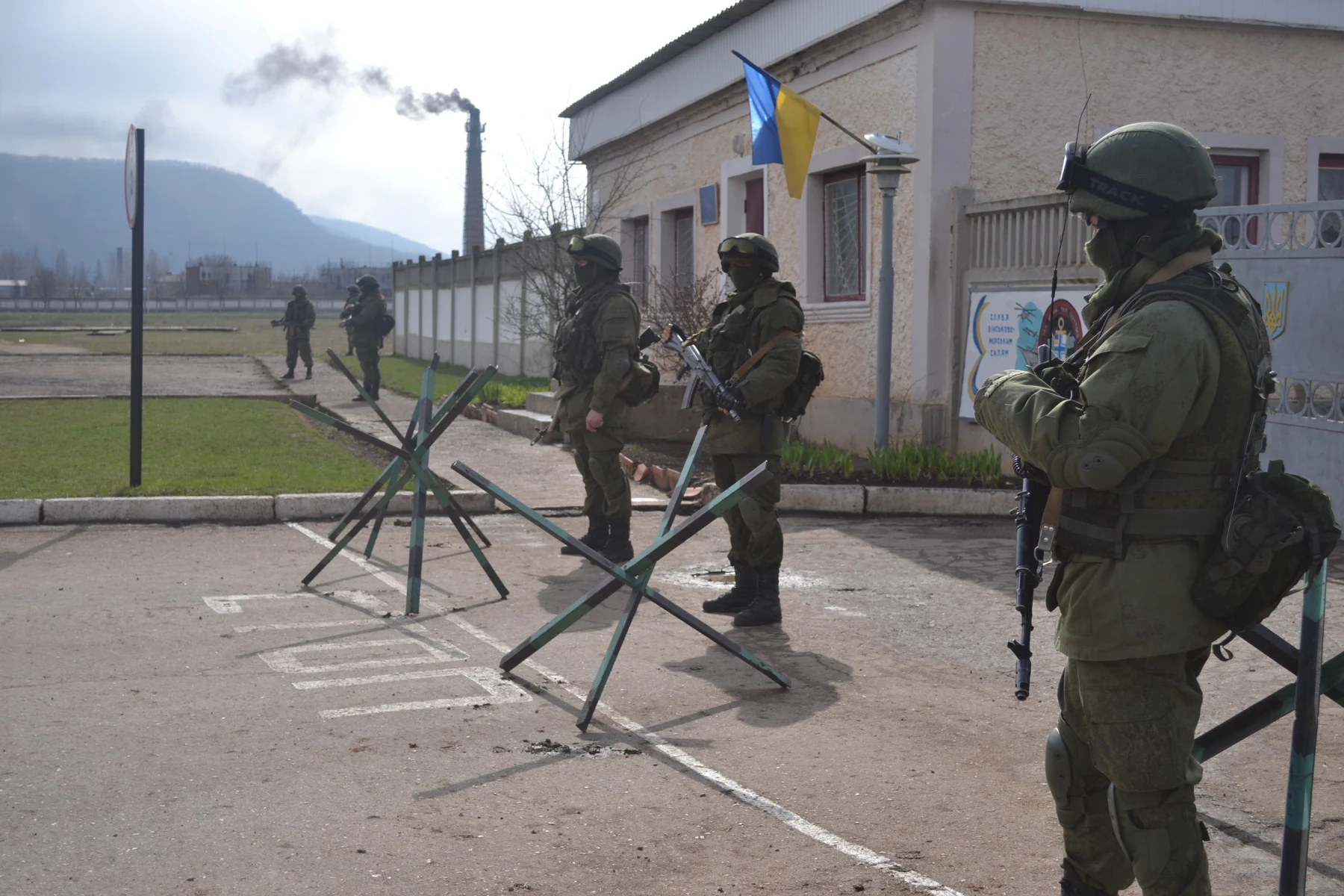
Crimea was not conquered through a bombing campaign comparable to the one that began in the rest of Ukraine in 2022. It was, however, the scene of a seizure of power backed militarily by Russia. The European Court of Human Rights dates Russian effective control to 27 February 2014, before the referendum. The occupation of decision-making centres, the blockade of bases and the paralysis of Ukraine’s response made a rapid change in territorial control possible. [1][2]
Three things can be true at the same time: genuine support for Russia existed on the peninsula; the referendum did not comply with Ukraine’s constitutional framework and the democratic standards examined by the Venice Commission; there were victims and repression even without extensive fighting. None of these three findings automatically cancels out the others. [3][4][5]
Questions and answers
Was there no war in Crimea in 2014?
There was no prolonged conventional battle to conquer the peninsula. That does not mean there were no military operations, coercion or deaths. Humanitarian law expressly covers occupation that meets no armed resistance. [6]
Were the men without insignia Russian?
The involvement of Russian forces is documented. Putin acknowledged their support for local self-defence forces in April 2014. It does not follow that every armed man photographed was a Russian soldier: local formations were also present. [7]
Does the referendum prove that everyone wanted Russia?
No. It does not measure all residents, or all eligible voters; part of the opposition boycotted it. The results announced by the organizers must be distinguished from opinion polls and from scrutiny of the conditions under which voting took place. [3][4][5]
Was popular support for Russia invented?
It is not correct to claim that. A Pew survey after the referendum found strong support among respondents in Crimea. A survey, however, does not certify the ballot count or make a change of borders legal. [4]
Did Kosovo automatically authorize Crimea’s separation?
No. The International Court of Justice’s 2010 advisory opinion examined a specific declaration of independence. It did not establish a general right for any region to secede, or authorize a neighbouring State to annex it. [8]
Was the referendum observed by the OSCE?
Not by an official OSCE mission. The organization’s chairmanship ruled out observing the vote under the conditions then envisaged. Observers invited by the organizers are not equivalent to an OSCE mission. [9]
Were there victims?
Yes. Section 10 distinguishes the documented incidents and the period covered by the death toll: it does not cover all subsequent years. [5]
Does the 2024 ECtHR judgment decide who Crimea belongs to?
Its subject is State responsibility for violations of the European Convention. Effective control serves to identify who is responsible for people’s rights: it must not be confused with recognition of Russian sovereignty. [1]
1. The first question: what does “taking a territory” mean?
To understand Crimea, four dimensions must be separated: physical control, political preferences, the legality of the territorial transfer and individual rights.
An army can control airports, communications, access routes and institutions without destroying a city. Some of the inhabitants may approve of that outcome. The way it was achieved may remain illegal. A person may suffer violence even while their neighbour celebrates the new government. Describing just one of these dimensions gives an incomplete account.
The useful question is therefore not only “how many shots were fired?”, but also “who could issue orders, move units, call a vote, transmit information or demonstrate without fearing consequences?”. That is the thread followed in this dossier: distinguishing the fact that a change took place from proof that it took place freely.
2. The past matters, but it is not an eternal title deed
Crimea became part of the Russian Empire in 1783. In 1954, the Soviet authorities transferred it from the Russian republic to the Ukrainian republic, both part of the USSR. Mark Kramer reconstructs the Soviet procedure and distinguishes the official reasons from his hypotheses about Khrushchev’s political consolidation: the phrase “a personal gift” compresses a more complex institutional history. [10]
This history explains the strength of the symbolic bond with Russia. It does not, however, prove that the territory always belonged to the same State, or that a subsequently recognized border can be changed by force. The imperial past, the Soviet structure and post-Soviet international law are not the same legal order.
The subject of the story must also be chosen carefully. “Crimea wants” is a shortcut: it speaks as if ethnic Russians, Ukrainians, Crimean Tatars and people with mixed identities formed a single will. There is no need to deny the importance of the Russian component to recognize that a minority retains rights even when it loses a vote.
3. February 2014: the crisis in Kyiv and real fears
The fall of Viktor Yanukovych’s government produced a crisis of legitimacy perceived very differently across Ukraine’s regions. For Maidan supporters, it meant moving beyond a discredited government; for Moscow and many opponents of the new authorities, it was an illegitimate overthrow. Not all opposition to Kyiv began after the soldiers arrived. [2][11]
On 23 February, Parliament voted to repeal the 2012 language law. Acting President Oleksandr Turchynov did not approve that measure: the UN report of 15 April makes clear that the law continued to apply. Nevertheless, Russian speakers and other minorities perceived the vote as hostile. [11]
The distinction is crucial: a political act capable of provoking fear is not the same as a ban already in force. A serious investigation must describe both elements, neither erasing the fear nor turning it into a nonexistent law.
4. The sequence that changed control of the peninsula
Timeline · 2014
- 26 February
pro-Ukrainian and pro-Russian demonstrators clash in Simferopol; two people die. [5]
- 27 February
Parliament and the government are occupied; in the presence of armed men, deputies install Sergei Aksyonov. [5]
- Late February–March
Russian units and local forces contribute to controlling infrastructure and isolating Ukrainian installations; the seizure of decision-making centres precedes political formalization. [2]
- 6 March
the referendum is scheduled for 16 March, with ten days between the decision and the vote. [3]
- 16 March
the vote takes place, unrecognized by the Ukrainian authorities and without official OSCE observation. [3][9]
- 18 March
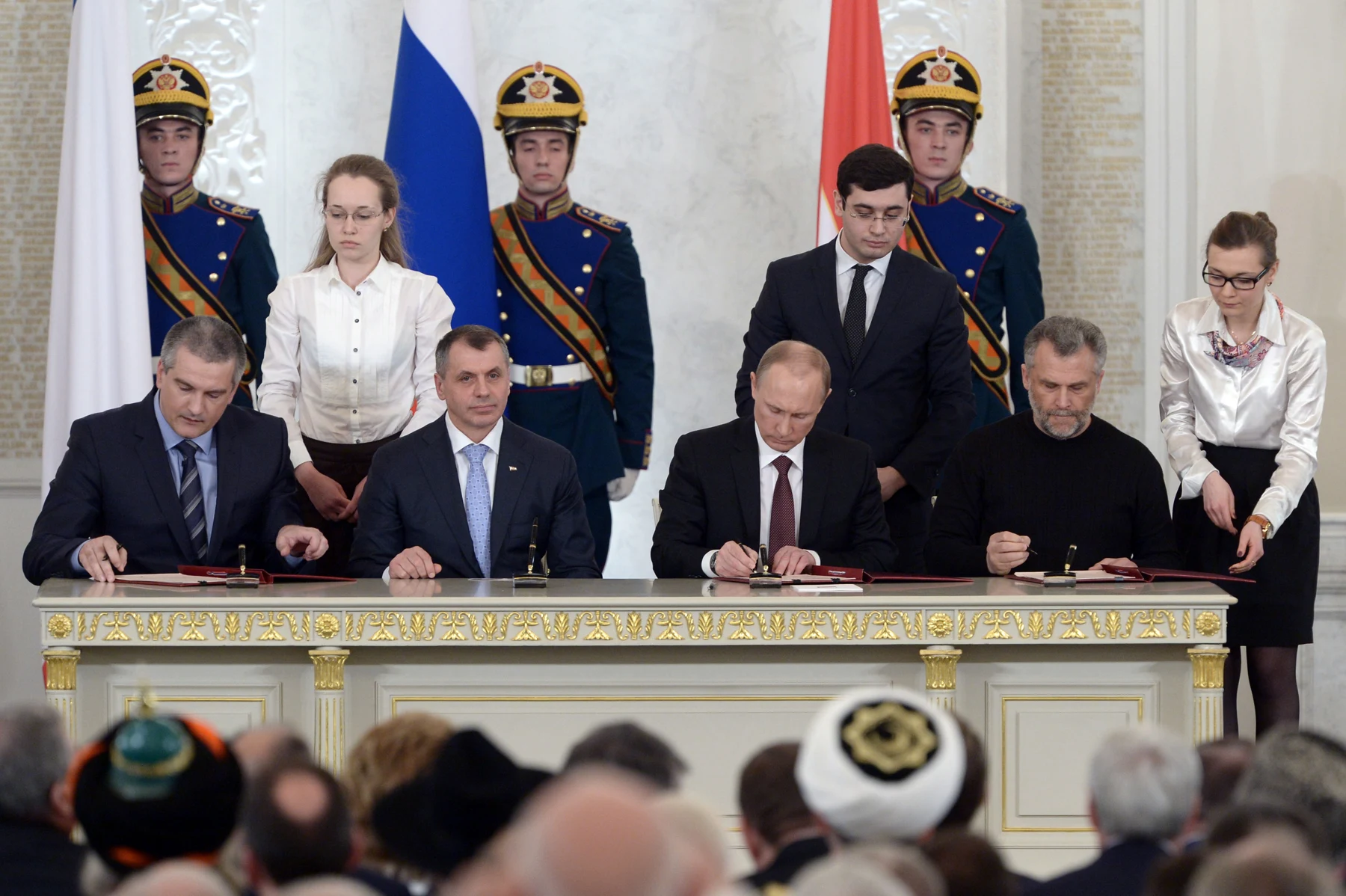
Putin and representatives of the new authorities sign the treaty of incorporation into the Russian Federation in Moscow. [12]
- 27 March
the UN General Assembly adopts Resolution 68/262, which considers the referendum invalid for the purpose of changing status. [13]
- 17 April
Putin publicly acknowledges that Russian servicemen had supported Crimea’s self-defence forces. [7]
This sequence rules out describing the military intervention as merely the consequence of an electoral choice already made: the new control had been imposed before the vote.
5. Men without insignia: what is proven and what must be distinguished
The absence of insignia initially made it harder to attribute the operations publicly. But a dispute about uniforms cannot ignore subsequent evidence. Putin’s acknowledgment and the ECtHR’s assessment refute the thesis of an exclusively local process without Russian military support. [1][7]
It is necessary, however, to avoid the mirror-image error: automatically assigning any man with a weapon on the peninsula to a Russian unit. “Self-defence”, regular servicemen, volunteers and local groups are not interchangeable categories. Responsibility for a specific assault requires identification, connections and relevant evidence; a State’s territorial control does not make that verification unnecessary.
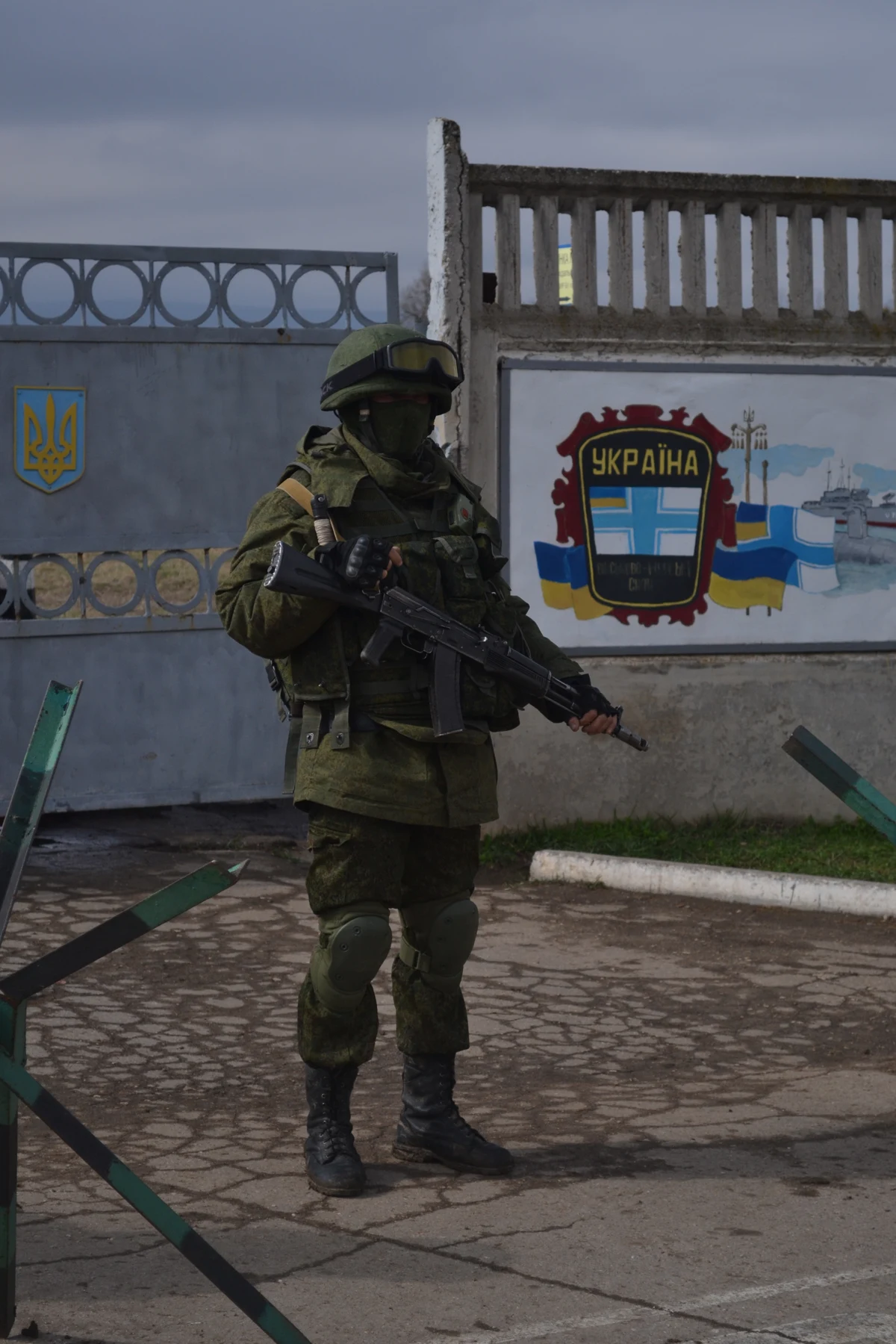
A photograph can document the presence of armed people in a particular place on a particular date. Alone, it cannot reconstruct orders, a chain of command or motives. That is why the dossier’s images have narrowly framed captions, rather than attributions broader than what they demonstrate.
6. Why was the conquest so rapid?
The study by Michael Kofman and colleagues for RAND identifies a combination of factors: Russian forces already present, the ability to introduce additional capabilities, relatively confined geography, operational speed, the political crisis in Kyiv and social ties favourable to Moscow. The operation’s efficiency must not be separated from the weak resistance it encountered. [2]
This is a retrospective military analysis, not a neutral expert assessment produced by a court. It helps propose and compare an explanation, rather than certify every operational detail.
The general point is sound: a headcount of soldiers on paper does not equal a force ready to fight. The availability of equipment, orders, communications, confidence in commanders and prospects of reinforcement matter. Control of essential nodes can render a garrison ineffective before a major battle begins. Neither Russian omnipotence nor unanimous Ukrainian consent needs to be assumed to explain the outcome.
At Belbek on 4 March, unarmed Ukrainian soldiers marched towards the airfield controlled by Russian forces, who fired warning shots. ABC News’s on-the-ground report describes a prolonged standoff and the Ukrainians’ subsequent return to their base; ITV published further images and accounts. It was not a battle to retake the airfield, but neither was it an absence of all opposition. It is a concrete example of resistance without large-scale combat. [16][17]
7. Moscow’s version, presented without endorsing it
In his speech on 18 March, Putin presented incorporation as historical reunification and an application of self-determination. He accused Ukraine’s new authorities of depending on radicals, invoked the security of the population and of Russia’s presence on the Black Sea, and cited Kosovo. He also maintained that Russian servicemen were already legitimately present and that the total number of Russian forces in Crimea did not, according to him, exceed the agreed limit of 25,000 personnel. [12]
This is a primary source for what Putin said, not independent verification of his claims. The reproduction consulted is preserved in the archive of the Parliament of North Rhine-Westphalia, together with the Russian consulate’s covering letter; the original Kremlin website did not respond during this verification.
The argument about troop numbers does not resolve the issue on its own: permission to station troops is not automatically permission to control the political organs of the host country. Agreed presence, actual conduct and the consent of the territorial State must be distinguished. The ECtHR bases its conclusion on effective control, not simply on the fact that Russian bases existed in Crimea. [1]
8. The referendum: two questions that must not be confused
The first question is what the inhabitants preferred. The second is whether the procedure was suitable and lawful for deciding a change of sovereignty.
The alternatives offered were union with Russia or restoration of the Crimean Constitution of 1992 with the status of being part of Ukraine. The second option did not formally propose annexation, but neither did it propose preserving the existing arrangements.
The Venice Commission concluded that a local referendum on secession was not permitted by the Ukrainian Constitution. It also noted the military presence, the extremely short timeframe and problems with the alternatives: there was no explicit choice to preserve the arrangements then in force; the reference to the Crimean Constitution of 1992 was ambiguous, since that text had undergone amendments. [3]
This is not a linguistic nicety. A ballot paper must make it possible to understand what happens when each option is chosen. And a numerical majority is not enough, on its own, to make any procedure valid. Conversely, the invalidity of the procedure does not allow the conclusion that every individual vote in favour was false.
9. What do polls and announced results really tell us?
Putin cited more than 96% voting in favour and turnout above 82%. These are figures claimed by the organizing authorities, not percentages certified by SINE VELO. [12]
In interviews conducted from 5 to 23 April 2014 and published on 8 May, Pew found that 91% of respondents in Crimea viewed the fairness of the vote positively and 88% favoured Kyiv’s recognition of the result. The methodology describes face-to-face interviews and an oversample of Crimea; the 1,659 respondents make up the overall Ukrainian sample, not the sample for the peninsula alone. [4][14]
This is important counterevidence to the claim that support was entirely invented. But the question asked for an assessment of the referendum: it did not recount the ballots. A subsequent opinion poll, electoral turnout and a constitutionally valid vote answer different questions. They must not be merged into a single number.
10. Few battles does not mean no victims
The UN death toll for incidents in February–April 2014 distinguishes two deaths during the confrontation on 26 February, the killing of Tatar activist Reshat Ametov, two deaths in a shooting in Simferopol on 18 March and the killing of a Ukrainian officer in Novofedorivka on 6 April. [5]
In Ametov’s case, Human Rights Watch collected testimony from family members as early as March 2014 and described footage in which men in uniform took him away. The statement issued at the time distinguished what the organization could establish from reports of torture that had not then been directly verified. That precaution must be preserved, not erased by reading events retrospectively. [15] The 2017 OHCHR report subsequently documents the abduction, torture and summary execution, attributed to people believed to belong to the Crimean self-defence forces: the caution in the initial statement does not mean that the uncertainty remained unchanged over the years. [5]
The phrase “without bloodshed” is therefore too absolute. Even a relatively low death toll compared with other wars includes people killed, families and responsibilities to be established. It is not correct to use a quantitative comparison to turn victims into zero.
11. What the ECtHR established, and what it did not
In its judgment of 25 June 2024, the Grand Chamber confirms Russian effective control from 27 February 2014 and establishes practices violating human rights. This is State responsibility under the European Convention, distinct from each individual’s criminal guilt. [1]
The fact that a court establishes who controls a territory does not mean that it awards that territory to them. The law must be able to protect inhabitants even when sovereignty is disputed. Therefore, “Russia exercises jurisdiction” and “Russia has lawfully acquired sovereignty” are not synonymous.
A judgment must also be distinguished from a monitoring report, and an advisory opinion from a political declaration. These are sources with different functions, not votes to add up until a truth is obtained by majority.
12. Kosovo, the UN and the meaning of occupation
The International Court of Justice’s 2010 advisory opinion on Kosovo did not establish a universal right to secession. The Court itself delimited the question: determining whether the declaration under examination violated international law, not deciding whether all entities within a State have a right to secede from it. [8]
The reference to Kosovo can therefore be discussed as a political argument about Western conduct, but it does not replace an analysis of Crimea. Declaring independence, using armed forces and incorporating the territory into another State are distinct acts.
UN Resolution 68/262 reaffirms Ukraine’s territorial integrity and calls for non-recognition of the change of status based on the referendum. It is neither a criminal judgment nor a military authorization by the Security Council. [13]
The law of occupation, as the International Committee of the Red Cross explains, applies on the basis of physical control and even without armed resistance. A State need not declare war or accept the word “occupation”. [6]
13. What remains unresolved, and why it does not negate the overall picture
Questions remain that are more difficult than acknowledging Russia’s military role: when all operational decisions were taken, how fully the political project had already been defined, what orders individual units received, who committed each specific abuse, and how the inhabitants would have voted in a different procedure free from coercion.
The last question is a counterfactual: no reporter today can recover a vote that never took place. Neither the official results from 2014 nor a subsequent poll resolves it. That limitation must not be hidden to make a conclusion more satisfying.
Access to sources also has limits. After its visit on 21–22 March 2014, OHCHR did not obtain access to the peninsula for the monitoring described in the report and worked from the mainland, corroborating information according to its methodology. This must be stated, without automatically equating documented monitoring with an unverified rumour. [5]
14. The conclusion: support, force and law are not alternatives
The most convincing reading is neither “all spontaneous” nor “nobody wanted Russia”. It is the reconstruction of an operation in which military force, the crisis of the Ukrainian State and support from a substantial share of the population acted together, but on different levels.
Support helps explain the ease of the takeover. It does not make weapons irrelevant. Weapons help explain who was able to organize the new arrangements. They do not prove that every citizen was opposed. The law establishes conditions and obligations that do not disappear because the operation was rapid.
Crimea in 2014 was a military and political takeover with limited fighting, not a story without coercion, victims or opposition. Understanding that difference makes it possible to discuss what happened without reducing the Crimean people to extras and without confusing a fait accompli with its legitimacy.
What the evidence establishes
Assessments of individual claims, not of the entire investigation.
Verified
Russian forces were involved in the takeover before the referendum.
The ECtHR confirms effective Russian control from 27 February 2014; in April, Putin acknowledged Russian military support for the self-defence forces. This does not automatically identify every armed man or determine sovereignty. [1][7]
Verified
The referendum of 16 March 2014 had no official OSCE observation mission.
On 11 March, the OSCE Chair ruled out observation under the planned conditions. Any observers invited by the organisers are not equivalent to an official mission of the organisation. [9]
Not established
The announced referendum results precisely measure the preferences of the entire population.
This is not established. Organisers’ results, voting conditions and later polls are different things. Pew found strong support among respondents, but did not recount ballots or certify the vote’s validity. [3][4][14]
False
Nobody died in incidents connected with the takeover of Crimea between February and April 2014.
False. The UN report distinguishes deaths in the clashes of 26 February, the Ametov case, the shooting of 18 March and the killing of an officer on 6 April. This verdict concerns this precise claim, not every interpretation of the events. [5][15]
Video archive
Kremlin.ru · CC BY 4.0
Sources and limitations
[A] = original document or the organization’s original publication examined directly. [B] = primary document reproduced by a third-party archive; provenance disclosed. This does not automatically mean a less truthful source, but a different route of access.
Here the letters identify source access, not the A/B checks of our general method.
- [1] [A] ECtHR, Ukraine v. Russia (re Crimea), Grand Chamber, 25 June 2024; particularly §§864 and 873. Original PDF downloaded and text examined.
- [2] [A] Michael Kofman et al., RAND, Lessons from Russia’s Operations in Crimea and Eastern Ukraine, 2017, chapter 2. Original secondary analysis, not a judgment.
- [3] [A] Venice Commission, CDL-AD(2014)002, 21–22 March 2014, §§9–28.
- [4] [A] Pew Research Center, results published on 8 May 2014.
- [5] [A] OHCHR, Crimea report, 22 February 2014–12 September 2017; §§20–35,80–83. Original PDF downloaded and read.
- [6] [A] ICRC, Occupation and international humanitarian law, explanation of the criteria and absence of resistance.
- [7] [A] Interfax, 17 April 2014, contemporary report of Putin’s acknowledgment. Original journalistic source, not direct access to the Kremlin transcript.
- [8] [A] ICJ, official press release 2010/25 on the Kosovo advisory opinion, 22 July 2010, section II. Official summary of the opinion, not the full text.
- [9] [A] OSCE Chairmanship, 11 March 2014, ruling out official observation.
- [10] [A] Mark Kramer, Wilson Center, CWIHP e-Dossier 47, 19 March 2014. The author’s original historical research.
- [11] [A] OHCHR, report of 15 April 2014, §67.
- [12] [B] Putin’s speech of 18 March 2014, English copy of the original page preserved by the Landtag of North Rhine-Westphalia, transmitted by the Russian consulate on 19 March. Used for the Russian position, not as certification of the facts claimed.
- [13] [A] UN General Assembly, Resolution 68/262, 27 March 2014.
- [14] [A] Pew Research Center, methodology of the April 2014 survey.
- [15] [A] Human Rights Watch, Crimea: Disappeared Man Found Killed, 18 March 2014.
- [16] [A] Alexander Marquardt, ABC News, report from Belbek, 4 March 2014.
- [17] [A] ITV News, footage and report of the Belbek standoff, 4 March 2014.