
Dossier
Eastern Congo, M23 and Rwanda: what the evidence documents about external support
In brief
Documentary dossier. Sources considered up to 17 November 2026; military data in the latest UN report used extend to 15 April 2026.
M23 has been back in arms in the eastern Democratic Republic of the Congo since 2021. Since 2023 it has spoken and fought under the AFC/M23 banner. On 12 October 2026, in Goma, that political umbrella was relaunched as the FRN, with Joseph Kabila declared president; on 14 October an FRN statement declared the AFC dissolved. On 11 November 2026 the 1533 Sanctions Committee listed FRN as an alias of AFC (entry CDe.010): this was not a new listing of M23, but an update to the designation. This dossier examines the evidence behind different allegations of Rwandan intervention, distinguishing military presence, material support and operational command.
In its 2024–2026 reports, the Security Council’s Group of Experts describes RDF troops in the DRC, weapons systems that M23 alone cannot account for, training and de facto direction of operations. On 21 February 2025 all fifteen Council members called on the RDF to stop providing support and withdraw without preconditions. Kigali speaks of defensive measures against the FDLR. Kinshasa speaks of aggression. Both positions must be tested against documents and evidence, without equating a party’s statement with an independent finding. The FDLR are present. According to the same experts documenting the FDLR, the RDF are also present, numbering in the thousands and not only along the border.
The period examined runs from M23’s return to arms in 2021 to 17 November 2026. But the dates of the evidence matter: the latest Group report used here, S/2026/466 [1], closes its investigations on 15 April 2026. Subsequent news and sanctions do not constitute a new independent troop count.
Frequently asked questions
Has Rwanda sent soldiers into Congo?
Yes: the UN Group of Experts repeatedly documents the RDF’s presence in 2024–2026. Estimates vary by period and province. Those in the June 2026 report describe deployments from December 2025 and investigations ending on 15 April, not a count updated to November 2026.
Are M23, AFC and FRN the same thing?
The acronyms are not interchangeable in every context. M23 is the armed group; AFC is the political-military platform established in 2023. In November 2026 FRN appears as an AFC alias in the UN sanctions update. The formal identity of a designation does not, by itself, establish who commands every unit.
Are the FDLR real, or a pretext?
Their presence and cooperation with elements of the Congolese government coalition are documented. The Group nevertheless disputes that neutralizing the FDLR alone explains RDF operations and territorial conquests. The existence of a threat and the legitimacy of every military response are different questions.
Does coltan finance M23?
The Group documents control of trade and taxation in Rubaya. In 2024 it estimates at least $800,000 a month from coltan production and trade; in 2026 it describes an updated taxation system and supply chain. Not all Rwandan production or every export can automatically be attributed to smuggling.
Have the peace agreements resolved the conflict?
The 2025 texts are authentic, but signing and implementation are not the same. The Group documents subsequent offensives and redeployments; the United States imposed further sanctions in 2026. This dossier does not certify a complete withdrawal or implementation of every obligation.
Three claims, three different assessments
“There are Rwandan soldiers in Congo,” “they provide weapons and training” and “they direct M23 operations” are different assertions requiring separate assessment. The first concerns deployment. The second concerns the embargo and logistics. The third concerns direction: who decides whether to seize, hold or leave a town. An ally can be present without commanding. A supplier can arm a force without occupying territory. Since 2024 the Group of Experts has connected the three levels in sequence: systematic presence; “unequivocal” combat support; “de facto control and direction” that “renders Rwanda liable for the actions of M23” (S/2024/432 [2], para. 45). The OHCHR mission, which did not enter Goma, is more cautious legally: the support “may amount to overall control” (A/HRC/60/80 [3], para. 20). In its full June 2026 report, HRW goes further, discussing effective control and belligerent occupation. Kigali rejects all three interpretations. The method requires distinguishing evidence of operational command from the legal classification of the conflict and occupation.
The competing accounts, kept separate
Kinshasa says Rwanda occupies Kivu with M23, takes towns, takes Rubaya and launders coltan. Kigali says M23 is Congolese, the FDLR are the cause, the RDF are defending themselves and UN reports are unbalanced. AFC/M23 says it protects persecuted communities and wants to rebuild the state. The United States, which mediated in Washington, subsequently sanctioned Kabarebe and Kanyuka first, then the entire RDF, and then, on 28 October 2026, the Rwandan Ministry of Defence and Zigama Credit and Savings Society. The European Union listed RDF officers and Bisimwa in Regulation 2025/509. HRW and Amnesty describe killings, detention and mines. These sources do not all perform the same function: governments set out their positions, investigative reports present evidence and limitations, and sanctions instruments explain political and administrative decisions. This dossier distinguishes those levels.
Who is who: keeping the acronyms straight
M23 is a sanctioned Congolese armed group (CDe.006), reconstituted in 2021 and commanded in the field by Sultani Makenga. AFC is a political-military platform launched in Nairobi on 15 December 2023 by Corneille Nangaa, alongside Bertrand Bisimwa. The Group of Experts wrote that M23 and Kigali saw AFC as a way of presenting the rebellion as a Congolese affair (S/2024/432 [2], para. 25). UN texts have since referred to AFC/M23: two organizational wrappers, one campaign.
On 12 October 2026, in Goma, Joseph Kabila signed the FRN’s founding document. The 14 October statement published by FRN [4] declares AFC dissolved and says the new movement assumes its rights, obligations and commitments, including those relating to Doha. This is a conflict party’s self-description, not an independent assessment of its conduct. Makenga remained military leader. The 1533 Committee had listed AFC (CDe.010) on 14 July 2026. On 11 November 2026, in statement SC/16506 reproduced by the Securities Commission of The Bahamas [5], the previously empty alias field reads “Front pour la Refondation de la Nation (FRN).” Nothing else changes. The listing date remains 14 July. Treating FRN, AFC and M23 as if all three emerged together in 2012 is a mistake. Treating them as separate worlds after three years of joint statements and the UN alias is the opposite mistake.
The resurgence, 2021–2024
Eight years after its 2013 defeat, M23 returned to Rutshuru’s trails. The 2012 dossier had already placed James Kabarebe at the top of a de facto chain of command (S/2012/843 [6], cited in S/2025/446 [7], para. 41: “the de facto chain of command of M23 … culminate[d] with … Gen. James Kabarebe”). That is not automatic evidence for 2021. It is a precedent the Group considers relevant, resurfacing in 2025–2026 with Kabarebe as a minister and then Senior Defence and Security Advisor from 1 December 2025.
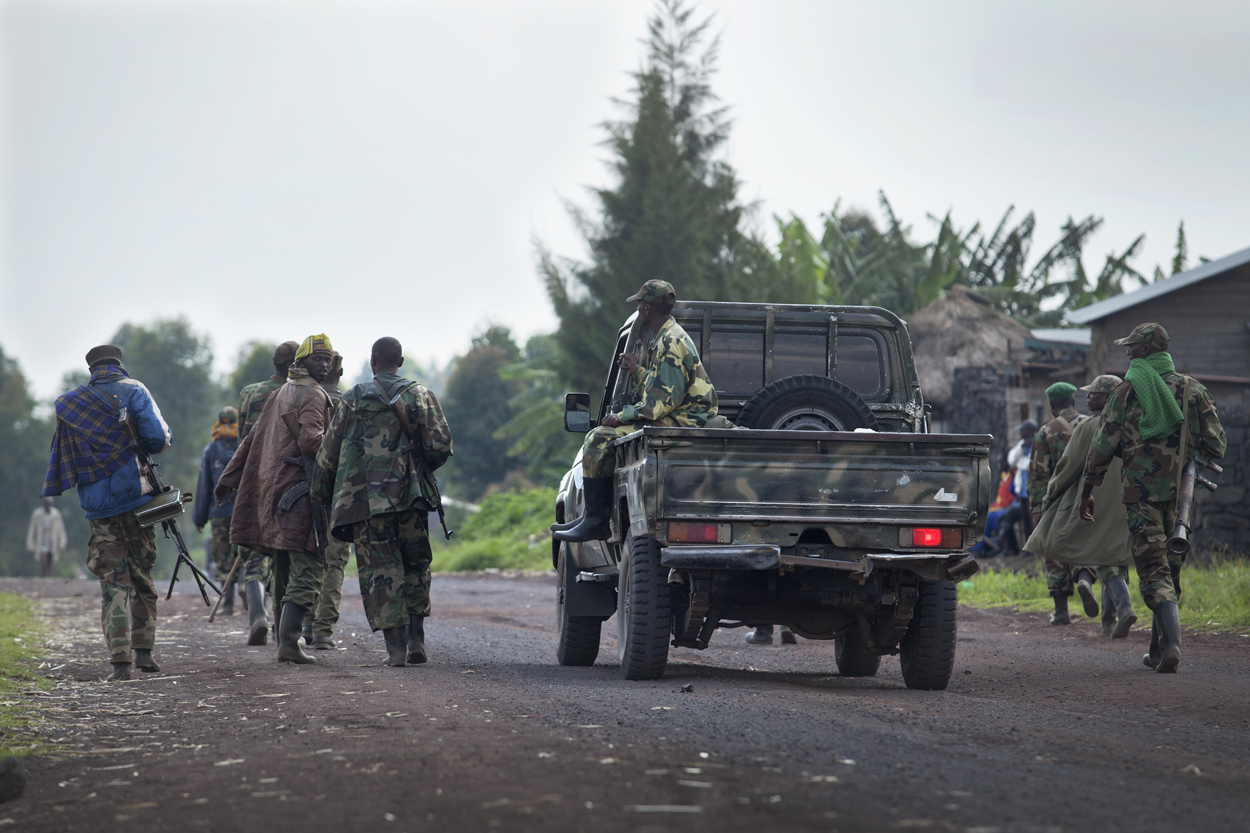
By 2024 the theatre already involved one army facing another, with militias in between. On one side were M23 and the RDF; on the other, FARDC, Wazalendo designated VDP, FDLR, Burundian troops, contractors and later SAMIDRC. Report S/2024/432 [2], transmitted on 31 May and published on 4 June, describes RDF intervention extending “beyond mere support” to “direct and decisive” involvement. Its conservative estimate was 3,000–4,000 RDF troops in Nyiragongo, Rutshuru and Masisi, compared with around 3,000 M23 combatants in Petit Nord. M23 combatants and two RDF officers, the Group writes, explained that M23’s ability to operate simultaneously on several axes depended on RDF support (para. 44).
AFC was established in Nairobi on 15 December 2023. Rubaya fell on 30 April 2024.
Presence: the Group’s figures, not social-media numbers
The traffic light for presence is green: several reports document repeated RDF operations in the DRC. That does not establish a single force strength valid throughout the period.
In 2024 the Group gives 3,000–4,000 (S/2024/432 [2], para. 43; S/2024/969 [8], para. 49). For January–February 2025, covering Goma and its aftermath, the conservative estimate rises to 6,000, with a footnote: former RDF and Rwandan intelligence sources spoke of at least 10,000 (S/2025/446 [7], para. 36 and footnote 25). After Goma’s capture the Group records a reduction “to the minimum necessary” to maintain a low profile: 1,000–1,500 still active in AFC/M23 territories, plus thousands on the Rwandan side ready to return (paras. 37–39). In the late-2025 interim report, the conservative estimate is 6,000–7,000, comprising two brigades and two special-forces battalions, with a base on Idjwi used for rotations across Lake Kivu (S/2025/858 [9], paras. 68–69). For December 2025, the June 2026 report gives a conservative range of 8,000–10,000 in South Kivu and 6,000–8,000 in North Kivu, “with no evidence of significant withdrawals thereafter” (S/2026/466 [1], para. 96). Subsequent movements, up to the investigation cutoff of 15 April 2026, are described as rotations and reinforcements.
These estimates concern different periods and areas: they must not be added together or presented as current strength in November 2026.
The Group adds methodological details rather than decorative ones: every M23 unit supervised by RDF special forces (S/2024/969 [8], para. 49); mixed battalions, including commandos from Bigogwe, Rubavu and Cyangugu; RDF personnel wearing M23 uniforms “to avoid detection”; movements mainly at night (S/2026/466 [1], para. 97). Interviewed AFC/M23 recruits “have all referred to the presence of RDF, notably special forces, involved in high-stake frontline operations” (para. 99). In the late-2025 report, AFC/M23 sources distinguished RDF soldiers from M23 combatants by equipment, discipline, operational conduct and chain of command (S/2025/858 [9], para. 70).
On 26 January 2025, Kigali [10], as Goma was falling, issued a statement: the conflict was triggered by FARDC in coalition with FDLR, mercenaries, Wazalendo, Burundi, SAMIDRC and MONUSCO troops; M23 could not violate its own country’s territorial integrity; the defensive posture was “necessitated.” This is not evidence that the RDF were absent. It is a party’s statement, and part of the record.
Weapons that M23 alone cannot explain
The Group does not stop at witnesses. In 2024 it describes a mobile SHORAD system with radar and surface-to-air missiles at Bumbi on 7 February, in an M23/RDF area; the shooting down of a FARDC CH-4 drone; and an attempt against a MONUSCO drone (S/2024/432 [2], paras. 47–48). It describes guided 120 mm mortars, as well as jamming and spoofing, which resolution 2773 would condemn in paragraph 15 for endangering humanitarian and mission aircraft. An aircraft serving the RDF was hit by a FARDC CH-4 at Walikale (S/2025/446 [7], para. 38 and annex 22). In 2025–2026 drones appear, including attacks on Kisangani’s Bangoka airport (S/2026/466 [1], summary and annex 50: waves of fixed-wing UAVs on 5 February and 1 March 2026). In March 2025, in Masisi, a Tadiran RT-7106 radio was seized from an RDF soldier; the Group publishes its technical specifications (S/2025/858 [9], para. 71 and annex 34).
On 2 March 2026 OFAC repeats, in designation language: GPS jamming, air defence, drones, thousands of troops and training at RDF centres. A Treasury statement establishes the sanctions authority’s position and decision; it does not replace independent ballistic verification. It nevertheless aligns with the Group, while reflecting a party’s interest: the United States guarantees the Washington process and is sanctioning a signatory.
Command: who decides whether to seize, hold or leave a town
The command claim is the most sensitive. Saying “they are allies” is not enough. Direction must be established.
In 2024 the Group writes that the RDF’s de facto control and direction of M23 operations makes Rwanda liable for M23’s actions (S/2024/432 [2], para. 45). In 2025, discussing the withdrawal from Walikale, a tin-mining territory containing the industrial Alphamin Bisie mine, it writes that the decision followed “direct instruction from the Government of Rwanda, once again confirming command and control” and “hierarchical subordination” (S/2025/446 [7], para. 18). This is not an inference drawn from a photograph: an operational sequence, advance followed by withdrawal on orders, is used as evidence of a chain of command.
An AFC/M23 commander says in the late-2025 report that the RDF “Friendly Force” “manage the front lines” and “control M23 combatants” (S/2025/858 [9], para. 70). In 2026 Kigali “continued to dictate which territories to seize, hold or withdraw from, reflecting centralized operational control and hierarchical subordination of AFC/M23” (S/2026/466 [1], para. 100). The named chain runs from Kagame to Kabarebe and, from 29 January 2026, deputy Jean-Paul Nyirabutama, formerly intelligence’s number two, with meetings often held in Gisenyi; Nyakarundi as army chief of staff; Nkubito (3rd Division, North Kivu); the 4th Division in South Kivu; and Gashugi commanding special forces. Division commanders remained in Rwanda; brigade commanders “occasionally deployed” to the DRC (paras. 98–99). On 2 April 2026 the Group wrote to Kigali seeking clarification about support for AFC/M23 and was awaiting a response at the time of drafting (para. 101).
The OHCHR mission, which did not enter Goma, is more cautious legally: the support “may amount to overall control” (A/HRC/60/80 [3], para. 20). In the report *Death Was Everywhere* [11] (10 June 2026 release; 102 former detainees; imagery of Rumangabo and Tshanzu), HRW says Rwandan military presence and direction “show that it exercises effective control over the area, meeting the legal threshold for belligerent occupation.” Kigali rejected HRW’s findings. M23 has its own officers, Congolese recruits and discourse on federalism. De facto direction and a combatant’s ethnic identity are not the same question. In this dossier the traffic light for operational direction is green; for the full legal classification of occupation across every territory, yellow.
Goma and Bukavu, January–February 2025
On 23 January 2025 M23 and the RDF attacked Sake. The Group (S/2025/446 [7], para. 16) and A/HRC date Goma’s capture to 27 January; resolution 2773 records Goma on 28 January. Kavumu fell on 14 February. According to the Group (para. 17) and A/HRC (para. 14), Bukavu fell on 16 February “without combat”; resolution 2773, adopted on 21 February, records Bukavu on 14 February. The unanimous text lists Masisi-centre (4 January), Sake (23 January), Goma (28 January), Nyabibwe (5 February; the Group says 6 February) and Bukavu (14 February), captured “by the 23 March Movement (M23) with the direct support and participation of the Rwanda Defence Forces (RDF).” Meeting record S/PV.9865 [12] records 15 votes in favour, none against and no abstentions (President Fu Cong).
Paragraph 1 condemns the offensive “with the support of” the RDF. Paragraph 2 demands that M23 stop hostilities, withdraw from Goma and Bukavu and dismantle parallel administrations. Paragraph 4 calls on the RDF to stop providing support and withdraw “immediately […] without preconditions.” Paragraph 6 condemns FARDC support for the FDLR. The text addresses both sides, rather than indicting only one capital.
The Group describes RDF columns numbering hundreds moving towards Sake, Mubambiro and Goma; entry from Gisenyi; occupation of the Bulenga peninsula and airport surroundings, from which fire was directed at FARDC, contractors, SAMIDRC and MONUSCO; and urban combat on 26 January (S/2025/446 [7], para. 35). In Bukavu, the RDF role is described as critical to taking the city “without urban combat” / “without combat” (paras. 17 and 35). A/HRC/60/80 [3] confirms an “active and decisive” role and adds an explicit limitation: after February, continued RDF presence was harder to verify within its mandate. HRW reports an increase in graves at Kanombe military cemetery in Kigali: an average of 22 new graves a week between December 2024 and April 2025. That is an indicator, not a list of identified personnel killed in the DRC.
On 26 January Kigali blamed Kinshasa’s coalition. Both sequences can coexist: fighting was already underway, and the Goma offensive nevertheless involved RDF personnel in the field, according to the UN, US and EU.
Parallel administration, not just trenches
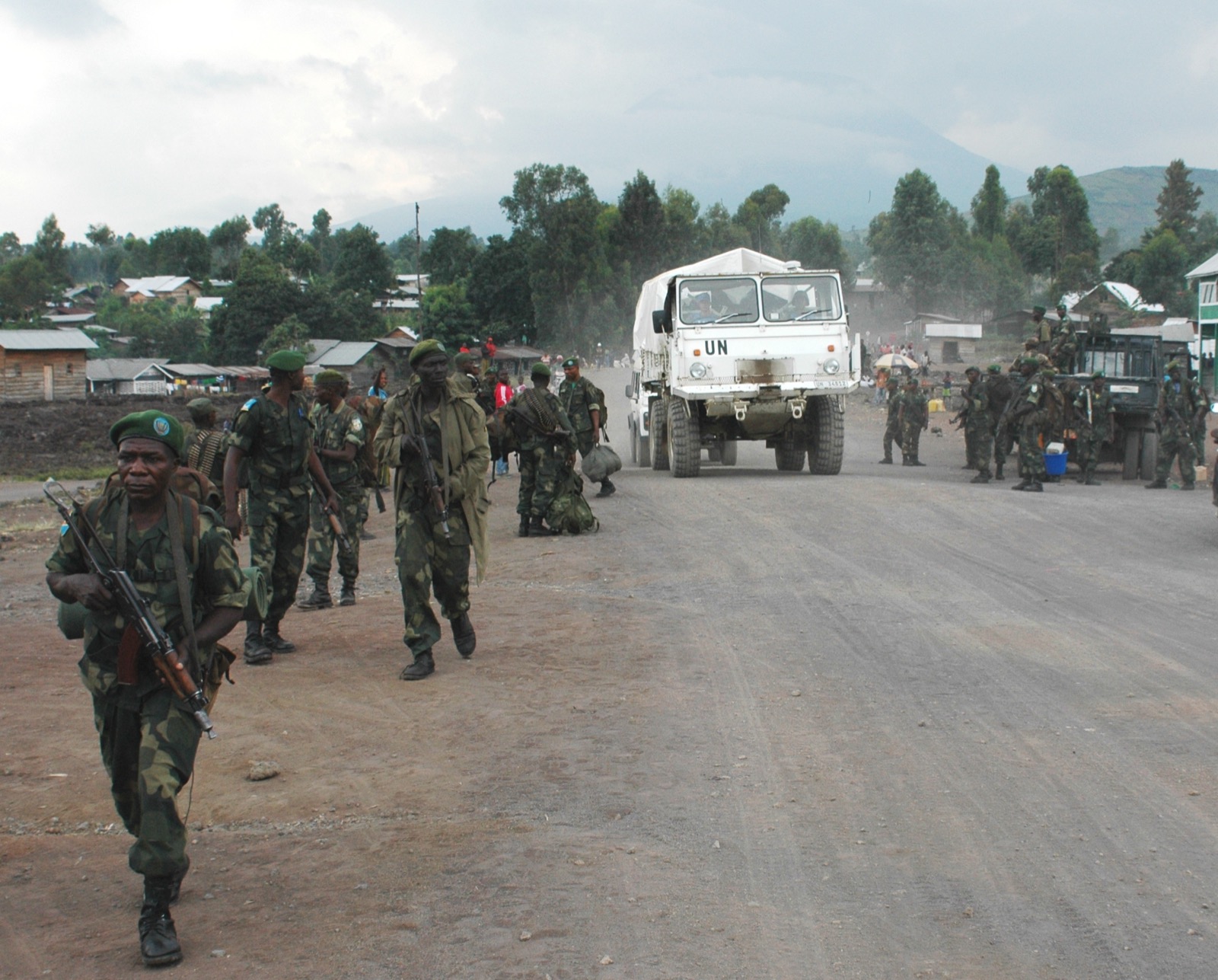
Since 2025 AFC/M23 has done more than hold the frontline. The Group (S/2025/858 [9], summary; S/2026/466 [1], paras. 90–94) describes administrative, judicial, tax and security structures, with the stated objective, at certain stages, of governing an autonomous eastern region. Water and electricity services (SNEL, REGIDESO) fall under the AFC/M23-appointed governor; Imperial Assur replaces SONAS in insurance; unlicensed financial operators such as “Accès Finance S.A.” appear in Goma and Rubaya after Kinshasa suspends the banking system. This alone does not prove RDF command. It shows territorial control becoming de facto government: the basis for HRW’s occupation argument and resolution 2773’s demand to dismantle “illegitimate parallel administrations.”
Rubaya, coltan and what a four-dollar tax establishes
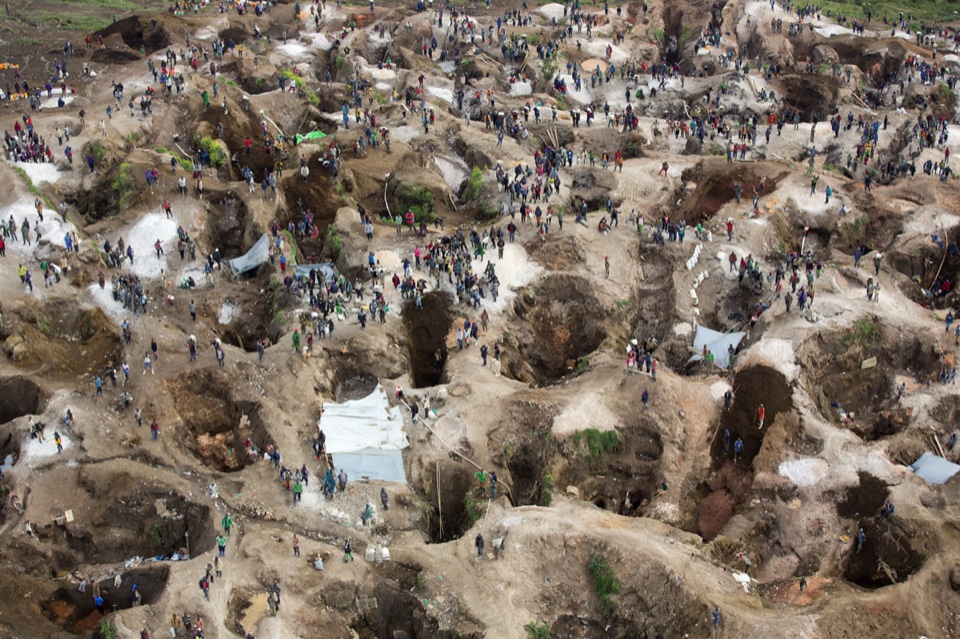
Rubaya is not a metaphor. It is a mining district in Masisi. AFC/M23 seized it on 30 April 2024. The late-2024 report describes a monopoly over trading centres, routes to Rwanda, blending with Rwandan production, convoys twice a week, around 120 tonnes of coltan a month, taxes of $7 per kilogram of coltan and at least $800,000 a month (S/2024/969 [8], paras. 64–66). The same report’s summary refers to “at least 150 tons” fraudulently exported; an annex refers to “at least 150 tons per month” produced. These are not the same formulation as paragraph 64 and must remain distinct.
In 2026 the Group returns with satellite evidence: a 3D model based on March 2026 imagery indicates a substantial increase over the previous year, with production “assessed to exceed” the roughly 120 tonnes a month estimated for 2024 (S/2026/466 [1], para. 213). The tax at the point of commercialization is given as around $4/kg for coltan and $2 for cassiterite. Invoices are paid after delivery in Rwanda into an Equity Bank account held by Patient Haba, AFC/M23’s provincial financial coordinator, with branches in Remera and Nyabugogo in Kigali. There is a checkpoint at Mubambiro. Kigali companies appear among buyers: Rani Mining Ltd. (over 84 tonnes in customs records through March 2026), 3U Mining Supporters Ltd., Philbert Trading Minerals Ltd. (suspended by ITSCI) and Kanzamin Limited. Rwandan coltan and cassiterite exports increase in ways the Group does not consider explained by domestic production. On 2 April 2026 it requested clarification from Kigali. As of 5 June, the text records no response.
Amnesty International, on 21 September 2026 [13], approaches the mines from another angle: 18 miners killed across Rubaya and Lomera, pits used as cells, forced labour and recruitment (26 interviews). Amnesty states it did not independently investigate coltan transport to Rwanda and refers to the UN and Global Witness. For Lomera gold, however, it independently traced gold-bearing soil to Kamembe’s “sand port,” without confirming its onward destination. This is a declared limitation on coltan, not additional proof of the Rubaya chain; the gold investigation follows a separate, partial chain. On 25 June 2026 OFAC attributes “over 200 people, including children” to a March 2026 shaft collapse in Rubaya: this is a US designation figure, not a Group finding, and remains attributed.
Speaking about Twangiza, Nangaa said AFC/M23 lacked the expertise to operate industrial gold mines. That denial concerns a different site and mineral. It does not cover Rubaya.
On gold, OFAC sanctioned Gasabo Gold Refinery on 25 June 2026, already listed under EU Regulation 2025/509, and described a scheme: gold from RDF/M23 areas of South Kivu, escorted to Rusizi and Kigali, “at least 60 kg” in early 2026. This is the US Treasury’s account, reflecting its role as guarantor of Washington. In the same theatre, the Group has a separate evidential chain involving satellites, invoices, customs and interviews. The files intersect at Gasabo; they are not merged.
The traffic light for the Rubaya–Kigali mechanism is green. For the precise share of Rwandan exports, yellow. For “state financing” in the strict sense, distinct from taxes collected on the ground, yellow.
Money: local taxes and Washington’s allegations about Zigama
The financing most strongly documented by the Group is extracted in Congolese territory: mining taxes, parallel tax administration and a transport monopoly. The UN reports examined contain no RDF budget line labelled “M23.”
On 28 October 2026 the State Department (an official statement by spokesperson Thomas Pigott) and OFAC (sb0668 [14]) designated the Rwandan Ministry of Defence and Zigama Credit and Savings Society. The State Department says thousands of RDF soldiers fight alongside M23, providing weapons and training, surface-to-air missiles and jamming; that the MoD violates Washington obligations; and that forced labour and illegal taxation occur in Rubaya. OFAC says Zigama serves the Rwandan security forces; facilitated payments in China and elsewhere for RDF arms and ammunition; had a subsidiary that “enabled the transportation of gold” from M23 territory to Kigali; and facilitated transactions for M23 and AFC “amounting to tens of millions of dollars.” A listing statement establishes the US allegation and designation decision. It is not a published bank audit or a Group finding. This is why the traffic light for budget financing remains yellow: taxes and in-kind support are solidly documented; the “Kigali cheque” now has an original US source, not an equivalent UN evidential chain.
The FDLR are not imaginary
The FDLR’s role is essential to understanding Rwanda’s stated security rationale and the responsibilities of the Congolese government coalition.
The FDLR are sanctioned (CDe.005). They have combatants and recruitment activities, with CRAP units reported even on Goma’s outskirts. The Group estimates 3,500–4,500 personnel, mainly FDLR-FOCA; Washington gave 3,000–3,500; the FDLR claim far more (S/2026/466 [1], para. 130). Kinshasa has used them. North Kivu’s military governorate coordinated the VDP. FARDC supplied weapons. According to the Group, Congolese officers knew FDLR personnel were “embedded” among Wazalendo. Paragraph 6 of resolution 2773 calls for support to cease and the FDLR to be neutralized. The Washington agreement of 27 June 2025 links FDLR neutralization and RDF disengagement within one CONOPS (31 October 2024).
Kigali builds its entire justification on this. In MINAFFET’s transcript of his RFI interview, Biruta asks whether the experts saw artillery fired at Rwanda from Congo and calls the FDLR “the huge thing which could have been discovered.” The 26 January 2025 statement speaks of a border threat. Kagame, quoted by the Group in 2026, includes the DRC deployment among “defensive measures.”
The Group does not deny the FDLR exist. It rejects them as the sole explanation. In 2025 it writes that RDF interventions “did not primarily aim at neutralizing FDLR or halting an alleged existential threat.” “Instead, RDF reinforcements and decisive military operations aimed at conquering additional territories” (S/2025/446 [7], para. 42). In 2026 it notes operations such as Uvira, where no FDLR presence had been reported, “calling into question the self-defence rationale used to justify military intervention under the guise of ‘defensive measures’” (S/2026/466 [1], para. 95). This is the Group’s assessment of operational objectives and geography, not evidence that the FDLR threat is nonexistent. Anti-FDLR operations did occur in Bwito and Bwisha; the Group also describes the targeting of Hutu civilians alongside them, a separate issue that erases neither the FDLR nor the civilians.
Yellow traffic light: the FDLR threat is real; self-defence as a complete explanation does not account for the documented operations.
Washington and Doha: signed more than implemented
On 27 June 2025 the foreign ministers signed a peace agreement in Washington. The text, read in Rwanda’s Official Gazette of 29 August 2025, commits the parties to the CONOPS of 31 October 2024: Kinshasa neutralizes the FDLR, Kigali disengages and “lifts defensive measures.” It prohibits support for armed groups and directs negotiations with AFC/M23 to Doha.
On 19 July, in Doha, Sumbu Sita Mambu (DRC) and Benjamin Mbonimpa (AFC/M23) signed a declaration of principles covering a ceasefire, state authority and a timetable towards a comprehensive agreement that did not arrive on the August dates. The Qatari Ministry of Foreign Affairs [15] confirms the 19 July ceremony and the parties involved. The declaration’s text, reproduced in the annexes to UN report S/2025/858, identifies the signatories. Kigali welcomed the declaration in a MINAFFET statement. Patrick Muyaya, through ACP, said AFC/M23 withdrawal from occupied areas remained non-negotiable.
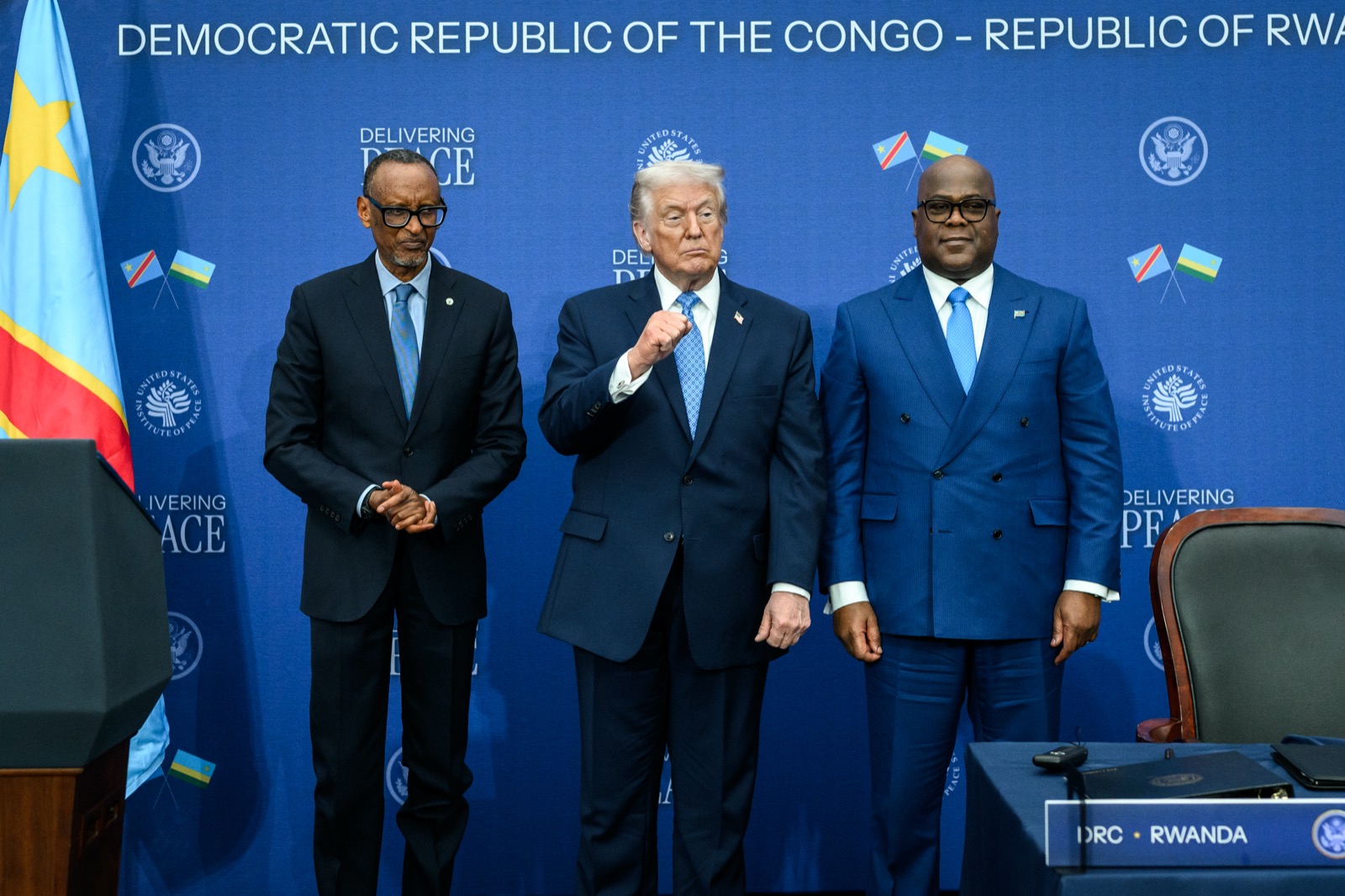
On 4 December Tshisekedi and Kagame, in Donald Trump’s presence, signed a joint declaration bringing the April DoP, June agreement and REIF under the name “Washington Accords.” Around that ceremony, the Group reports, RDF and AFC/M23 took Uvira (10 December). Command of the offensive is attributed in S/2026/466 [1]; on the same 10 December Kigali blamed FARDC and Burundi, spoke of 20,000 Burundian soldiers and shelling of Kamanyola, a party’s figure not verified here. Uvira was vacated on 18 January 2026 under international pressure; the forces redeployed. The Group calls these movements, and the March 2026 “initial steps” involving movements of 15–20 km, “tactical repositioning.” On 2 March OFAC sanctioned the RDF for “blatant violations.” On 28 October it sanctioned the MoD and Zigama, again calling for withdrawal.
The texts exist. Their full implementation was not documented when the Group’s investigations closed on 15 April 2026. Regarding the subsequent timetable, French draft resolution S/2026/522 [16] (29 June 2026) requests an interim report “no later than 30 December 2026.” S/2026/522 [16] is a draft resolution, not the interim report and not, by itself, evidence that the mandate renewal was adopted. No subsequent interim report is used here: the dossier’s military data remain limited to the stated window. Resolution 2808 (19 December 2025) reiterates the demand to end RDF support and withdraw, and mentions Uvira’s capture. Red traffic light for the assertion that the agreements have already been fully implemented: the sources used do not establish that. Red means an unconfirmed conclusion, not that the agreements are forged documents.
Sanctions: different evidential weight, one method
On 20 February 2025 the United States listed Kabarebe and Kanyuka (sb0022 [17]). On 17 March the EU listed Bisimwa, Karusisi, Nkubito, Muhizi, other M23 officials and Gasabo Gold Refinery: RDF presence in the DRC “has as its objective reinforcing the operations” of M23/ARC. On 2 March 2026 the United States escalated to designating the RDF institution (sb0411 [18]). On 25 June it targeted the gold supply chain (sb0543 [19]). On 28 October it targeted the ministry and Zigama (sb0668 [14]). On 11 November the 1533 Committee added FRN as an AFC alias.
Sanctions create obligations within the jurisdictions and for the persons to which they apply; they are not criminal judgments. They establish that Washington, Brussels and the 1533 Committee adopted, for listing purposes, the position on RDF support or AFC/FRN identity. They do not replace the Group. They do not settle Kigali’s invocation of a right to self-defence. Kigali has called them unfair and unilateral.
Civilians are not a separate issue
This dossier concerns evidence of external support. The relationship between operational direction and responsibility for abuses is central to the reports cited, distinct from a court’s determination of individual responsibility. A/HRC/60/80 [3] identifies possible crimes by all sides between January and July 2025, with M23 conducting repression in captured territories. HRW’s June 2026 PDF describes Rumangabo and Tshanzu as detention and recruitment camps: cells, pits, instructors described as Rwandan, children and “graduation” ceremonies filmed in 2026. Amnesty had already described detention sites in Goma and Bukavu in May 2025, and mines in September 2026. The Group attributes the largest share of violations among non-state groups in 2025–early 2026 to AFC/M23, and the largest share among state actors to FARDC. Roundups, sexual violence and child recruitment must be documented and attributed case by case, regardless of the perpetrator.
Kigali rejected HRW’s Binza dossier as having “no basis in fact.” That is recorded as a denial, not an expert investigation.
Reading the evidence: the dossier’s traffic lights
RDF presence — green. Strong, repeated evidence of Rwandan troops in the DRC. Limitation: varying numbers, with the latest UN investigation cutoff in April 2026.
Weapons and training support — green. The Group documents systems and training as breaches of the embargo.
De facto operational command — green; full legal occupation classification — yellow. The Group describes direction and hierarchical subordination. OHCHR retains “may amount.” HRW asserts occupation.
Rubaya to Rwanda — green for the mechanism, yellow for export volumes.
FDLR self-defence as the sole cause — yellow. The FDLR are real; they do not alone explain the scale of RDF operations.
FARDC–FDLR collaboration — green. The Group documents support and cooperation. This does not mean all Wazalendo militias are FDLR or that Kinshasa ordered every action they took.
Full Washington/Doha implementation — red. The texts are authentic; investigations through 15 April 2026 and the later instruments cited here do not demonstrate full implementation. This is not a real-time assessment of every obligation.
Rwandan budget financing, distinct from taxes collected on the ground — yellow. Taxes and in-kind support: solidly documented. Zigama/MoD: an original US allegation, not a UN audit.
No “debunked/false” label is applied to these claims: Kigali’s denials are not contrary evidence of the same strength as the UN report series; UN evidence does not erase the FDLR or Kinshasa’s failures to implement its obligations.
Sources and limits of verification
The five Group of Experts reports (S/2024/432 [2], S/2024/969 [8], S/2025/446 [7], S/2025/858 [9], S/2026/466 [1]); resolutions 2773 and 2808; meeting record S/PV.9865 [12]; A/HRC/60/80 [3]; the peace agreement in Rwanda’s Official Gazette; the Joint Declaration of 4 December 2025; OFAC sb0022 [17], sb0411 [18], sb0543 [19] and sb0668 [14]; the State Department statement of 28 October 2026; EU Regulation 2025/509 (EUR-Lex PDF); SC/16506 (official reprint); MINAFFET statements; Amnesty AFR62/1454/2026; HRW’s Death Was Everywhere (PDF and release of 10 June 2026). Citations lead to the documents used. Investigative reports set out their own methods and limitations; sanctions are attributed to the authorities adopting them. Non-public evidence cited by investigators has not been independently reconstructed by the editorial team.
For other developments in the DRC: Eastern Congo: fighting in Kalehe [20] (15 November 2026); Congo: violence disrupts Ebola treatment and contact tracing [21] (16 November 2026).
Claims and limits of the evidence
Ten separate assertions. The colour concerns the statement and cited evidence, not the entire conflict. Latest UN military investigation cutoff: 15 April 2026; this is not field verification as of 17 November. Red means unconfirmed, not FALSE.
Documented within the stated scope
During the periods investigated from 2024 to 15 April 2026, RDF troops were deployed in the DRC.
The UN Group repeatedly documents their presence. Estimates concern different periods and provinces: they cannot be added together and do not describe troop strength in November 2026. [2] [1]
Documented within the stated scope
In its 2024–2026 reports, the UN Group documents Rwandan operational direction of M23.
The Group describes withdrawal orders and decisions on territories to seize, hold or leave. Operational command does not automatically establish the legal classification of occupation. [2] [7] [1]
Conclusion not fully established
All the territories considered can uniformly be classified as occupied by Rwanda.
That extension is not established. HRW assesses effective control and occupation; OHCHR uses qualified language on overall control. These are different analyses, not a universal judgment covering every area. [3] [11]
Conclusion not fully established
The exact share of all Rwandan exports originating in Rubaya trafficking is established.
Not established by the sources used here: documenting this supply chain does not alone provide the full denominator of national exports. This is not an estimate of zero. [1]
Conclusion not fully established
Self-defence against the FDLR alone explains all the RDF operations examined.
The FDLR threat is documented. However, the Group identifies territorial conquest and consolidation as predominant aims and notes Uvira without a reported FDLR presence; this does not mean the FDLR do not exist. [7] [1]
Documented within the stated scope
During the period examined in the 2026 report, FARDC elements cooperated with FDLR elements according to the UN Group.
Paragraph 104 describes FDLR elements in coalitions with the knowledge or approval of several FARDC officers and authorities. It does not equate every Wazalendo with the FDLR or attribute every action to Kinshasa. [1]
Full implementation unconfirmed
The Washington/Doha agreements had been fully implemented by 15 April 2026.
An unconfirmed conclusion: the Group documents repositioning, continued control, reinforcements and failure to implement anti-FDLR operations. Red does not mean forged agreements or a real-time assessment of every obligation. [1]
Conclusion not fully established
Rwandan budget funding for M23, distinct from field taxation, has been publicly verified.
The US statement of 28 October 2026 describes the role of Rwanda’s Defence Ministry and attributes transactions benefiting M23/AFC to Zigama. It establishes the US act and allegations, not a public banking audit or an equivalent UN Group finding. [14]
Sources
- S/2026/466
A · Provenance · Link to the document cited in the dossier.
B · Content and limitations · Documentary verification limited to passages identified in the manuscript and addendum; it does not certify a full reading, independent reconstruction of evidence or automatic independence between sources. §§96–99; §100; §§213–221; §95;§130; §104; §§47–51
- S/2024/432
A · Provenance · Link to the document cited in the dossier.
B · Content and limitations · Documentary verification limited to passages identified in the manuscript and addendum; it does not certify a full reading, independent reconstruction of evidence or automatic independence between sources. §43; §§38–39;47–48; §45
- A/HRC/60/80
A · Provenance · Link to the document cited in the dossier.
B · Content and limitations · Documentary verification limited to passages identified in the manuscript and addendum; it does not certify a full reading, independent reconstruction of evidence or automatic independence between sources. §20
- https://www.frn-rdcongo.com/discours
- https://scb.gov.bs/wp-content/uploads/2026/11/IOEAMA-UNSCR-Ref-SC16506-Democratic-Republic-of-the-Congo-11-November-2026-1.pdf
- S/2012/843
- S/2025/446
A · Provenance · Link to the document cited in the dossier.
B · Content and limitations · Documentary verification limited to passages identified in the manuscript and addendum; it does not certify a full reading, independent reconstruction of evidence or automatic independence between sources. §24; §18; §42
- S/2024/969
A · Provenance · Link to the document cited in the dossier.
B · Content and limitations · Documentary verification limited to passages identified in the manuscript and addendum; it does not certify a full reading, independent reconstruction of evidence or automatic independence between sources. §§64–66
- S/2025/858
- https://www.minaffet.gov.rw/updates/news-details/statement-on-situation-in-eastern-drc
- Human Rights Watch · Death Was Everywhere (2026)
A · Provenance · Link to the document cited in the dossier.
B · Content and limitations · Documentary verification limited to passages identified in the manuscript and addendum; it does not certify a full reading, independent reconstruction of evidence or automatic independence between sources. p.3;pp.68–71 (printed);p.71: would appear
- S/PV.9865
- https://www.amnesty.org/en/documents/afr62/1454/2026/en/
- U.S. Treasury · sb0668
A · Provenance · Link to the document cited in the dossier.
B · Content and limitations · Documentary verification limited to passages identified in the manuscript and addendum; it does not certify a full reading, independent reconstruction of evidence or automatic independence between sources. 28 October2026;Zigama/MoD paragraphs
- https://mofa.gov.qa/en/qatar/latest-articles/latest-news/details/2025/07/19/qatar-hosts-signing-of-declaration-of-principles-between-drc--march-23-movement
- S/2026/522
- U.S. Treasury · sb0022
- U.S. Treasury · sb0411
- U.S. Treasury · sb0543
- https://sinevelo.com/en/news/congo-sud-kivu-frn/
- https://sinevelo.com/en/news/congo-ebola-violenze-cantine-aloya/