
Dossier
Bandera, the OUN-UPA and Ukraine’s far right
In brief
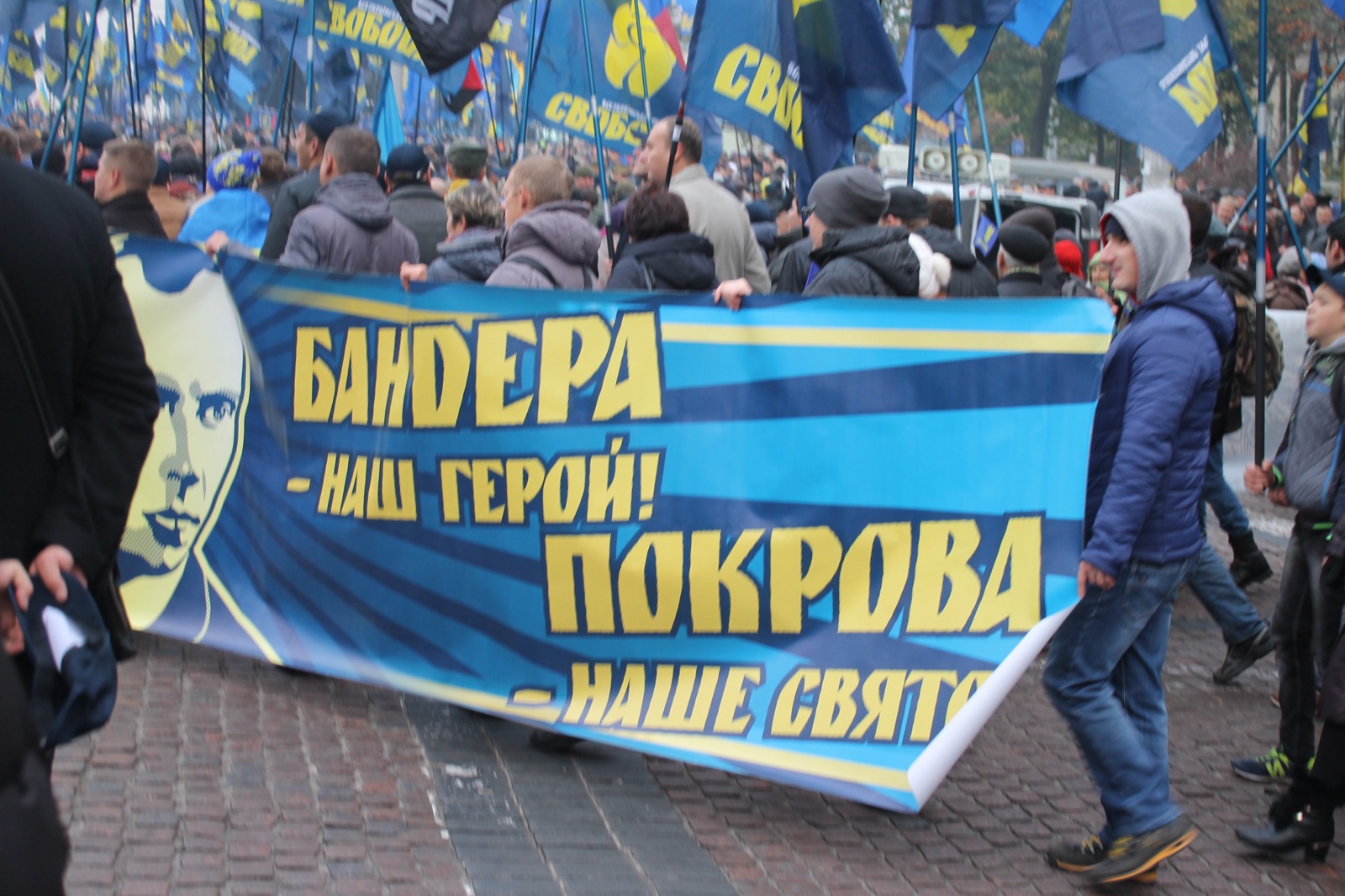
Stepan Bandera is not merely a historical figure: he has become a symbol where Ukrainian independence, nationalist violence, Nazi occupation, Soviet repression and contemporary war overlap. Precisely for that reason, his name is often used to answer questions that it cannot answer on its own. A flag in a march does not measure an election result. An election result does not describe every network of power. Condemning the crimes of the OUN and UPA does not automatically turn the whole of contemporary Ukraine into a continuation of those organizations.
The starting point is to distinguish three levels. The first concerns what Bandera, the Organization of Ukrainian Nationalists and the Ukrainian Insurgent Army did. The second concerns how that past is remembered, celebrated or suppressed. The third concerns the weight of radical parties and formations in Ukraine over recent decades. There are connections between the three, but no shortcut allows one to stand in for another.
This dossier offers neither absolution through anti-communism nor collective guilt through nationalism. Collaboration with Nazi Germany, crimes against civilians and repression suffered at German hands can belong to the same history. Fighting a criminal regime does not absolve anyone of their own crimes. Being victims of repression does not mean having respected other populations’ rights at other times.
The question to keep in view is concrete: who did what, against whom, in which year and under whose command? From there we can approach the political question: why has such a controversial leader become a national emblem for many Ukrainians, while for many Poles and Jews his name evokes persecution and massacres above all?
Frequently asked questions
Did Bandera command every unit called “Banderite”?
No. The term can indicate political affiliation or a symbolic reference, not just military subordination. To attribute an operation, the actual command in the period concerned must be reconstructed. This matters particularly in 1943, when Bandera was detained and other leaders operated on the ground. His political authority remains an important issue, but does not replace evidence of a specific order.
Does German imprisonment prove that he did not collaborate with the Nazis?
No. The attempt to obtain German support for a Ukrainian state preceded repression. Collaboration and subsequent detention can belong to the same biography. The arrest of July 5, 1941, does not erase earlier choices and does not support the claim that Bandera was already a prisoner during the pogrom of July 1.
Were the OUN, UPA and Waffen-SS Galizien the same organization?
No. The OUN was an underground political movement, later divided into factions; the UPA an insurgent structure; Galizien a Waffen-SS division. Relationships between people, recruitment and territories must be studied, but do not make the structures identical. The distinction is also essential for correctly assigning crimes and responsibility.
Does discussing Ukrainian victims minimize the massacres against Poles?
It should not. Every civilian population deserves an accurate account of the violence it suffered. Acknowledging reprisals and deportations does not justify a campaign against Polish civilians, nor automatically establish symmetry. Comparisons require compatible periods, territories and criteria: setting two figures against each other is not enough.
What happened to the “Hero of Ukraine” title awarded in 2010?
That decree was annulled. The ruling of April 2, 2010, concerned the citizenship requirement, not a criminal conviction over his historical activities. The fact that he remains celebrated by part of society or local institutions is a different question from the validity of that particular honor.
Does the 2015 law imprison people who criticize Bandera?
That conclusion cannot automatically be drawn from Article 6. The provision considers denial of the struggle’s legitimacy unlawful and refers to liability under legislation; it does not itself specify a prison sentence for any criticism. To speak of a concrete conviction requires an applicable provision and an identified court case. The question of freedom of research can still be debated without inventing penalties.
If Bandera was popular in polls, did Ukrainians approve of the massacres?
The poll cited did not ask that question. A positive view of the figure does not directly measure knowledge or approval of every action of the OUN and UPA. Nor does it prove the opposite. Studying that relationship would require asking respondents what they know about individual episodes and how they assess them.
Do few votes mean the far right had no influence?
No. Election results measure one form of political strength, not every form. Organization, networks and presence during crises can generate additional influence. But that influence, too, must be demonstrated through episodes and decisions: it cannot become a universal explanation detached from evidence.
Does the 2024 US review absolve Azov’s entire history?
No. An assessment of a unit’s eligibility for assistance is not a final judgment on every past episode, or on every individual’s ideology. Allegations and facts described in human rights reports must be examined within their time frame and according to their respective degree of substantiation.
How can this history be read without becoming a tool of propaganda?
By checking the relationship between the question and the evidence. An image is not an ideological census; an election result does not reconstruct military command; a memory law does not resolve a historical dispute. Asking for dates, perpetrators, those affected and context is not relativism. It is the way to avoid both collective absolution and collective accusation, keeping the facts and the victims at the center.
1. A map of the names, before the judgments
The OUN was founded in Vienna in 1929. After the death of its first leader, Yevhen Konovalets, the struggle over the organization’s leadership led to the split between Andriy Melnyk and Stepan Bandera in 1940; the Banderite faction held its own congress in April 1941. The names OUN-M and OUN-B therefore designate competing organizations. Source: Internet Encyclopedia of Ukraine, OUN [1].
The Waffen-SS “Galizien” division belonged to a different military organization: the German Waffen-SS. It was not simply another name for the UPA. Even where recruitment, territory, national references or individual biographies overlapped, command and organizational affiliation remained matters requiring precise identification. Confusing the structures does not make an account of crimes more rigorous: it makes it less capable of assigning responsibility.
Svoboda and Pravyj Sektor, by contrast, belong to contemporary Ukrainian politics. Azov emerged in the context of the war of 2014. Discussing them requires tracing any ideological or symbolic continuities, rather than assuming automatic organizational continuity with movements from seventy years earlier. A reused name, a displayed portrait and a chain of command are three different kinds of connection.
From local formations to the UPA controlled by the OUN-B
The UPA’s emergence was a process involving competing formations. In 1943 the organization controlled by the OUN-B disarmed and absorbed some of Taras Borovets’s men and members of Melnykite groups. Following Mykola Lebed, Roman Shukhevych took over the OUN-B leadership in May 1943, while Bandera was detained. The following August the movement announced a more open political program: its promises, however, do not establish conduct on the ground, where massacres of Polish civilians were taking place. Source: IEU, OUN [1].
2. Bandera before the war: independence and political violence
Bandera was born in 1909 in Galicia, then part of Austria-Hungary. His political formation took place in interwar Europe, amid a Ukrainian national question shaped by disputed borders and states hostile to its realization. This context helps explain the movement, but cannot replace an assessment of its methods. A demand for independence and authoritarian methods can coexist: the former does not make the latter democratic.
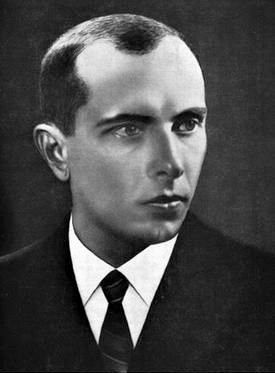
The OUN sought an independent Ukrainian state and conceived of the national struggle as a commitment above the ordinary rules of politics. Its repertoire included underground activity, sabotage and political assassination. Bandera rose through the organization’s ranks in interwar Poland; he was arrested in 1934 and tried over the movement’s activities, including the assassination of Polish minister Bronisław Pieracki. His death sentence was commuted. The historical article by Mirosław Szumiło for the IPN [2] traces this trajectory and the acceptance of violence within Banderite political culture.
Defining that culture also requires terminological precision. “Nationalist,” “fascist,” “collaborationist” and “Nazi” are not universally interchangeable. The first term can describe very different movements; the second involves a historical classification that must be argued; the third describes a relationship with an occupying power; the fourth identifies a specific ideology and political system. Using these words carefully does not soften antisemitism or violence: it makes it possible to explain how they operated.
3. 1941: the statehood project and the relationship with Germany
The German attack on the Soviet Union opened a possibility that Ukrainian nationalists interpreted as an opportunity for state-building. On June 30, 1941, in Lviv, the Banderite faction proclaimed a Ukrainian state and a government led by Yaroslav Stetsko. The project sought Nazi Germany’s support; it did not originate as an embrace of liberal democracy or principled opposition to Nazism. Berlin, however, had no intention of recognizing that independent state.
The break came when Bandera and Stetsko did not withdraw the proclamation. According to historian Kai Struve’s account, Bandera was arrested on July 5, 1941, and Stetsko on July 9; detention and internment followed. This sequence is essential: the attempt at collaboration preceded German repression. That repression does not prove that such collaboration had not been sought. Source: Struve, “Stepan Bandera: Geschichte, Erinnerung und Propaganda,” bpb [3].
4. Lviv: distinguishing the perpetrators does not mean dividing guilt until it disappears
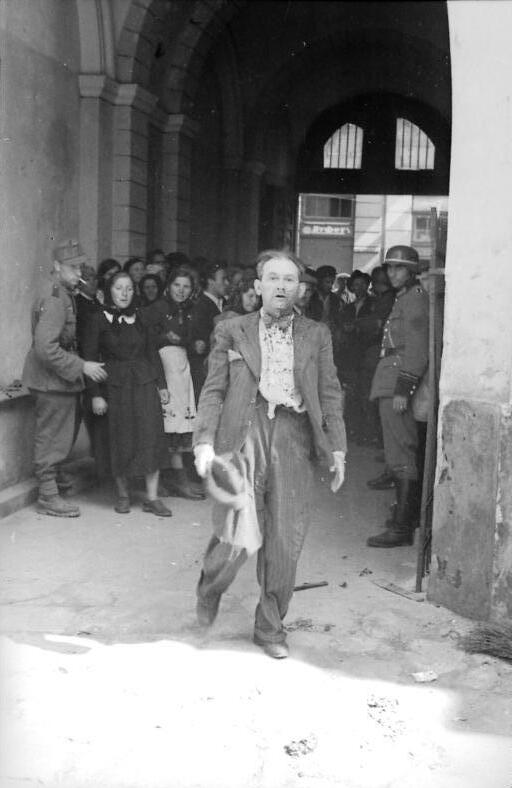
The Lviv pogrom of July 1, 1941, is an episode in which distinguishing the actors is particularly important. In his study published in 2011, John-Paul Himka examines German agencies, the nationalist militia and the urban crowd. His account assigns the Germans a decisive role in the context of the violence and in executions, and the militia established by the OUN an active role in roundups and in taking victims away. The crowd’s participation added public violence, humiliation and assaults. Himka, “The Lviv Pogrom of 1941,” pp. 209–243 [4].
Limits of the evidence: the personal order
The sources discussed here do not document a personal order from Bandera for the pogrom of July 1. Himka’s [4] research reconstructs the role of the organization and the perpetrators: it must not be turned into an order signed by the leader. This limit is not a general absolution and cannot be transformed into proof of freedom from all political responsibility.
5. Volhynia and Eastern Galicia: civilian communities were also targeted
The question of the anti-Polish massacres cannot be reduced to an abstract comparison between nationalisms. In the villages of Volhynia and Eastern Galicia, violence targeted civilian communities: people who did not become combatants simply because they belonged to the population regarded as the enemy. A military history of the UPA told only through clashes with Germans or Soviets would therefore be incomplete.
The IPN’s historical portal places the toll between the winter of 1942–1943 and mid-1945: around 100,000 Polish victims, including 40,000–60,000 in Volhynia, 30,000–40,000 in Eastern Galicia and at least 4,000 in territories now belonging to Poland. The core of the campaign occurred in 1943–1944; that overall toll, however, uses a broader time frame. These are territorial estimates, not a complete named list, and must not be added together as though every endpoint of the ranges were a certain count. The same page acknowledges Ukrainian victims of Polish reprisals and distinguishes that violence from the OUN-UPA campaign. Source: IPN, “The Effects of the Volhynian Massacres” [5].
Acknowledging those reprisals does not mean turning every episode into an inevitable or justified response. A civilian does not lose the protection they are owed because others belonging to their community have committed crimes. But acknowledging them does not automatically mean asserting perfect symmetry between campaigns, responsibilities and the scale of violence either. Comparison requires compatible dates, locations, perpetrators and criteria, not two isolated numbers on opposite sides of a scale.
In 2016 the Polish Sejm recognized the killings as genocide and established a national day of remembrance. The resolution refers to more than 100,000 citizens of the Second Polish Republic, a category that does not consist only of ethnic Poles. It also remembers Ukrainians who helped the victims. It is important not to rewrite the document in a way that is simpler and more exclusive than it actually is. Resolution of July 22, 2016, Monitor Polski, no. 726 [6].
A parliamentary resolution can be a primary source for understanding memory politics and the characterization adopted by a state. It does not replace an individual criminal trial. This limit does not cast doubt on the massacres: it clarifies that documenting a campaign of violence, defining it legally and assigning responsibility to individual defendants are connected but different operations.
6. Who was in command? The problem of personal responsibility
Saying “the Banderites” can be useful for identifying a political current, but is not enough to reconstruct who commanded a particular operation. In 1943 Bandera was detained by the Germans. Leadership of the OUN-B and UPA on the ground therefore requires examining active leaders and commanders, including Roman Shukhevych, rather than automatically attributing every order to the symbolic leader.
This distinction is not a device for closing discussion of Bandera’s responsibility. In his IPN article, Szumiło separates uncertainty about the detainee’s operational influence from a judgment on the leader’s moral responsibility. It is a signed historical assessment, not a judicial ruling. Readers must be able to recognize the difference between the fact of detention, evidence about contacts and a judgment on the consequences of the ideas advocated. Source: Szumiło/IPN [2].
7. Repression and deportations: another part of the history, not an erasure
The story does not end with the German-Soviet war. The return of Soviet power involved a struggle against the insurgency and forms of repression that also affected the civilian population. Telling this experience is necessary to understand why the UPA’s image could become associated, in family memory, with resistance to an oppressive power. But the memory of repression suffered does not retroactively determine an organization’s innocence regarding crimes committed against other communities.
A case to keep distinct is Operation Wisła in 1947. The introduction to the IPN documentary collection of that name describes the forced transfer of more than 140,000 people of Ukrainian nationality from southeastern Poland to the country’s western and northern territories. The motive of depriving the UPA of territorial support does not make the deported population equivalent to combatants. Source: IPN, “Akcja Wisła 1947” [7].
Here one of the difficulties of public memory becomes apparent. A family may remember its own dead or deportation above all; a neighboring community may associate the same movement with attacks it suffered. Those two memories do not become equivalent in evidentiary terms, but neither should be erased simply because it disrupts a national narrative. History’s task is to reconstruct the relationships between those experiences, not turn one group’s suffering into a license to deny another’s.
Release, exile and assassination
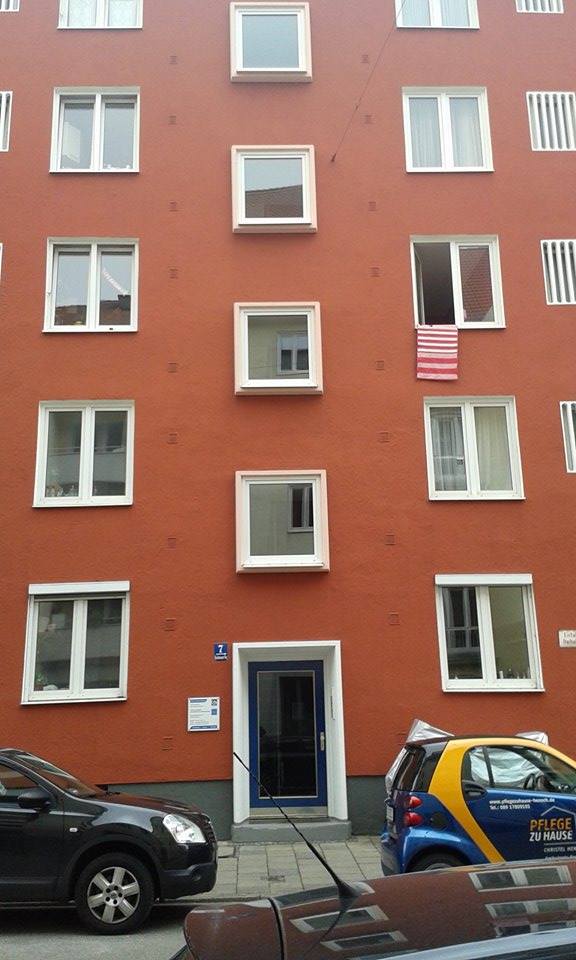
Bandera was released from German detention in September 1944. In his IPN article, Szumiło dates the release to September 27 and places it within the German attempt to use Ukrainian networks against the Soviet advance. Release did not bring about the independent state sought in 1941. After Germany’s defeat, Bandera settled in Munich, in the American occupation zone, and continued political activity in exile. Source: IPN, postwar section [2].
The émigré group did not remain united: Bandera continued to assert his leadership amid political and organizational divisions. The IEU biographical entry identifies him as head of the OUN’s foreign sections from 1953. On October 15, 1959, he was assassinated in Munich by Soviet agent Bohdan Stashynsky. His death strengthened his image as a martyr among supporters, without resolving controversies over his choices and the crimes of organizations that had invoked him. Source: IEU, Bandera [8].
8. National hero: a legal title is not unanimous consensus
In January 2010 Viktor Yushchenko awarded Bandera the title of Hero of Ukraine. The decree is dated January 20; the public presentation of the insignia to his grandson took place on January 22. On April 2 of the same year, the Donetsk Administrative Court annulled the decree, citing the Ukrainian citizenship requirement for that title. Bandera had died in 1959, before independent Ukraine came into existence.
In its reasoning, the court expressly ruled out making an assessment of Bandera’s historical activities. Its decision concerned the legality of the award. It was therefore neither a criminal conviction for wartime crimes nor a denial of them. Text of the judgment of April 2, 2010, case 2а-1219/10/0570 [9].
The decision to honor him also prompted a European response: in its resolution of February 25, 2010, the European Parliament deplored the award, referring to the OUN’s collaboration with Nazi Germany. This is confirmed by the official summary of the parliamentary procedure [10]. It was a political position on the honor, distinct from the Ukrainian court’s subsequent legal reasoning.
The case shows why “national hero” can mean different things. It can be a title awarded under a law; it can describe a political cult; it can be the judgment of part of society. The loss of the first does not automatically make the other two disappear. Conversely, a monument or commemoration does not prove that a legal title remains valid.
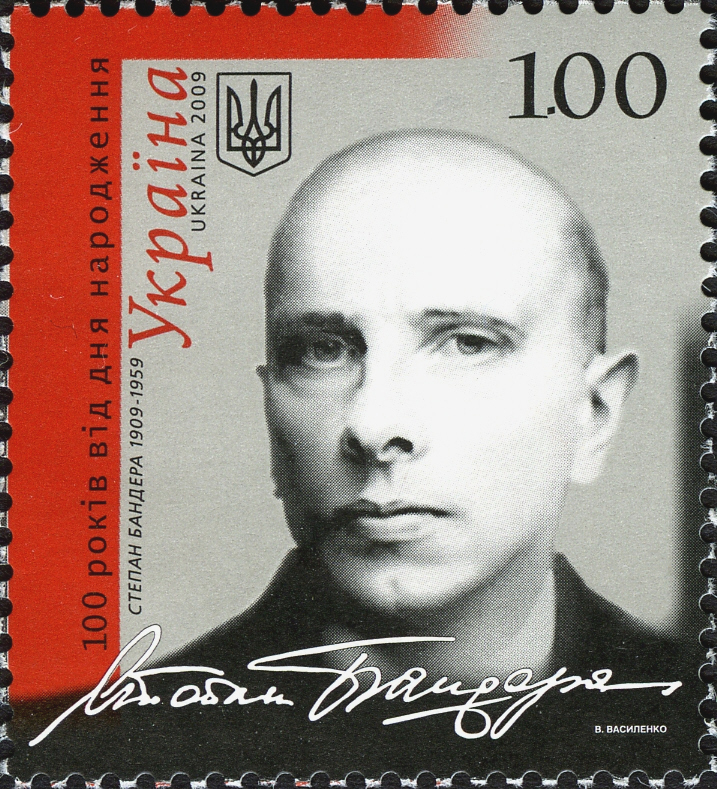
9. The 2015 law: recognition and limits on public discourse
Law 314-VIII was adopted on April 9, 2015, and signed on May 15; it entered into force on May 21. It included the OUN and UPA among organizations whose members are recognized as fighters for Ukrainian independence. It did not individually confer the title of Hero of Ukraine on every militant. The dates and the scope of recognition must be distinguished. Text of the law, ministry-hosted copy of the Rada printout [11]; UINP, chronology of the legislative package [12].
In the historical version examined, paragraph 2 of Article 6 characterizes public denial of the legitimacy of the independence struggle as unlawful. Paragraph 1 refers to legislation for liability relating to public contempt toward the fighters and obstruction of their rights. It does not, on its own, establish a prison sentence for every historical criticism. To assert a specific prosecution or conviction, the applicable provision and proceedings must be identified, rather than inferred from the mere existence of the commemorative provision.
A substantive question remains: how much room does a memory law leave for an account that also documents crimes committed by members of the celebrated movements? There is no need to invent penalties to take the problem seriously. Public recognition can shape school curricula, museums, monuments and institutional language even when it does not lead to a trial.
10. What polls about Bandera measure
In the KIIS survey conducted from January 19 to 27, 2023, 83% of respondents expressed a positive view of Bandera and 11% a negative one. The survey comprised 2,004 telephone interviews and was commissioned by the Ministry of Culture and Information Policy. The result must be tied to that survey and its reachable population, not presented as a current poll or one indiscriminately representative of everyone living within Ukraine’s international borders. KIIS, historical memory report, January 2023 [13].
The question about the figure did not ask respondents to approve the Lviv pogrom, the Volhynia massacres or the OUN’s programs individually. The figure therefore does not directly measure approval of those crimes. But neither does it show that every respondent knew about and condemned them: specific questions would be needed to establish that. The limitation works in both directions.
11. Far-right votes: real strength, not unlimited power
In the 2012 parliamentary election, Svoboda received 10.44% [31] of party-list votes. The CEC records 25 elected representatives in the nationwide constituency and 12 in single-member constituencies: 37 seats overall. The total must not be confused with the size of the parliamentary group at a later date, which can change. CEC, party-list representatives [14]; CEC, constituency results [15].
In 2014 Svoboda fell to 4.71% in the proportional component, while Pravyj Sektor received 1.80%. In 2019 the Svoboda list reached only 2.15%. The figures describe a reduction in electoral weight compared with 2012, not an identical measurement at every stage of the political crisis. CEC, 2014 parliamentary election [16]; CEC, 2019 parliamentary election [17].
In the 2019 presidential election, Ruslan Koshulynskyi received 1.62% in the first round. Zelensky received 30.24% in the first round and 73.22% in the runoff, equivalent to 13,541,528 votes. These are results published by the CEC, not a measure of every service member’s or official’s ideological orientation. CEC, first round [18]; CEC, runoff [19].
The objection “but they had few votes and still mattered” deserves a serious response. During political crises, influence can also operate through organization, presence in the streets, local networks and coercive capacity. Those factors cannot be measured by vote share alone. They do not, however, justify jumping straight to the opposite conclusion: that a minority controlled every state decision.
To demonstrate such influence, specific decisions must be traced: who imposed a choice, through which institution or pressure, with which allies and with what outcome? Without these steps, “they mattered more than their votes” may be a useful question but remains too vague a description to explain a government, a law or a military operation.
For the context of street protests, militant groups and the shootings, see the chapter on Maidan and the far right [20].
12. The 2014 government: documenting appointments without extending them to everyone
The first Yatsenyuk government included Svoboda representatives. The official announcement of February 27, 2014, records Oleksandr Sych as deputy prime minister, Andriy Mokhnyk at Ecology and Ihor Shvaika at Agriculture. In an interview the following November, Sych described Mokhnyk and Shvaika as his party colleagues. Cross-referencing the two documents makes it possible to distinguish the appointments, established by the institution, from political affiliation, directly stated by a participant. Ukrainian government, appointments [21]; interview with Sych, November 28, 2014 [22].
Their presence is a fact to report, not a detail to hide behind subsequent election results. It shows that the radical right’s weight in the 2014 change of government cannot be described solely by the percentage obtained in the October parliamentary election. It does not, however, prove that all ministers belonged to that current or that the entire government shared the same ideology.
13. Azov: origins, conduct and assistance require different checks
Two mirror-image conclusions must be avoided regarding Azov: that a later favorable assessment erases the entire past, or that the past automatically determines every member’s responsibility in any year. The unit’s history, its founders’ ideology, individuals’ conduct and decisions on international assistance require different sources.
In its thirteenth report on human rights in Ukraine, published in March 2016, OHCHR described incidents involving Azov at Shyrokyne and reported allegations of ill-treatment in Mariupol. The document also includes the case of an Azov service member tortured after capture: in that passage, his affiliation identifies the victim, not the perpetrators. Allegations collected from detainees must be presented as such, not automatically turned into judicial convictions. OHCHR, report of March 3, 2016, paragraphs 25, 61, 103 and 161 [23].
In 2018 the US appropriations law Public Law 115-141, in Section 8129, prohibited the use of funds made available by that act for arms, training or other assistance to the Azov Battalion. The restriction concerned those funds: it was not a statement about NATO and did not, through that provision alone, establish an unchangeable ban for every subsequent period. Original text, Govinfo, Section 8129 [24].
In June 2024, according to State Department statements reported by CBS, the 12th Azov Brigade was found eligible for US assistance after the review required under the Leahy rules. That result concerned a particular assessment and unit: it was not a retroactive judgment on every episode of the earlier war. CBS, June 11, 2024 [25].
14. Hunka in Canada: a real scandal, inferences requiring proof
On September 22, 2023, during Zelensky’s visit to the Canadian Parliament, Speaker Anthony Rota paid tribute to Yaroslav Hunka. The episode caused a scandal connected to his service in the Waffen-SS. The 14th Division is identified in the Friends of Simon Wiesenthal Center’s public protest of September 24 [26]. The German government spokesperson, on September 27 [27], confirmed his voluntary service in the Waffen-SS and called the tribute unacceptable. These statements are not an individual judgment on Hunka’s conduct during the war. In his September 24 statement, Rota assumed responsibility for the initiative and said that parliamentarians and the Ukrainian delegation had not been informed of his intentions in advance. Parliamentary record, appendix of September 22 [28]; Rota’s official statement [29].
The statement documents what Rota said. It does not provide access to the private knowledge of everyone present. Applause is observable behavior; claiming that those applauding already knew that biography and intended to celebrate it requires additional evidence. The distinction does not diminish the seriousness of the institutional error, but prevents the attribution of unproven intentions.
Similarly, an episode in Canada does not prove a different assertion about funerals or reburials in Ukraine. If a president is said to have attended a particular ceremony for a collaborator, the person commemorated, location, date, participants and president’s role must be identified. Mixing different videos or using the Hunka scandal as universal proof does not answer those questions.
Further viewing: Rota’s apology in the House, September 25, 2023, on Global News [30].
15. National memory can be debated without denying a nation
The conflict around Bandera cannot be resolved simply by asking whether he was “good” or “bad.” Political choices, organizations’ crimes, detention and the later use of his image must be distinguished without separating them artificially. A biography does not coincide with propaganda constructed after death, but neither does it disappear inside that propaganda.
For a society, choosing a symbol also means deciding which aspects to make visible. Celebrating only the struggle for independence can leave out Polish and Jewish victims; describing every form of independence movement solely as a foreign instrument can erase real repression and aspirations. The criterion should not be the convenience of the narrative, but its ability to include what challenges it.
Criticizing a monument does not mean denying the right to Ukrainian independence. Documenting a nationalist crime does not attribute that crime to today’s citizens. And challenging Russia’s use of the theme of “denazification” does not require pretending that Ukraine’s far right never existed. Effective research must be able to maintain these distinctions simultaneously.
Claims and limits of the evidence
Documented within the stated scope
The OUN split into two competing factions in 1940.
The division between the OUN-B and OUN-M is documented in the encyclopedic account; the Banderite congress of April 1941 was a subsequent development. [1]
Documented within the stated scope
Bandera’s arrest followed the proclamation of June 30, 1941.
The July 5 date separates the moment of repression from that of the collaborationist project. It does not support the assertion that he was already detained during the pogrom of July 1. [3]
Documented within the stated scope
The OUN militia played an active role in the Lviv pogrom.
This is the conclusion of Himka’s research based on testimony and visual documentation. Green refers to the documented organizational reconstruction, not to the participation of every member or a personal order from Bandera. [4]
Documented within the stated scope
The Sejm characterized those massacres as genocide in 2016.
This is verifiable in the adopted text. The card establishes the parliamentary position and its content; it does not attribute to an international court a judgment that the document is not. [6]
Limits of the evidence
The sources discussed here do not establish Bandera’s operational influence over the massacres of 1943 with certainty.
Detention, possible communications and symbolic authority are not the same thing. We do not present as a documented order what the sources discussed treat as uncertain influence or political responsibility. [2]
Documented within the stated scope
The 2010 decree was annulled at first instance over a legal requirement.
The judgment bases its decision on citizenship and distinguishes its task from a judgment on historical activities. That is the documented reason, not a trial concerning the massacres. [9]
Documented within the stated scope
The 2015 law includes the OUN and UPA in its recognition of independence fighters.
Points 10 and 12 of Article 1 establish this. It is a commemorative and legal status, not an examination of every member’s conduct. [11]
Documented within the stated scope
KIIS recorded a predominantly positive view of Bandera in January 2023.
Green refers to the poll’s result and period. It does not automatically measure adherence to OUN ideology, knowledge of the crimes or voting intentions in 2026. [13]
Documented within the stated scope
In 2019 Svoboda received 2.15% of party-list votes.
This is a narrowly defined electoral figure. It means neither “no far right” nor a complete measurement of militant groups’ power. [17]
Documented within the stated scope
Svoboda representatives held positions in the government of February 2014.
The appointments of Sych, Mokhnyk and Shvaika and Sych’s political testimony support this proposition. We do not automatically extend their affiliation to the other members of the executive. [21] [22]
Documented within the stated scope
The March 2016 OHCHR report recounts allegations collected against Azov members.
The documentary fact is verifiable in paragraph 103. Green certifies the presence of the testimonies in the document, not the judicially established truth of every allegation: these are not final convictions. [23]
Documented within the stated scope
Rota publicly assumed responsibility for the tribute to Hunka.
The September 24 statement is verifiable. Green does not automatically certify everything each participant knew before the ceremony. [29]
Sources
- IEU · OUN
A · Provenance · HTML copy of the IEU entry; historical sections for 1929–1943 and selected exile passages read.
B · Content and limitations · Supports the founding, 1940 split and organisational development. An encyclopaedic reconstruction, not original minutes; it does not transfer responsibility between organisations.
- Mirosław Szumiło / IPN
A · Provenance · Szumiło’s English historical article for IPN read; the recorded checks revisit Volhynia, release and death.
B · Content and limitations · Distinguishes uncertain operational influence in 1943 from the author’s assessment of moral responsibility. Not a judgment or proof of a personal order; clandestine contacts do not establish command.
- Kai Struve / bpb (2022)
A · Provenance · Kai Struve’s bpb article, 22 June 2022; the notes record a full reading of its body and targeted historical comparison.
B · Content and limitations · Supports the proclamation and arrests on 5 and 9 July 1941. Does not establish Bandera’s exact location on 1 July; normative judgments and 2022 observations do not certify conditions in 2026.
- John-Paul Himka (2011)
A · Provenance · PDF of Himka’s 2011 article obtained from a university host; selected reading of pp. 209–211, the Nachtigall passage and conclusions on p. 243.
B · Content and limitations · Supports the OUN militia’s active role, distinguishing the crowd and German apparatus. Not all 35 pages or underlying archival testimonies were read; no personal order by Bandera established here.
- IPN · The Effects of the Volhynian Massacres
A · Provenance · Body of the IPN historical page read.
B · Content and limitations · Polish casualty estimates with specified territories and winter 1942–1943 to mid-1945 scope, not a named inventory. Its Ukrainian total mixes 1945/1947 windows: not used as a comparable aggregate or automatic symmetry.
- Sejm · Monitor Polski 726 (2016)
A · Provenance · Official Monitor Polski 726 PDF, Sejm resolution of 22 July 2016: both pages read.
B · Content and limitations · Green concerns the fact that the Sejm called the massacres genocide. Not an international judgment; “citizens of the Second Republic” does not mean ethnic Poles alone, and the document is not a victim census.
- IPN · Akcja Wisła 1947
A · Provenance · IPN’s catalogue description of Akcja Wisła 1947 read.
B · Content and limitations · The description reports over 140,000 deportees. Neither the 832-page volume nor original orders were read; this figure does not verify Soviet deportations.
- IEU · Stepan Bandera
A · Provenance · Body of IEU’s Bandera entry read; updated in 2004, bibliography not consulted.
B · Content and limitations · Supports biography, exile and assassination on 15 October 1959. Original 1962 judgment not read; the entry does not establish monuments or current conditions in 2026.
- Dебет-Кредит · 2а-1219/10/0570
A · Provenance · Decision of 2 April 2010 read through the web on the commercial Dебет-Кредит mirror; download returned 403, original host not reached.
B · Content and limitations · First-instance annulment on citizenship grounds, not a historical judgment. Appeals, cassation and original decree not read here. Absence from the hearing does not mean no written defence.
- OEIL · 2010
A · Provenance · Official two-page OEIL summary read through the web; download timed out, full EP resolution blocked by a challenge.
B · Content and limitations · Supports the limited attribution of the February 2010 criticism of the honour. An institutional summary, not evidence of reading the full adopted resolution.
- 314-VIII · Rada / MVA
A · Provenance · Complete four-page PDF read: a ministry-hosted copy of the Rada printout dated 27 July 2020 for law 314-VIII.
B · Content and limitations · Article 1 points 10/12 recognises OUN/UPA; article 6 does not itself set an automatic prison sentence. Historical text, not verification of the version in force in 2026 or actual convictions.
- UINP · 2015
A · Provenance · Opening paragraphs of UINP’s institutional page on the legislative package read.
B · Content and limitations · Supports signature on 15 May and entry into force on 21 May 2015, distinct from adoption on 9 April. Does not establish every provision or its application through 2026.
- KIIS · 2023
A · Provenance · KIIS’s 76-page PDF acquired; summary, method and Bandera results read, not the full report.
B · Content and limitations · 2,004 interviews on 19–27 January 2023: 83% positive and 11% negative in the reachable population. Not a 2026 poll or a measure of approval of specific crimes or ideological allegiance.
- CEC · 2012 · 25
A · Provenance · CEC’s 2012 list-elected table read through the web: Svoboda heading, total of 25 and some names.
B · Content and limitations · Provides the list component of the 37-seat total. Must be combined with S15 for 12 constituencies; alone it proves neither 37 seats nor the later parliamentary group size. Not all biographies read.
- CEC · 2012 · 12
A · Provenance · Twelve CEC records of Svoboda’s 2012 constituency winners read: 19, 83, 116, 118, 119, 125, 145, 152, 163, 164, 189, 215.
B · Content and limitations · 12 constituency members plus 25 list members (S14) equals 37. Transparent calculation, not a full reading of the CEC book or a signed protocol; complementary components from the same election authority.
- CEC · 2014
A · Provenance · CEC’s 2014 parliamentary table read through the web according to the notes; direct download returned 500, no successful HTML copy in the package.
B · Content and limitations · Svoboda 4.71% and Pravyj Sektor 1.80% of list votes. Published data, not signed protocols; not a measure of all political or militant influence.
- CEC · 2019
A · Provenance · CEC’s 2019 parliamentary table read through the web according to the notes; download attempt returned 500.
B · Content and limitations · Svoboda received 2.15% of list votes in 2019. Not a complete measure of extra-electoral power; the link to our Maidan chapter is context, not independent evidence for this figure.
- CEC · 2019 · 1
A · Provenance · CEC’s first-round 2019 presidential table read through the web; extraction retained, direct download returned 500.
B · Content and limitations · Koshulynskyi 1.62%, Zelensky 30.24%: informational data published by the CEC, not a signed protocol. They do not measure every soldier’s or official’s ideology.
- CEC · 2019 · 2
A · Provenance · CEC’s 2019 presidential runoff table read through the web; extraction retained, direct download returned 500.
B · Content and limitations · Zelensky received 73.22%, or 13,541,528 votes. The result of that round, not an ideological census or confirmation of other historical claims.
- SINE VELO · Maidan
A · Provenance · Internal editorial link to the Maidan chapter; localised routes checked in the checkout according to the handoff, cloud HTTP attempts returned 403.
B · Content and limitations · Context on protests, groups and shootings only. Not a primary source or independent corroboration of CEC votes; remains outside green card c10.
- KMU · 2014-02-27
A · Provenance · Official KMU announcement of 27 February 2014, 15:37: appointment text read and HTML copy retained.
B · Content and limitations · Establishes Sych as deputy prime minister, Mokhnyk in Ecology and Shvaika in Agriculture. Party affiliation requires S22; the appointment list alone does not classify the entire government.
- Oleksandr Sych / Ukrainski Novyny
A · Provenance · Sych’s original Ukrainski Novyny interview, 28 November 2014; government passages read, HTML copy retained.
B · Content and limitations · Sych identifies Mokhnyk and Shvaika as party colleagues; appointments come from S21. An interested participant’s account, not verification of his political accusations. Reprints of the interview are not independent corroboration.
- OHCHR · 2016-03-03
A · Provenance · Original OHCHR PDF of 3 March 2016 acquired; §§25, 61, 103, 161 and context read, not the full report.
B · Content and limitations · c12 establishes that allegations appear in §103, not convictions. In §61, Azov identifies the victim. The 2014–2016 incidents alone do not prove ideology, every member’s responsibility or the 2024 brigade’s conduct.
- Govinfo · Public Law 115-141 · §8129
A · Provenance · Section 8129 and context of the 2018 Public Law 115-141 read on Govinfo according to the notes; not the entire law.
B · Content and limitations · Restriction on that act’s funds for weapons, training and assistance to Azov. Not a perpetual ban, a NATO decision or confirmation of law in force in 2026.
- CBS · 2024-06-11
A · Provenance · CBS article of 11 June 2024 read in full; copy retained. State.gov original not obtained: the saved file is an error page.
B · Content and limitations · Reports Department statements on Leahy vetting of the 12th Brigade. Not retrospective exoneration; exact lifting date unspecified. Repeated coverage of one statement is not independent corroboration; some history relies on the Washington Post.
- FSWC · 2023-09-24
A · Provenance · Original FSWC statement of 24 September 2023 read in full according to the notes; no body copy included.
B · Content and limitations · Primary source for the protest; identifies the 14th Waffen-SS Division. Waffen-SS service has separate institutional corroboration in S27, not personal guilt for specific crimes by Hunka.
- Auswärtiges Amt · 2023-09-27
A · Provenance · Final Hunka section of the German government’s 27 September 2023 press conference read in full; HTML copy retained.
B · Content and limitations · Official statement confirming voluntary Waffen-SS service and condemning the tribute. Guests’ lack of prior knowledge remains the spokesperson’s assertion, not independent access to their private knowledge.
- Hansard 222 · 2023-09-22
A · Provenance · Hansard 222: motion of 21 September and appendix for 22 September 2023 read, including Rota’s passage; not the entire sitting.
B · Content and limitations · Documents the setting and content of the 22 September tribute. The containing sitting’s date does not move the event to the 21st; it does not certify everyone’s prior knowledge.
- Anthony Rota · 2023-09-24
A · Provenance · Rota’s official statement of 24 September 2023: single page read in full, PDF retained.
B · Content and limitations · Documents his public acceptance of responsibility and claim that others had not been informed. c13 concerns the statement, not independent proof of each participant’s private knowledge.
- Global News · 2023-09-25
A · Provenance · Global News page and metadata dated 25 September 2023 documented; stated duration 46 seconds. Playback not verified.
B · Content and limitations · Link to the publisher’s player only. No audiovisual viewing attested, no embed or reuse rights verified; it does not replace the written statements and record.
- CEC · 2012 · Svoboda
A · Provenance · According to the independent reviewer’s handoff, the official CEC 2012 page was reopened and the Svoboda row read. This adaptation records that finding without a new direct opening.
B · Content and limitations · The national party-list vote table reports 10.44%, 2,129,933 votes and a 100% protocols indicator. These are not constituency results or a measure of overall influence. This does not mean all signed protocols were read; c09 remains based on the two seat tables.
- Stepan_Bandera_2.jpg
A · Provenance · Commons file page and metadata retained with the research; original image visually inspected during preparation. Stated credit and rights status: Unknown author / Wikimedia Commons; PD-Polish · Public domain.
B · Content and limitations · Stepan Bandera in a portrait dated before 1934 according to Wikimedia Commons. Unidentified photographer; retouched reproduction.
- Bundesarchiv_Bild_101I-186-0160-11,_Lemberg,_Misshandlung_eines_Juden.jpg · CC BY-SA 3.0 de
A · Provenance · Commons file page and metadata retained with the research; original image visually inspected during preparation. Stated credit and rights status: Bundesarchiv, Bild 101I-186-0160-11 / Franke / CC-BY-SA 3.0 · CC BY-SA 3.0 de.
B · Content and limitations · Lviv, June 1941: the Bundesarchiv catalogue describes the scene as the mistreatment of a Jewish man beside a German sentry. The photograph alone does not establish OUN membership or a chain of command.
- Dom_w_którym_mieszkał_Stepan_Bandera._Kreittmayrstraße_7_Monachium.jpg · CC BY-SA 4.0
A · Provenance · Commons file page and metadata retained with the research; original image visually inspected during preparation. Stated credit and rights status: Tomasz Szygulski / Wikimedia Commons / CC BY-SA 4.0 · CC BY-SA 4.0.
B · Content and limitations · The building at Kreittmayrstraße 7 in Munich, where Stepan Bandera lived, photographed on 26 May 2014. A contemporary view, not a photograph of the events of 1959.
- Stamp_of_Ukraine_ua1020.jpg
A · Provenance · Commons file page and metadata retained with the research; original image visually inspected during preparation. Stated credit and rights status: Ukrainian Post; design Vasyl Vasylenko / Wikimedia Commons / PD-UA-exempt · Public domain.
B · Content and limitations · Ukrainian postage stamp issued in 2009 for the centenary of Stepan Bandera’s birth. It documents a postal commemoration, not the separate 2010 decree awarding the title Hero of Ukraine.
- Марш УПА 2016 Київ 12.jpg · CC0
A · Provenance · Commons file page and metadata retained with the research; original image visually inspected during preparation. Stated credit and rights status: A1 / Wikimedia Commons / CC0 1.0 · CC0.
B · Content and limitations · Kyiv, 14 October 2016: a march marking the UPA’s 74th anniversary, with Svoboda flags and a banner featuring Bandera. An archive photograph of a specific demonstration, not a measure of support across the population.


