
Dossier
Do weapons sent to Ukraine end up in Africa? What the documents actually establish
In brief
The risk of arms trafficking is real, but a risk is not a proven route. The reports consulted document weapons outside official control, seizures, small-scale trafficking and gaps in verification systems. They do not, however, establish that Ukraine has sold a substantial share of Western military aid to African armed groups.
This distinction is not intended to clear anyone in advance. It helps identify which facts exist and which evidence is missing. If a weapon intended for Kyiv is resold, reconstructing its journey matters. If equipment is destroyed, captured or registered late, describing it as “sold on the black market” produces a conclusion different from the data.
Frequently asked questions
Have Western weapons entered illicit circulation?
The seizures analysed show that the problem exists. This does not establish a systematic export chain to Africa.
Does the absence of evidence establish that no weapon has ever left?
No. It limits the conclusion we can support; it does not eliminate every possibility.
Does “not observed” mean weapons have disappeared?
Not necessarily. The classification concerns verification; the cause must be established.
Why not stamp the entire allegation “FALSE”?
Because an undocumented general claim and a positively falsified photograph are different cases. The judgment must concern the precise assertion.
What conclusion can we draw today?
There are gaps, domestic trafficking and serious risks. The documents verified here lack a sufficient evidentiary chain to support the systematic transfer of Western aid from Ukraine to Africa. The dossier remains open to updates: one new piece of concrete evidence is worth more than a hundred repetitions of the same rumour.
1. Five phenomena that are not the same thing
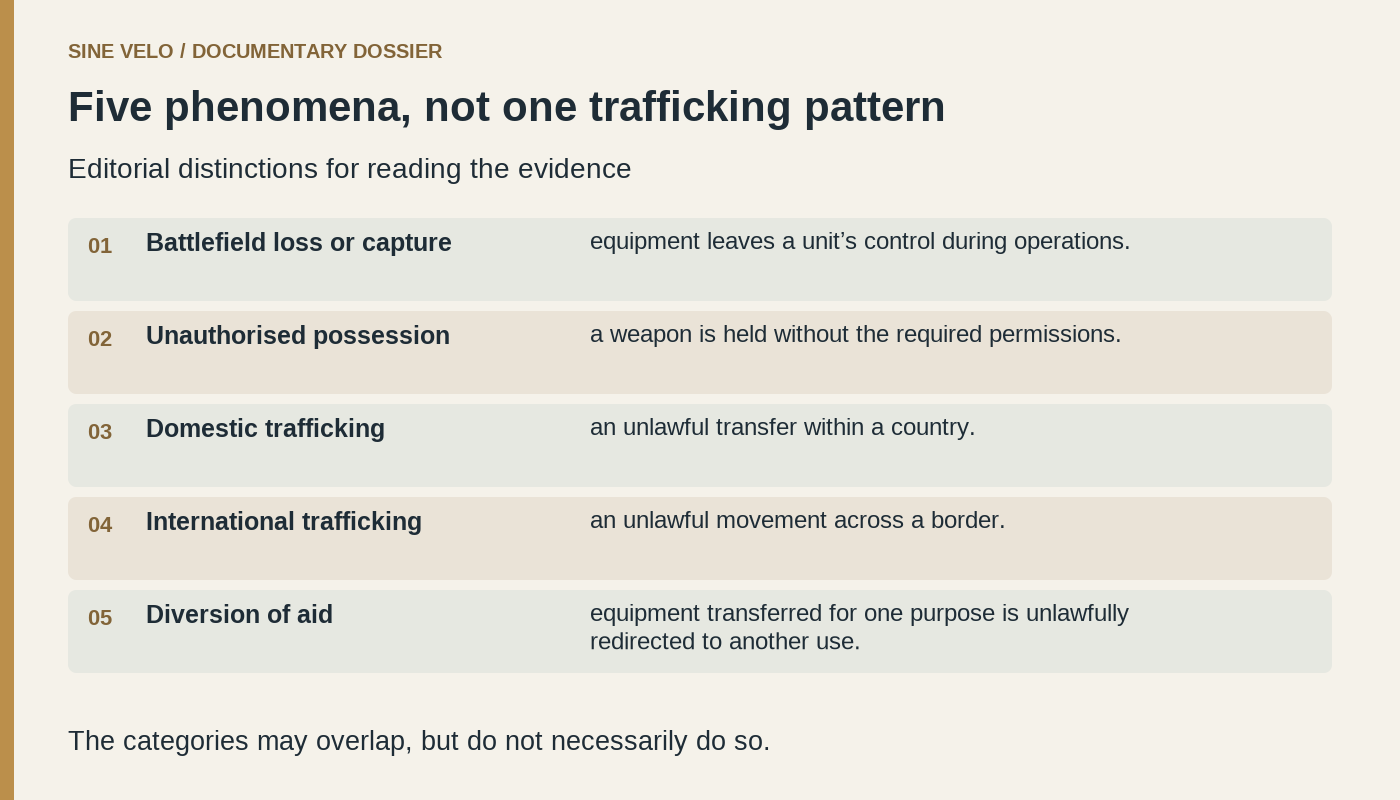
For this investigation, we distinguish five editorial categories:
- Battlefield loss or capture: equipment leaves a unit’s control during operations.
- Unauthorised possession: a weapon is held without the required permissions.
- Domestic trafficking: an unlawful transfer within a country.
- International trafficking: an unlawful movement across a border.
- Diversion of aid: equipment transferred for one purpose is unlawfully redirected to another use.
These categories can overlap, but do not necessarily do so. A Soviet weapon stolen from a depot does not establish that a donated Western missile reached Africa. Nor does a photograph of a Western model, on its own, identify its last legitimate owner.
2. What the UN found
The UNODC report published in July 2025 describes known trafficking as predominantly small-scale and opportunistic, also involving weapons collected from battlefields or taken from stockpiles. The material examined did not reveal substantial transnational trafficking out of Ukraine after February 2022. The report nevertheless warns that the availability of armaments and criminal networks creates serious risks. Much of its empirical picture concerns the period up to mid-2024: it should not be presented as a universal census for November 2026. UNODC report, arms-trafficking chapter [1].
“It has not emerged on a large scale” and “there has not been a single incident” are different statements. The first is compatible with individual seizures and a growing future risk. The second would require an observational capacity that none of these sources claims.
3. Seizures also reveal a real problem
Weapons Compass, published by the Small Arms Survey and CENSS in December 2025, analyses seizures and court files. It identifies illicit proliferation of Western weapons within Ukraine, but no evidence of large-scale, systematic diversion. Among 2023–2024 seizures classified by model, 437 of the 4,129 identified grenades were Western. That is a share of the seizure sample, not of all military aid. The study also describes rare cross-border cases and warns that many media allegations lack verifiable supporting evidence. Original report, chapter 1 [2].
An important methodological limitation: seized equipment does not automatically represent everything in circulation. Checks intercept what they can observe, and public data may be incomplete. It is wrong to turn a sample percentage into a national percentage of stolen weapons, or to dismiss seizures because they are small.
4. Finland: a warning turned into an unfounded certainty
On 1 November 2022, Finland’s National Bureau of Investigation clarified that it had no evidence of weapons donated to Ukraine ending up with Finnish organised crime. An earlier interview had been interpreted as confirmation of trafficking that had already occurred; the authority explained that it intended to flag a risk and criminal groups’ interest, not an established transfer. Original clarification by Finnish police [3].
This episode does not establish that every subsequent allegation is false. Instead, it shows why an investigation must return to the original wording: “we fear”, “we are investigating” and “we have seized” are not synonyms. Even an article’s headline can erase an essential distinction contained in an interview.
5. Where do weapons in Africa come from?
In the UNODC report on the Sahel released in 2023, the main sources of regional trafficking are within Africa: diversion from local armies, weapons from Libya, remnants of conflicts, transfers to non-state groups and craft production. Long-distance routes are also documented, but this picture does not identify Ukraine as the general explanation for the region’s armed groups’ weapons. UNODC, *Firearms Trafficking in the Sahel* [4].
This is a historical reference, not a complete map updated to today. A useful comparison must be specific: a seizure in which country, on what date, with which serial numbers? Speaking generically of “Africa” combines different territories, conflicts and markets, making the claim almost impossible to verify.
The documents examined here do not reconstruct a specific, verified chain connecting a Western delivery to Ukraine with its subsequent resale in Africa; this does not rule out incidents that have not come to light.
The prior presence of Ukrainian or Soviet weapons in an African country does not, by itself, establish diversion of aid after 2022. Earlier commercial transfers, re-exports, captured equipment and contemporary deliveries must be distinguished.
Two African allegations traced to their sources
Buhari and Lake Chad, November 2022. The Nigerian presidency’s original statement of 29 November confirms that Muhammadu Buhari spoke of weapons from the Russia–Ukraine conflict beginning to reach the region. The quotation is therefore not invented. But the statement provides no serial numbers, identifiable seizures or transfer documents; nor does it specifically identify a Western aid delivery resold by Kyiv. It is an official statement requiring further investigation, not an already reconstructed evidentiary chain. Nigerian presidency, original text [5].
The alleged Molot mortar in Niger, March 2025. A Journal du Niger article dated 21 March claims that a Ukrainian mortar was found together with a manual. The page attributes the information to unnamed military sources and an anonymous retired officer; it also carries a disclaimer that the partner’s opinions do not represent the editorial team. The text provides no serial number, seizure record or documents linking the object to Western aid. We cannot confirm the reported provenance: even Ukrainian manufacture would not, on its own, establish the resale of aid. Original article and its evidentiary limitations [6].
In both cases, classifying the story as “requiring verification” does not mean ignoring it. It means stating precisely which evidence is missing, rather than promoting a statement or an anonymous account to the status of an established fact.
6. Gaps in Western controls are documented
In March 2024, the US GAO found delivery data that was insufficiently reliable: some articles were recorded as delivered while still in transit; some monitoring of sensitive equipment had been adapted to the conflict without a formal evaluation of its effectiveness. The updated page shows progress, but also recommendations still open in 2026. It is therefore wrong to claim either that every weapon was perfectly tracked or that no corrective measures have been adopted. GAO-24-106289 and recommendation status [7].
An administrative gap increases uncertainty and can create criminal opportunities. It does not automatically identify the perpetrator, buyer or destination country. Proving trafficking requires a further step: connecting the untracked object to a concrete unlawful transfer.
7. The most recent oversight report consulted
The US inspectors’ report covering July–September 2026 states that USEUCOM and SAG-U had not identified credible evidence of illicit diversion or misuse of US defence articles. In its breakdown of active articles subject to enhanced monitoring, 86.8% were observed, 3.9% not observed and 9.3% classified as other. The denominator is active equipment subject to that particular monitoring, not all weapons delivered or their financial value. These are verification-system categories, not percentages of weapons sold. Report to Congress, equipment accountability section, pp. 30–31 [8].
Distance from the source must also be maintained: the report relays what operational authorities communicated, rather than independently inspecting every individual item. It also covers the US scope: it does not justify conclusions about every weapon supplied by any country.
8. Evidence that would change the picture
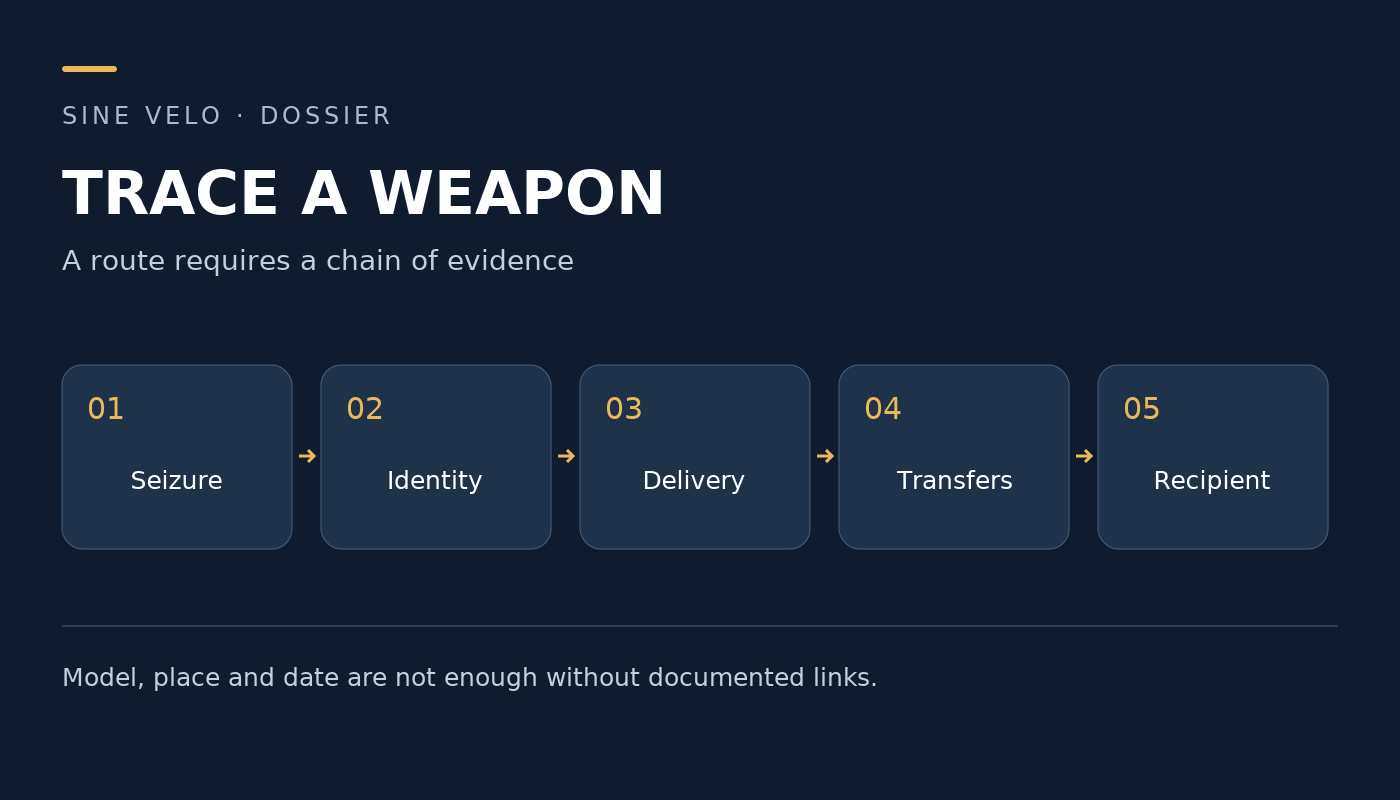
To verify a Ukraine–Africa route, we look for a documentary chain:
- A seizure record or judicial document with a place and date.
- Identification of the weapon, with a readable serial or lot number.
- A document linking that object to a delivery intended for Ukraine.
- Verifiable subsequent steps, including any battlefield capture.
- Evidence concerning the seller, intermediaries and recipient, distinguished from investigative hypotheses.
- The outcome of proceedings, or an explicit indication that the investigation remains open.
An online advertisement may be a lead, a scam or propaganda. An image may show a real weapon without establishing the journey described. Editorial responsibility means not skipping these steps, even when the story matches readers’ expectations.
Claims and limits of the evidence
A indicates provenance; B indicates content and limitations. They are not two independent checks. Green applies only to the narrowly defined proposition stated, not to innocence or guilt.
Not established by the sources examined
The data examined prove systematic sales of Western military aid from Ukraine to African groups.
The statements and cases cited do not provide a complete chain of serial numbers, deliveries, seizures and transfers from aid supplies to African recipients. A real risk is not proof of the route. [1] [4] [5] [6]
Interpretation not supported by the figure
The figure of 437 out of 4,129 represents the proportion of all military aid stolen.
The report counts grenades in the 2023–2024 seizure sample, not all supplies or their value. It is not a general estimate of aid diversion. [2]
Sources
- UNODC report, arms-trafficking chapter
A · Provenance · UNODC report on Ukraine, published in July 2025; a study using data mainly up to mid-2024.
B · Content and limitations · It describes illicit activity, risks and trafficking that is mostly limited or domestic. It is not a universal inventory updated to November 2026 and does not prove the absence of all international trafficking.
- Original report, chapter 1
A · Provenance · Small Arms Survey/CENSS report Weapons Compass, December 2025.
B · Content and limitations · It documents seizures and proliferation: 437 grenades of Western models out of 4,129 identified in the 2023–2024 sample. This is neither the percentage of aid diverted nor a representative estimate of all weapons in Ukraine; it does not establish a systematic route to Africa.
- Original clarification by Finnish police
A · Provenance · Official Finnish police clarification dated 1 November 2022.
B · Content and limitations · It distinguishes the risk from evidence that donated weapons had actually reached Finland, which police said they did not have. It is a clarification limited to that case and time, not a universal denial of future trafficking.
- UNODC, *Firearms Trafficking in the Sahel*
A · Provenance · UNODC report Firearms Trafficking in the Sahel, a copy distributed in 2023 on ecoi.net.
B · Content and limitations · It describes African regional sources and networks during the period studied. It provides historical context, not a complete current map or evidence that every weapon of Ukrainian origin came from post-2022 aid.
- Nigerian presidency, original text
A · Provenance · Nigerian presidency, original account of Buhari’s speech on 29 November 2022.
B · Content and limitations · It confirms that Buhari linked proliferation in the Lake Chad basin to the Russia–Ukraine war. It provides no serial numbers, records or chain of custody and does not prove that Kyiv resold Western aid.
- Original article and its evidentiary limitations
A · Provenance · Journal du Niger article dated 21 March 2025, featuring unnamed military sources and partner content.
B · Content and limitations · It reports a Molot mortar and Ukrainian equipment in Niger, but without a serial number, seizure documentation or a chain linking them to Western aid. The origin remains unconfirmed in the dossier; Ukrainian manufacture and aid diversion are different propositions.
- GAO-24-106289 and recommendation status
A · Provenance · GAO-24-106289, March 2024 report and the updated official recommendations page.
B · Content and limitations · It documents gaps in tracking and subsequent corrective measures: four recommendations implemented and four open when consulted. Incomplete data do not establish trafficking, and adopting a corrective measure does not guarantee flawless execution.
- Report to Congress, equipment accountability section, pp. 30–31
A · Provenance · Operation Atlantic Resolve report to Congress, July–September 2026, by US inspectorates.
B · Content and limitations · It reports USEUCOM/SAG-U statements that no credible diversion had been identified and shares of 86.8%/3.9%/9.3% for active items subject to enhanced monitoring. These are not percentages of all aid, monetary value or weapons sold; this is not independent verification of every individual item.