
Gaza’s shelters hit by rain: what we know about damage and aid
Early estimates describe an emergency at displacement sites. Israel reports entries of winter materials; the UN and European Union call for obstacles to the response to be overcome. Understanding where assistance breaks down requires data distinguishing supplies, crossings and deliveries.
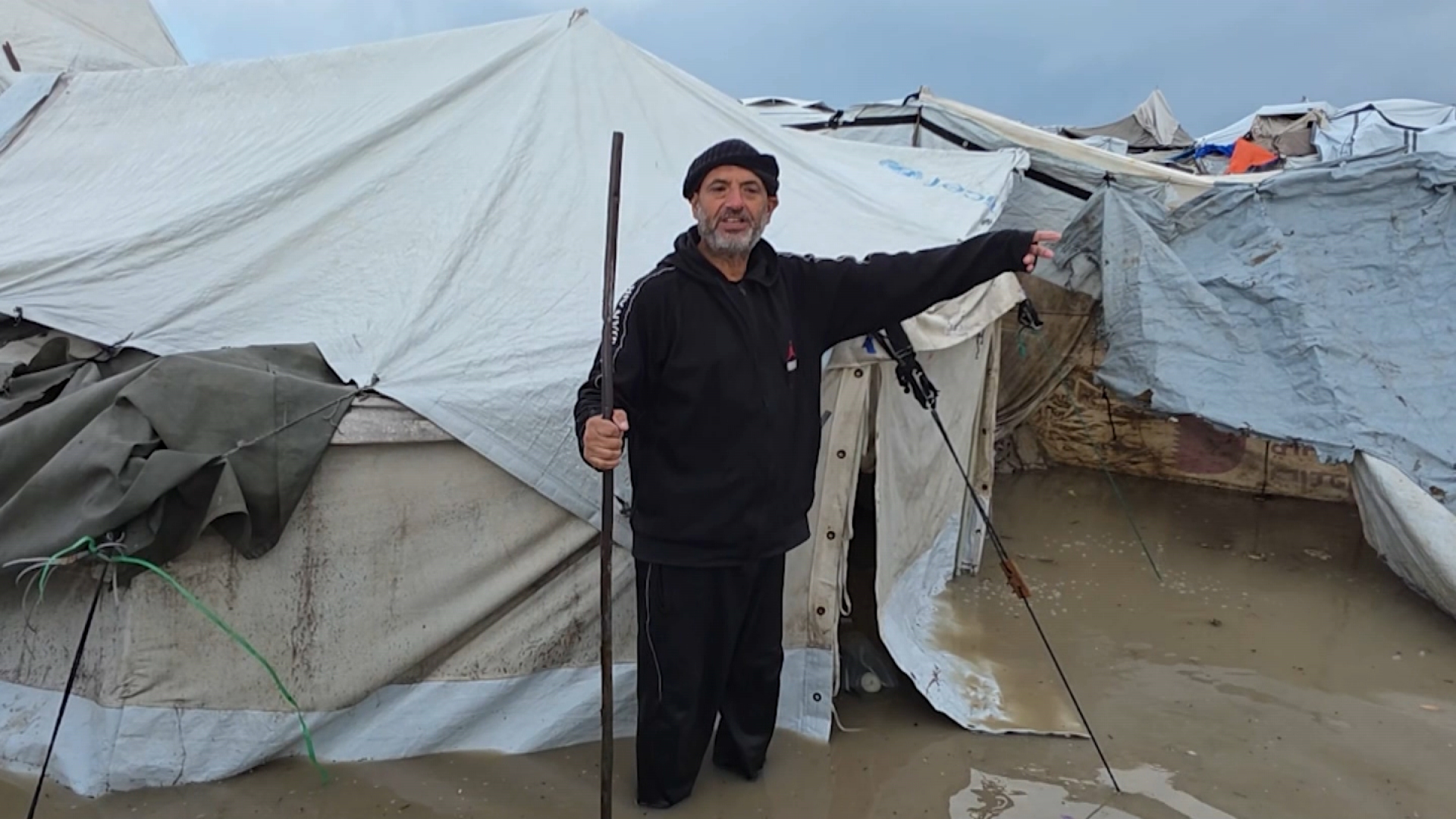
In brief
Rain beginning on 6 November hit shelters for displaced people in Gaza. Initial damage figures remain provisional. Israeli statements about cumulative material entries cannot be compared directly with the weekly decline in UN and partner trucks recorded by OCHA. Neither indicator alone measures what each family received.
Frequently asked questions
What impact did the rains have in Gaza?
Rain beginning on 6 November hit shelters for displaced people in Gaza. Initial damage figures remain provisional. Israeli statements about cumulative material entries cannot be compared directly with the weekly decline in UN and partner trucks recorded by OCHA. Neither indicator alone measures what each family received.
Are the flood damage estimates final?
OCHA reports preliminary estimates; responsibility and counts are not all independently corroborated.
What does the 42% fall in trucks mean?
OCHA records 228 UN and partner trucks offloaded on the Israeli side of Kerem Shalom from 2 to 8 November, about 42% fewer than the previous week. The report identifies the suspension of the Egyptian corridor and funding constraints among the causes. The figure concerns that specific flow: not all aid, and not the amount delivered to recipients. [1]
What do the 150,000 tents cited by the four ministers represent?
The ministers said on 15 November that those tents were being held at the border. On 13 November, COGAT reported that more than 93,000 tents had already entered. These attributed figures cover different stages and periods. The sources reviewed do not verify the stock awaiting entry or deliveries to families.
In the rain, the risk is more than losing a tent
UNICEF reports that, over the weekend, three children aged four, five and eight and their mother died when a sand dune collapsed onto their tent in Deir al-Balah. Its statement of 9 November links the collapse to heavy rain. This toll is attributed to the agency; the event was not witnessed directly by our newsroom. [4]
Shelter and essential services are interconnected. In the same statement, UNICEF says only two of six pumps at the Sheikh Radwan stormwater basin are functioning and reports delays in bringing in equipment needed for repairs. The agency describes distributions of winter clothing and blankets, drain clearing and sandbag barriers, while warning that emergency assistance is not a lasting solution. [4]
Wet mattresses and few replacement tents
On 9 November, the International Rescue Committee described soaked mattresses, blankets and clothing, with roads cut off by water. Dozens of its staff in Gaza reported their tents or already damaged homes completely flooded. A staff member identified by the organization as Mona said she no longer had a dry place to sleep. This testimony was gathered and published by IRC, not in a SINE VELO interview. [5]
The statement also describes depleted stocks: according to the shelter coordination group’s assessment on 1 November, organizations inside Gaza had about 2,800 tents against an estimated need for 121,000, and no emergency shelter kits. IRC describes pumping and drainage hampered by shortages of fuel, engine oil and spare parts. [5]
The organization says it is rehabilitating water infrastructure, maintaining water supplies and distributing hygiene kits. The immediate problem does not end when water drains: materials are also needed to repair leaking roofs and replace wet mattresses and blankets. [5]
An emergency not measured only at the crossing
In its report of 13 November, OCHA records about 46,000 households, or 226,000 people, potentially affected. Reports gathered through 9 November indicate more than 40,000 damaged shelters, including over 9,000 described as beyond repair. These estimates remain unconfirmed, not a final census. The agency also describes difficulties accessing services and risks associated with contaminated water. [1]
Israel’s position and Europe’s call
On 9 November, the Times of Israel reported the position of the Israeli military and COGAT: more than 91,000 tents and over 8,200 trucks carrying materials had reportedly entered since the winter plan began. Israeli authorities attribute some delays to organizations’ logistical and financial difficulties and justify some restrictions by citing the risk of use by Hamas. These are statements by the Israeli side, not an independent verification of deliveries. [2] [10]
In Lazar Berman’s 15 November report, COGAT told The Times of Israel that it assesses requests for dual-use equipment according to humanitarian need, the equipment’s characteristics and the risk of Hamas using it. Where it identifies a risk, it says it works with international organisations on alternatives subject to oversight. The statement explains the criteria COGAT cites. The sources reviewed do not link it specifically to the four ministers’ appeal or establish whether each delay was justified. [9]
On 14 November, the European Union called on Israel to allow immediate, unhindered access, sustained large-scale distribution and the reopening of crossings. Its statement also links persistent shortages to access restrictions, while noting that aid must serve peaceful purposes and not be diverted by armed groups. It reiterates that Hamas should have no role in Gaza’s future governance. This is a diplomatic position, not an independent inspection of every load. [3]
15 November 2026 · The four ministers’ appeal
The foreign ministers of Australia, Canada, Italy and the United Kingdom urged Israel to speed up humanitarian access after the flooding. In a statement issued by the UK Foreign Office on 15 November, they said 150,000 tents and other essential supplies were being held at the border. They called for crossings to open and for the admission of dual-use items needed for humanitarian operations and early recovery. Australia’s Foreign Ministry published the same text with a local date of 16 November. [6]
Two days earlier, the Humanitarian Country Team for the occupied Palestinian territory said that more than 150,000 tents procured by humanitarian partners and member states were ready for dispatch but still outside Gaza, most of them in Al Arish, Egypt. The ministers’ statement and the humanitarian appeal document their respective positions. The sources reviewed provide no cargo records to establish whether the two figures cover exactly the same tents or how many subsequently entered. [7] [6]
In an official post on 13 November, COGAT said that more than 93,000 tents and over 8,600 trucks of winter supplies and other equipment had already entered. That cumulative count of entries and the tents said to be waiting refer to different stages and time windows. Subtracting one figure from the other cannot show how many tents remain needed or how many reached families. The post predates the 15 November appeal, as do the Israeli positions reported on 9 and 10 November. The sources reviewed on 16 November yielded no subsequent official Israeli response specifically to the appeal. [8] [6]
What the 42% decline actually means
OCHA records 228 UN and partner trucks offloaded on the Israeli side of Kerem Shalom from 2 to 8 November, about 42% fewer than the previous week. The report identifies the suspension of the Egyptian corridor and funding constraints among the causes. The figure concerns that specific flow: not all aid, and not the amount delivered to recipients. [1]
The winter-plan cumulative figure and the weekly flow do not measure the same period or logistical stages. The former can rise while the latter falls without establishing how many families received materials.
Traffic light for the overall-damage claim: YELLOW, preliminary estimate. The emergency is documented in the sources consulted. Its final extent and the allocation of responsibility remain unresolved. This is not a seal on every sentence in the article.
Sources
[1] OCHA, humanitarian report of 13 November 2026. [2] Emanuel Fabian, Times of Israel, IDF/COGAT position of 9 November 2026. [3] European Union, statement of 14 November 2026. [4] UNICEF, statement of 9 November 2026 on rain and child protection.
[5] International Rescue Committee, 9 November 2026.
[6] Four foreign ministers’ joint statement · FCDO, 15 November 2026 · Same statement on the Australian Foreign Ministry website
A. Opened the original FCDO release dated 15 November 2026. Checked the signatories, the 150,000-tent passage and the requests concerning crossings. Australia’s publication dated 16 November locally carries the same text.
B. Documents the appeal and the figure reported by the ministers. Republishing it on ministry websites does not add another declaration. The statement offers no independent count of cargo or deliveries.
[7] Humanitarian Country Team appeal · OCHA, 13 November 2026 · UN News report on the appeal
A. Opened the original 13 November appeal published by OCHA for the Humanitarian Country Team. Read the passage on tents ready for dispatch outside Gaza, most of them in Al Arish.
B. Documents the estimate reported by humanitarian operators. It does not include a cargo-level inventory or verification of actual deliveries.
[8] Official COGAT post on X · 13 November 2026
A. Opened the 13 November original post on the official COGAT X profile, ID 2121181277516640478. Read the full text, including both entry figures.
B. Establishes what COGAT reported about cumulative entries. It does not document deliveries to families or stock awaiting entry and predates the ministers’ appeal.
[9] Lazar Berman, The Times of Israel · 15 November 2026
A. Reopened Lazar Berman’s original report of 15 November 2026, section “Hamas responsibility”. Read the passages carrying COGAT’s statement to the newspaper on dual-use items.
B. Documents the position COGAT gave the newspaper on the broader criticism. It does not verify how the criteria were applied to individual shipments or delays, or establish a reply to the four ministers’ appeal.
[10] Embassy of Israel in Australia · newsletter of 13 November 2026, p. 3
A. Opened the official newsletter of the Embassy of Israel in Australia dated 13 November 2026. On page 3, the winter plan reproduces an earlier Netanyahu statement. The 10 November gov.il page returned HTTP 403.
B. The newsletter documents the official position and reproduces the plan figures, more than 91,000 tents and over 8,200 trucks. The figures remain attributed. The document predates the appeal and provides no independent count of deliveries.