Dossier
Zelenskyy and controversial commemorations: what the individual cases document
In brief
Attendance at a ceremony, an honorary military designation and a parliamentary tribute are not the same act. Comparing the documents distinguishes two reburials that the Presidency says Zelenskyy attended, a regional ceremony that does not name him, and a decree with a different purpose. Ottawa requires separate examination: documenting public recognition does not establish what everyone present knew beforehand.
Frequently asked questions
Do all these cases establish the same thing?
No. Attending, naming a unit and introducing a person are different acts requiring relevant evidence.
Does the absence of a name prove someone was not there?
Not necessarily. We need to know whether the list is complete and what other evidence exists; silence is not enough.
Does a commemoration approve the person’s entire biography?
Not automatically. The tribute’s content and historical responsibilities require separate analysis.
Are OUN, UPA and the Galicia Division synonyms?
No. Conflating them replaces analysis of individual acts with a generic association.
Does Rota’s statement settle every question about Ottawa?
No. It concerns his intentions and remarks and what he says he communicated beforehand; it does not establish every private state of knowledge. [S05]
What could change these assessments?
New relevant documents on participants, prior communications or the acts’ contents. Each piece of evidence must address the precise proposition under examination.
In brief
- Two presidential attendances are documented, but they do not concern the Chervone ceremony.
- Silence in an account is not enough to certify an absence.
- An honorary name is an institutional decision, not attendance at a funeral.
- Public acts do not automatically establish private knowledge or a comprehensive assessment of those commemorated.
1. First question: which event and which evidence?
Verification begins by separating four questions: who is commemorated, which institution organises or recognises the act, who participates, and what can be inferred from it. A source may answer the third question well without resolving the others. A presidential statement is therefore relevant to documenting attendance reported by the organiser, but does not become an independent historical assessment of the person commemorated.
Inferences must also be explicit. Participation can carry political significance and invite criticism; recognising this does not justify inventing an order, prior knowledge or approval of every past action. Conversely, limiting a conclusion to the evidence neither erases the public act nor shields it from discussion. The point is to distinguish what happened, what is stated and what remains interpretation.
2. Melnyk and Konovalets: two documented attendances
The presidential statement of 25 May 2026 reports Zelenskyy’s presence at the reburial of Andriy Melnyk and his wife Sofia Fedak-Melnyk at the National Military Memorial Cemetery. It describes Melnyk as a leader of the Organization of Ukrainian Nationalists. [S01]
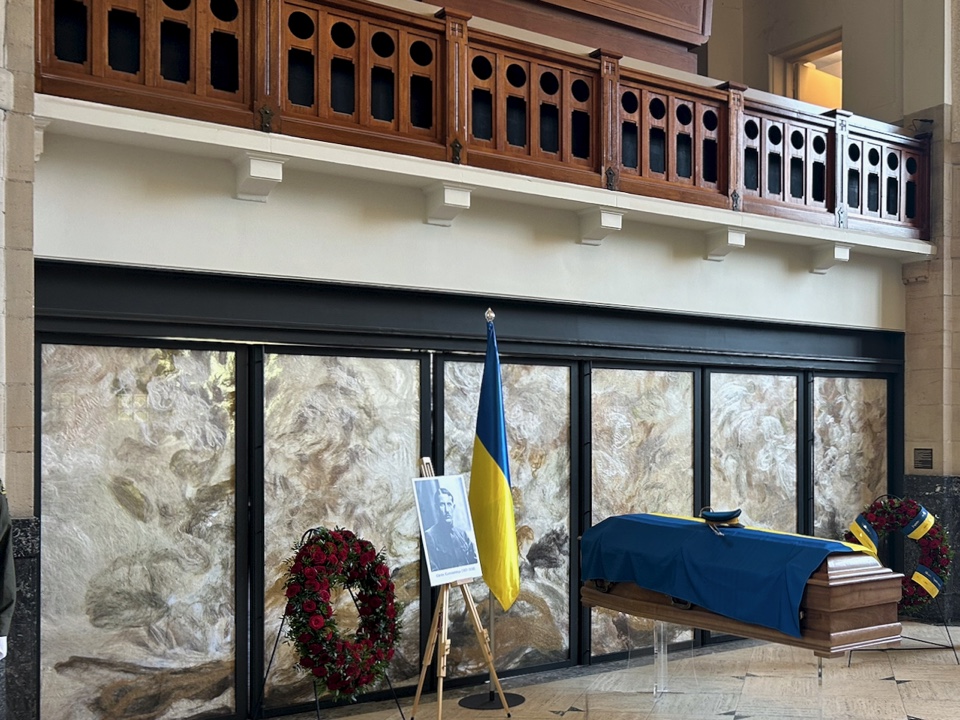
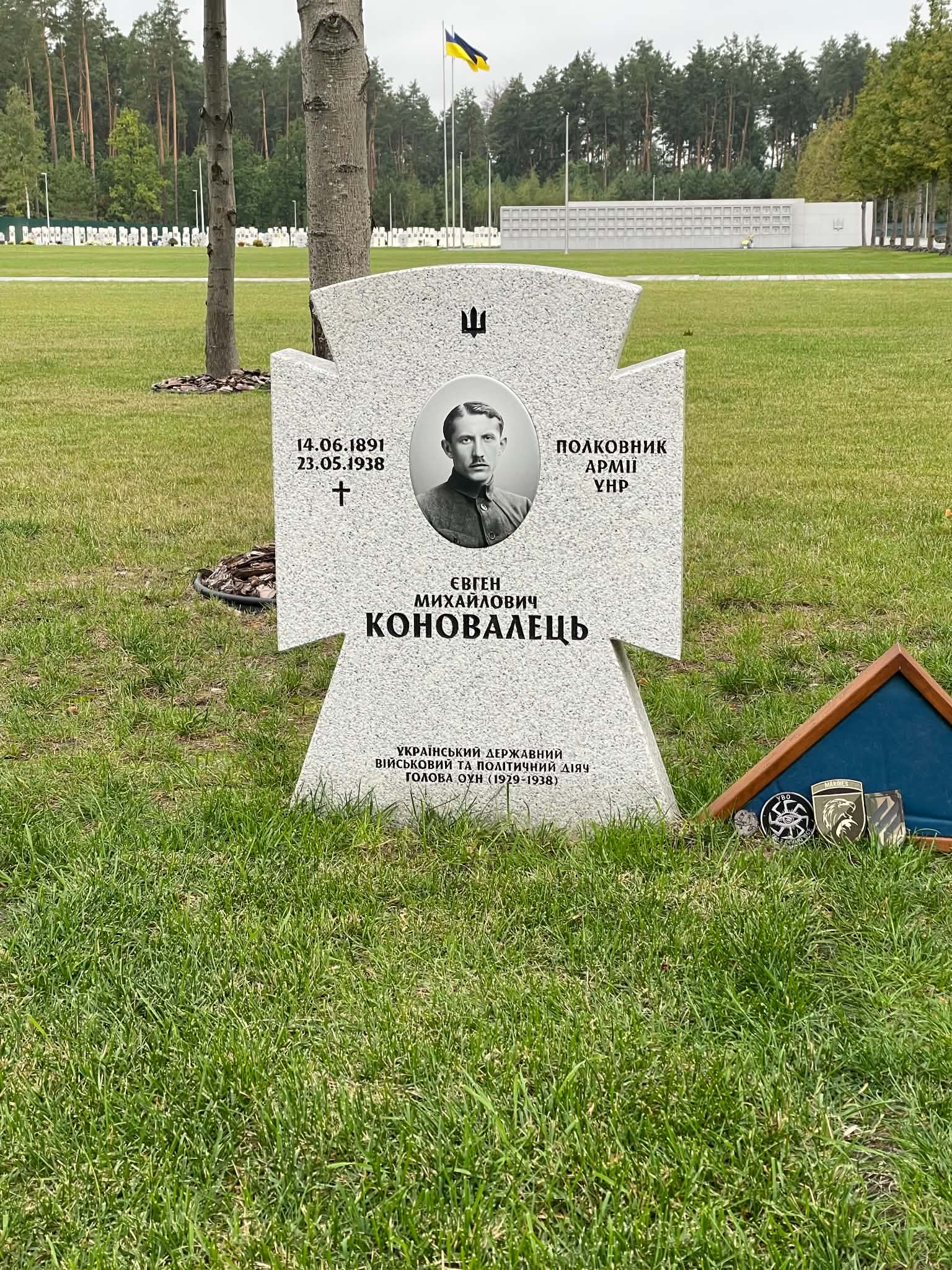
A second statement documents Zelenskyy’s participation and address at the reburial of Yevhen Konovalets at the same cemetery on 18 August 2026. The source describes this burial location as temporary. These are two official accounts of separate events. [S02]
Historical identities should not be reconstructed solely through commemorative praise. The Encyclopedia of Ukraine describes Konovalets as leader of the OUN founded in 1929 and dates his death to 1938. [S08] Its entry on Melnyk traces his rise to leadership after that death, ratification in 1939 and the split with Bandera in 1940. [S07] These are older specialist entries, useful for these basic distinctions, not an exhaustive account of wartime responsibilities.
OUN, UPA and the Galicia Division are not interchangeable names. Replacing one with another makes events documented separately appear uniform. Discussing relationships between those organisations requires specific historical examination, not an inference from attendance at a reburial alone.
3. Chervone: the document’s specific limitation
The Lviv regional administration’s report of 25 July 2021 describes the reburial in Chervone of nineteen members of the Galicia Division who died in 1944. It names regional officials Andriy Hodyk and Yuriy Horun, not Zelenskyy. [S03]
This source therefore does not establish the president’s presence. But a list of participants not identified as exhaustive cannot automatically become a complete list of absentees. The appropriate conclusion remains confined to the document examined: establishing attendance would require relevant positive evidence; establishing absence requires more than this silence. We do not attribute a claim to an unidentified author or construct a universal rebuttal of an unspecified allegation.
4. Centre “North”: a designation, not a funeral
Presidential decree No. 440/2026 of 26 May assigns the honorary name “Heroes of the UPA” to the Separate Special Operations Centre “North”. It concerns that unit, not the armed forces’ overall designation. [S04]
Here the evidence is a legal act with a specific recipient. Establishing its contents does not require finding someone’s physical presence at a ceremony; equally, presenting it as evidence of attendance at a burial would be inappropriate. The designation can be analysed as an institutional choice about remembrance. The further step of treating it as approval of every historical episode associated with that name would require additional arguments and sources.
5. Ottawa: public recognition and private knowledge
The Canadian parliamentary record documents Speaker Anthony Rota’s laudatory introduction of Yaroslav Hunka after Zelenskyy’s address on 22 September 2023. The passage appears in an appendix to the 21 September record: that placement does not move the event back a day. The introduction alone is not a reliable historical source for the biography of the man honoured. [S06]
His military past emerges from different sources. On 24 September, the Friends of Simon Wiesenthal Center identifies Hunka as a member of the 14th Waffen Grenadier Division of the SS. [S10] On 27 September, a German Foreign Office spokesperson confirms voluntary service in the Waffen-SS. [S09] We report these attributions without inferring individual criminal responsibility for every crime associated with the organisation.
In his 24 September statement, Rota takes responsibility for the initiative and says that nobody, including the Ukrainian delegation, knew beforehand about his intentions or remarks recognising Hunka. This is his statement, not an independent finding about what each person present knew of Hunka’s biography, nor an explanation of invitations to different events. [S05]
Comparison with the Ukrainian ceremonies does not fill that evidentiary gap. Documented participation in 2026 does not retrospectively establish knowledge in 2023. Equally, Rota’s words do not justify certifying universal private ignorance. Clarifying possible advance notice would require evidence concerning the people, time and particular information involved, rather than simply associating names and ceremonies.
Document chronology
Claims and limits of the evidence
Documentary green
Attendance at the reburial of Melnyk and Sofia
The Presidency explicitly reports it. Green concerns the event account, not comprehensive historical approval of those commemorated. [S01]
Documentary green
Attendance at the reburial of Konovalets
The presidential statement describes participation and an address. We do not adopt celebratory language as independent historical assessment. [S02]
Documentary green
Regional officials named at Chervone
Hodyk and Horun appear in the account. This scope does not automatically extend to other participants. [S03]
Yellow
Does that account establish Zelenskyy’s presence at Chervone?
It does not name him; this source does not establish attendance. We do not, however, turn its silence into definitive proof of absence. [S03]
Documentary green
Honorary name for Centre “North”
The decree specifies the designation and unit. It is not evidence of attendance at a funeral or of renaming the entire military. [S04]
Documentary green
Rota introduced Hunka in Parliament
The passage appears in the relevant appendix. It documents the recognition, not the accuracy of the speaker’s biographical portrait. [S06]
Documentary green
Rota said there was no advance notice of his intentions and remarks
Green concerns the statement and its attribution, not everyone’s private knowledge. [S05]
Sources
- Ukrainian Presidency · Melnyk and Sofia · 25 May 2026
A · Provenance · Ukrainian original consulted during the research, in passages about the ceremony. A subsequent reopening attempt timed out.
B · Content and limitations · Documents attendance reported by the organiser, not independent on-site testimony or a comprehensive historical assessment.
- Ukrainian Presidency · Konovalets · 18 August 2026
A · Provenance · Original reopened; the body of the account and its conclusion were read.
B · Content and limitations · Documents presidential participation and an address. The praise is not adopted as independent historical judgment.
- Lviv regional administration · Chervone · 25 July 2021
A · Provenance · Original reopened; the event account and historical note were read.
B · Content and limitations · Names regional officials, not the president. Non-mention does not prove absence; the historical note is not a comprehensive assessment of the division.
- Ukrainian Presidency · Decree No. 440/2026 · 26 May 2026
A · Provenance · Original reopened and its provisions read in full.
B · Content and limitations · Documents an honorary name assigned to a specific unit. Does not document funeral attendance or establish that different organisations are identical.
- Canadian House of Commons · Anthony Rota’s statement · 24 September 2023
A · Provenance · The one-page original PDF was reopened and read in full.
B · Content and limitations · Documents what Rota says about his own initiative, not a finding about everyone’s private knowledge or invitations to other events.
- Canadian House of Commons · Parliamentary address of 22 September 2023
A · Provenance · The procedural order, appendix heading and Rota’s remarks in the 21 September record were read, not the entire sitting. No video was verified in this check.
B · Content and limitations · The appendix concerns the next day’s event. The laudatory introduction does not certify Hunka’s biography or the private knowledge of those present.
- Encyclopedia of Ukraine · Melnyk, Andrii
A · Provenance · Volodymyr Yaniv’s entry, volume 3 of 1993, read in full. Specialist secondary source.
B · Content and limitations · Used for identity and succession to OUN leadership; does not cover the 2026 events or provide an exhaustive assessment of wartime responsibilities here.
- Encyclopedia of Ukraine · Konovalets, Yevhen
A · Provenance · Volodymyr Yaniv’s entry, volume 2 of 1989, read in full. Specialist secondary source.
B · Content and limitations · Used for the essential role and chronology. The death date does not amount to general historical exoneration; praise is not adopted as a verdict.
- German Foreign Office · Press conference · 27 September 2023
A · Provenance · Original transcript consulted during the research; the relevant passage of Fischer’s response was read.
B · Content and limitations · Attributes service in the Waffen-SS. Statements about the knowledge of those present are not verification of their mental states or proof of individual criminal responsibility.
- Friends of Simon Wiesenthal Center · Statement · 24 September 2023
A · Provenance · Original statement read in full during the research.
B · Content and limitations · Source for identifying the military formation. We do not automatically transfer collective allegations to Hunka or certify individual criminal responsibility here.
- Wikimedia Commons · T1nus0707 · Rotterdam, 11 August 2026
A · Provenance · The Commons entry identifies the image as T1nus0707’s own work, dated 11 August 2026. The CC BY-SA 4.0 licence was read and the original image inspected.
B · Content and limitations · A scene in Rotterdam, not the Ukrainian ceremony of 18 August or proof of Zelenskyy’s attendance. The date is stated in the entry, not independently authenticated.
- Wikimedia Commons · Замішанець · Konovalets’s grave, 2 September 2026
A · Provenance · The Commons entry identifies the image as Замішанець’s own work, dated 2 September 2026. The CC BY-SA 4.0 licence was read and the original image inspected.
B · Content and limitations · The grave photographed after the reburial, not the ceremony of 18 August or proof of presidential attendance. The date is stated in the entry, not independently authenticated.

