
Dossier
Odesa, 2 May 2014: what we know about the Trade Union Building fire
Forty-eight deaths, two scenes of violence, delayed rescue and failed investigations: a chronology of the evidence and responsibility for the Odesa tragedy of 2 May 2014.
In brief
On 2 May 2014, 48 people died in Odesa: six in clashes in the city centre and 42 in the Trade Union Building tragedy. In 2025, the European Court of Human Rights found Ukraine responsible for failing to adequately protect the lives of those involved and for shortcomings in the investigations. The judgment became final on 13 June 2025.
This is not a criminal judgment attributing all the killings to a single organisation, nor does it establish a government plan of extermination. Neither does it mean that this was a fire without attackers or responsibility. Understanding Odesa requires us to distinguish the behaviour of the groups on the streets, the origin and spread of the fire, the conduct of the authorities and the subsequent search for the truth.
[1].
Frequently asked questions
Did all 48 people burn to death in the Trade Union Building?
No. Six died in the city-centre clashes; 42 in the tragedy associated with the building fire. Even within that second group, the specific causes were not all identical.
Who started the afternoon clashes?
The UN and judicial reconstructions identify an attack by an anti-Maidan group on the pro-unity march. This does not absolve anyone of responsibility for subsequent violence.
Were people trying to escape attacked?
Yes, such attacks are documented. Rescues carried out by other members of the pro-unity camp are also documented.
Did the ECtHR recognise a genocide?
No. It established violations of the Convention by Ukraine, not general criminal responsibility for genocide.
Were incendiary bottles thrown only from outside?
No: the sources document throws from both sides. This does not establish who caused every individual fire.
Is there a final European judgment?
Yes: the judgment of 13 March 2025 became final on 13 June 2025. This does not mean that all domestic criminal investigations have concluded.
Does the dossier regard all sides as equally responsible?
No. Reconstructing conduct by both groups is not a mathematical division of blame. Individual and state responsibility must be established and distinguished.
Do the archive photographs show the fire as it happened?
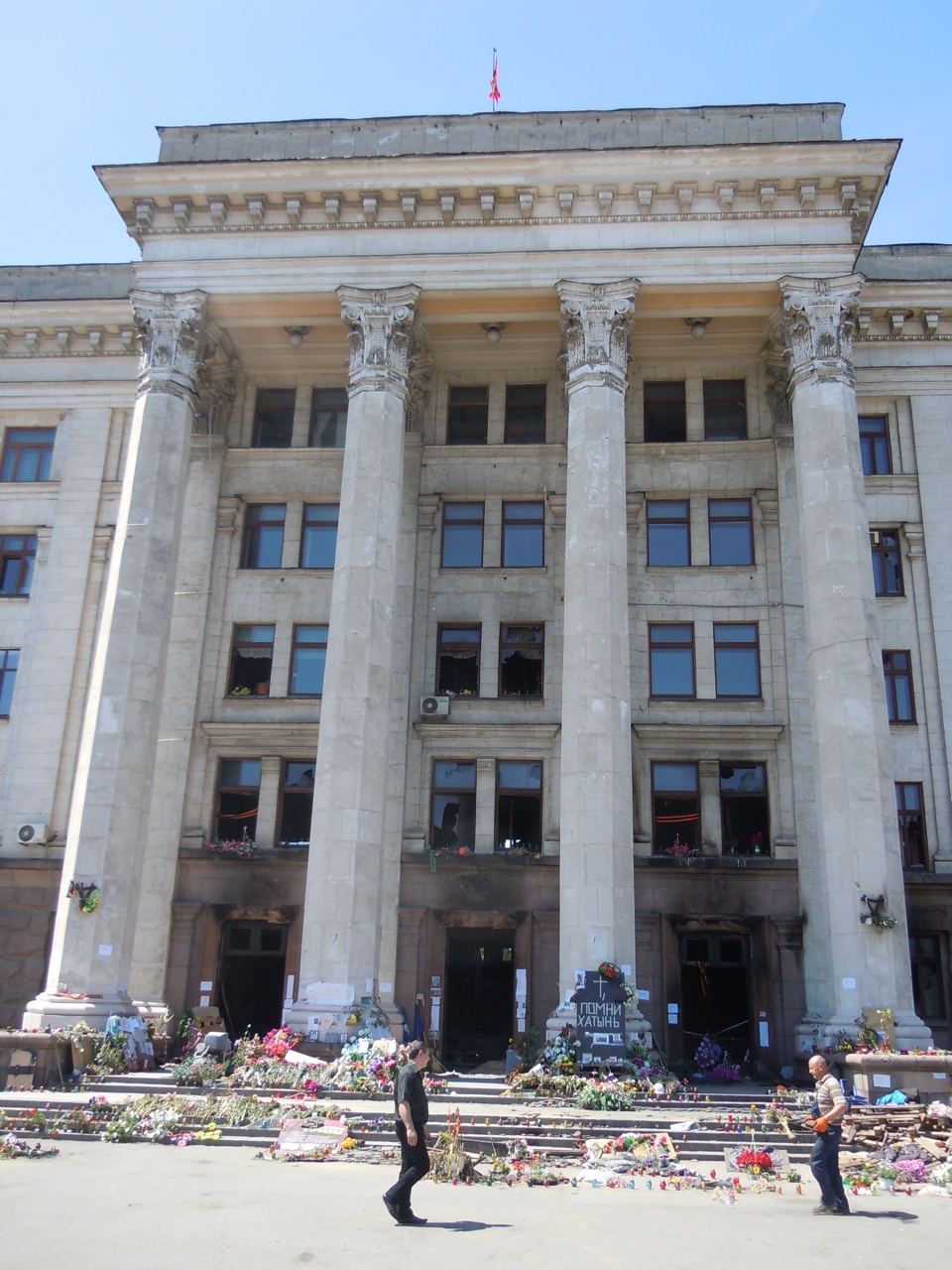
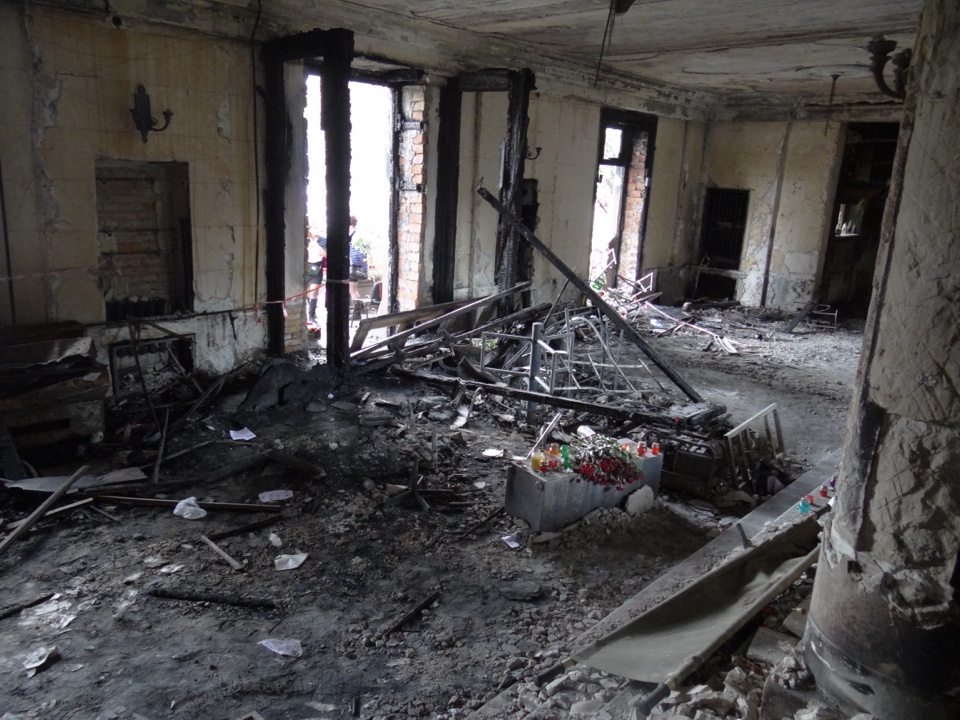
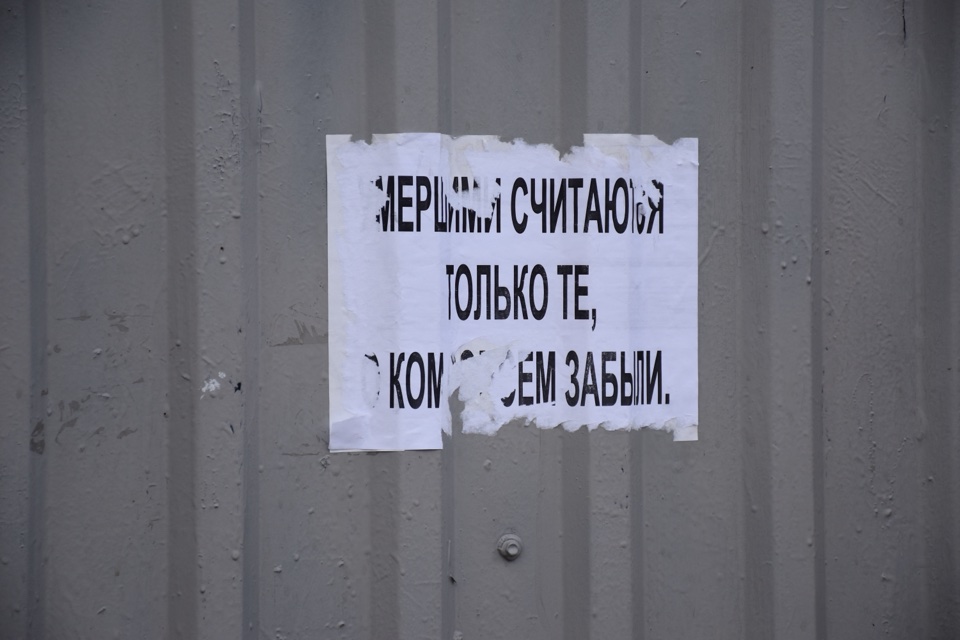
The photographs published on this page show the building on 22 May 2014 and a commemorative message on 18 September 2016, not the ongoing fire.
Key timeline
- 2 May 2014, Around 15:30 (local time) · Clashes begin in the city centre
Clashes begin in the city centre. [1]
- 2 May 2014, Around 18:50 (local time) · The crisis shifts towards Kulykove Pole; anti-Maidan protesters enter the Trade Union Building
The crisis shifts towards Kulykove Pole; anti-Maidan protesters enter the Trade Union Building. [1]
- 2 May 2014, Around 19:20 (local time) · The pro-unity crowd arrives and the tents are destroyed
The pro-unity crowd arrives and the tents are destroyed. [1]
- 2 May 2014, 19:31 (local time) · First call to the fire service recorded in the judgment
First call to the fire service recorded in the judgment. [1]
- 2 May 2014, Around 19:45 (local time) · Fire in the Trade Union Building
Fire in the Trade Union Building. [1]
- 2 May 2014, 19:55 (local time) · Order to dispatch fire engines
Order to dispatch fire engines. [1]
- 2 May 2014, From 20:09 (local time) · Fire engines arrive according to the judicial chronology
Fire engines arrive according to the judicial chronology. [1]
- 2 May 2014, 20:50 (local time) · The fire is reported extinguished
The fire is reported extinguished. [1]
1. Why start with two locations, not a single video
The images of the burning Trade Union Building have come to symbolise that day. But starting the account with the fire alone leaves out the clashes and deaths that preceded it. Conversely, stopping at the initial clashes obscures what subsequently happened to the people besieged inside the building.
The first sequence took place in central Odesa, around Hretska Square and nearby streets. The second involved Kulykove Pole, the square containing the anti-Maidan encampment and the Trade Union Building. These episodes are connected, not interchangeable. Whoever started one clash does not automatically become the perpetrator of every subsequent crime; whoever suffered an attack does not acquire the right to attack others.
The UN mission also uses this distinction in its reconstruction of responsibility. [2].
2. Who were the opposing groups?
The recurring labels in the documents are pro-unity, pro-federalism, Maidan and anti-Maidan. They need explaining, not turning into ethnic categories.
Supporters of Ukrainian unity included activists and football fans, including those who had travelled from Kharkiv for the match against Chornomorets. The camp opposing the new government encompassed different positions: opposition to Maidan, federalism and, among some, separatism and a pro-Russian orientation. The Council of Europe expressly cautions that the anti-Maidan movement was not homogeneous and that not all its members supported separatism or violence.
Consequently, “Russian-speaking” does not automatically mean pro-Russian; “pro-Russian” does not establish Russian citizenship; and “pro-unity” does not identify a single organisation. Individual responsibility likewise cannot be inferred from membership of a camp. [3].
3. A city already under pressure
The events followed Maidan and the change of government in Kyiv, Russia’s occupation and annexation of Crimea, and the beginning of the conflict in eastern Ukraine. Odesa had already experienced opposing demonstrations and attacks.
This context explains why the authorities should have assessed the risk with particular care. It does not make 48 deaths inevitable. Public-order services must protect demonstrators even when their views are hostile to the government, and must act against those using violence even if they support the state.
It is also important to distinguish the new government’s political vulnerability from the decisions of local institutions. “The Ukrainian authorities” does not necessarily mean a single decision-making centre controlling every official. This complexity does not remove the state’s obligations towards people within its jurisdiction.
4. The city-centre clashes: the initial attack and gunfire
According to the UN mission’s reconstruction, around 300 pro-federalism supporters attacked a pro-unity march of around 2,000 people. UN observers at the scene saw stones and incendiary bottles being thrown at the march. The clashes lasted for hours, with weapons used on both sides. Six men died from gunshot wounds: four from the pro-federalism camp and two from the pro-unity camp.
This sequence is not a detail to erase when recounting the fire. But it does not absolve the perpetrators of the violence that followed. The evidence must be read episode by episode. The numerical superiority of the pro-unity camp eventually forced its opponents to retreat; some took refuge in a shopping centre as the crisis shifted towards Kulykove Pole. [4].
5. From the encampment to the building
The judicial reconstruction places the decision by anti-Maidan protesters at Kulykove Pole to take refuge in the Trade Union Building at around 18:50. Materials were carried inside and barricades erected. At around 19:20, pro-unity supporters reached the square, destroying and setting fire to the tents.
Incendiary bottles were thrown from outside towards the building and from the building towards the crowd. The evidence also documents gunfire. Describing this as an exchange does not automatically attribute identical conduct to everyone or divide blame equally: it means not omitting some of the documented actions.
[1].
6. The essential timeline of the fire and rescue
The times should be understood as those in the documentary reconstruction, not as a claim to greater precision than the available evidence permits.
The decisive issue is not choosing between summaries such as “around forty” or “forty-five minutes”: it is the long interval between the alarm and the response. The first request already concerned fire in the square; it should not be confused with the point when the whole building was affected. [1].
7. What we know about the origin of the fire
The sources distinguish at least three questions: where the fires started, how the fire spread, and who carried out each materially relevant action. Answering the second does not automatically resolve the third.
The Council of Europe report describes findings concerning several points of origin and the importance of the entrance and staircases. The technical reconstruction by the 2 May Group, reproduced in the records, emphasises ignition near the entrance barricade during the exchange of Molotov cocktails, the spread inside and the presence of combustible materials. Not all the technical accounts coincide: some fires are described as separate in an expert examination and as secondary in the group’s reconstruction.
The cautious conclusion is not “we know nothing”. We know that the fire developed in a context of violence and the throwing of incendiary devices. We do not have a sufficient basis to attribute every ignition with certainty to an individual, or to treat multiple fires as automatic proof of a prearranged plan. [3].
8. Why the building became a trap
The studies cited in the records describe flammable materials, barricades, obstructed routes, smoke and rapidly increasing heat in the central staircase. The danger was not confined to rooms directly reached by the flames: smoke and combustion gases can make routes apparently far from the fire lethal.
There is also a human dimension that a floor plan cannot show. Someone inside a besieged building may fear both the fire and the people outside. The presence of an exit on paper does not establish that it was accessible, recognisable or perceived as safe by those trying to escape.
That is why photographs of rooms not completely burned do not, by themselves, constitute evidence of executions. Nor should the desperate behaviour of someone jumping from a window be interpreted as a choice made under normal conditions. [1].
9. Rescuers and attackers: both were present
UN observers saw some pro-unity supporters helping trapped people escape; they also saw people rescued from the building being beaten. These opposing forms of conduct are both essential to the account. [4].
It is wrong to select only the rescues to deny the attacks. It is wrong to select only the beatings to deny the rescues. A crowd is not a single person. Assessing each action requires identifying its perpetrator, victim, timing and consequences. Even recognising an attacker in a video requires checks: resemblance and an identification circulated online are not equivalent to forensic identification or a final conviction.
Why the fire engines did not leave immediately
The judicial reconstruction identifies a specific step: at 19:32, the regional head of the emergency service, Volodymyr Bodelan, ordered that no engines be sent without his consent. During internal inquiries, he justified the decision by pointing to the earlier seizure of a fire engine during the clashes and the risk to personnel. This explains the official’s stated reason; it does not establish that it was an adequate response to the emergency. The Court did not consider the rescue obligations to have been fulfilled.
Another distinction concerns the counterfactual: we cannot know exactly how many people would have survived had the response been different. We can, however, assess whether the measures reasonably to be expected were taken. The judgment rests on that concrete obligation, not on a perfect simulation of an alternative day. [1].
10. Forty-eight victims, not a number to set against other deaths
The established total is 48 deaths: six in the first phase and 42 in the Trade Union Building tragedy. Some figures released in the first days were provisional. On 5 May, the OSCE reported, on the basis of information from the local head of forensic medicine, that 46 bodies had been taken to the morgue: five connected with the clashes and 41 with Kulykove Pole. This was not the final toll, but a snapshot of the information available at the time.
The same source reported that those already identified came mainly from Odesa and nearby regions. This does not justify describing all the victims as foreign agents. [5].
The breakdown of causes of death also differs between documents. We do not add together incompatible categories here. For the injured, we use “more than 200”: in 2019 the UN reported an estimate of 247, while other documents used different counts.


Reportage
Odesa marks the second anniversary
Tensions in Odessa on anniversary of 2014 deadly clashes
The automatic English transcript covers the commemoration and tensions in Odesa two years on. The toll of 48 concerns the whole day of 2 May 2014.
The transcript also includes a resident’s account. It records how the event was remembered. Responsibility must be assessed through investigations and court findings.
YouTube is contacted when you load the player.
11. Why the investigations became part of the case
The problem is not simply that a difficult question went unanswered. Preserving the scene, gathering evidence, conducting examinations promptly and protecting witnesses, lawyers and judges all matter.
In 2019, the UN documented stalled proceedings, shortcomings in charges, suspects who had fled and intimidation during hearings. It also highlighted considerable initial selectivity: of 29 people prosecuted in connection with the clashes, 28 belonged to the pro-federalism camp. The mission called for genuinely independent investigations and a response to pressure on the courts. [2].
The effect of a poor investigation is not only delay. An unprotected scene, an unexamined piece of evidence or an intimidated witness may irreversibly reduce what can be proved. Time does not automatically make one account true; it can make it harder to prove or disprove.
What a video can and cannot prove
The records refer to footage of men shooting and people striking those leaving the building. But the Court also notes missing forensic identifications. In several episodes, the appearance of a name in public debate was not followed by an adequate technical determination of identity.
A video can document an action without documenting its outcome; it can show a weapon without proving which bullet struck a victim. The original, the full sequence when available, location, timing and comparison with other evidence are needed. In this dossier, we describe material examined by our sources, without pretending to have independently authenticated every video circulated online. [1].
12. The ECtHR: a serious finding, but not the one portrayed in slogans
The European Court judges the state’s international responsibility for violating the Convention. It does not perform the same task as a criminal court determining the individual guilt of all participants.
The finding concerns preventing and stopping the violence, rescue and investigations. The Court also distinguished independence from impartiality: it found that the investigations lacked independence, but did not consider substantiated, overall, the allegation that they favoured pro-Maidan supporters by selectively prosecuting their opponents. The deaths of pro-Maidan supporters had also been investigated very inadequately. It is therefore wrong to present the UN’s 2019 assessment as though it were the exact finding of the 2025 judgment.
A finding against the state cannot be reduced to a mere administrative mishap. But neither can it be turned into judicial proof of every political accusation associated with Odesa. [1].
13. The trials: why even “no one has ever been convicted” needs a date
Among the various proceedings, the European judgment records a fifteen-year sentence imposed in absentia on former regional deputy police chief Dmytro Fuchedzhy on 18 April 2023. This does not automatically identify the perpetrators of the deaths in the building, nor does it establish that the sentence has been served. Other proceedings experienced delays and expired limitation periods: on 14 June 2024, former regional police chief Petro Lutsyuk was released from criminal liability because the statutory time limit had expired, according to the European Court’s account (§§166 and 398).
The latest procedural update documented here dates from January 2026. That month, Ukrainian public broadcaster Suspilne reported that proceedings concerning 19 people acquitted in 2017 were to be re-examined. Its subsequent hearing report described a referral to the appeal court to determine which court should hear the case. This is a procedural update, not a finding of guilt. Being sent for trial and receiving a final conviction are not equivalent. This dossier attributes the update to Suspilne: we do not present the order from the judicial register, which was inaccessible during verification, as having been examined directly. [1]; [6]; [7].
14. Political accounts and their blind spots
In his speech of 21 February 2022, Vladimir Putin invoked Odesa as the killing of participants in a peaceful protest and said that Russia knew the names of those responsible. Interfax reported his words. This is a source for Putin’s position, not an expert examination of the fire. [8].
The Ukrainian position considered by the Court instead pointed to the risk of Russian destabilisation and the role of local officials close to anti-Maidan. The Court regarded that context as relevant and discussed evidence of police official Fuchedzhy’s support for, or possible collusion with, that movement. It did not, however, turn this reconstruction into judicial proof of a specific Russian order to set the building on fire. Nor does an official’s flight to Russia establish, by itself, who ordered every preceding action. [1].
At the opposite extreme, an account dismissing everyone who died in the building as responsible for their own fate fails to address the external attacks, rescuers’ obligations or victims’ rights. We need not choose between two entirely predetermined narratives. We need to ask which propositions are demonstrated and which are not.
The use of a tragedy for propaganda does not make its victims imaginary. Documented omissions and crimes do not automatically make every narrative exploiting them true.
15. Is it true that nobody in the West paid attention?
No, if the claim is taken literally. As early as 8 May 2014, Human Rights Watch and Amnesty International called for an impartial, transparent investigation. UN reports, OSCE monitoring, the Council of Europe’s 2015 report and proceedings before the European Court followed.
This does not answer a different question: how much coverage did Odesa receive in different media, with what omissions and for how long? Measuring that would require an analysis of archives and coverage, not simply counting a few articles. “It was not discussed enough” is an assessment open to debate and examination; “there are no international investigations” is contradicted by the documents. [9].
Reportage
Euronews reports on Odesa
Dozens dead as Ukraine conflict spreads south to Odessa
The automatic English transcript covers the clashes and the fire in Odesa. Around 0:57 the report moves to Sloviansk.
The reported tolls were preliminary. The check covers the transcript. The report does not establish the cause of the fire or who was responsible. It may contain footage of violence or the fire.
YouTube is contacted when you load the player.
16. What remains to be clarified
A responsible reconstruction must make its limitations visible. Identifying individual responsibility for the shootings and incendiary acts, fully reconstructing conduct and local chains of decision-making, and establishing the outcomes of proceedings whose status may change all remain crucial.
We do not fill these gaps with an editorial verdict. We do not label as “false” what is merely unproven. But neither do we place a fact supported by converging testimony and documents on the same footing as a claim lacking verifiable evidence.
The strongest conclusion is also the least convenient for exculpatory narratives: there was real violence, real loss of life, extremely serious failings by the authorities and a compromised pursuit of justice. Victims should not have to choose a propaganda narrative to secure their right to a serious account.
Documentary assessment
Red means insufficient supporting evidence, not automatically false. The FALSE sign applies only to the specific claim refuted by the documents.
DOCUMENTED
The 2019 UN briefing records 48 deaths in Odesa on 2 May 2014: 6 in the city centre and 42 at Kulykove Pole/the House of Trade Unions.
This breakdown is explicit in the 2 May 2019 briefing. It confirms the toll reported by the mission, not the perpetrators of each death. [2]
Sources and limitations
- Vyacheslavova and Others v. Ukraine
European Court of Human Rights · 2025-03-13
A · Full judgment, final on 13 June 2025; documentary reconstruction and findings of state violations.
B · Not a criminal trial of all perpetrators; distinguishes its own findings from the expert reports and statements cited.
- Accountability for Killings and Violent Deaths on 2 May 2014 in Odesa
UN Human Rights Monitoring Mission in Ukraine · 2019-05-02
A · Monitoring, witnesses, visits and court records; reasonable-grounds methodology.
B · Procedural situation as of 2019; do not present it as updated to 2026.
- International Advisory Panel report on the Odesa investigations
Council of Europe, International Advisory Panel · 2015-11-04
A · Assesses investigations and provides a chronology and technical findings, with annexes.
B · The Panel was not tasked with determining criminal responsibility; differences between expert reports and reconstructions must be preserved.
- Seven years with no answers: investigations into the Odesa events
UN Human Rights Monitoring Mission in Ukraine · 2021-04-30
A · Observers present testify to the attack, violence, rescues and beatings; monitoring of trials.
B · Assessments from 2021, not identical to the ECtHR’s 2025 judicial conclusions on impartiality.
- OSCE report on information received up to 5 May 2014
OSCE, Special Monitoring Mission · 2014-05-05
A · Visit to the building and information from the local head of forensic medicine.
B · The toll of 46 was provisional, not the established total of 48; attributes information to an interlocutor.
- Re-examination of the 2 May proceedings
Suspilne Odesa · 2026-01
A · Report on re-examination of proceedings concerning the 19 people acquitted in 2017, referring to the register.
B · Journalistic source; the original order was inaccessible during verification. No finding of guilt.
- Re-examination of proceedings: the question of jurisdiction
Suspilne Odesa · 2026-01
A · Hearing report and referral to determine the competent court.
B · Not a verdict; the latest procedural update documented in this dossier is from January 2026.
- Putin promises to punish those responsible for the Odesa tragedy
Interfax · 2022-02-21
A · Contemporaneous report of Putin’s statements.
B · Evidence of the stated political position, not of the allegations; Kremlin page inaccessible during verification.
- Ukraine: Investigate Odessa Deaths
Human Rights Watch and Amnesty International · 2014-05-08
A · Contemporaneous call for an impartial investigation demonstrates international public attention.
B · The reported toll of 46 was provisional; does not measure the intensity of Western media coverage.