
Dossier
ISIS in Ukraine: what the allegations actually prove
From the headlines of 2015 to individual cases: sources, proceedings and evidentiary limits behind claims of an ISIS battalion in Ukraine.
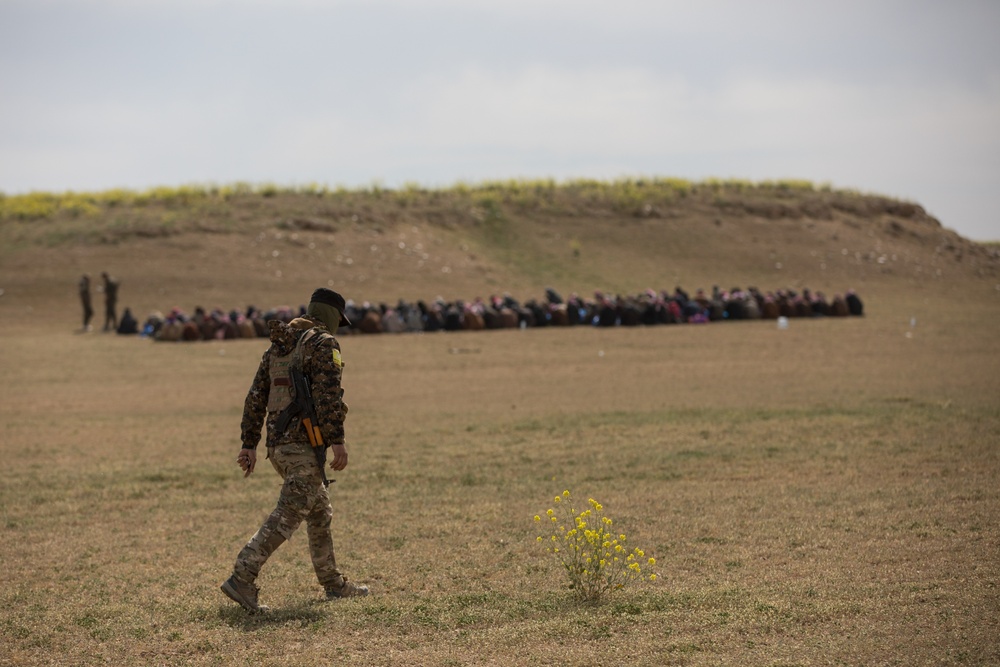
The appearance of U.S. Department of War (DoW) visual information does not imply or constitute DoW endorsement.
In brief
The sources reviewed document controversies and individual cases. They do not establish that a battalion was subordinate to ISIS or that the Ukrainian state cooperated with the organisation. [1] [18] [21]
The right question is not whether Muslim volunteers exist
An “ISIS battalion” is not simply a unit containing Muslims, Chechens or veterans of Syria. ISIS is a terrorist organisation: attributing a military unit to it means asserting a specific organisational link. This dossier separates five questions: have former members been present in Ukraine? Has anyone fought in Ukrainian formations? Have individuals had ideological ties? Was there a unit subordinate to ISIS? Did the Ukrainian state cooperate with the organisation? A positive answer to one question does not automatically answer the others.
The same standard applies in reverse. Failing to find a document identifying an ISIS unit does not prove that no former member ever entered the country. An arrest may document a genuine risk without describing government policy. A jihadist past can matter without defining a person's entire identity, subsequent affiliation and conduct. Evidence must be tied to the exact proposition it supports, not stretched for convenience.
2015: a report, its readers and the alliance thesis
One identifiable stage in the story's circulation is Sierra Rayne's article published by American Thinker on 30 November 2015. Its title already presents an “alliance” between Ukraine and ISIS. It invokes Marcin Mamon's February report in The Intercept, maintains that ISIS fights alongside Ukrainian nationalists, and then connects this picture to Andrew Kramer's July New York Times report on Islamic battalions. This is therefore not a thesis invented merely to refute it: an author explicitly advanced it. Reading the article establishes first that Rayne asserted this conclusion, not that the links he proposed were verified. [7]
Mamon's text reproduced by Jihad Intel, presented as a republication from The Intercept, describes the milieu of Ruslan, a fighter from the Caucasus, and his connections with the Dudayev battalion. It describes solidarity among militants, fundraising and criminal activities. This version starts with Ruslan's story: it lacks the passage about an ISIS leader that Rayne attributes to the report's opening. It therefore cannot authenticate that missing passage. The full original version was not verified for this dossier. [5]
The same limitation concerns Kramer's complete report: we do not present it as directly checked corroboration. The connection requiring verification remains the move from units described as “Islamic” to units belonging to ISIS. Proof of the stronger thesis must rest on that connection, not simply on the presence of Muslim volunteers.
When the UN is invoked
Another strand attributed the accusation to the United Nations. On 30 November 2015, StopFake examined a Russia 24 report broadcast three days earlier: according to the fact-checker's reconstruction, the channel had attributed to the UN the presence of hundreds of Islamists in Right Sector's volunteer unit. StopFake said it had found no such statement in the official resources consulted. The old link to the Vesti report now leads to the site's general page. [8]
We can document this contemporary challenge, not turn it into proof that we examined every relevant UN document. Without identifying any document cited by the broadcast, the precise attribution remains to be checked. Above all, a statement made by a national representative at the UN does not automatically become the organisation's conclusion.
2018: from some men's training to the name of an entire organisation
On 26 December 2018, UNIAN reported that Sergei Markov had shared a Marc Bennetts article on Facebook. The issue concerned alleged admissions by some fighters that they had trained in ISIS camps. The original Times article is identifiable, but its full contents were not verified here; Markov's post is also known through this account, not direct reading. The criticisms reported by UNIAN do not settle the issue: challenging the journalist's position or the season shown in a photograph does not verify the interviewees' biographies. [11]
An acknowledged reproduction of RT, published that day by Internationalist 360°, shows a further transformation. Its body discusses some men trained with ISIS and the Sheikh Mansur battalion's relations with Ukrainian forces; its headline introduces al-Qaeda instead. These are distinct organisations. The changed label in the reproduction is not additional proof: it is part of the problem to examine in the story's transmission. [12]
Russia's 2025 accusations do not all say the same thing
In the 10 February 2025 speech published by Russia's UN mission, Vassily Nebenzia accuses Kyiv of supporting militants in Africa and acting as a logistical hub; he also draws an analogy between Ukrainian radical nationalists, al-Qaeda and ISIS. That text does not identify an ISIS battalion in the Ukrainian army. [13]
On 20 August, Dmitry Polyanskiy returns to allegations of supplies, training and coordination in Africa, mentioning JNIM in Mali and demanding an international investigation. This too is a national statement, not a UN finding; mentioning JNIM does not establish an ISIS unit in Ukraine either. [14]
The chain thus documents real accusations, but also changes in subject and meaning. Verification must preserve these differences: neither dismiss every individual report as propaganda nor combine heterogeneous references into proof of a single alliance.
What the 2020 foreign-fighter study actually says
Egle E. Murauskaite's study for the Vilnius Institute for Policy Analysis, hosted by ICCT, uses 49 public profiles and separate interviews, with a mainly European focus: not a global census. It reports that some Sheikh Mansur members allegedly supported ISIS and fought in its ranks in Syria or Iraq, citing András Rácz (2017). The same passage distinguishes the lack of public identification of terrorist organisations as such.
These are different propositions: individual histories and organisational presence. Rácz's original chapter was not fully verified: that link remains secondary, not our own investigation of the fighters. The 2020 report does not certify the present. [1]
Ukraine as a refuge: a more complex picture
In July 2021, International Crisis Group described Russian-origin Muslims in Ukraine: most had no Islamist militant ties, while some had fought in Syria, in ISIS or its opponents. The research belongs to a series based on over a hundred interviews across several countries, not a hundred Ukraine-only interviews. One interlocutor's estimate of “several hundred” Syrian veterans did not mean as many ISIS members.
The report also documents a grey area involving irregular residence, extradition requests, fears of persecution and substantive suspicions. It cites the Sheikh Mansur commander's claim that he arrived in 2014 at Ukrainian intelligence's invitation, under oral agreements; this does not prove agreements between those authorities and ISIS. Residence, protection, military service and terrorist membership remain distinct categories. The study neither reduces all migrants to militants nor removes problematic cases. It analyses 2021, not every current presence in the country. [2]
Kultanov: one story is not proof of a battalion
A May 2023 Meduza investigation describes Baurzhan Kultanov, who recounts his past in ISIS and subsequent recruitment by Russia's FSB. According to the reconstruction, in 2019 he was tasked with infiltrating a pro-Ukrainian formation; his path subsequently changed, taking him to Türkiye. The material examined does not demonstrate successful infiltration of the intended unit.
Meduza says it obtained messages, instructions and recordings. We have not independently authenticated that underlying material. Vera Mironova's consultancy relationship with the Ukrainian authorities is also disclosed; she was involved in the investigation. This is relevant information, not an automatic rebuttal. The case shows why an individual's past, whoever may subsequently have employed him, and an operation's actual success must be distinguished. It warrants neither calling an entire Ukrainian formation “ISIS” nor classifying every former ISIS member as a Russian agent. [3]
Which UN document? An essential distinction
The Secretary-General's 31 July 2026 report on the ISIL threat is an institutional document, distinct from individual states' Security Council statements. The examined paragraphs 1–22 do not present an ISIS battalion in Ukraine. However, this is not a catalogue of every militant worldwide: its silence cannot demonstrate universal absence. Its value here is also methodological: identify the author, mandate and precise passage instead of writing vaguely that “the UN says so”. [4]
Al Bara Shishani: arrest is not enlistment
Al Bara Shishani's case shows why a suspect's presence in a country must be distinguished from a military formation's existence. In January 2020, presenting the previous year's results, Ukrainian intelligence chief Ivan Bakanov recalled his arrest, describing him as an ISIS leader hiding in Ukraine. This is an official account of an intelligence operation: it does not say Ukrainian forces enlisted him. The difference matters. Arresting a wanted person, sheltering him clandestinely and incorporating him into a unit are three different facts, none automatically implied by another. [19]
A document submitted by Georgia to the OSCE identifies him as Tsezar Tokhosashvili. It reports his arrest in Kyiv in November 2019 and attributes activities in Syria and Daesh membership to him. These are Georgian investigative findings, not independent OSCE verification. It also makes an important procedural distinction: Tbilisi's court order of 6 November 2019 was a precautionary measure, not a final conviction. At the time of that account, proceedings on the merits were still pending. Translating both stages indiscriminately as a “prison sentence” would change the judicial history. [15]
The update comes from the US terrorism report covering 2020: it reports extradition to Georgia that May and a subsequent ten-year sentence for participation in a terrorist organisation. ACCORD publishes the full chapter. It does not replace the judgment or reconstruct every piece of evidence or possible appeal. It does, however, take the reader beyond the arrest. This case therefore contains an individual ISIS link reported by institutional sources and a reported criminal outcome; those sources do not establish service in a Ukrainian battalion. [23]
From Syria to Ukraine: Abdul Hakim's trajectory
Rustam Azhiev, known as Abdul Hakim al-Shishani, is a different case. Interviewed by Kavkaz.Realii in December 2022, he recounted his path from the Chechen war through Syria to Ukraine, presenting it as continued struggle against Russia. The outlet described his announced incorporation into OBON, the formation linked to Ichkeria's government-in-exile. Asked how he obtained Ukrainian citizenship, he withheld details and invoked an agreement between the parties. The interview documents his public position and stated motivation; it does not retrospectively authenticate all his activities. [21]
His background requires returning to Syria. A September 2015 RFE/RL report distinguished Ajnad al-Kavkaz, which he led, from ISIS. It also reported these Caucasian formations' cooperation with Jabhat al-Nusra, al-Qaeda's Syrian affiliate, and Ahrar al-Sham. Being jihadist does not make Ajnad ISIS; distinguishing it from ISIS does not erase military alliances with other extremist groups. The report concerns that phase of the conflict, not every member's subsequent conduct. [18]
In a subsequent RBC-Ukraine interview published in January 2025, Abdul Hakim said he had participated in operations in Bakhmut, Toretsk, Kharkiv and the Belgorod region. The attribution must remain visible: the commander claims those activities. The interview further documents his stated participation in the war, not independent corroboration of every operation or proof that he acted for ISIS. The relevant question concerns his trajectory and actual relationships, not an identity assigned to all Muslim fighters. [22]
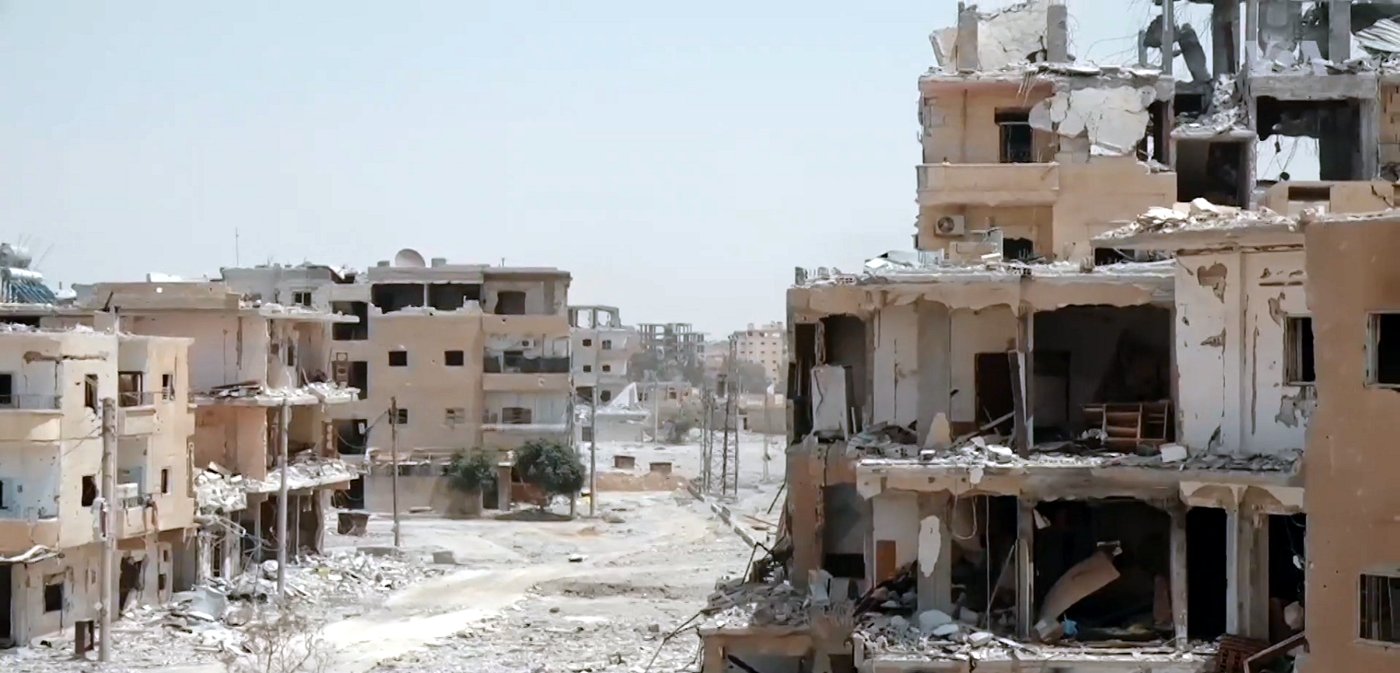
VOA archive footage of Raqqa, Syria, 1 August 2017 Watch the footage on VOA ↓
Tumgoev: allegations, extradition and the defence's objections
Timur Tumgoev, an Ingush man, followed another trajectory. Ukrainian human-rights group KHPG, involved in his legal defence, reports that he was arrested in 2016 at Russia's request, released in 2017 after extradition detention, and subsequently joined the Sheikh Mansur battalion. Ukraine handed him to Russia in September 2018. His lawyers challenged the extradition and alleged non-compliance with a UN Human Rights Committee interim measure. Their direct involvement makes their account relevant, but must be disclosed: it is the defence's reconstruction, not an independent ruling on the allegations' merits. [16]
In June 2019, KHPG reported an eighteen-year Russian sentence, contesting the evidence and circumstances of testimony. The accusation concerned jihadist activities in Syria; Tumgoev denied ever being there. Without the full records, neither erasing the reported conviction nor presenting every allegation as independently verified is justified. The case can document an individual dispute over a volunteer's past, not the entire battalion's organisational affiliation. Two articles from the same organisation are not two independent confirmations. [17]
What diaspora interviews can explain
A Souleimanov and Colombo study helps avoid another logical leap. Its interviews, collected between 2012 and 2019, examined motivations and willingness to travel to Syria and Ukraine. The main sample comprised 33 people; some travelled or tried to, others did not. It is therefore not a census of former ISIS militants transferred into Ukraine's army. The authors explicitly describe the sample as exploratory and unrepresentative. National, personal and religious motivations may intersect; establishing someone's organisation and activities still requires evidence about their history, not an inference from diaspora membership. [20]
How to read the verdict
The claim of a unit organisationally belonging to ISIS requires evidence of that relationship: identifiable command, verifiable affiliation and activities attributable to it. Juxtaposing headlines, religious labels and biographies is insufficient. Conversely, reports about individuals must not be discarded because they are inconvenient: identities, dates, records and independent sources must be checked.
“Not demonstrated” describes an evidentiary limit, not a promise that new evidence can never emerge. A narrowly framed rebuttal of a headline does not absolve everyone mentioned; an individual conviction does not condemn all compatriots or fellow believers. More than a political label, this discipline helps distinguish what we know from what someone asks us to believe.
Key dates
- 30 November 2015 American Thinker explicitly advances the Ukraine–ISIS alliance thesis. [7]
- 30 November 2015 StopFake challenges a UN attribution circulated by Russia 24. [8]
- 26 December 2018 Further reports conflate individual training and group names. [11] [12]
- November 2019 Tsezar Tokhosashvili is arrested in Ukraine; Georgia orders a precautionary measure. [15]
- 2020 The US report records extradition and a ten-year Georgian sentence. [23]
- 8 July 2021 Crisis Group publishes its research on Russian-origin Muslims in Ukraine. [2]
- 2 December 2022 Radio Svoboda publishes its Rustam Azhiev interview. [21]
- 22 May 2023 Meduza publishes its Kultanov investigation in English. [3]
- 2025 Two Russian UN statements advance distinct accusations also concerning Africa. [13] [14]
Evidence by claim
The assessments apply to the statements listed.
Strong evidence
The alliance thesis was indeed published
Green concerns the American Thinker article’s existence, not the alliance’s truth. [7]
Original source of the assertion, not corroboration of its content.
Conflicting evidence or fragile conclusion
Kultanov: successful infiltration not demonstrated
The investigation reports a plan; we neither independently authenticate underlying materials nor attest completion. [3]
One investigation with disclosed limitations and professional relationships.
Frequently asked questions
Does being Muslim mean being an ISIS member?
No. Religion does not establish organisational affiliation. Evidence about the group and individual is required. [1]
Does fighting in Syria mean fighting for ISIS?
No. Its opponents also operated there; identify the unit, period and trajectory. [18]
Is the presence of former ISIS members in Ukraine documented?
Individual cases exist: the US Georgia report records Tsezar Tokhosashvili’s conviction following extradition from Ukraine. [23]
Did Al Bara fight for Ukraine’s army?
The examined arrest and proceedings sources do not establish this. Residence is not military service. [19]
Was the November 2019 Georgian decision already a conviction?
No: Georgia’s document describes a precautionary measure. Another report records the later conviction. [15]
Was Ajnad al-Kavkaz another name for ISIS?
The examined report distinguishes them, while also reporting cooperation with al-Nusra. [18]
Does Azhiev’s interview verify all his activities?
No: it documents his statements, not every military episode or past affiliation. [21]
Has the UN certified a Ukrainian ISIS battalion?
Does the 2020 study exclude all ISIS backgrounds?
No. It distinguishes reported individual histories from organisational presence; the relevant bibliographical reference remains unverified in full. [1]
Are thirty-three interviewees thirty-three verified fighters?
No. The academic sample is unrepresentative; stated willingness to travel is not verified enlistment. [20]
Does not demonstrated mean false?
No. It describes insufficient evidence for a particular thesis, not the impossibility of new evidence.
What could change the assessment?
Authentic documents and independent corroboration of a specific unit’s command, affiliation and activities. Similar names are insufficient.
Sources, licences and limitations
Sources reviewed through .
- Check A. Provenance and passage consulted
- Egle E. Murauskaite · Foreign Fighters in Ukraine: Assessing Potential Risks · 2020 · PDF pp. 4–5, 9–10 and 16–17.
- Check B. What it documents and its limits
- The study examines 49 cases and interviews. The Mansur passage relies on Rácz, whose chapter was not obtained.
- Check A. Provenance and passage consulted
- International Crisis Group · Russian-Origin Muslims in Ukraine · 2021-07-08 · Overview, methods in I, passages 65–73 and 149–170.
- Check B. What it documents and its limits
- The original and mirror are the same work. Not all of the series’ interviews were conducted in Ukraine.
- Check A. Provenance and passage consulted
- Lilia Yapparova; Vera Mironova · You really are a terrorist · 2023-05-22 · Opening and passages 1–145 and 178–292.
- Check B. What it documents and its limits
- The authors’ materials were not independently authenticated. Mironova disclosed advisory work for Ukrainian services.
- Check A. Provenance and passage consulted
- UN Secretary-General · S/2026/638 · Secretary-General’s report on the ISIL threat · 2026-07-31 · Paragraphs 1–22 and a text search for Ukraine.
- Check B. What it documents and its limits
- A UN report within its own scope, not an exhaustive list. The companion S/2026/651 was not read.
- Check A. Provenance and passage consulted
- Marcin Mamon · In Midst of War, Ukraine Becomes Gateway for Jihad · 2015-02-26 · Copy consulted · Original inaccessible. Declared republication, lines 9–36.
- Check B. What it documents and its limits
- The copy lacks the ISIS–Istanbul passage. It cannot verify what is missing.
- Check A. Provenance and passage consulted
- Andrew E. Kramer · Islamic Battalions, Stocked With Chechens, Aid Ukraine in War With Rebels · 2015-07-07 · Headline and reception documented. Full article not read.
- Check B. What it documents and its limits
- The headline’s word “Islamic” does not say “Islamic State”.
- Check A. Provenance and passage consulted
- Sierra Rayne · The Ukraine-ISIS Alliance · 2015-11-30 · Main text, lines 22–49.
- Check B. What it documents and its limits
- Documents Rayne’s thesis and its reliance on Mamon, the NYT and intermediaries. It does not independently verify an alliance.
- Check A. Provenance and passage consulted
- StopFake · Fake: United Nations Admits Presence of Islamists Among Ukrainian Armed Forces · 2015-11-30 · Main text, lines 61–71.
- Check B. What it documents and its limits
- StopFake describes the Russia 24 report. The video was not viewed and the alleged UN document was not identified.
- Check A. Provenance and passage consulted
- Russia 24 report cited by StopFake · 2015-11-27 · The link redirects to the homepage. Video not viewed.
- Check B. What it documents and its limits
- Known through StopFake. The source label is descriptive rather than the verified original title.
- Check A. Provenance and passage consulted
- Marc Bennetts · Putin is our enemy too, says Chechen fighter in Ukraine · Headline visible behind access limits. Body not read.
- Check B. What it documents and its limits
- Intermediaries document circulation by 26 December 2018. The publisher’s date was not verified.
- Check A. Provenance and passage consulted
- UNIAN · Kremlin’s useful idiots once again spreading fake narrative of Islamic State in Ukraine: OSINT group · 2018-12-26 · Main text, lines 32–58.
- Check B. What it documents and its limits
- Cites Markov and The Times. His Facebook post was not opened, and the interviews were not independently checked.
- Check A. Provenance and passage consulted
- Internationalist 360° · republished from RT · Chechen Al-Qaeda Fight Alongside Ukraine Nazis · 2018-12-26 · Original not read · Declared RT republication, main text 9–25.
- Check B. What it documents and its limits
- The RT original was inaccessible. The republication’s headline refers to al-Qaeda, a distinct organisation.
- Check A. Provenance and passage consulted
- Vassily Nebenzia · Security Council statement on terrorism · 2025-02-10 · Speech text, lines 38–69.
- Check B. What it documents and its limits
- A Russian statement rather than a UN finding. Allegations concerning Africa do not document an ISIS battalion in Ukraine.
- Check A. Provenance and passage consulted
- Dmitry Polyanskiy · Security Council statement of 20 August · 2025-08-20 · Speech text, lines 35–63.
- Check B. What it documents and its limits
- Russian allegations and petition for investigation. JNIM is distinct from ISIS. The UN minutes S/PV.9982 were not read.
- Check A. Provenance and passage consulted
- Georgia · FSC.EMI/375/20 · Communication from Georgia · 2020-10-09 · Header, disclaimer and PDF p. 28.
- Check B. What it documents and its limits
- Georgia’s communication distributed by the OSCE is not an OSCE finding. The 2019 measure was pretrial.
- Check A. Provenance and passage consulted
- KHPG · Ukraine hands asylum seeker Timur Tumgoev over to FSB to face certain torture in Russia · 2018-09-13 · Main text, lines 115–131.
- Check B. What it documents and its limits
- KHPG took part in legal assistance. Same reporting chain as [17]. The underlying case papers were not obtained.
- Check A. Provenance and passage consulted
- KHPG · Defender of Ukraine sentenced to 18 years after being treacherously handed over to Russia · 2019-06-27 · Main text, lines 115–128.
- Check B. What it documents and its limits
- Same reporting chain as [16]. The reported 18-year sentence does not substitute for the full judgment.
- Check A. Provenance and passage consulted
- Joanna Paraszczuk · Why Russian Propaganda Links Chechen Militants, IS, And Assad's Coastal Stronghold · 2015-09-14 · Main text, lines 107–153.
- Check B. What it documents and its limits
- Direct contact with an anonymous activist. The distinction between Ajnad and ISIS concerns the group and period discussed.
- Check A. Provenance and passage consulted
- Security Service of Ukraine · СБУ стає більш сучасною і змінює підходи у своїй роботі – Іван Баканов · 2020-01-31 · Account of SSU activity in 2019, including the arrest.
- Check B. What it documents and its limits
- The SSU describes its own operation. This is neither a judgment nor evidence of military service.
- Check A. Provenance and passage consulted
- Emil A. Souleimanov; Roberto Colombo · Chechen diaspora members as foreign fighters in Syria and Ukraine: a diachronic study · 2024-05-17 · Abstract, introduction and methods pp. 91–92.
- Check B. What it documents and its limits
- 33 people and 44 interviews, in a non-representative sample. Reported willingness is distinct from verified enlistment.
- Check A. Provenance and passage consulted
- Anzhelika Kaimova · Отвоевать Ичкерию в Украине: интервью с командиром чеченского отряда Рустамом Ажиевым · 2022-12-02 · Introduction 80–84, interview 86–133 and notes 136–141.
- Check B. What it documents and its limits
- Azhiev speaks directly. His claims were not independently verified and the Russian decision was not obtained.
- Check A. Provenance and passage consulted
- RBC-Ukraine · Abdul Hakim al-Shishani in an interview with RBC-Ukraine - About Chechnya, Kadyrov, Russia and Ukraine's victory | RBC-Ukraine · 2025-01-05 · Title, introduction and sections through line 46.
- Check B. What it documents and its limits
- Direct interview. The operations claimed were not independently verified.
- Check A. Provenance and passage consulted
- US Department of State · Country Report on Terrorism 2020 – Chapter 1 – Georgia · 2021-12-16 · Full Georgia chapter of the US State Department report, as republished by ACCORD.
- Check B. What it documents and its limits
- The State website errored. The chapter reports extradition and sentence rather than providing the judgment.
- Check A. Provenance and passage consulted
- 1TV · US Department of State: Georgia remains strong security partner - 1TV · 2021-12-17 · Main text, lines 47–54.
- Check B. What it documents and its limits
- Follows the same US State Department report as [23] and offers no independent corroboration.
- Check A. Provenance and passage consulted
- András Rácz · The Elephant in the Room: Russian Foreign Fighters in Ukraine · 2017 · Chapter not obtained. Reference seen in [1].
- Check B. What it documents and its limits
- The underlying chapter, pp. 60–73 of Not Only Syria?, was not checked directly.
- Check A. Provenance and passage consulted
- Mahmoud Bali / VOA, via Wikimedia Commons; public domain · Resized without cropping.
- Check B. What it documents and its limits
- Scope documented by the archive and caption.
- Check A. Provenance and passage consulted
- Elke Wetzig (elya) / Wikimedia Commons / CC BY-SA 3.0 · CC BY-SA 3.0 · Entrance to the Verkhovna Rada, Ukraine’s parliament in Kyiv, 21 May 2005. Archive image illustrating the institutional context.
- Check B. What it documents and its limits
- Scope documented by the archive and caption.
- Check A. Provenance and passage consulted
- David Shankbone / Wikimedia Commons / CC BY-SA 3.0 · CC BY-SA 3.0 · Resized without cropping.
- Check B. What it documents and its limits
- Scope documented by the archive and caption.
- Check A. Provenance and passage consulted
- Alsandro / Wikimedia Commons; public domain · Resized without cropping.
- Check B. What it documents and its limits
- Scope documented by the archive and caption.
- Check A. Provenance and passage consulted
- Mahmoud Bali / VOA · Watch the footage on VOA · 01.08.2017 · VOA archive footage of Raqqa, Syria, 1 August 2017
- Check B. What it documents and its limits
- Played on VOA’s site. The opening sequence shows damaged buildings and streets in Raqqa. It provides Syrian context for the photograph and does not address the allegations about Ukraine.
- Check A. Provenance and passage consulted
- Staff Sgt. Raymond Boyington / U.S. Army / DVIDS · DVIDS terms of use · Public domain
Opened original DVIDS record 5196817. U.S. Army photo credited to Staff Sgt. Raymond Boyington. Taken in Deir ez-Zor province on 13 March 2019. VIRIN 190313-A-JR267-8588. Inspected the 1,000 × 667 px copy displayed by DVIDS and used it without further changes. - Check B. What it documents and its limits
- Documents the setting in Syria and the screening described by DVIDS. The people in the background are out of focus and unrecognisable in the copy used. The photograph shows no combat and provides no evidence for the allegations about Ukraine.


