Dossier
Iran without headscarves: what street videos really show

In brief
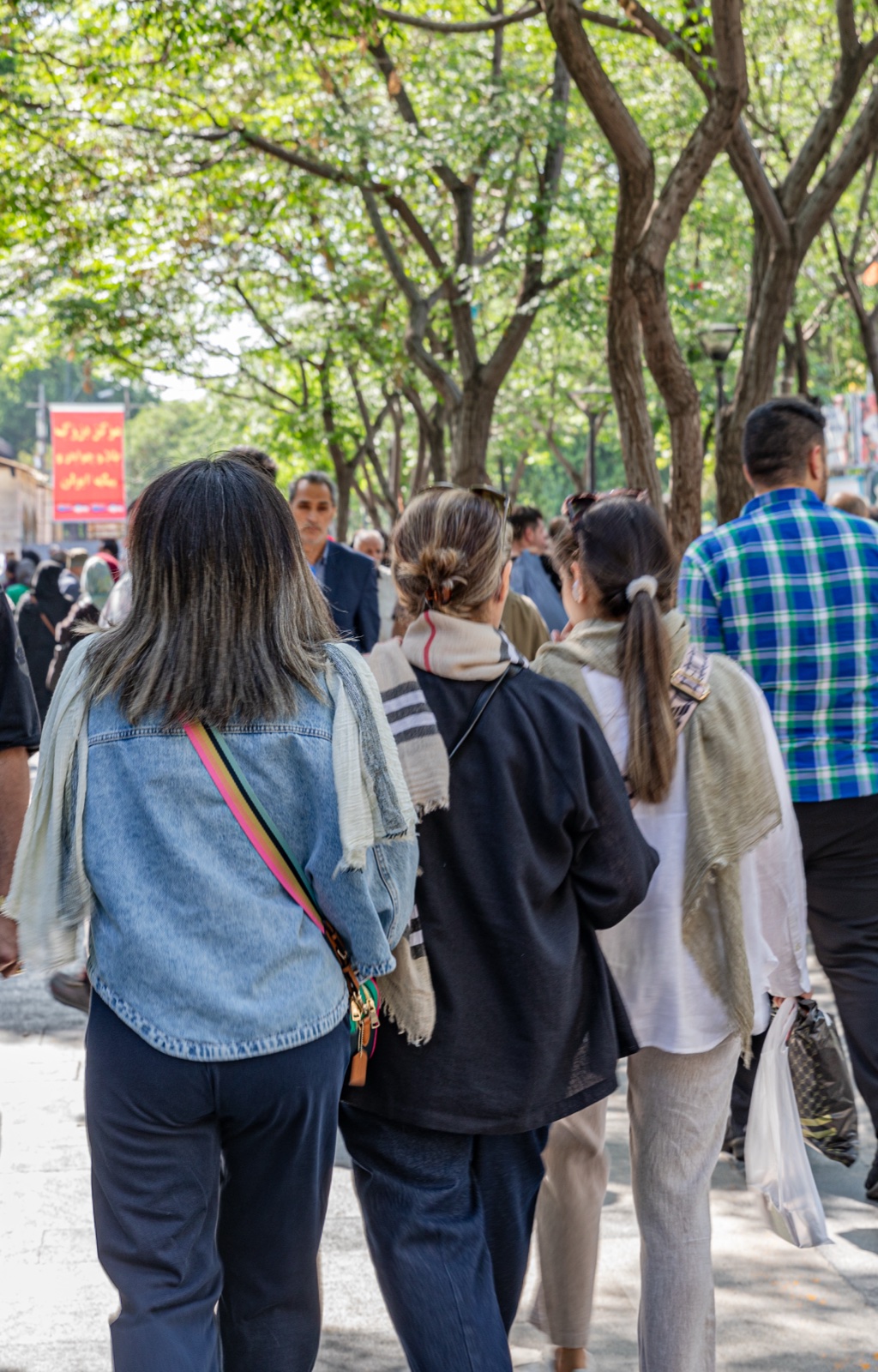
Women without hijabs on Iranian streets are not a contradiction to be explained away. Their presence reveals real change, but does not by itself prove that the requirement has been abolished. Saudi Arabia and Afghanistan show why clothing, laws and freedom must be distinguished.
- Authentic footage documents what happens in the place and at the time filmed, not the entire political system.
- Defiance of compulsory veiling is visible in Iran, while the coercive framework has not disappeared. Freedom exercised and freedom guaranteed are different things.
- Saudi Arabia lifted its ban on women driving on 24 June 2018. That is a concrete change, not proof that all inequalities have ended.
- Hijab, niqab and burqa are not synonyms. Muslim women do not all dress in the same way.
Frequently asked questions
If I see women without headscarves, is the video fake?
No. There is no reason to reject it merely because it conflicts with a stereotypical image of the country. It should be verified like any other testimony.
If nobody intervenes on camera, does that mean it is allowed?
Not necessarily: conduct may be tolerated, ignored or punished later. The scene alone does not answer the legal question.
Must every woman in Saudi Arabia wear a burqa?
Can Saudi women drive?
Is a woman wearing a headscarf necessarily being forced to?
No. Her clothing alone cannot tell us whether faith, preference, social convention, family pressure or a state requirement is involved. And one woman's choice does not establish freedom for everyone.
Can we describe the walking videos cited here as verified?
Not fully: we found public metadata for the example mentioned, but did not independently verify the filming date, complete route or editing. It is a case study, not the central evidence for this dossier.
1. A genuine scene can be used to reach the wrong conclusion
A filmed walk can show people laughing, shopping, dressing in different ways and moving about without being stopped. The first mistake would be to deny these images because they do not fit a narrative of a uniformly repressed country. The second would be to treat a few minutes as a referendum on national freedom.
The useful question is not “videos or human-rights reports: who is lying?” It is: what can each source establish? A camera can show that nobody intervened during a sequence. A legal document can show that a prohibition exists. A personal account can describe a threat received afterwards. These pieces of evidence are not necessarily incompatible.
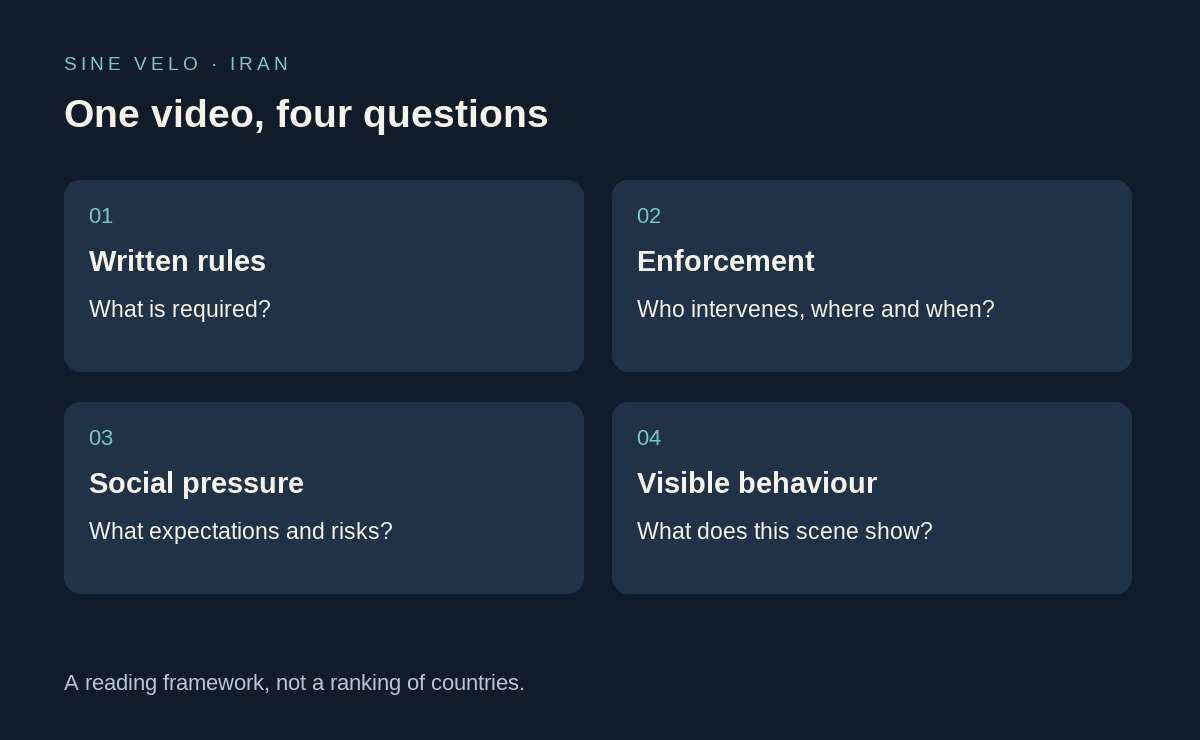
A proper comparison requires at least four levels: written rules, enforcement by authorities, social pressure and actual behaviour. Confusing them obscures precisely what is most interesting: how much space people win for themselves, and how much they can lose.
Open the full-resolution graphic
- Written rules: What is required?
- Enforcement: Who intervenes, where and when?
- Social pressure: What expectations and risks?
- Visible behaviour: What does this scene show?
2. Visible Iran: the change is not invented
An AFP report from Tehran on 13 November 2026 describes women wearing more revealing clothing and shopkeepers changing their stock. It also reports new arrests announced by the authorities and caution among the women interviewed. S1 [1]
That coexistence is the point: we should not choose only images of repression or only images of ordinary life. Ordinary life continues under coercive rules, and defiance can become widespread enough for enforcement to turn selective.
As early as March 2023, Human Rights Watch published the account of a woman walking without a headscarf as a protest, despite fearing the consequences. S2 [2] Not all women make the same gesture with the same intention; we do not attribute motives to strangers filmed in the street. But this account shows why interpreting the absence of a headscarf as proof of the absence of oppression can reverse the gesture's meaning.
An IranWire report dated 28 October 2025 described confrontations with women without headscarves near Tehran's metro. S3 [3] A localised account does not measure national prevalence. It does, however, remind us that going without a headscarf and experiencing intimidation can be part of the same experience.
3. The law does not match every encounter in the street
UN report A/HRC/61/60, dated 19 March 2026, distinguishes the controversial new hijab measure from the pre-existing framework: the requirement and mechanisms of repression had not been removed. S4 [4]
That is why headlines such as “new law suspended” must not automatically become “compulsory veiling abolished”. We need to identify which text is suspended, which remains, which authority decides and from when. “The morality police are not visible” and “no controls exist any more” are also different propositions.
HRW's annual report covering events in 2025 describes surveillance, proceedings and penalties while noting the suspension of the new legislation. S5 [5] This information has a reference period: we do not present it as a count of what is happening today in every neighbourhood.
An inquiry into freedom must therefore ask: can a woman choose without depending on an officer's mood? Can she maintain that choice at school, at work or at a public office? Can she challenge a penalty? A right is more than what she manages to do when nobody stops her.
4. What evidence walking videos lack
Assessing a video requires concrete questions, not automatic suspicion:
- Origin: is this the creator's upload or a reposted excerpt?
- Date: does the upload date match the filming date? The season may help, but does not certify the day.
- Location: do signs, junctions and buildings match a route that can be reconstructed?
- Continuity: are there cuts, time jumps or added audio tracks?
- Selection: why this neighbourhood, this time and this route?
- Limit: what subsequent consequences, indoor settings or people outside the frame can we not see?
The example “Tehran Iran Walking Tour”, found on YouTube with a stated publication date of 31 January 2025, remains material requiring context here: we do not have independent verification of the full route or filming date. V1 [13] The published date does not become a certified date of the event. We do not derive national percentages from the number of people in the frame.
Likewise, footage of an arrest does not prove that every woman is arrested. Demanding the same standard for reassuring and dramatic footage is a method, not a compromise between two forms of propaganda.
5. A wardrobe is not a map
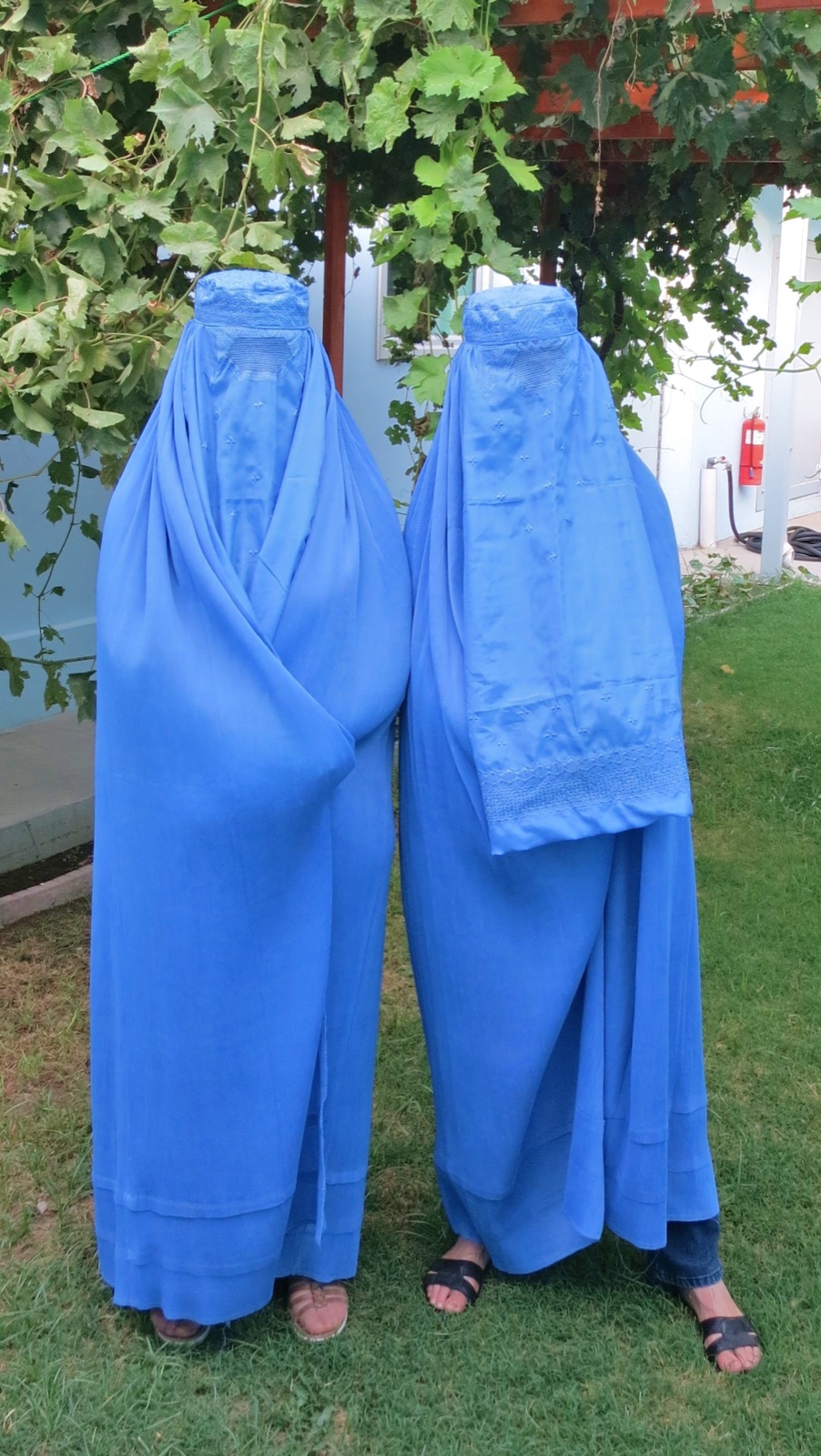
In the terminology used here, hijab means a headscarf leaving the face uncovered; niqab a face veil leaving the eyes visible; burqa a full-body garment with a mesh screen in front of the eyes. S6 [6]
We do not use “burqa” for every woman dressed in black. Nor do we treat greater bodily coverage as an automatic measure of individual radicalism. People's motives need to be heard, not drawn from their silhouettes.
Even “where do women wear burqas?” contains two questions: where they are worn and where they are imposed. A cultural presence is not a national obligation; a local requirement does not automatically describe a whole country. A serious map must be able to show internal differences, not merely colour in states.
6. Saudi Arabia: correcting the comparison, not absolving the government
The official Saudi charter for public places requires modest dress; that provision does not prescribe a burqa. S9 [9] British travel guidance specifies that female visitors do not have to wear an abaya or cover their hair. S7 [7]
That does not authorise us to turn guidance for visitors into a complete description of citizens' experiences. A tourist, a resident worker and a Saudi woman may face different expectations and constraints. Nor does a shopping centre sum up a family or a religious city.
Amnesty documented the lifting of the driving ban on 24 June 2018 while also drawing attention to the repression of activists. S8 [8] Acknowledging a concrete reform does not require ignoring its limits or erasing those who demanded it.
HRW's 2026 report highlights continuing discrimination in Saudi male guardianship and family law. S10 [10] The test of freedom therefore does not end with being able to drive, attend a concert or appear without a headscarf in a tourist area.
The standard must be identical for Western allies and adversaries: recognise documented openings, describe documented restrictions and do not use one country as an excuse for another. The possibility that criticism is selective does not automatically make the reported fact false.
7. Afghanistan: a necessary comparison that requires attention to detail
OHCHR describes the Taliban's 2024 morality law as expanding restrictions and enforcement powers. S11 [11] It would be wrong to equate this setting with every Muslim-majority country.
An April 2026 OHCHR report traces a burqa requirement for accessing offices and services introduced in Herat in November 2025, an official denial and a subsequent apparent easing; the chador requirement remained. S12 [12]
The sequence shows why local detail matters. Simply writing “burqas are compulsory in Afghanistan” would lose the specificity of measures, timing and enforcement. Simply writing “the Taliban deny it” would lose the observed practices. The authority's statement and independent verification must be considered together, without treating them as interchangeable.
The CFMM terminology guide also notes burqa use in northern Pakistan: it describes a cultural practice, not evidence of a national requirement. S6 [6] Burqas and niqabs are also found outside the three countries at the centre of this dossier. We do not, however, produce a global ranking without comparable data: distinguishing individual use, custom and coercion is more informative than a list of supposedly identical nations.
8. Religion, society and power are not the same thing
A woman can choose religious clothing and oppose its imposition on others. She can go without a headscarf and hold conservative views. She can change clothing according to context without changing her beliefs. These are interpretative possibilities, not diagnoses of people in videos.
Understanding the relationship between state and society means allowing room for these combinations. Reducing Iranian women to victims without agency erases their ability to change customs; reducing them to living proof of the authorities' benevolence erases the cost of that change.
Even the label “Western-dressed” needs care: a person in jeans is not automatically declaring a political allegiance, lack of religion or sympathy for a foreign government. Clothing is not a ballot paper.
9. How to avoid two mirror-image mistakes
First mistake: the postcard country. Venues, music and smiles are selected and used to deny all coercion. The problem is not that the scenes are necessarily false; it is that the conclusion goes beyond the images.
Second mistake: the prison country with no social life. Only abuses are selected, and change, differences and the capacity to resist go unrecognised. Here too, a documented reality is turned into a total description.
A good dossier does not average these images. It asks which claims stand up to the evidence. If a rule exists, it says so. If enforcement retreats in some settings, it says so. If reliable measurements of a practice's prevalence are missing, it does not invent a percentage.
10. What we can and cannot conclude
We can conclude that the absolute opposition between women without headscarves and repression is misplaced. A freedom exercised can precede its legal recognition, and can be reversible. This is our synthesis of the evidence, not a national survey.
We cannot certify the safety of those filmed, a neighbourhood's representativeness or a video's date from its title alone. We cannot establish that every veiled woman is coerced, or that every woman without a headscarf is an activist.
The final question is not which government wins a comparison of images. It is whether a woman can choose to cover or uncover herself without violence, arbitrary penalties or exclusion. Applying this criterion to Tehran, Riyadh and Kabul allows real differences to be compared without reducing millions of people to a geopolitical symbol.
Sources and limits of verification
Editorial update: 17 November 2026. The sources cover different periods, specified above. We have not conducted on-the-ground reporting or a complete forensic verification of the walking videos. UN reports are primary documents of investigative activity, not direct editorial access to every incident. Statements reported by news agencies remain attributed. Travel guides are not surveys of female citizens' rights.
Claims and limits of the evidence
Not established
YouTube video V1 represents the situation of all Iranian women.
The filming route and date have not been fully verified; a selected sample is not a national survey. [13]
Date documented
Saudi Arabia lifted its ban on women driving on 24 June 2018.
The contemporary source dates the lifting of the ban and distinguishes the reform from limitations on other rights. [8]
Content of the report documented
The UN report describes a local burqa requirement in Herat in November 2025 and a subsequent apparent easing.
Paragraph 18 concerns access to offices and services; it mentions an official denial and the continuing chador requirement. This is not a uniform nationwide rule. [12]
Institutional videos: documents and limitations
UN press conference on Iran · 14 March 2025
The official page’s text and shotlist were consulted; playback was not viewed in full. This documents institutional statements, not independent verification of the events.
OHCHR statement on Afghanistan · 27 August 2024
The official page’s text and shotlist were consulted; playback was not viewed in full. This documents institutional statements, not independent verification of the events.
Sources
- AFP, reporting from Tehran, 13 November 2026, republished by Times of Israel
A · Provenance · AFP, bylined report dated 13 November 2026, republished by Times of Israel.
B · Content and limitations · Documents accounts and observations in Tehran and reports announcements of arrests. Does not measure national frequency or substantiate every official statement.
- Human Rights Watch, an Iranian woman’s account, 7 March 2023
A · Provenance · HRW, interview of 7 March 2023 with a witness using a pseudonym.
B · Content and limitations · An individual account of walking as protest and fear; not a survey.
- IranWire, reporting from Tehran, 28 October 2025
A · Provenance · IranWire, report dated 28 October 2025.
B · Content and limitations · Describes localised confrontations in Tehran; page opened, later returned 403. Not a national measure.
- UN Fact-Finding Mission on Iran, A/HRC/61/60, 19 March 2026, paragraphs 107–115
A · Provenance · UN A/HRC/61/60, 19 March 2026, complete PDF, paragraphs 107–115.
B · Content and limitations · Distinguishes the new measure from the pre-existing framework. The Mission had no access to the country: findings are attributed to the report, not verified on the ground by the editorial team.
- Human Rights Watch, World Report 2026: Iran, events of 2025
A · Provenance · HRW World Report 2026, Iran; events of 2025.
B · Content and limitations · Describes suspension of the new law and repression during the period, not abolition of the requirement.
- Centre for Media Monitoring, terminology guide
A · Provenance · CFMM, media terminology guide; original page read.
B · Content and limitations · Distinguishes garments and also locates cultural burqa use in northern Pakistan. Does not document a Pakistani national requirement.
- FCDO, Saudi Arabia guidance, dress code section
A · Provenance · FCDO, Saudi Arabia travel guidance; dress code section read on 17 November 2026.
B · Content and limitations · Guidance for female travellers: do not automatically extrapolate to the lives of all female citizens.
- Amnesty International, lifting of the driving ban, June 2018
A · Provenance · Amnesty, 21 June 2018, contemporary announcement.
B · Content and limitations · Dates the lifting of the driving ban to 24 June 2018 and criticises repression of activists. Restrictions from 2018 are not automatically described as current.
- Visit Saudi, Public Decorum Charter
A · Provenance · Official Saudi eVisa portal, Public Decorum Charter.
B · Content and limitations · Provision requiring modest dress; does not require a burqa. Does not prove the absence of all other restrictions.
- Human Rights Watch, World Report 2026: Saudi Arabia, events of 2025
A · Provenance · HRW World Report 2026, Saudi Arabia; events of 2025.
B · Content and limitations · Criticism of the guardianship and family system; attributed assessments, not the original legal text.
- OHCHR, statement on the Taliban law, 27 August 2024
A · Provenance · OHCHR / UNOG, 27 August 2024; full text and shot list read on the original page.
B · Content and limitations · Statement on restrictions and coercive powers under the new law. Attributed institutional position, not footage of incidents in Afghanistan. Embedding explicitly offered; download expired.
- OHCHR, Afghanistan, A/HRC/61/54, 7 April 2026, paragraph 18
A · Provenance · OHCHR A/HRC/61/54, 7 April 2026; paragraph 18 read.
B · Content and limitations · Herat, November 2025: offices and services, denial and apparent easing; chador requirement remained. Do not generalise the burqa requirement to the entire country.
- Tehran Iran Walking Tour, YouTube, example not fully verified
A · Provenance · Indexed YouTube metadata dated 31 January 2025; opening failed.
B · Content and limitations · Example requiring context; location, filming date and editing not certified. No download licence.
- UN Geneva, Iran Fact-Finding Mission press conference, 14 March 2025
A · Provenance · UN Geneva press conference, 14 March 2025; original page with player, shot list and embedding option.
B · Content and limitations · Documents the UN presentation, not an independent visual verification of incidents in Iran. Download expired; embed or link only.