
Dossier
Georgia 2008: who started the war, what Russia did and what the courts established
The Russia–Georgia war: escalation, the Tskhinvali offensive, Russia’s response, the ceasefire, civilians and the limits of court rulings.
In brief
How did the Russo-Georgian war begin, and which responsibilities are documented? Here we separate the background, the outbreak of large-scale hostilities, the legality of operations, violations against individuals and what can still be documented years later. Distinguishing does not mean equating: it means attributing each responsibility to the evidence supporting it.
This is a historical dossier, with judicial and institutional developments dated individually. A 2008 source, a 2010 report and a 2026 judgment are not snapshots of the same moment. Comparison with Ukraine helps us ask better questions, not automatically transfer conclusions from one war to another.
Frequently asked questions
Who started the 2008 war?
Was Georgia already in NATO?
No: Bucharest announced future membership, with the move to the Membership Action Plan still undecided. A political promise and entry into the Alliance are different things. [3]
Are South Ossetia and Abkhazia the same conflict?
No. Their histories and ceasefire arrangements differ. The 2008 war involved both without erasing those differences. [1]
Did the European Court acquit Russia for 8–12 August?
No. The jurisdictional limit concerning military operations did not declare them lawful; detention and the duty to investigate required a separate analysis. [16]
Has the ICC already convicted the three wanted suspects?
The official May 2026 document listed them as wanted and not in custody. Warrants and completion of the investigative phase do not amount to convictions or acquittals. [19]
Did the ICJ establish that no racial discrimination occurred?
No. In 2011 it stopped at a procedural obstacle to jurisdiction without deciding the merits of the allegations. [21]
Can European monitors enter everywhere?
No. EUMM declares a mandate covering all Georgian territory but has no access to Abkhazia and South Ossetia. [14]
Did the six points recognise the territories' independence?
No. The document provided for cessation of hostilities, aid, withdrawals and security discussions, not such recognition. [10]
Does awarded compensation mean paid compensation?
No. These are separate stages: the official execution register still listed sums owed in Georgia v. Russia II on 12 November 2026. [20]
Do photographs prove who caused every instance of damage?
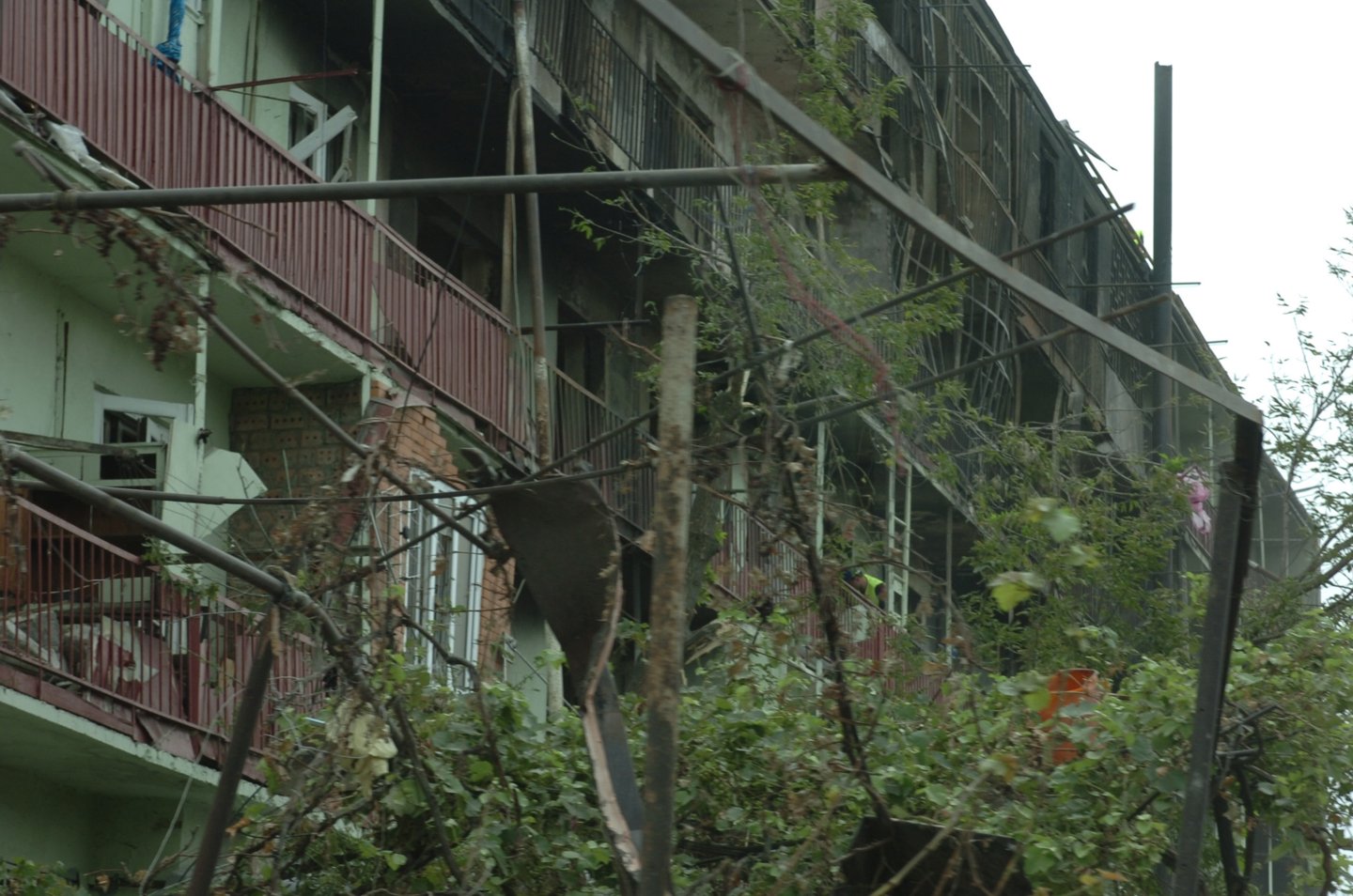
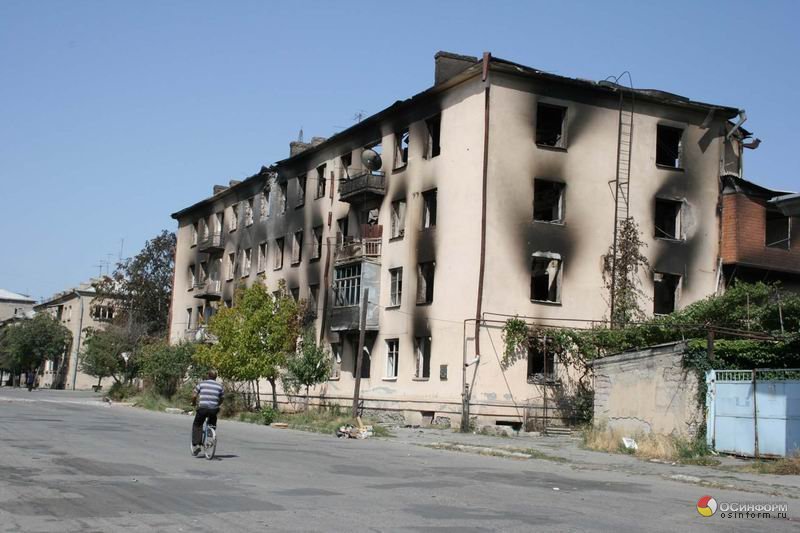
Not alone. They document places and scenes within the limits of their provenance; identifying the attacker, target and responsibility requires other evidence.
Two unresolved conflicts, not one rebellious province
Abkhazia and South Ossetia have distinct histories. The UN's 2010 report traces South Ossetia's Sochi Agreement of 24 June 1992; for Abkhazia, the escalation in 1992, April 1994 return agreements and the Moscow Agreement of 14 May separating forces. August 2008 marked a new phase of existing conflicts. §§3–4 [1]
The word “peacekeeper” also requires precision. In April 2008 the Security Council described UNOMIG and the Commonwealth of Independent States peacekeeping force as stabilising elements in the Georgian-Abkhaz conflict. Resolution 1808 simultaneously supported Georgia's sovereignty, independence and territorial integrity within internationally recognised borders. It called on both sides to avoid violence and provocations and upheld displaced people's right to return to Abkhazia. An existing peacekeeping arrangement therefore did not automatically make every subsequent Russian operation lawful; nor should that arrangement be erased from the account of the war. Each phase's mandate and events must be examined separately. preamble and §§1,6,9,14 [2]
Bucharest: a NATO promise, not entry into the Alliance
On 3 April 2008 NATO announced that Georgia and Ukraine would become members. However, the same paragraph identified the Membership Action Plan as the next step, still awaiting a decision, and tasked foreign ministers with an initial assessment of progress in December. Both elements matter: there was a political promise of future membership, but the summit had not admitted Georgia to the Alliance. §23 [3]
This document helps explain the strategic context. It does not, by itself, establish that a particular military decision was inevitable, who took it or what objective it pursued. A diplomatic declaration, an operational plan and a reconstruction of combat are different kinds of evidence. Using “NATO was involved” as a complete explanation removes precisely the steps an investigation must reconstruct.
Before August: an already militarised crisis
Understanding the war requires separating three questions: how the confrontation developed, who launched the large-scale offensive and which operations were lawful. These are not synonyms. An earlier provocation does not authorise any response; an unlawful attack does not automatically legitimise every action by its opponent. This distinction reconstructs specific responsibilities rather than distributing them equally.
A UN Secretary-General's report of 23 July 2008 already documented serious escalation in Abkhazia. On 29 April Moscow reinforced the CIS peacekeeping contingent with a 525-strong airborne battalion; in late May it also introduced a military railway unit. UNOMIG verified deployments within its own area, not everything happening beyond it. Concerning the Georgian drone downed on 20 April, the mission authenticated video and radar recordings and, absent compelling contrary evidence, attributed the downing to a Russian aircraft. However, it considered both that intervention and Georgian military reconnaissance flights incompatible with the ceasefire regime. This is documented background to the crisis: alone, it does not establish when the ground offensive in South Ossetia began. UN report S/2008/480, §§10, 15–20 [4].
Tbilisi instead presented the downing as aggression and part of an annexation policy, demanding an apology, compensation and inspections of the Gudauta base. This was the Georgian Foreign Ministry's position, transmitted to the UN on 27 May: circulation as a United Nations document did not turn it into the organisation's conclusion. A/62/850–S/2008/345, annex [5].
The night of 7 August and the limits of Russia's response
Heidi Tagliavini's independent mission identified Georgia's bombardment of Tskhinvali on 7–8 August as the start of large-scale hostilities, not the origin of every preceding conflict. It found a prior large-scale Russian invasion insufficiently substantiated, without excluding all Russian presence or fighters' movements. It also noted indications of Russian non-peacekeeping troops before Moscow's officially declared entry time.
The mission found Georgia's offensive unjustified. Its conclusion on defending Russian peacekeepers was conditional: if attacked, they could be defended through a necessary, proportionate response. It did not definitively establish the circumstances of the initial attack on their base. According to the report, Russia's subsequent campaign exceeded those limits and could not be justified in its entirety as protecting peacekeepers or Russian citizens. These are findings of an international inquiry, not a criminal judgment. Tagliavini report, volume I, pp.19–25; volume II, pp.249–252 and 266–275 [6]; IIFFMCG · Tagliavini · II [7].
Civilians are not a footnote
Amnesty International analysed damage, munitions and testimony collected on the ground. In its November 2008 report, the use of Grad rockets and scattered destruction in residential areas supported an assessment of indiscriminate attacks during Georgia's assault. Georgian authorities acknowledged using Grads against three areas of Tskhinvali, claiming military targets. Amnesty observed that these were adjacent to civilian buildings. It also emphasised a crucial limitation: damage and accounts collected afterwards do not automatically reveal the information available to whoever ordered an attack, or their intentions. It called for further investigation into responsibility. Amnesty, Civilians in the line of fire, pp.23–26 [8].
Human Rights Watch's investigation did not stop at Georgia's assault. Based on visits and over 460 interviews, it also described indiscriminate or apparently disproportionate Russian attacks and systematic destruction of Georgian villages by South Ossetian forces. It attributed to the latter a campaign aimed at expelling residents and preventing their return. It documented differing Russian conduct: some troops protected civilians, while others participated in or facilitated looting; it condemned failures to protect people in controlled areas. The research distinguishes incidents and actors rather than deducing every soldier's conduct from nationality. HRW, Up in Flames, pp.7–10 and 13–14 [9].
These distinctions do not cancel one another out. A military target's presence is insufficient to make a bombardment lawful; equally, a civilian casualty does not automatically prove an intentional attack on civilians. Weapons, targets, precautions and available information must be examined. This is also why government accusations, humanitarian organisations' investigations and court decisions must be presented according to their different nature, not merged into one verdict.
The six ceasefire points
On 13 August the EU Council reproduced the principles agreed through French mediation: renunciation of force; cessation of hostilities; free access for aid; return of Georgian forces to their usual bases; withdrawal of Russian forces to pre-hostilities lines, with temporary additional measures by Russian peacekeepers pending an international mechanism; and international discussions on security and stability in Abkhazia and South Ossetia. pp 6–7, §2 [10]
The fifth point must not be cut in half: it included both a withdrawal obligation and a transitional clause. But the text contains no authorisation to recognise new states or annex territories. That is what the document says; the implementation dispute requires separate evidence, not merely the plan's signature.
In September the EU Council welcomed further implementation measures and linked Russian withdrawal from adjacent areas to a ten-day deadline after deployment of an international mechanism, envisaged by 1 October. It urged full implementation of the 12 August and 8 September agreements and prepared a mission of at least 200 monitors. These conclusions document commitments, deadlines and European demands: they do not certify subsequent compliance with every condition. pp 1–2 [11] [25]
Russian recognition and the two narratives
On 26 August 2008 Dmitry Medvedev announced Russia's recognition of Abkhazia and South Ossetia as independent. His official statement argued that Georgia's offensive, civilian casualties and the attack on peacekeepers had made that decision necessary, also invoking self-determination. The text went as far as alleging genocide. It is an essential source for understanding the Kremlin's justification, not independent proof of every accusation it contains. Russian Mission to the United Nations · 26.08.2008 [12]
Georgia's position is the opposite. In its anniversary statement of 8 August 2026, the Foreign Ministry characterises Russia's intervention as aggression and the territories as occupied; it denounces non-implementation of the ceasefire, restrictions on returns and obstacles to international organisations' access, while reaffirming a policy of peaceful resolution. This is a later official position, not a statement contemporaneous with the outbreak of fighting. Here too, a party's voice documents its claims rather than replacing independent verification. Ministry of Foreign Affairs of Georgia · 08.08.2026 [13]
What monitors can see
EUMM is an unarmed civilian mission. Its mandate covers all Georgian territory, but the de facto authorities deny it access to Abkhazia and South Ossetia. A “countrywide mandate” and “effective countrywide access” are therefore not synonymous. The mission itself declares this limitation; we are not inferring it from missing reports. European Union Monitoring Mission · Mandate [14]
A September 2026 EEAS article describes patrols, hotlines and incident-prevention mechanisms. The spokesperson explains that, for inaccessible territories, the mission also uses public information and conversations with people crossing the lines. These tools can reduce risks and clarify incidents, but do not amount to freely inspecting every location. The account also recalls the end of the OSCE and UN missions after Russia blocked renewal of their respective mandates. This is an institutional explanation of EUMM's work, not independent monitoring of EUMM. European External Action Service · EUMM [15]
Displacement cannot be reduced to one figure
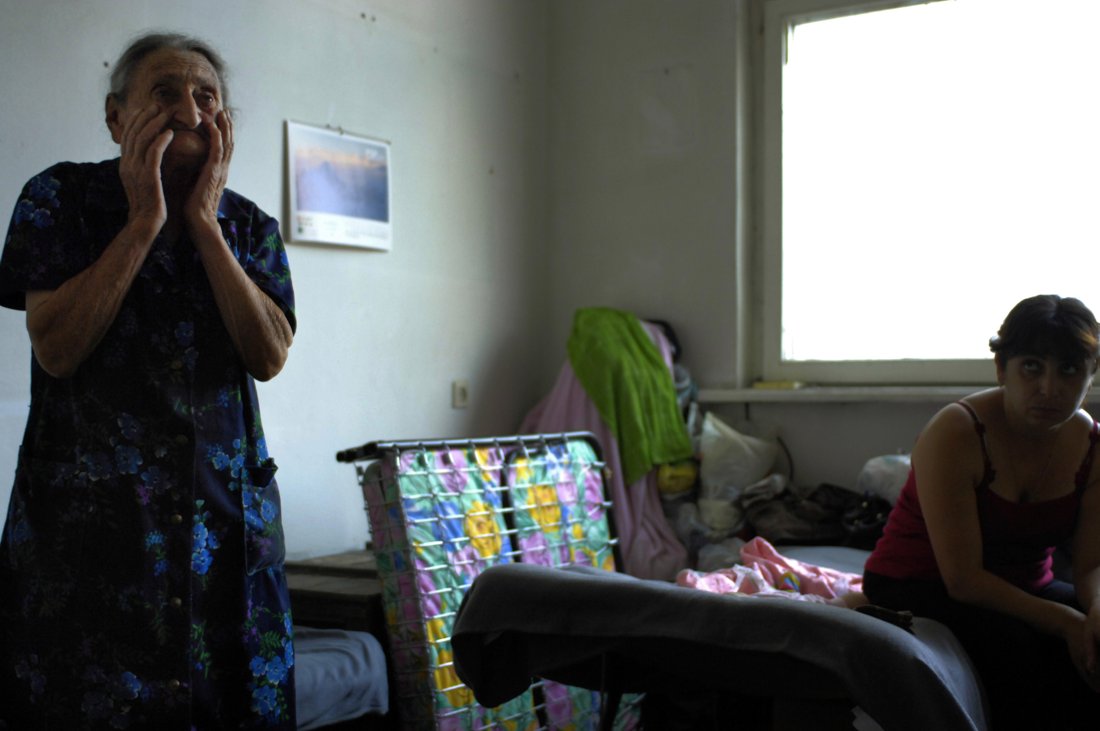
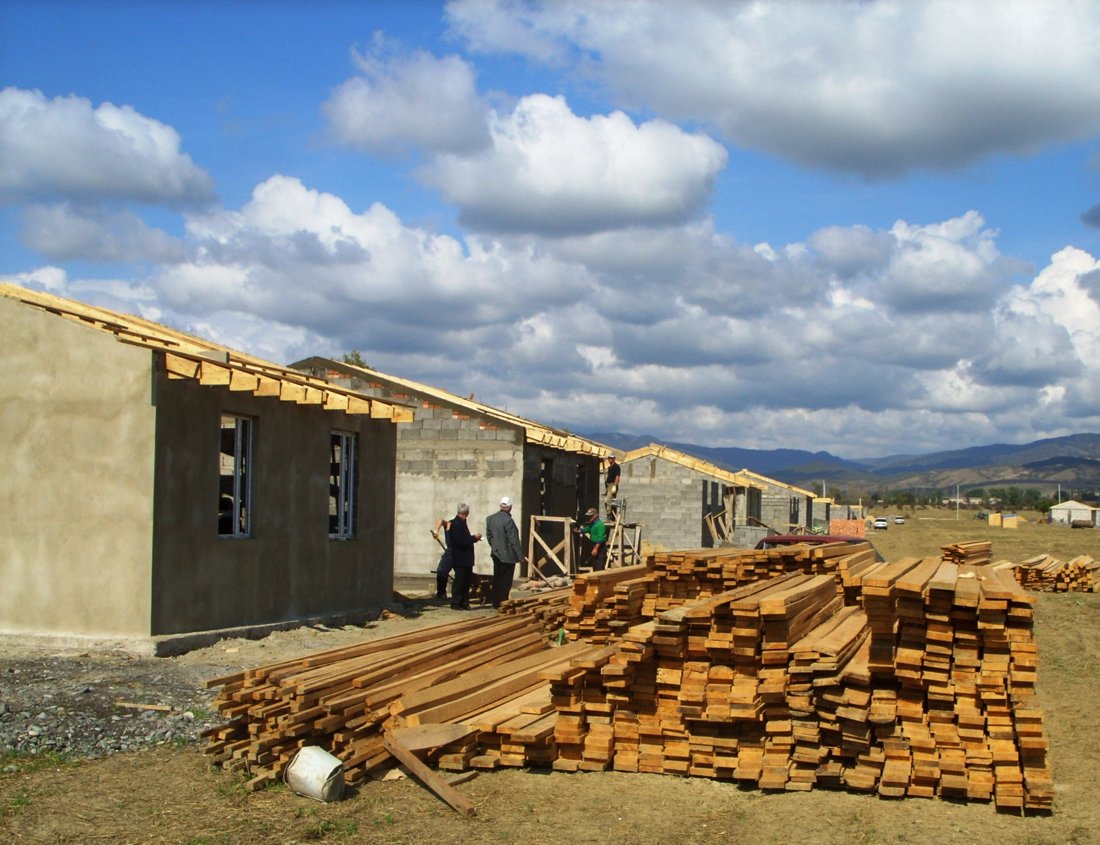
The UN's 2010 report distinguishes displacement in the 1990s from the new 2008 wave and notes discrepancies between administrative data and actual returns. Physically returning does not always mean losing displaced status or recovering safe, sustainable conditions. Limited access also prevented verification of some movements. The figures describe specific historical periods: they must not be presented as current totals or automatically added together. §§5–10 [1]
The courts: established responsibilities, unanswered questions
Judicial decisions do not form a single verdict on who was right throughout the war. They answer different questions: which rights were violated and by which state, whether there are grounds to arrest particular suspects, or whether a court can hear a dispute. Confusing these levels produces two opposite mistakes: reading a warrant as a conviction or lack of jurisdiction as an acquittal.
Strasbourg: the active-phase limitation does not erase violations
On 21 January 2021, in Georgia v. Russia (II), the European Court of Human Rights ruled by a majority that military operations on 8–12 August fell outside Russian jurisdiction under the Convention. It did not declare the war lawful: humanitarian law remained applicable. It established Russian effective control after the ceasefire and violations involving killings, arson and looting, civilian detention, torture of prisoners and prevention of return. The detentions examined included days before 12 August; Russia also had a duty to investigate active-phase deaths. The judgment found that duty unfulfilled. The distinction is therefore not “no responsibility before the 12th, responsibility afterwards”, but concerns the conduct and the basis of jurisdiction. ECtHR, §§125–144,173–175,328–337 and operative provisions [16].
In its just-satisfaction decision of 28 April 2023, the Court awarded €129,827,500 overall. The largest share, €115 million, concerns at least 23,000 people prevented from returning home; other shares concern killings, detention, torture and failures to investigate. Compensation is intended for victims through a distribution mechanism supervised by the Committee of Ministers, not for the Georgian government's unrestricted use. Russia's departure from the Convention system did not remove jurisdiction over earlier events or the obligation to execute decisions. ECtHR 2023, operative provisions 1–10 [17]. [24]
As of 18 November 2026, the Council of Europe listed €157,418,155.75 as outstanding in Georgia v. Russia (II): €129,827,500 in compensation and €27,590,655.75 in default interest. [18]
The ICC: warrants remain different from convictions
The warrant against Mikhail Mindzaev, issued on 24 June 2022 and released in redacted form on 30 June, concerns alleged crimes against people detained between 8 and 27 August 2008. They include unlawful confinement, torture, inhuman treatment, outrages upon personal dignity, hostage-taking and unlawful transfers. Mindzaev was South Ossetia's de facto interior minister. The standard is reasonable grounds to believe: it authorises arrest, not the finding of guilt required for a conviction. ICC, warrant, pp 3–6 and 24–25 [19].
The ICC's official May 2026 overview listed three wanted suspects not in Court custody: Mindzaev, Gamlet Guchmazov and David Sanakoev. It also stated that in December 2022 the prosecutor had concluded the investigative phase beyond pending cases. Concluding the investigation does not mean cancelling warrants or acquitting suspects. The authorised investigation covered alleged crimes committed from 1 July to 10 October 2008 in and around South Ossetia. ICC, The Court Today, Georgia section, May 2026 [20].
The ICJ: no merits ruling in 2011
The International Court of Justice examined a dispute under the Convention against Racial Discrimination, not the Genocide Convention. In 2011 it recognised a relevant dispute but found that Article 22's procedural requirements were unmet: attempts at resolution through relevant negotiations or the Convention's procedures were missing. It could therefore not proceed to the merits. Presenting this as a ruling excluding ethnic cleansing attributes a conclusion the judgment does not contain. ICJ,1 April 2011, §§113–114 and 180–187 [21].
Later developments, without conflating them with the war
Georgia v. Russia (IV) concerns “borderisation” beginning in 2009 and its consequences for movement, homes, land, families and education, alongside detention and violence. The decision of 14 October 2025 awarded €253,018,000: this is not a second financial accounting confined to victims of the 2008 war. ECtHR, §§3–6 and operative provisions [22].
On 23 June 2026, Malachini and Others v. Russia returned to killings and torture of prisoners in 2008. The Court distinguished detention from combat and established Russian responsibility for the violations examined, even where Russian troops' direct participation was not demonstrated. It nevertheless clarified that this result did not automatically extend jurisdiction to every active-phase military operation. This is an important clarification concerning prisoners, not a wholesale reversal of the 2021 judgment. ECtHR, §§52–62,69–92 and 99 [23]. The judgment became final on 23 September 2026. [23]
Georgia and Ukraine: useful comparison, non-transferable verdicts
Analogies help build a research framework: contested territories, invoked citizenship and protection, military presence, de facto institutions, displacement and NATO relations. But recognising similarities does not prove that the two conflicts have identical beginnings, actors, scales or legal justifications.
The first rule is not to backdate evidence. A judgment concerning prisoners in 2008 does not decide who organised the Donbas uprisings in 2014; a Bucharest declaration does not by itself document a specific military operation; a ceasefire agreement does not certify compliance. The Russo-Ukrainian conflict requires a separate case file, linked to this dossier but not replaced by it.
The second is to apply the same method to all sides. A Georgian statement remains a Georgian statement even when published by the UN. A Russian justification remains a Russian justification even when voiced by a president. Independent investigations and courts carry greater evidentiary weight on particular issues, but their mandates, documents examined and questions actually resolved still matter.
That is the central conclusion: not to select a sentence absolving one side for the entire war, but to make the chain connecting a specific claim to its evidence verifiable, and declare where that chain breaks.
Assessment of claims
Documented
The Bucharest summit announced future membership, not Georgia’s immediate entry into NATO.
Paragraph 23 leaves the Membership Action Plan undecided. [3]
Documented
In 2008 the United Nations documented escalation before the August hostilities.
The July report describes military reinforcements and the drone incident, distinguishing UNOMIG’s checks and territorial limits. [4]
Documented official position
Moscow justified recognition by invoking protection and self-determination.
The presidential statement establishes the argument invoked, not the truth of every allegation it contains. [12]
Documented
The ICJ did not decide the merits of the racial-discrimination dispute.
The 2011 judgment found a procedural obstacle to jurisdiction; it was not an acquittal on the facts. [21]
Documented
EUMM’s observation capacity is narrower than its mandate’s reach.
The mission explicitly states that access to Abkhazia and South Ossetia is denied. [14]
Documented
The courts distinguish prisoners’ detention from combat operations.
Malachini 2026 clarifies this without extending the outcome to every active-phase operation. [23]
Sources
Check A · Relevant passages reviewed for the dossier. Dates and locators appear in the text.
Check B · The findings follow the scope of each record. The two Tagliavini volumes form one inquiry. The Russian and Georgian official positions are party sources. Amnesty and the Georgian note were read on the web, separately from the unsuccessful direct downloads.
- UN · A/64/819
- UN Security Council · S/RES/1808 (2008)
- NATO · Bucharest Summit Declaration
- UN · S/2008/480
- UN · A/62/850–S/2008/345
- IIFFMCG · Tagliavini · I
- IIFFMCG · Tagliavini · II
- Amnesty International · Civilians in the Line of Fire
- Human Rights Watch · Up in Flames
- Council of the EU · 13.08.2008
- Council of the EU · 15.09.2008
- Russian Mission to the United Nations · 26.08.2008
- Ministry of Foreign Affairs of Georgia · 08.08.2026
- European Union Monitoring Mission · Mandate
- European External Action Service · EUMM
- ECtHR · Georgia v. Russia (II) · 2021
- ECtHR · Georgia v. Russia (II) · 2023
- Council of Europe · Execution register
- ICC · CR2022_05214
- ICC · The Court Today · 05.2026
- ICJ · Georgia v. Russian Federation · 2011
- ECtHR · Georgia v. Russia (IV) · 2025
- ECtHR · Malachini and Others v. Russia · 2026
- Council of Europe · SG/Inf(2026)33 · §23
- UN · S/2008/631 · §§11,15
- Gori, Georgia, 25 August 2008: a damaged residential building after the Russo-Georgian war. Archive photograph. · Lt. Jim Hoeft / U.S. Navy, via Wikimedia Commons · Public domain (US federal official work) · Resized without cropping
- Near Gori, 10 October 2008: homes being built for people displaced by the war. Archive photograph. · Lorenz King / Matti&Keti, via Wikimedia Commons · CC BY-SA 4.0 · Resized without cropping
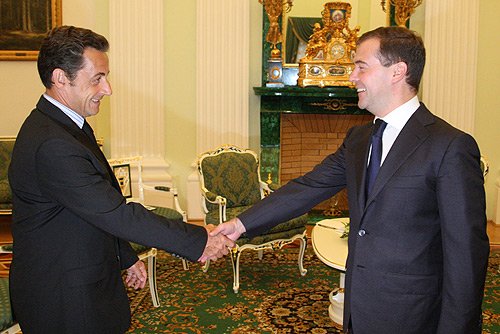
- Dmitry Medvedev and Nicolas Sarkozy meet on 12 August 2008. Archive image of diplomacy during the Georgian crisis. · Presidential Press and Information Office / Kremlin.ru, via Wikimedia Commons · CC BY 4.0 · Resized without cropping
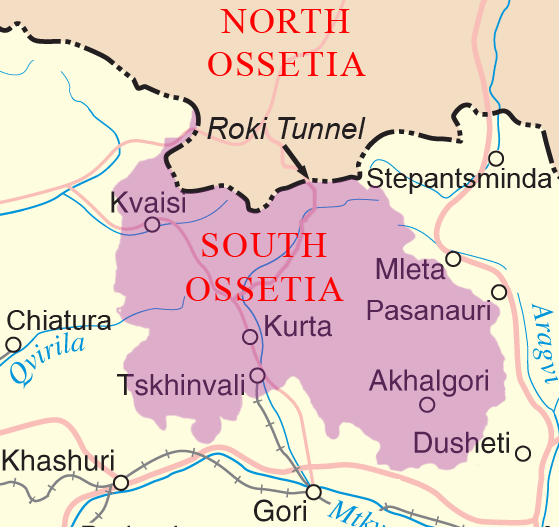
- Orientation map of South Ossetia and nearby places, produced in 2008 from a UN base map. It does not depict the progress of fighting. · United Nations Cartographic Section; adaptation by ChrisO, via Wikimedia Commons · Public domain (UN map derivative, as documented on Commons) · Resized without cropping
- Tskhinvali, 18 August 2008: a damaged building in a photograph distributed by OSinform. Archive image. · OSinform (ИА ОСинформ), via Wikimedia Commons; uncropped version uploaded on 3 September 2008 · CC BY-SA 3.0 · Resized without cropping
- Tbilisi, 28 August 2008: a woman in a centre for displaced people housed in a former military hospital. Archive photograph. · Staff Sgt. Jason T. Bailey / U.S. Air Force, distributed by the U.S. Navy, via Wikimedia Commons · Public domain (US federal official work) · Resized without cropping


