
Dossier
Gaza: What the IPC hunger figures measure
What the Gaza hunger figures measure: 1.41 million in the IPC projection and about 1.9 million in the scenario without humanitarian food assistance.
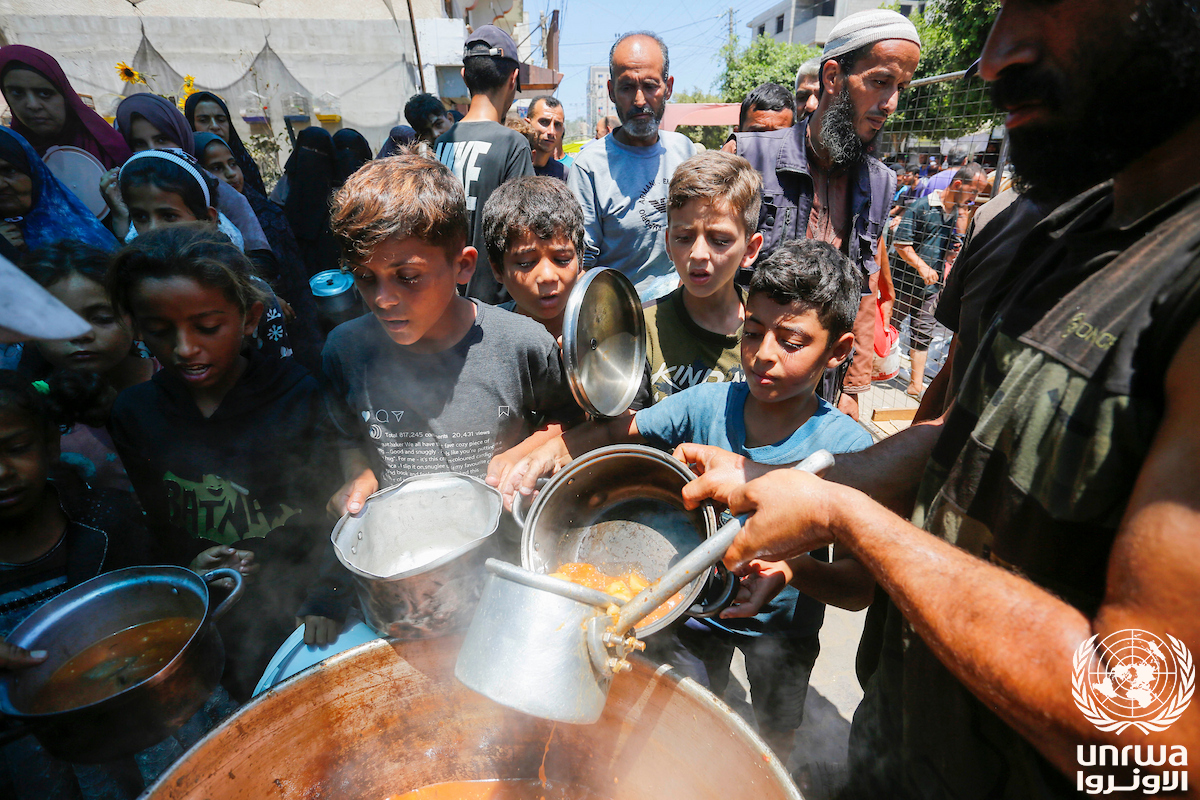
In brief
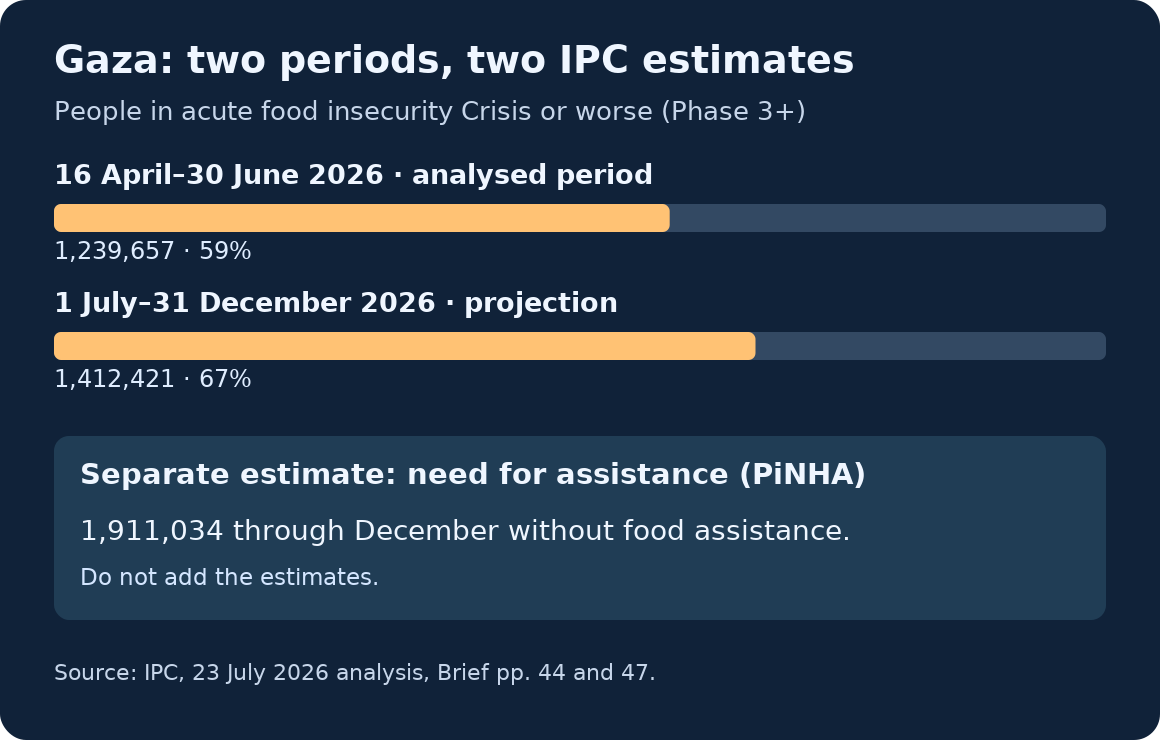
The IPC projects that 1.41 million people will face acute food insecurity at Crisis level or worse between July and December 2026. In the same report, it estimates that about 1.9 million people would face high levels of acute food insecurity in the absence of humanitarian food assistance through December. The second figure, cited by IOM and WFP in November, is not a new count or a figure to add to the first. Neither figure represents a count of people in Famine. [1] · [2] · [3].
Green · Documented
IPC projected 1,412,421 people in Phase 3 or above between July and December 2026.
This is the standard projection in the IPC Brief, not a count taken in November. [6].
Yellow · Conditional estimate
Around 1.9 million people would face high levels of acute food insecurity without humanitarian food assistance through December.
This is the PiNHA estimate for assistance planning, not an observation in November. It should not be added to the standard projection. [6].
Three figures, three different questions
The population base for the IPC table is 2,118,215 people analysed across the five governorates. This is a population estimate to which proportions by phase are applied, not a census by name. The figures are reproduced to the last digit as shown in the table; that does not imply the underlying measurements are that precise.
| Period / type of estimate | IPC estimate | How to read it |
|---|---|---|
| 16 April–30 June 2026, classification for the period analysed | 1,239,657 people in Phase 3 or above (59%); 211,821 in Phase 4 | Assessment based on available evidence, not a count of people visited. The Phase 4 estimate is already included in the total. |
| 1 July–31 December 2026, projection | 1,412,421 in Phase 3 or above (67%), including 1,200,600 in Phase 3 and 211,821 in Phase 4 | Projection for the same population analysed. This is neither a new November survey nor a daily figure. |
| Through December 2026, estimate in the absence of food assistance | About 1.9 million people (90% of the population, as reported by IPC) facing high acute food insecurity | Supplementary estimate of the need for assistance (PiNHA), not a third table by phase. Table 9 of the Brief gives a projected PiNHA of 1,911,034 people, using the same denominator of 2,118,215. The total is not a breakdown of Phase 4 or 5. |
The [4] explicitly distinguishes the PiNHA exercise from the standard estimates and points to the [5]. The [6] gives 1,805,123 people in need of assistance for the period analysed and 1,911,034 for the projection period. To estimate the need, IPC takes the Phase 3-or-above estimate and adds a share of people in Phase 2 who would be at risk of falling into Phase 3 or above without assistance. The gap between 1.41 and 1.9 million is not a count of people saved, does not establish the causal effect of any one intervention and does not by itself quantify the effects of a partial reduction in aid. The 17 November IOM/WFP headline brings hunger, displacement and shelter together; the associated figures are not separate groups to be added together. For the 1.9 million estimate, the announcement uses broader wording about aid not being sustained. The technical condition comes from IPC, which specifies the absence of humanitarian food security assistance. [2] · [3].
A map does not answer the same question as a table
An area’s phase describes the severity assigned to the territory under the IPC protocol, which uses a threshold of at least one in five households facing conditions at that phase or worse, with special criteria for Famine. The population breakdown, by contrast, estimates how many people fall into each phase. For July–December, the table assigns Phase 3 to all five governorates; in the same analysis, 33% of the population is in Phase 2 and 10% is in Phase 4. Not everyone living in a Crisis area is therefore individually in Crisis; some face worse conditions. The number in Phase 3 or above is not a diagnosis, a death toll or a ranking of responsibility. [7] · [2].
Diet, malnutrition and Famine are not synonyms
The IPC combines evidence on food consumption, coping strategies and other outcomes, interpreting it in light of food access and local conditions. For example, WFP’s Food Consumption Score estimates the frequency and weighted diversity of food groups consumed by the household over the previous seven days. It does not directly measure individual calorie intake or how food is shared within the household, and it does not determine an IPC phase on its own. A household may still be able to eat only by forgoing essentials or exhausting resources it depends on. A tally of food shipments, by contrast, measures an input, not household consumption. [8] · [7].
Acute malnutrition is a nutritional outcome estimated using measures such as weight-for-height, mid-upper arm circumference or bilateral oedema. Inadequate food intake, illness and health conditions can contribute; the measurement does not identify the cause on its own. IPC also uses a separate scale for acute malnutrition. Phase 2 on that scale means Alert, not Phase 2 on the food insecurity scale. The report estimates 74,200 cases of acute malnutrition among children aged 6–59 months from May 2026 to April 2027: an estimated caseload over twelve months, not the percentage of children who are malnourished on a given day, and not a subgroup directly comparable to the 1.41 million figure. [9] · [2].
Famine is an area classification. It requires extreme outcomes to converge across different denominators: at least one in five households experiencing extreme food deprivation; an acute malnutrition threshold for children under five (at least 30% using weight-for-height and/or bilateral oedema, or about 15% using mid-upper arm circumference and/or bilateral oedema); and more than two non-trauma deaths per 10,000 people per day, or at least four per 10,000 children under five per day. The strength of the evidence must be stated. In IPC terminology, Catastrophe describes households in Phase 5. They can be present even when the area as a whole does not meet the Famine criteria. IPC classifies conditions; it does not determine intent or legal responsibility. [10] · [7].
The dates change what the figures mean
- August 2025: for the period analysed at the time, IPC found Famine with reasonable evidence in Gaza Governorate, not the entire Gaza Strip, and projected that it would spread to other areas. This is a historical classification. [11].
- December 2025: the subsequent analysis covered October–November 2025 and projected conditions through mid-April 2026. IPC reported an improvement compared with August, while still estimating that some households faced Catastrophe. [12].
- 23 July 2026: a new analysis for April–June and projection for July–December. The table classifies no area in Famine and estimates no people in Phase 5 for either period. That does not mean no one is going hungry or that the 2025 classification was necessarily wrong.
- 4 and 17 November: [13] and [3] refer back to the July analysis. The joint warning also reports on winter conditions; it does not reclassify the population. As of 22 November, the IPC database consulted did not show a later assessment for this period.
What can still be challenged or checked
IPC identifies assistance and commercial trade among the factors supporting improvement relative to 2025. For the Israeli position, the [14] documents what the agency was saying before the IPC publication: COGAT reports that 1,778,363 tonnes of food were recorded from 10 October 2025 to 7 June 2026, including commercial supplies, based on supplier declarations (note 5), and estimates that the food price index fell by about 72% between September 2025 and May 2026. These are attributed figures with their own periods and units, not independent measures of household diet or of need in the absence of aid. The report predates IPC’s 23 July analysis and is not a reply to it. The indexed excerpt of the [15] shows a note dated 23 July disputing the new analysis and pointing to COGAT statements. Opening the page directly gives only the title. The longer critique on the same page describes itself as a response to the December 2025 IPC Brief and the August 2025 classification; it should not be attributed in its entirety to the July 2026 note. We have not read the specific COGAT texts cited on 23 July.
The IPC evidence base has explicit limitations. The food surveys cited were conducted remotely; the second survey round met IPC criteria only in Gaza Governorate. The anthropometric survey does not cover the entire study population: about 17% of the population was excluded from its sampling frame because of access and security problems, and data were insufficient to classify malnutrition in Rafah. This gap does not carry over to the food insecurity analysis, which covers all five governorates. The team considered data available through 15 June and used a technical review external to the analysis team but internal to the IPC partnership. Later events can make the projection outdated. The appropriate response is to seek new measurements, not fill the gaps with figures inferred from truck flows. [2].
WFP video
Published 23 July 2026; 2 min 30 sec. Context footage, not independent evidence of the IPC classification. The publication date is not necessarily the filming date. [18]
FAQ
Were 1.9 million people counted in November?
No. It was a conditional IPC estimate from July, cited in November by IOM and WFP, not a new survey.
Does Phase 3 mean Famine?
No. It means Crisis on the acute food insecurity scale. Famine is an area-level Phase 5 classification and requires extreme outcomes to occur together.
How can there be severe hunger without Famine?
Households can face severe conditions even where the area-level thresholds for malnutrition and mortality are not met. The absence of a Famine classification does not mean there is no suffering.
Does the aid that entered show how many people ate?
No. Availability, economic and physical access, distribution and household consumption are distinct steps, measured with different tools.
Source register
IPC, 23 July analysis and table
- A
- Opened in the documented editorial review.
- B
- Source of the figure and its scope.
- A
- Opened in the documented editorial review.
- B
- Source of the figure and its scope.
- A
- Opened in the documented editorial review.
- B
- Cites the IPC analysis in the context of winter aid.
IPC technical review from August, pp. 2 and 8
- A
- Opened in the documented editorial review.
- B
- Technical or historical context, with no new November survey.
general IPC PiNHA guidance, pp. 5–6
- A
- Opened in the documented editorial review.
- B
- Technical or historical context, with no new November survey.
full IPC Brief, p. 47, Table 9
- A
- Opened in the documented editorial review.
- B
- Source of the figure and its scope.
- A
- Opened in the documented editorial review.
- B
- Technical or historical context, with no new November survey.
- A
- Opened in the documented editorial review.
- B
- Technical or historical context, with no new November survey.
IPC acute malnutrition analysis
- A
- Opened in the documented editorial review.
- B
- Technical or historical context, with no new November survey.
- A
- Opened in the documented editorial review.
- B
- Technical or historical context, with no new November survey.
- A
- Opened in the documented editorial review.
- B
- Technical or historical context, with no new November survey.
- A
- Opened in the documented editorial review.
- B
- Technical or historical context, with no new November survey.
- A
- Opened in the documented editorial review.
- B
- Cites the IPC analysis in the context of winter aid.
original COGAT report of 9 July 2026, pp. 7 and 12–13
- A
- Opened in the documented editorial review.
- B
- COGAT’s stated position and administrative data, distinct from IPC figures.
- A
- Government note seen in the indexed excerpt. The full COGAT post was unavailable.
- B
- COGAT’s stated position and administrative data, distinct from IPC figures.
- A
- Opened in the documented editorial review.
- B
- Archive photograph, provenance and licence.
- A
- Opened in the documented editorial review.
- B
- Archive photograph, provenance and licence.
- A
- Opened in the documented editorial review.
- B
- Footage providing context in Gaza, separate from IPC measurement.
