
Dossier
Gaza: how medical evacuations work
From referral to treatment outside Gaza. OCHA separates patients and companions across two overlapping reporting periods in November.
In brief
A referral for treatment outside Gaza is not permission to leave. Permission, in turn, does not show that the patient crossed the border or started treatment. For 10–16 November 2026, OCHA reported that 97 patients, including 34 children, were medically evacuated through Rafah and Kerem Shalom. The 145 companions are a separate category, not additional patients. [1]
Yellow
The published figures reviewed do not show where every request stalled.
Departures are reported, but no public series follows the same cases from referral to treatment. That is a limit of the evidence reviewed, not a denial that cases exist.
From referral to treatment
- Clinical referral. If specialist care is unavailable in Gaza, a doctor at the public hospital treating the patient can refer them for care outside the Strip. The Gaza health ministry’s Referral Committee reviews the case, decides its priority and determines whether to approve the referral. WHO says it does not select patients or set their priority. [2]
- Acceptance and clearances. The process depends on the route. For evacuations via Kerem Shalom to a third country, WHO describes acceptance by the receiving country and Israeli security clearance for patients and companions. For the route through Israel, the protocol published by Israel’s coordination body, COGAT, describes written acceptance by the destination country and Israeli security screening. For Rafah, WHO describes a list of patients already prioritised that the Palestinian Authority sends to Israeli and Egyptian authorities for clearance. The European Union’s civilian EUBAM mission supports Palestinian border staff. [2] · [3] · [4]
- Actual departure and care. WHO coordinates the transfer with partners once the necessary arrangements and clearances are in place. A departure means the patient crossed, not that their name was on a list. A crossing alone does not show whether someone was admitted to hospital, received follow-up care or improved. For a separate group that arrived in 2025, the UK government confirmed that children were receiving specialist treatment in National Health Service hospitals. That documents care for that group, not for everyone evacuated. [5] · [6]
What the sources count
| Period or reference | Patients | Companions | What it covers |
|---|---|---|---|
| 24 September 2026, WHO Director-General’s remarks | About 12,400 | Not stated | Cumulative since October 2023, not a waiting list. [7] |
| 15 October 2026, OCHA report | More than 13,800 | Not stated for this total | Cumulative since October 2023. The same report separately identifies 3,423 patients whose evacuations WHO facilitated since the October 2025 ceasefire. [8] |
| 3–9 November 2026 | 119 (including 40 children) | 141 | Reported medical departures through Rafah and Kerem Shalom. [9] |
| 10–16 November 2026 | 97 (including 34 children) | 145 | Reported medical departures through the same two crossings. [1] |
| 4–16 November 2026 | 174 (including 66 children) | 235 | OCHA snapshot dated 18 November, published on 19 November. The same two crossings, over a period that overlaps the two preceding rows. [14] |
The OCHA snapshot dated 18 November also reports 174 patients, including 66 children, and 235 companions from 4 to 16 November. This period overlaps the weekly report. The figure cannot be added to the other rows and does not replace the 10–16 November count. [14]
The two OCHA weeks can be compared as reported departures, not approval rates. Subtracting the September and October cumulative figures does not produce a precise change: the figures are approximate or stated as a lower bound, and the sources do not reconcile the series. Do not add a weekly count to a cumulative total without checking whether it is already included. Neither the number of people needing specialist care nor the total number of crossings measures how many medical requests were approved. [7] · [8] · [10]
What remains unclear
On 24 September WHO said that 19 of Gaza’s 36 hospitals were at least partially functioning, and none was fully operational. It reported difficulty accessing cancer treatment and dialysis and called for referrals to East Jerusalem and the West Bank to resume. That was WHO’s assessment that day, not a November measure or evidence that those referrals resumed. The public sources reviewed do not show the numbers of referrals, acceptances, clearances, departures and treatment starts for the same cohort and period. They therefore cannot establish an approval rate or identify the step responsible for every delay. [7]
UN: Medical evacuations at Rafah, 3 February 2026
The report shows the WHO briefing and the convoy setting out towards Rafah on 2 February 2026. WHO reported that five patients and seven companions left. The footage does not establish that the convoy crossed the border or arrived in Egypt. This is one operation, not a cumulative count. UNTV CH and UNIFEED / UN Geneva Multimedia Newsroom UN: Medical evacuations at Rafah, 3 February 2026 ↗ [13]
FAQ
Does a doctor’s referral mean a patient can leave immediately?
No. It is a clinical request. A priority decision, route-specific clearances and arrangements still have to follow.
Who sets patient priorities?
According to WHO, the Gaza health ministry’s Referral Committee does. WHO supports and coordinates the process.
Were the 145 companions on 10–16 November also patients?
Not in OCHA’s reporting. There were 97 patients and a separate count of 145 companions. A separate OCHA period, 4–16 November, overlaps that week and also counts patients and companions separately.
Does a departure confirm treatment started?
No. Confirmation of care requires separate information from the receiving facility or authorities.
Source register
- A
- Passage reviewed. Report headed 18 November and published 20 November. Health section, 10–16 November: 97 patients and 145 companions.
- B
- Counts reported departures through both crossings. The 34 children are included in the 97 patients. It does not count referrals or approvals.
- A
- Passage reviewed. WHO diagrams of 23 February for Rafah and Kerem Shalom and its paragraph on WHO’s role.
- B
- Describes the process as set out in February and separates prioritisation from coordination.
- A
- Passage reviewed. Israeli COGAT protocol, §§ 1–3, for transfers to third countries through Israel.
- B
- Documents written acceptance and checks for that route. It does not define a universal Rafah procedure.
- A
- Passage reviewed. EU civilian mission page describing support for Palestinian border staff and the coordination of medical lists.
- B
- Establishes the mission’s stated role at Rafah. It does not document capacity, quotas or individual permissions.
WHO at UN briefing, 23 October 2026
- A
- Passage reviewed. UN readout of 23 October, Christian Lindmeier’s answer on the procedure and permissions.
- B
- WHO explaining its role at a UN briefing. It is not independent corroboration of WHO and does not assign responsibility for individual delays.
UK government, 17 September 2025
- A
- Passage reviewed. UK government release of 17 September 2025 on the first children arriving for NHS care.
- B
- Receiving-country evidence for a historical group. It does not trace every patient or give clinical outcomes.
- A
- Passage reviewed. WHO Director-General’s 24 September 2026 remarks citing around 12,400 patients since October 2023.
- B
- Reports the figure and care conditions as of that date. It does not measure November departures or an individual waiting list.
- A
- Passage reviewed. 15 October report, Health section: over 13,800 patients since 2023 and 3,423 WHO-assisted patient evacuations since the ceasefire.
- B
- The figures cover different populations and periods and must not be added. The difference from September is not a verified count of later departures.
- A
- Passage reviewed. OCHA’s 13 November report: 119 patients and 141 companions through the two crossings, 3–9 November.
- B
- Measures reported departures. The 40 children are included among patients. It does not measure approvals.
EUBAM, separate crossing figures
- A
- Passage reviewed. EU mission crossing figures for Rafah, separating general crossings from medical cases.
- B
- Covers Rafah alone. The figures cannot be added to or treated as an independent count of OCHA’s combined totals.
- A
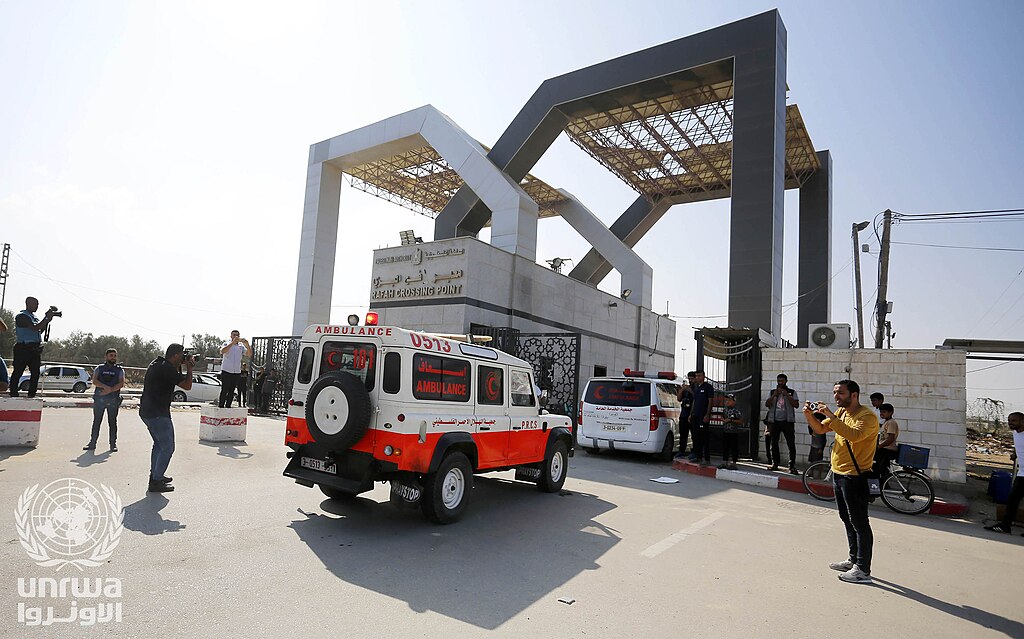
- Passage reviewed. Commons record and 1,024×639 original, credited to Ashraf Amra / UNRWA and dated 2 November 2023.
- B
- Archive image of the crossing. The full image retains the watermark and does not document 2026 procedures or totals.
- A
- Passage reviewed. Text of the CC BY-SA 3.0 IGO licence listed for the photograph.
- B
- Establishes attribution and reuse terms. It does not authenticate the photograph’s date or setting.
UN: Medical evacuations at Rafah, 3 February 2026
- A
- Passage reviewed. UN report of 3 February. Documented media review found the WHO briefing at 0:31–0:40 and the convoy leaving at 2:41–3:00.
- B
- WHO reported five patients and seven companions for 2 February. The footage shows the briefing and departure. It does not show a border crossing or arrival.
- A
- Passage reviewed. OCHA PDF dated 18 November, p. 1: 174 patients and 235 companions through both crossings, 4–16 November.
- B
- Overlaps the report’s date windows and should not be added. The 66 children are included among patients.
